
Lanj Karayib
Google 5/5 (92 reviews)
4.4 km away as the crow flies
Basse-Terre · Guadeloupe · Caribbean
Max. depth · 23 mExplore the 'Franjack', a 50-meter sand dredger intentionally sunk in 1996, now a vibrant artificial reef teeming with marine life and offering accessible wreck penetration.
For subtitles in English: start the video firstthen click the gearat the top right of the video, select “Subtitles/CC”, then “Auto-translate” and choose “English”.
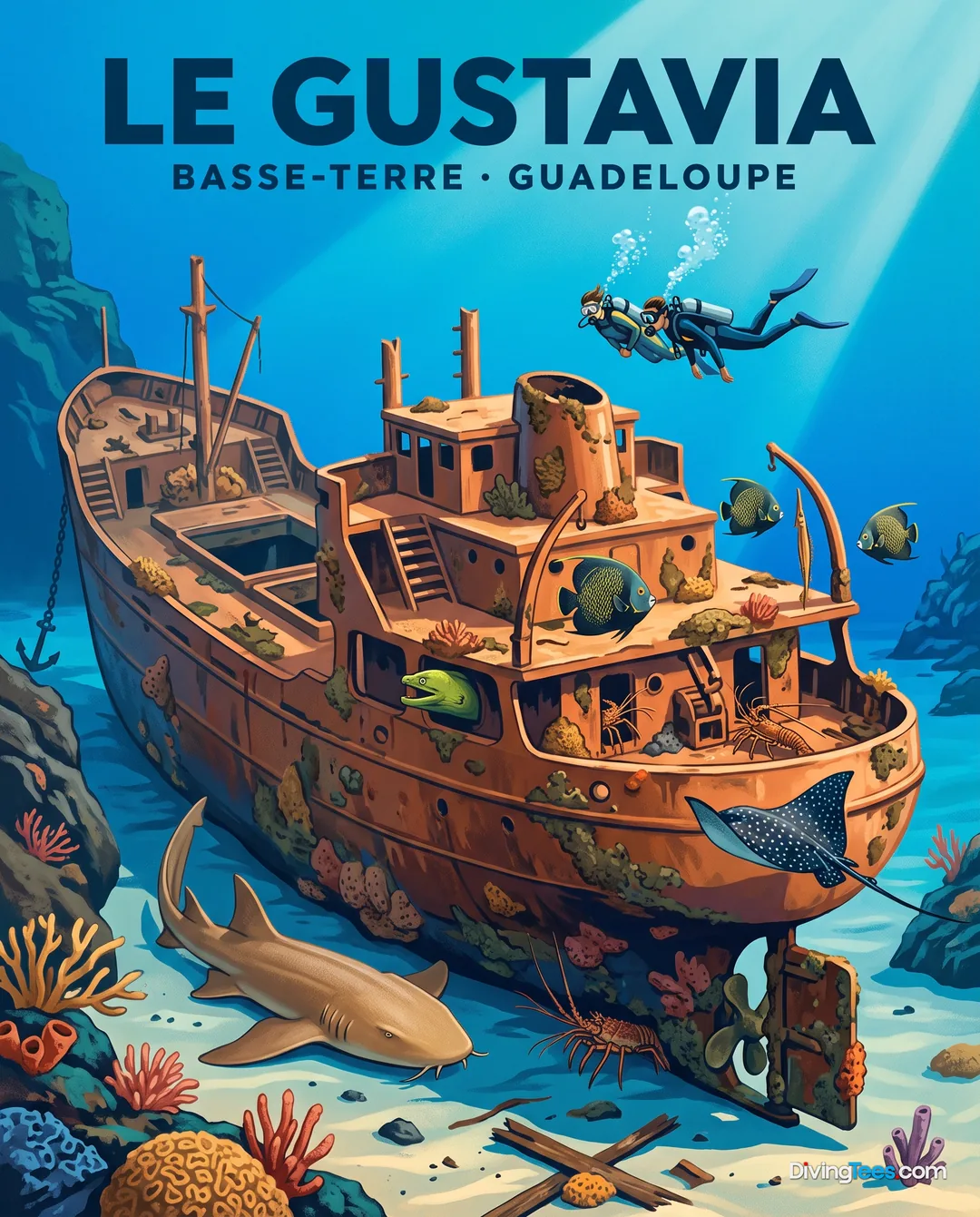
Descending along the mooring line into the tranquil waters of the Réserve Cousteau, the silhouette of the 'Franjack' slowly materializes from the blue. This 50-meter sand dredger, originally the Danish 'Oresund' built in 1958, saw service between Copenhagen and La Rochelle before finding its way to a Guadeloupean company in 1983. Remarkably, it survived Hurricane Hugo in 1989, only to be purposely scuttled seven years later in June 1996 off Malendure to create an artificial reef. The 'Franjack' rests upright on a sandy bottom, remarkably intact, allowing you to appreciate its original form as you make your way down.
The sheer size of the vessel at this relatively shallow depth creates an immediate sense of immersion, providing an expansive canvas for marine life to flourish. As you approach the main deck, the structure reveals itself to be less of a rusting hulk and more of a vibrant, living ecosystem. The 'Franjack' has been fully colonized, adorned with a riot of sponges, delicate bryozoans, and distinct ascidians, which wave gently with the subtle movements of the water. Anemones establish their territories on various surfaces, offering shelter to a community of tiny but active shrimps. Hard and soft corals have also begun to colonize its surfaces, providing shelter and hunting grounds. The entire wreck is a self-contained habitat, where every rivet and beam offers a home or a hunting ground.
One of the 'Franjack's' key features is the opportunity for penetration. You can navigate through the wheelhouse, imagining the helmsman's view, and then venture deeper into the engine holds. These internal spaces, though dark, are surprisingly accessible and allow you to appreciate the scale of the vessel from within. Attention to buoyancy is crucial here, maintaining trim to avoid stirring up silt and preserving visibility for yourself and others. While the rest of the ship holds its form well, the cabin has largely collapsed, creating intriguing nooks and crannies to peer into. This section is particularly interesting for exploring how the forces of the ocean have begun to reclaim man-made structures, turning them into part of the ecosystem.
Life around the wreck extends beyond the macro. Keep an eye out for larger residents, as the 'Franjack' attracts various species drawn to its structure as a hunting ground or refuge. While navigating the exterior, graceful sea turtles might glide past, and in the nooks and crannies, elusive lobsters find shelter. Small tropical fish are already making their homes within the metal framework, and you can expect to see various schooling fish utilizing the wreck as shelter, along with the resident invertebrates that find purchase on its metal hull. The absence of strong currents at this depth over the wreck allows for a relaxed exploration, giving you ample time to inspect the developing marine life. This dive is less about adrenaline and more about contemplative exploration, understanding the lifecycle of an artificial reef, and appreciating its integration into the greater underwater landscape of Guadeloupe.
This site is accessible from Open Water Diver level (or equivalent Niveau 1 / PE20). The dive profile involves a descent and ascent along the mooring line to a maximum depth of 24 meters (79 feet) at the surrounding sandy seafloor, with the deck at approximately 23 meters (75 feet). The region generally offers calm seas and optimal visibility from December to April. During May to November, water temperatures hover around an inviting 30°C. There are no strong currents at this depth over the wreck.
You can dive Epave du Franjack in calm seas with good visibility from December to April. From May to November, the water temperature is around thirty degrees Celsius. The wreck lies in the Réserve Cousteau, off Malendure, offering seasonal conditions suited to relaxed exploration.
Epave du Franjack is accessible to you with Open Water Diver certification or an equivalent Niveau 1 or PE20 qualification. You descend and ascend along the mooring line, reaching a maximum depth of twenty-four meters at the sandy seafloor. The deck sits at approximately twenty-three meters.
At Epave du Franjack, you encounter no strong currents at the wreck’s depth. The calm conditions allow you to explore the upright wreck at a relaxed pace and inspect its structure and marine life. You can move around the exterior, wheelhouse, engine holds, and collapsed cabin area.
At Epave du Franjack, you can explore a largely intact, upright sand dredger colonized by sponges, bryozoans, ascidians, hard and soft corals, and anemones. Look for sea turtles, lobsters, tropical fish, schooling fish, and shrimps around the wheelhouse, engine holds, hull, and collapsed cabin.