Great Barracuda
Sphyraena barracuda
The reef's torpedo: two metres of steel, a jaw full of razors, and the fastest sprint on the reef.
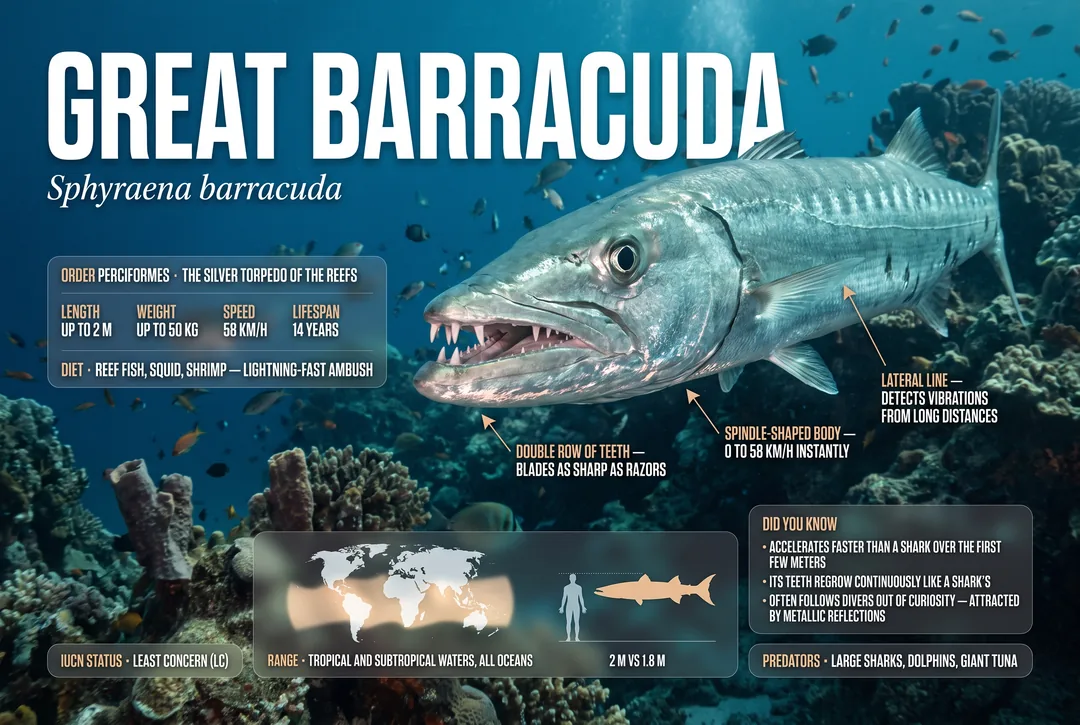
IDENTITY CARD
| Classification | Order Perciformes, family Sphyraenidae |
| Scientific name | Sphyraena barracuda (Edwards, 1771) |
| Size | Up to 2 m (average: 0.6-1.2 m) |
| Weight | Up to 50 kg |
| Speed | Up to 58 km/h in short bursts |
| Lifespan | 14 years on average |
| Depth | Surface to 100 m, most commonly between 3 and 30 m |
| Diet | Carnivore — reef fish, cephalopods, shrimp |
| IUCN Status | Least Concern (LC) |
PORTRAIT
It doesn't warn you. A metallic flash in the blue, a ruler-straight profile, a half-open jaw revealing two rows of razor-sharp teeth — and the great barracuda is there, motionless, four metres from the diver, carrying the air of a predator that has nothing to prove. It is the fastest hunter on the reef, and it knows it.
Sphyraena barracuda is built for speed. Its body is a perfect spindle, laterally compressed, clad in small, smooth scales. The head is pointed, the jaw prognathous and bristling with fangs and blades. It is an ambush hunter: motionless in the current, then a devastating acceleration to 58 km/h. The prey is often cut clean in two.
The flanks shimmer silver-grey, darker along the back, with black vertical bars running along the posterior half of the body. This countershading provides effective camouflage in the water column. A barracuda only reveals itself to the diver when the diver is already well within its field of vision.
HOW TO RECOGNIZE IT
The body is elongated and nearly cylindrical, almost rigid in its stillness. The head is long and flat, the lower jaw prominently protruding. Two widely spaced dorsal fins and a forked caudal fin complete the silhouette.
Absolute immobility is the barracuda's signature. It hangs in the water, barely moving a fin, its gaze locked on the diver with unblinking intensity.
Juveniles — 20 to 50 cm — swim in dense schools of hundreds, typically in mangrove habitats. Adults are solitary.
For subtitles in English: start the video firstthen click the gearat the top right of the video, select “Subtitles/CC”, then “Auto-translate” and choose “English”.
WAY OF LIFE
The great barracuda is a diurnal predator sitting at the very top of the reef food chain. It hunts by ambush: the anterior teeth function as fangs to seize the prey, while the posterior teeth act as blades to slice it apart. The result has a name in emergency medicine — "barracuda-like injury."
Juveniles begin life in brackish waters and mangroves before migrating to the reef as they mature, transitioning from schooling behaviour to a solitary existence.
Barracudas are attracted to shiny, reflective objects — jewellery, camera housings, dive knives. This is a visual confusion response, not aggression: the flash of metal mimics the flicker of a small fish's scales.
WHERE TO SEE IT
Red Sea — Egypt. Ras Mohamed, the Straits of Tiran, Elphinstone Reef, and the wreck of the Thistlegorm all deliver reliable barracuda encounters, often in impressive schools swirling above the reef.
Caribbean — Belize and Curacao. The Great Blue Hole regularly hosts barracuda patrols, while Curacao's Mushroom Forest provides encounters in shallower, more intimate settings.
Maldives. Channel dives through the kandus (passes) of the atolls frequently feature barracudas hunting in the current.
Indonesia — Raja Ampat and Komodo. Cape Kri, Blue Magic, and Batu Bolong are legendary for their barracuda tornadoes — spiralling columns of hundreds of juveniles rising through the water column.
French Polynesia — Fakarava and Rangiroa. The south pass of Fakarava and the Tiputa Pass in Rangiroa offer some of the most dramatic barracuda aggregations in the Pacific.
OBSERVATION CALENDAR
Click each button to show/hide
CONSERVATION
The great barracuda is classified as Least Concern (LC) on the IUCN Red List — welcome news among large marine predators.
Localised overfishing occurs in parts of the Caribbean, along with bycatch and degradation of coastal habitats. Paradoxically, the barracuda benefits from indirect protection: its flesh can carry ciguatera toxin, which limits commercial fishing pressure in many tropical regions.
For divers, no special precautions are needed beyond a simple rule: avoid wearing shiny jewellery or exposing reflective metal surfaces unnecessarily.
Organisations to support:
- Reef Check — coral reef monitoring worldwide
- Coral Triangle Initiative — marine conservation across the Indo-Pacific
- PADI AWARE — citizen science and ocean protection
3 THINGS YOU PROBABLY DON'T KNOW
1. The reef's sprinter — but not its marathoner. At 58 km/h, the great barracuda is one of the fastest fish in the ocean. But it is an ambush predator, not an endurance swimmer: a single explosive lunge lasts less than one second. If it misses, it doesn't chase.
2. Its jaw works like a pair of shears. The anterior teeth — long, pointed fangs — seize and hold the prey. The posterior teeth — flat, blade-like — slice through flesh and bone. The two sets work in sequence, like the blades of industrial scissors.
3. Juveniles form tornadoes. Schools of hundreds of young barracudas swirl in ascending spirals — a collective defensive behaviour that disorients predators while creating one of the most visually spectacular phenomena on the reef.
PHOTO AND VIDEO TIPS
Lens. Wide angle (10-17 mm fisheye) for schools and tornadoes. A moderate zoom or macro (60-100 mm) works well for solitary portrait shots.
Light. The barracuda's silver body acts as a mirror. A direct frontal flash produces a blinding, washed-out reflection. Angle the strobes at 45 degrees to each side, or shoot with natural light and underexpose by 2/3 of a stop.
Approach. Slow and frontal. A calm, steady approach allows you to close to 1.5 m without spooking a solitary barracuda. For schools, descend below the spiralling formation and shoot upward against the surface for dramatic backlighting.
Classic mistake. Photographing from the side. In profile, a barracuda is a featureless grey line. The most striking images are shot head-on or at a three-quarter angle, where the jaw and teeth dominate the frame.