
Scubaqua
Google 4.7/5 (107 reviews)
2.4 km away as the crow flies
St Eustache · Sint Eustatius · Caribbean
Max. depth · 18 mAt Anchor Point, you descend onto an 18th-century French anchor, a coral-encrusted relic that marks the entrance to a vibrant arena of marine life, all within recreational dive limits.
For subtitles in English: start the video firstthen click the gearat the top right of the video, select “Subtitles/CC”, then “Auto-translate” and choose “English”.
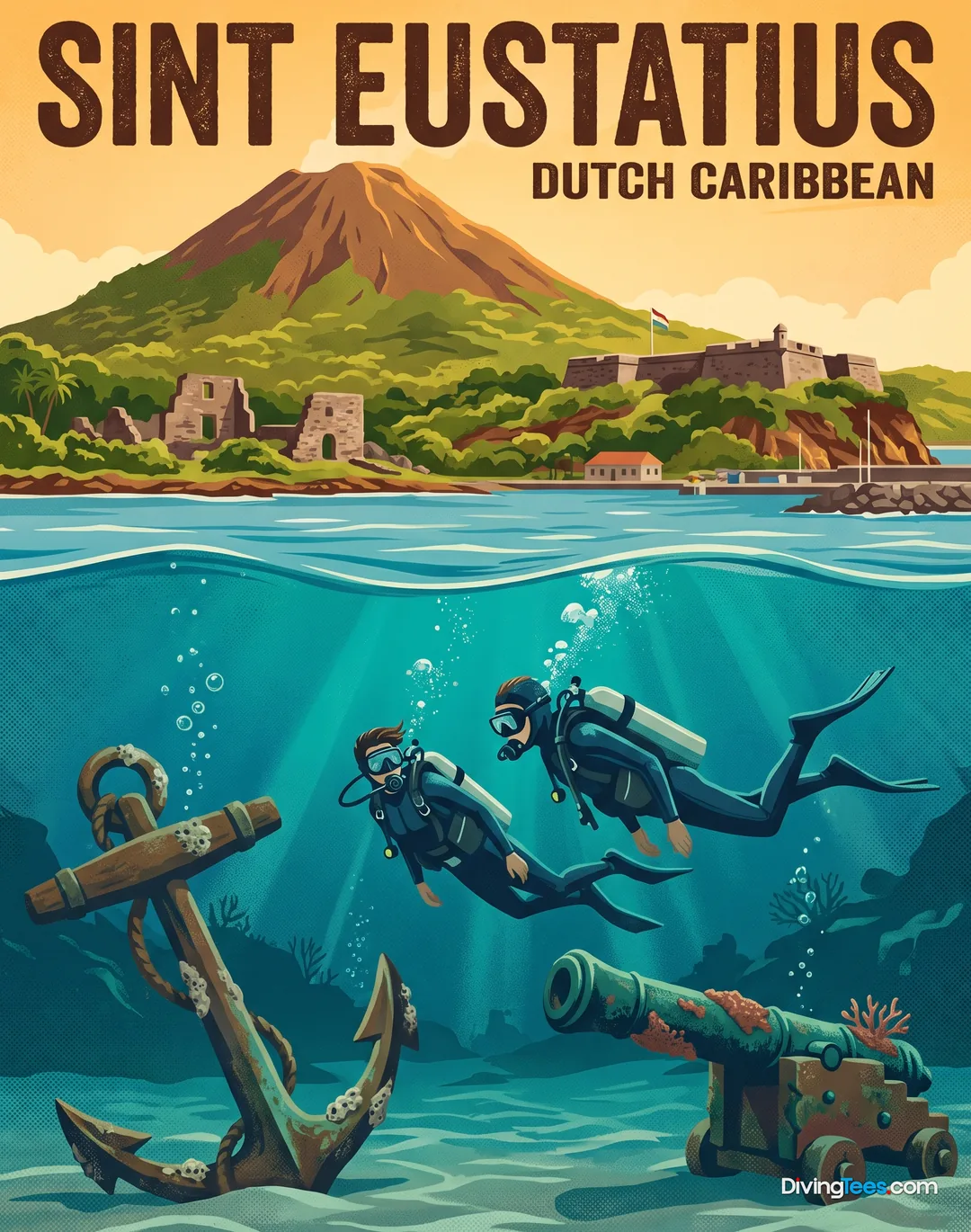
Anchor Point is named for an enormous, coral-encrusted French anchor, dating back to 1750-1775. It's one of over 200 such historical artifacts scattered around Statia, but this particular anchor stands out, acting as a clear visual marker on the reef. As you descend, the sheer size and age of the anchor are immediately apparent, drawing you into the history of the place before you even begin exploring the surrounding reef structure.
Beyond the main anchor, you'll find a distinct swim-through leading to a cleaning station. Here, Spanish hogfish (Bodianus rufus) are frequently observed tending to other reef fish, providing a dynamic interaction to watch. This area also serves as an entry point into a natural arena, where the reef forms a series of fissures and overhangs, creating diverse habitats for a variety of marine life.
The arena-like structure is a prime location for spotting drum fish and lobsters, which often seek shelter within the numerous crevices and beneath the overhangs. The topography here encourages exploration, with light filtering through the reef formations creating an engaging environment. Keep a steady buoyancy as you navigate these features to avoid disturbing the resident creatures.
The top of the reef at Anchor Point transforms into a dense landscape dominated by barrel sponges, interspersed with vibrant tubular sponges and various hard and soft coral species. This sponge garden creates a rich ecosystem, supporting a wide array of smaller reef inhabitants. Caribbean reef sharks (Carcharhinus perezi) are often seen patrolling the periphery, moving with purpose through the open water above the reef.
Moray eels are a common sight here, with various species peeking out from their hidden retreats within the reef's structure. Look closely into the nooks and crannies. The rare sharptail eel (Myrichthys breviceps) is also frequently encountered at Anchor Point, identifiable by its distinct pointed tail, adding to the site's unique biodiversity. Observing their behaviour requires patience and a gentle approach to avoid startling them.
Anchor Point is accessible to Open Water Divers, with a maximum depth of 18 metres. Water temperatures typically range between 26°C and 30°C. Currents are generally very mild at this site, making it suitable for all experience levels, though conditions can vary. Visibility is generally good, often exceeding 20 metres, providing clear views of the historical anchor and the vibrant reef.
Anchor Point is accessible to Open Water Divers and suitable for all experience levels because currents are generally very mild. Conditions can vary, so you should maintain steady buoyancy while exploring the swim-through, arena-like reef, fissures and overhangs, helping protect the resident marine life and keeping your dive controlled.
Anchor Point reaches a maximum depth of 18 metres. At that depth, you can explore the coral-encrusted French anchor, the swim-through leading to a cleaning station and the arena-like reef structure. The reef top features dense barrel sponge gardens, tubular sponges, hard corals and soft corals.
Currents at Anchor Point are generally very mild, which helps make the site suitable for divers of all experience levels. Conditions can vary, so you should remain attentive during the dive. Good visibility, often exceeding 20 metres, provides clear views of the historical anchor and surrounding reef.
At Anchor Point, you can see an enormous coral-encrusted French anchor dating from the 18th century, Spanish hogfish at a cleaning station, drum fish and lobsters among reef crevices, barrel and tubular sponge gardens, Caribbean reef sharks, moray eels and frequently encountered sharptail eels.