
Scubaqua
Google 4.7/5 (107 reviews)
3.5 km away as the crow flies
St Eustache · Sint Eustatius · Caribbean
Max. depth · 40 mDescend the vertical face of The Cliffs, where deep sea fans and wire corals cling to a dramatic drop-off frequented by pelagic life.
The Cliffs site begins on a reef top before plunging into a deep wall. As you fin over this upper plateau, you'll encounter schools of Creole wrasse (Clepticus parrae) moving across the reef structure. Keep an eye out for lettuce sea slugs (Elysia crispata) in the shallower sections here, often blending into their surroundings, alongside various hamlet species (Hypoplectrus spp.). This initial reef area acts as a natural transition before the main event.
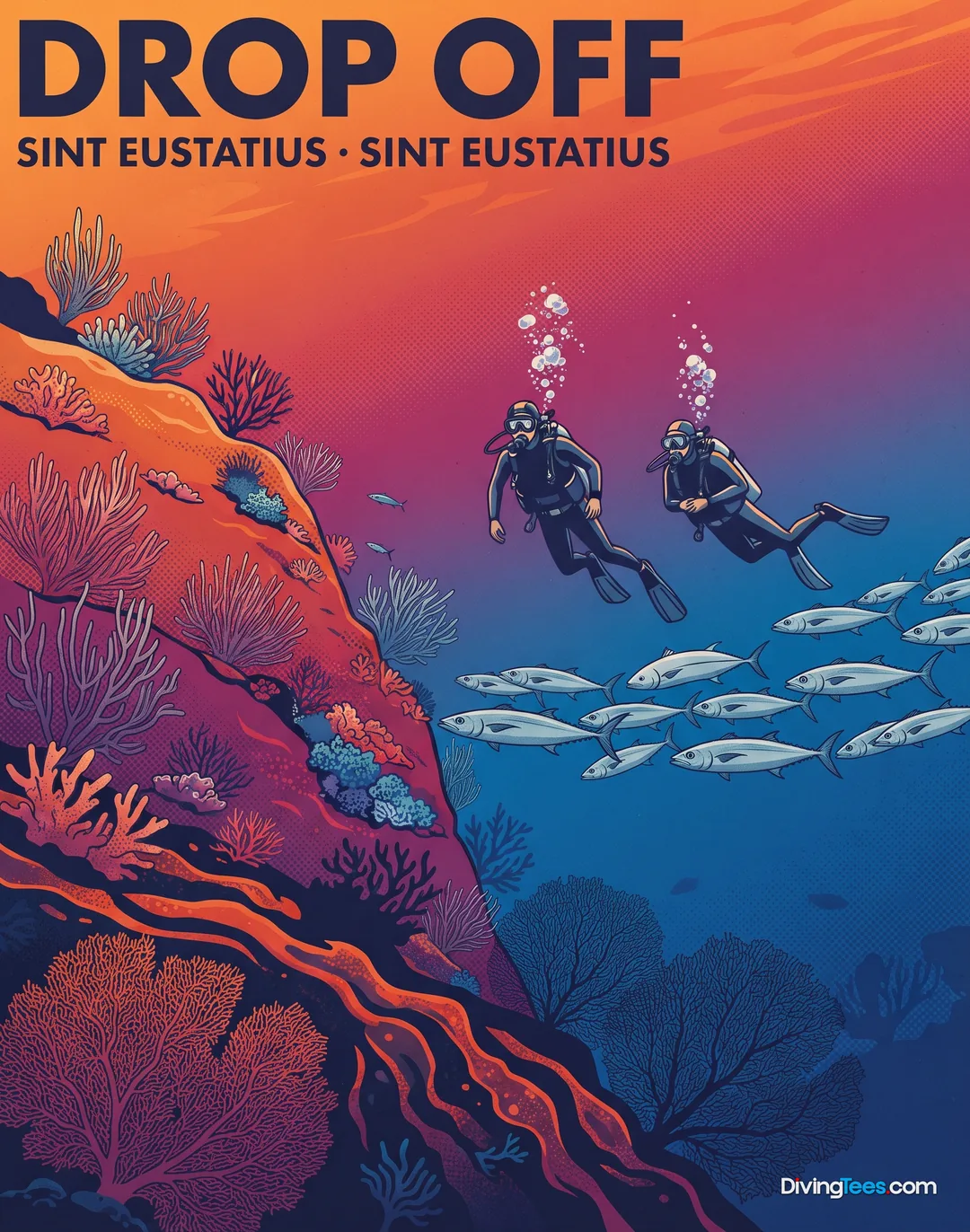
Beyond the plateau, the topography shifts dramatically to an impressive vertical wall that defines The Cliffs. This sheer face descends to a maximum depth of 40 metres. The light changes as you move deeper, highlighting the intricate growth on the wall itself. The descent is direct, offering an immediate sense of exposure to the open water as the reef drops away beneath you.
The vertical cliff face is densely covered with deep sea fans and wire corals (Cirrhipathes spp.). These formations create intricate patterns along the wall, providing shelter and feeding grounds for smaller reef inhabitants. The sheer scale of the wall, adorned with these delicate yet resilient organisms, is a primary feature of the dive, demanding attention to both the blue water and the coral details.
While exploring the wall, you'll need to maintain situational awareness in the blue. Caribbean reef sharks (Carcharhinus perezi) are frequent visitors here, often patrolling the deeper sections. Eagle rays (Aetobatus narinari) are also regularly seen gliding by, their distinct profiles unmistakable against the open water. Keep an eye out for oceanic triggerfish (Canthidermis sufflamen) moving through, especially closer to the top of the wall or in the transition zone.
This is an Advanced level dive, reaching a maximum depth of 40 metres. While currents in the region are generally mild, conditions can vary, with potential for stronger flow warranting a drift dive approach. The site is best avoided in September due to hurricane season and scheduled boat maintenance.
You should avoid The Cliffs in September because it is hurricane season and scheduled boat maintenance takes place then. Outside that period, the site features a reef-top start followed by a deep vertical wall, offering a dive that transitions from shallower reef terrain into open-water exposure.
The Cliffs is an Advanced level dive with a maximum depth of 40 metres. The dive begins across a reef-top plateau before dropping directly along a dramatic vertical wall. The descent creates immediate exposure to open water, while the wall is densely covered with deep sea fans and wire corals.
Currents around The Cliffs are generally mild, but conditions can vary and stronger flow is possible. When the current is stronger, you should be prepared for a drift dive approach. Maintain situational awareness in the blue while exploring the wall, particularly where the reef drops into open water.
At The Cliffs, you may see schools of Creole wrasse, lettuce sea slugs and hamlets around the reef top. The wall is covered with deep sea fans and wire corals, while Caribbean reef sharks frequently patrol deeper sections. Eagle rays regularly cross the open water, and oceanic triggerfish move near the wall top.