
Subaquatic
Google 4.7/5 (217 reviews)
Croatia · Mediterranean
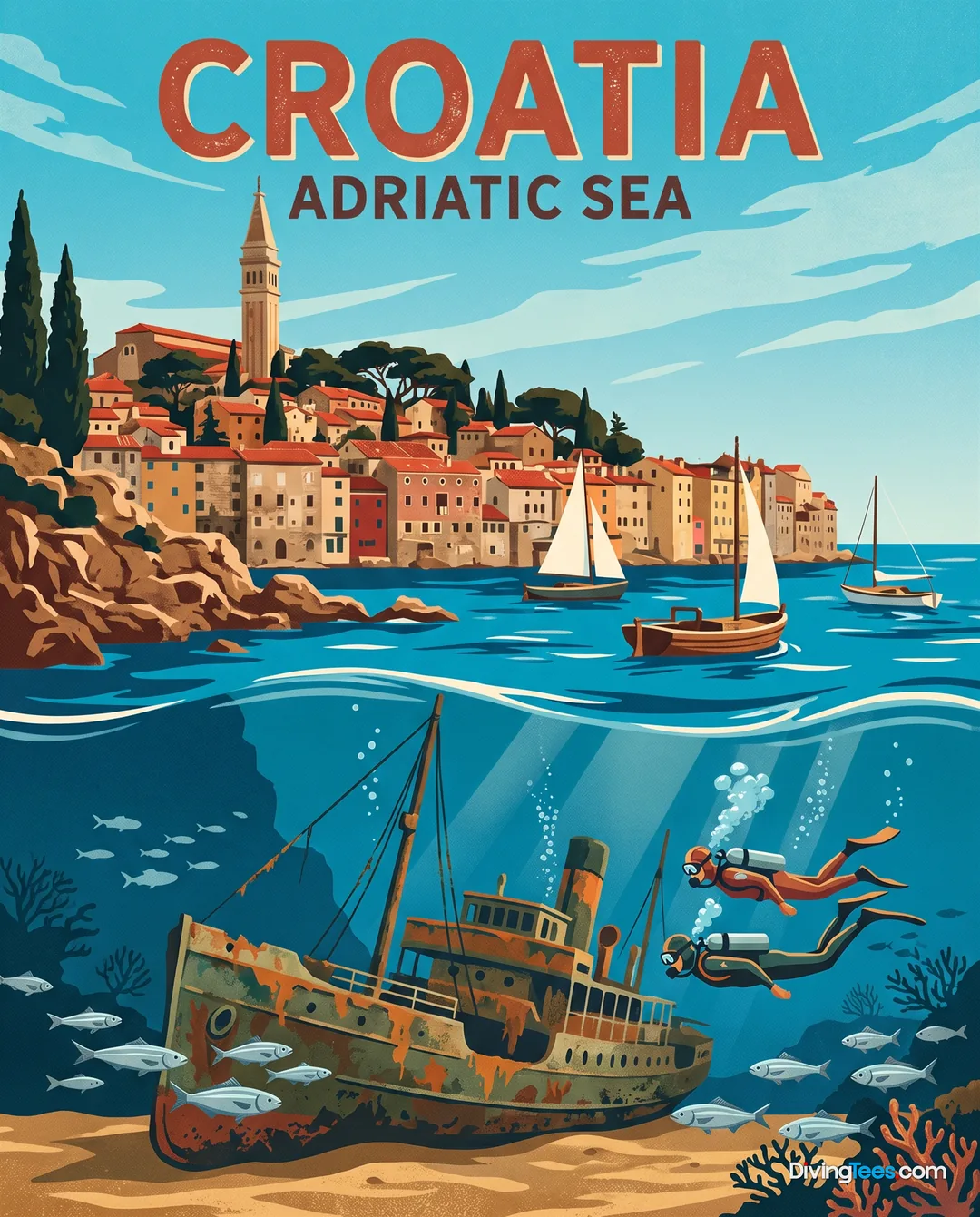
Historic wrecks, muddy bottoms, rocky shallows, conger eels and nudibranchs give Umag a distinctly Mediterranean alternative to tropical reef diving.
For subtitles in English: start the video firstthen click the gearat the top right of the video, select “Subtitles/CC”, then “Auto-translate” and choose “English”.
Umag is a land-based diving base in northern Istria, where easy coastal water sits alongside boat trips to historic wrecks. The attraction is the contrast: a first dive in a few metres near town, then a deeper run to the HMS Coriolanus, where the wreck lies around 28 to 30 metres. Romital, Sara and nearby reefs add variety without turning the holiday into a liveaboard itinerary. Bring a car, allow five to seven days, and treat Umag as a base for diving and exploring Istria.
The diving shifts between shallow coastal ground, rocky Mediterranean reef, sand and wreck structure. Near Umag, sheltered bays and low relief suit training, refresher dives and relaxed photography. Offshore, the character changes to boat diving, with the HMS Coriolanus at roughly 28 to 30 metres and Romital around 24 metres. Some wrecks and structures demand proper depth and wreck-navigation experience, rather than simply a higher certification on paper. Currents are variable, so the profile may feel calm on one outing and more involved on another, although this is not presented as a destination built around drift diving or downcurrent rides. Visibility is equally site-specific. Sheltered bays can be clear, while silty bottoms around Romital may reduce the view. A lamp earns its place for recesses, relief and wreck interiors, even when the water outside looks bright.
Umag’s wildlife is the small-scale Mediterranean sort that rewards a slow fin and a torch beam. Conger eels hold in cracks and wreck openings, while lobsters occupy darker recesses. Nudibranchs, cuttlefish, crabs and sponges add detail to rock and metal, giving photographers reasons to look closely rather than simply swim around the wreck. Seahorses are possible, but occasional rather than something to build an itinerary around. These encounters are not tied to a dependable month-by-month calendar, so the sensible approach is to expect regular sightings of nudibranchs, conger eels, cuttlefish and lobsters across the main diving season. On the wrecks, fixed life and small animals make a lamp and patient searching more useful than covering distance.
May, June, September and the beginning of October make the most sense for Umag. Boat diving remains practical, while the coast is generally less busy than in July and August. That matters when a day depends on a particular wreck, a suitable boat and a manageable sea state rather than a shore entry that can be moved at will. Full summer is still workable, but brings more people to the waterfront and onto boat trips. Keep several days available for the HMS Coriolanus or another distant wreck, because weather can rearrange a planned outing.
Umag works for all levels, provided the dive is matched to the diver. Very shallow coastal sites support first experiences, training and straightforward refresher dives. For the HMS Coriolanus, Romital and other deeper wrecks, Advanced Open Water or an equivalent qualification is useful, but depth control, navigation and previous wreck experience matter just as much. Ask about the maximum depth before booking. A diver comfortable in the water but new to wrecks should begin on a shallower site rather than assume every boat trip is suitable.
From London Heathrow, London Gatwick or Manchester, the practical route is a flight to Pula, Trieste or Ljubljana, followed by a road transfer. Umag has no airport of its own, so a hire car is usually the most flexible arrangement. Allow a half-day in general for the flight and road journey, with more time if the connection is inconvenient. Seasonal boat links from Venice serve the region, including Poreč, but they do not necessarily arrive in Umag, so the final journey still needs to be made overland. Once there, walking works around the centre, but a car is the useful option for reaching dispersed ports, dive bases and departure points around Umag and Savudrija.
Start by asking exactly which wreck is planned and what maximum depth it involves. Umag can mean a few metres near town or a serious wreck profile, and the difference changes the whole day. Carry a lamp for the holes, ledges and darker wreck sections where conger eels, lobsters and nudibranchs are found. Ask about expected visibility for the named site, not for Umag in general: silty ground around Romital can be much less forgiving than a sheltered bay. If the HMS Coriolanus is the priority, leave several days in the programme rather than relying on one departure. Use half-days for coastal dives and nearby wrecks, keeping a full day for a more distant site. A car lets you compare departure points around Umag and Savudrija. Finally, do not arrive expecting tropical reef scenery. The appeal is wreck metal, rock, sand, sponges and small Mediterranean life, not coral walls.
A five- to seven-day stay gives the diving room to breathe. Mix shallow coastal outings with nearby wrecks, then keep a full day for a more distant boat trip and leave space for weather changes. Umag’s centre works well for an evening stroll, but the car becomes important between accommodation, ports and dive departures. Non-divers can follow the coast, visit the old town, paddle or kayak, and explore Istrian villages, historic sites and food inland.
Hello, I'm Marina, DivingDeal.com's AI assistant. I guide you through destinations, areas and countries.
Thinking about the whole trip and the flights? Talk it over with Edith →
Marina is an AI. Some links are affiliate links: DivingDeal may earn a commission, at no extra cost to you. Bookings are made with the partner.
May, June, September and the beginning of October suit Umag well for boat diving with fewer people than July and August. Full summer remains workable, but the waterfront and boats are busier. Keep several days available, because weather and sea conditions can rearrange a planned wreck outing.
Umag suits all levels when the site matches your experience. Very shallow coastal sites support first dives, training and refreshers. The HMS Coriolanus, Romital and other deeper wrecks require suitable depth control, navigation and wreck experience. Advanced Open Water or an equivalent qualification helps, but certification alone does not determine readiness.
You can explore rocky Mediterranean reef, sand, wreck structure and shallow coastal ground rather than tropical coral. Conger eels, lobsters, nudibranchs, cuttlefish, crabs and sponges occupy cracks, recesses and metal. Sheltered bays may offer clearer water, while silty areas such as Romital can reduce visibility. A lamp helps you search.
Plan five to seven days and use Umag as a land-based base. Mix shallow coastal dives with nearby wrecks, then reserve a full day for a more distant boat trip and weather changes. Fly to Pula, Trieste or Ljubljana, arrange a road transfer, and use a hire car for ports and dive bases.