
Petra Diving Center
Google 5/5 (320 reviews)
Aqaba · Jordan · Red Sea
Max. depth · 58 mDescend to the Taiyong Wreck, a substantial crane barge resting on a sandy slope in Aqaba, offering a multi-level technical dive.
For subtitles in English: start the video firstthen click the gearat the top right of the video, select “Subtitles/CC”, then “Auto-translate” and choose “English”.
The Taiyong Wreck, a former crane barge, lies on its starboard side on a sandy slope adjacent to the Japanese Gardens reef in the Aqaba Marine Park. This vessel, purchased by the Aqaba Port Authority in 1974, was intentionally scuttled around New Year’s Eve 1999 to form an artificial reef, later rediscovered by technical divers in 2004. Its bow sits at approximately 35 metres, while the stern and its prominent crane structure extend down to 58 metres, creating a multi-level dive profile along its hull and superstructure.
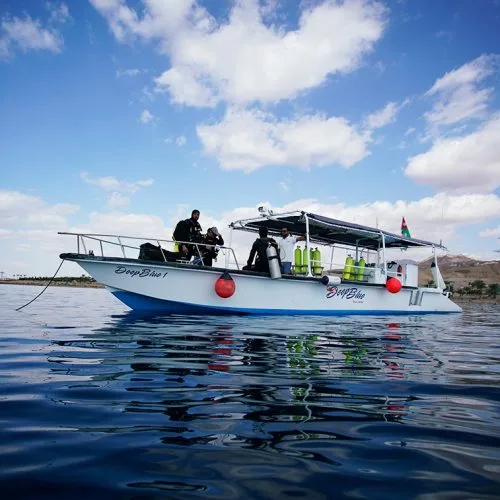
Approaching the Taiyong, you'll notice its substantial steel form materialising from the blue, a testament to its past life as a working vessel. The wreck is accessed primarily by boat, positioned roughly 360 metres offshore. While some operators may use shore access by following the slope from the beach, the boat approach offers a direct descent onto the site, allowing for immediate engagement with the wreck's unique topography. This deliberate placement away from natural reefs makes the Taiyong a standalone artificial habitat.
As you navigate the wreck, the intact crane machinery, cargo holds, and tire fenders become apparent. The name 'TAIYONG C486B' is still visible on the bow, a clear identifier of this deep-water structure. The wreck's orientation on the slope means you can plan your dive to explore different depth zones, moving from the shallower bow sections to the deeper stern, always mindful of your decompression limits and gas management. The sheer scale of the barge provides numerous points of interest for detailed exploration.
The Taiyong has become a thriving artificial reef, attracting a variety of marine life. You'll find soft corals and hard corals colonising its surfaces, providing shelter and feeding grounds. Fusiliers often school around the structure, while groupers and trevallies patrol its deeper sections. Lionfish are frequently observed, using the wreck's crevices for ambush hunting, and moray eels (Muraenidae) have established territories within its various compartments, peering out from shadowed openings.
Beyond the larger predators, the wreck's surfaces host a range of smaller reef inhabitants. Angelfish (Pomacanthidae) meticulously graze on the growth, and butterflyfish (Chaetodontidae) flit between the internal structures, utilising the newly formed shelter. Parrotfish (Scaridae) may also extend their foraging to the wreck, contributing to the ecological succession of this submerged habitat. The interaction of these species with the industrial structure offers a unique perspective on marine adaptation.
Visibility at the Taiyong typically ranges between 20 and 40 metres, allowing for clear views of the entire structure and its inhabitants. Currents are generally light, making it suitable for detailed exploration and photography, though standard Red Sea variability means conditions can shift. This relative calm, combined with the wreck's depth, makes it a preferred site for technical training, allowing divers to focus on skills and extended bottom times without battling strong flows.
The consistent warmth of Aqaba's waters, ranging from 20°C to 28°C, ensures comfortable extended bottom times, which is particularly beneficial for deeper technical dives. This stable environment encourages marine life to flourish on and around the Taiyong, enhancing the overall dive experience. The Taiyong stands as one of Aqaba’s deepest wrecks, offering a distinct challenge and reward for those prepared for its depths and the intricacies of technical wreck diving.
The Taiyong Wreck is accessible by boat, with depths ranging from a minimum of 35 metres at the bow to 58 metres at the stern. This site requires technical diving certifications with advanced deep and decompression or trimix qualifications for full exploration. For the shallower sections, advanced and deep certifications are the minimum. Currents are generally light, though Red Sea variability means conditions can change. Visibility typically ranges from 20 to 40 metres. Water temperatures remain consistently warm, between 20°C and 28°C, allowing for comfortable extended dives.
You need technical diving certification with advanced deep and decompression or trimix qualifications for full exploration of Taiyong Wreck. To visit the shallower sections, you need at least advanced and deep certifications. The wreck’s depth, multi-level profile, and decompression requirements make appropriate training, gas management, and planning essential.
Taiyong Wreck ranges from approximately 35 metres at the bow to 58 metres at the stern. The crane structure extends into the deeper section, while the wreck’s position on a sandy slope creates several depth zones. You can plan your route from the shallower bow toward the deeper stern within your limits.
Currents at Taiyong Wreck are generally light, which can help you focus on detailed exploration and photography. Red Sea conditions can change, however, so you should remain prepared for variability. Visibility typically ranges from 20 to 40 metres, and water temperatures stay between 20°C and 28°C.
You can explore intact crane machinery, cargo holds, tire fenders, and the visible name TAIYONG C486B on the bow. Soft and hard corals cover parts of the structure, while fusiliers, groupers, trevallies, lionfish, moray eels, angelfish, butterflyfish, parrotfish, and other reef inhabitants use the wreck.