African Penguin
Spheniscus demersus
Africa's only penguin brays like a donkey and is vanishing before our eyes.
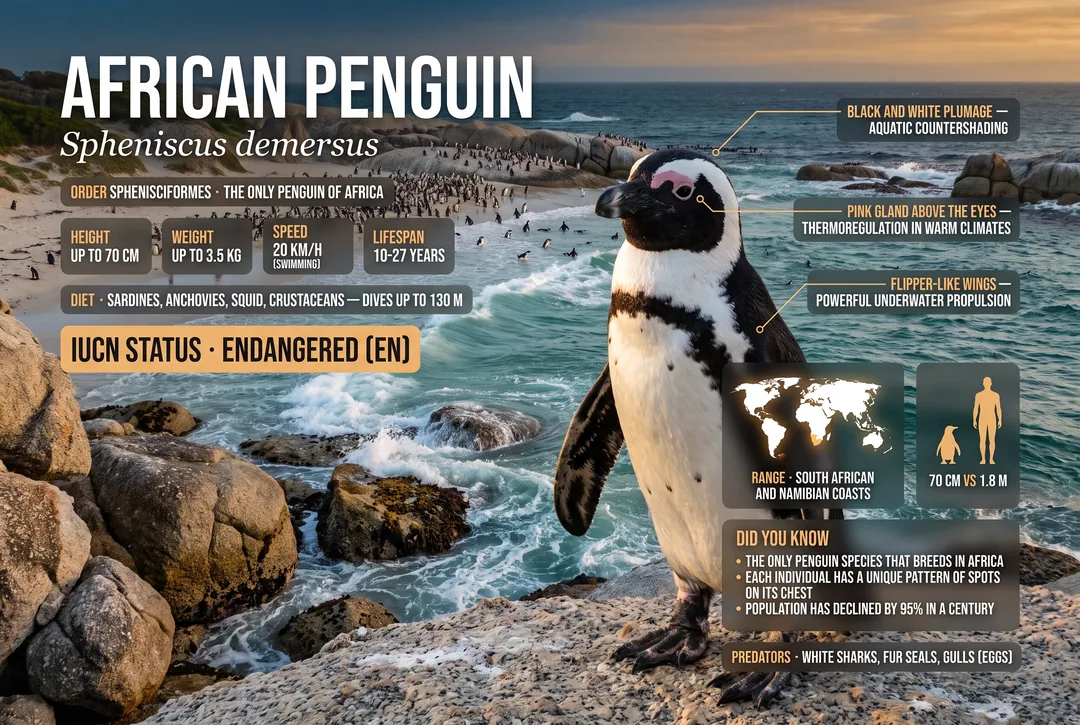
IDENTITY CARD
| Classification | Order Sphenisciformes, family Spheniscidae, genus Spheniscus |
| Scientific name | Spheniscus demersus (Linnaeus, 1758) |
| Size | 60 to 70 cm standing |
| Weight | 2.5 to 4 kg (varies with season and moult cycle) |
| Speed | Up to 20 km/h swimming |
| Lifespan | 10 to 15 years in the wild (up to 30 years in captivity) |
| Depth | Up to 130 m (routine dives between 30 and 70 m) |
| Diet | Sardines, anchovies, small pelagic fish, squid |
| IUCN Status | Endangered (EN) — population declined by ~97% since the early 20th century |
PORTRAIT
There is something deeply improbable about encountering a penguin on an African beach. The mental image of a penguin conjures pack ice, blizzards, Antarctica. And yet, an hour's drive from Cape Town, on a white sand beach flanked by granite boulders, hundreds of African penguins waddle among bathers' towels — and it seems the most natural thing in the world.
Spheniscus demersus is the only penguin species that breeds on the African continent. It nests along the coasts of South Africa and Namibia, in an environment that has nothing polar about it: sunshine, temperate-to-cold waters of the Benguela Current, and Mediterranean-type vegetation as a backdrop. It is this contrast — an animal of the Antarctic imagination under the African southern sun — that makes the encounter so striking.
It is also called the jackass penguin. The nickname is no insult: it comes from its call, a harsh, powerful bray startlingly similar to a donkey's, which colonies belt out at all hours of the day and night. That call, at once comical and poignant, is the soundtrack of any visit to Boulders Beach. Each individual possesses a distinct voice, recognisable by its partner amid thousands of others — an essential mechanism for monogamous birds that must reunite after weeks at sea.
HOW TO RECOGNIZE IT
The African penguin is easy to identify, provided you know where to look.
The silhouette first: it is a medium-sized penguin, distinctly smaller than the emperor penguin (1.20 m) or the king penguin (95 cm). An adult stands 60 to 70 cm tall and weighs between 2.5 and 4 kg — barely more than a large duck.
Then the markings. The back is slate black, the belly white, and a black horseshoe-shaped band crosses the chest and runs down the flanks. This is the signature of the genus Spheniscus, shared by all four banded penguin species (Humboldt, Magellanic, Galapagos), but the African penguin carries a single band where its South American cousins often have two.
The decisive detail: the black spots on the white breast. Every individual bears a unique pattern of dots — a natural fingerprint that biologists use to identify and track individuals without banding them. Above the eyes, a patch of bright pink bare skin, the supraorbital gland, serves thermoregulation: the hotter the animal gets, the pinker the patch becomes, as blood flow increases to dissipate heat.
For subtitles in English: start the video firstthen click the gearat the top right of the video, select “Subtitles/CC”, then “Auto-translate” and choose “English”.
WAY OF LIFE
The African penguin is a coastal animal. It does not migrate thousands of kilometres like the whale shark or the humpback whale: it lives within reach of its colony, rarely more than 40 km from shore, and returns to land to sleep, moult and breed.
At sea, it is an efficient hunter. It dives to depths of 30 to 70 m — sometimes down to 130 m — to catch sardines, anchovies and small pelagic fish. A foraging trip lasts an entire day on average: the penguin leaves the colony at dawn, fishes actively for 8 to 10 hours over a range of 30 to 70 km, and returns at dusk. Its rigid wings, transformed into flippers by evolution, allow it to "fly" underwater at top speeds of 20 km/h — enough to run down a fleeing school of sardines.
Breeding is one of the species' most endearing traits. African penguins are monogamous: a bonded pair often stays together for years, sometimes for life. The nest is a burrow dug into hardened guano, beneath a bush, or in a rock crevice — anything that shields the eggs from sun and predators. The female lays two eggs, incubated in alternation by both parents for roughly 40 days. Chicks hatch covered in grey-brown down and remain in the nest for 2 to 4 months before taking to the sea.
The annual moult is an ordeal. Over three weeks, the adult sheds its entire plumage and replaces it — a process known as catastrophic moult. With its feathers no longer waterproof, it cannot enter the water and must fast on land. It needs to have built up sufficient fat reserves to survive: a penguin at the start of moult weighs up to 4 kg; by the end, as little as 2.5 kg.
WHERE TO SEE IT
The African penguin lives exclusively along the coasts of South Africa and Namibia. Unlike most species featured on DivingDeal, it is not observed underwater but on land — from a boardwalk, a coastal path, or directly on the beach. The encounter is all the more memorable for being accessible, requiring no equipment or prior experience.
South Africa — Boulders Beach (Simon's Town). The most famous and most accessible site in the world for observing African penguins. The colony, established among the granite boulders of Boulders Beach since 1983 (two pioneering pairs), today numbers around 2,500 to 3,000 individuals. Wooden boardwalks allow visitors to walk through the colony just metres from the nests. On the neighbouring Foxy Beach, penguins mingle with swimmers — an experience unique on the planet. The site is managed by Table Mountain National Park (entrance fee applies). Simon's Town is 40 minutes from Cape Town city centre, and a visit combines naturally with a day of diving in the False Bay area — historically one of the world's premier locations for cage diving with the great white shark.
South Africa — Robben Island. The island where Nelson Mandela was imprisoned for 18 years also harbours a colony of African penguins. It can be observed during the guided tour of the island (ferry from the V&A Waterfront in Cape Town, duration 3h30). The colony is wilder and less accessible than at Boulders Beach — glimpsed from a distance, from the bus — but the historical setting makes the experience singular.
South Africa — Stony Point (Betty's Bay). An hour and a half from Cape Town along the Garden Route, the Stony Point colony offers a less crowded alternative to Boulders Beach. Wooden boardwalks thread through a colony of roughly 3,000 penguins, with access to deep water where visitors can watch the birds entering and leaving the sea. The site is managed by CapeNature and the entrance fee is modest.
South Africa — Bird Island, Algoa Bay (Gqeberha). The world's largest African penguin colony is found on this island in Algoa Bay, off Port Elizabeth (renamed Gqeberha). Bird Island and neighbouring St Croix Island together hold more than 40% of the species' global population. Access is restricted (protected island), but boat trips from Port Elizabeth allow visitors to observe penguins swimming around the island, and Algoa Bay offers excellent diving with other marine species.
Namibia — Halifax Island (Luderitz). On Namibia's desert coast, Halifax Island hosts a colony accessible by kayak from the town of Luderitz. The contrast between the Namib dunes and the penguins is striking. The Namibian colony is smaller and less visited than those in South Africa, adding to the wild character of the encounter.
OBSERVATION CALENDAR
| Destination | J | F | M | A | M | J | J | A | S | O | N | D |
|---|---|---|---|---|---|---|---|---|---|---|---|---|
| Boulders Beach (Simon's Town) | ||||||||||||
| Robben Island | ||||||||||||
| Stony Point (Betty's Bay) | ||||||||||||
| Bird Island (Algoa Bay) | ||||||||||||
| Halifax Island (Namibia) |
Click each button to show/hide
The African penguin is sedentary: colonies are occupied year-round. Breeding extends over several months, with peaks varying between colonies (generally February to August). The austral summer (November to March) offers the best weather conditions for visiting, but penguins are present in every season.
CONSERVATION
Spheniscus demersus is classified Endangered (EN) on the IUCN Red List. The population has crashed by approximately 97% since the early 20th century — from one and a half million breeding pairs to roughly 10,000 to 13,000 pairs today. It is one of the steepest declines ever documented for a seabird.
The threats are multiple and cumulative. Overfishing of sardines and anchovies — the very fish on which the penguins depend — has drastically reduced food availability along the South African coast. The historical harvesting of guano destroyed natural nesting substrates: penguins dug their burrows in layers of guano accumulated over centuries, and its industrial extraction in the 19th and 20th centuries left the birds homeless, exposed to sun and predators. Oil pollution remains a recurring threat — the wrecks of the Treasure (2000) and the Apollo Sea (1994) oiled tens of thousands of birds. Predation by Cape fur seals, kelp gulls and mongooses compounds the picture.
Climate change amplifies everything: the eastward shift of fish stocks, out of reach of the historical colonies, creates an "ecological trap" where penguins forage where food used to be but no longer is. More frequent storms flood ground-level nests. Rising sea temperatures reduce the productivity of the Benguela Current.
Active conservation programmes are working to halt the decline. Ceramic nest boxes are installed to compensate for the loss of guano. Fishing exclusion zones around colonies have been trialled with promising results. The rescue operation for penguins oiled by the Treasure in 2000 — 19,000 birds captured, cleaned one by one and rehabilitated by teams of volunteers from around the world — remains the largest wild animal rescue operation in history.
Organisations to support:
- SANCCOB — Southern African Foundation for the Conservation of Coastal Birds — rescue, rehabilitation and reintroduction of African penguins
- BirdLife South Africa — colony monitoring and advocacy for protected fishing zones
- African Penguin & Seabird Sanctuary — rehabilitation centre in Cape Town
- CapeNature — reserve management and colony protection
3 THINGS YOU PROBABLY DON'T KNOW
1. It brays like a donkey — and every voice is unique. The African penguin's call is uncannily similar to a donkey's bray, earning it the English nickname jackass penguin. But this is not mere noise: it is language. Every individual possesses a distinct vocal signature, recognisable by its partner and its chicks amid a colony of several thousand birds. Researchers have identified at least four distinct vocalisation types — contact call, courtship display, territory defence, chick begging — each with measurable individual variations. The dawn chorus of a colony, as hundreds of pairs reunite before heading out to fish, is one of the most singular sounds in the animal world.
2. Its chest spots are its barcode. The scattering of black spots on each African penguin's white breast is unique, like a fingerprint. This discovery revolutionised population monitoring: instead of banding the birds (an invasive method that can injure flippers and increase hydrodynamic drag), biologists now use photo-identification assisted by artificial intelligence. Algorithms compare photographs taken by visitors and automatic cameras to track the movements, survival and site fidelity of thousands of individuals without ever touching them.
3. The largest wild animal rescue in history was about this penguin. On 23 June 2000, the MV Treasure, a bulk carrier loaded with iron ore, sank between Robben Island and the Boulders Beach colony, spilling 1,300 tonnes of fuel oil. Forty thousand penguins were at risk. Within days, an unprecedented operation took shape: 19,000 oiled penguins were captured, cleaned one by one, and rehabilitated by teams of volunteers from around the world. Meanwhile, 19,500 as-yet-unoiled penguins were relocated 60 km from the contaminated zone to allow time for the waters to clear. The survival rate after reintroduction: 91%. The operation, coordinated by SANCCOB, mobilised 12,500 volunteers and remains, twenty-six years later, the absolute benchmark in wild animal rescue.
PHOTO AND VIDEO TIPS
The African penguin is one of the most accessible and rewarding wildlife subjects in Africa. The proximity permitted at Boulders Beach — just a few metres, with no barrier on Foxy Beach — offers conditions that most wildlife photographers achieve only after days in a hide.
Lens. A 70-200 mm is the ideal tool for portraits and behaviour shots at boardwalk distance (3 to 5 m). A 24-70 mm or a 35 mm prime works perfectly on Foxy Beach, where penguins pass within arm's reach. For video, a modern smartphone is more than adequate — light is generally excellent and the subjects are nearly motionless when on the nest.
Light. Cape Town offers remarkable light, particularly in the early morning and late afternoon. At midday, the sun hits hard and the black-white plumage contrasts blow out the highlights. Favour the golden hours (first and last quarters of the day) for warm-toned images. In austral summer, the light remains workable until 8 pm.
Approach. At Boulders Beach, stay on the wooden boardwalks — they are positioned at the optimal distance for photography and protect the nests. On Foxy Beach, the penguins come to you: sit on the sand at their level and wait. The most photogenic moments — courtship displays, mutual preening, chick feeding, territorial disputes — occur in the early morning and late afternoon.
Common mistake. Photographing penguins only from above, standing upright. The bird measures 65 cm: framing it from 1.80 m gives a crushing top-down angle and a background of nothing but sand. Kneeling or sitting to photograph at eye level transforms the image — a direct gaze, granite boulders in the background, the sea beyond. It is the difference between a tourist snapshot and a portrait.