Galápagos Penguin
Spheniscus mendiculus
The only penguin in the world that lives north of the equator — and it swims right alongside you.
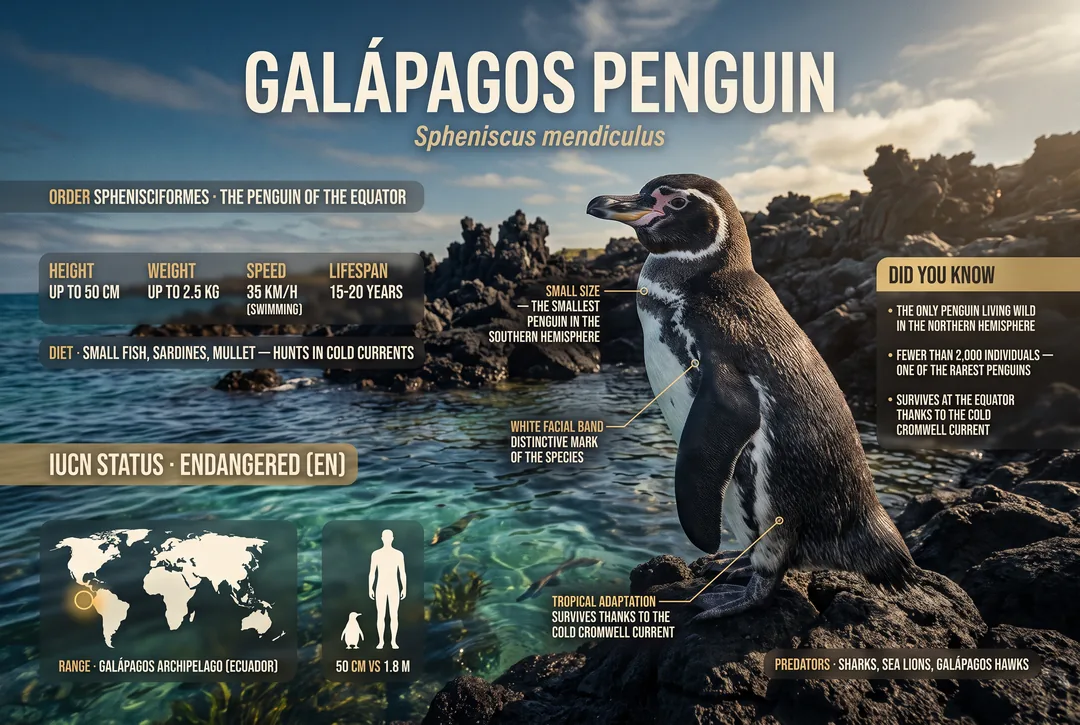
IDENTITY CARD
| Classification | Order Sphenisciformes, family Spheniscidae |
| Scientific name | Spheniscus mendiculus (Sundevall, 1871) |
| Size | 48 to 53 cm — the smallest penguin of the genus Spheniscus |
| Weight | 1.7 to 2.6 kg |
| Speed | Up to 20-25 km/h underwater |
| Lifespan | 15 to 20 years in the wild |
| Depth | Usual dives between 0 and 30 m, recorded maximum ~52 m |
| Diet | Small pelagic fish — mullet, sardines, anchovies — and crustaceans |
| IUCN Status | Endangered (EN) — population estimated at ~1,200 mature individuals |
PORTRAIT
There is a place on Earth where a penguin fishes in water at 20 degrees Celsius, a few metres from the equator, while a frigatebird circles overhead and a marine iguana grazes on the algae of the same volcanic rock. That place is the Galapagos. And this penguin — the only one on the planet to set foot north of the equator — is Spheniscus mendiculus, the Galapagos penguin.
Its very existence is a geographical anomaly. Penguins are birds of the southern hemisphere, from Antarctica to southern Africa. This one has no business under the tropics — except that a remarkable oceanographic phenomenon makes it possible: the Cromwell Current, a deep flow that pushes cold, nutrient-rich water upward along the western coasts of the archipelago, and the Humboldt Current, which drives water at 15-20 degrees Celsius northward from the south. These two currents create a local upwelling that lowers water temperature, feeds the plankton, attracts schools of small fish — and makes life possible for an equatorial penguin.
But this life hangs by a thread. The global population does not exceed 1,200 mature individuals, concentrated on just two islands: Isabela and Fernandina. A severe El Nino event — the one in 1982-1983 killed 77% of the population — can push the species to the brink of extinction within months. Spheniscus mendiculus is the rarest penguin on the planet, and every underwater encounter is a privilege that biology and climate could reclaim at any moment.
HOW TO RECOGNIZE IT
The Galapagos penguin is the smallest member of its genus and one of the easiest to identify — provided you remember you are in the Galapagos, where no other penguin exists. Its compact silhouette, slate-black back and cream-white belly immediately evoke the classic penguin tuxedo, but in reduced format: 50 cm standing, roughly the size of a mallard duck.
The head carries the distinctive markings of the genus Spheniscus: a white band shaped like a reversed C runs from the eye, around the rear of the cheek, and joins the throat. A second, thinner black band crosses the upper chest in an arc. The bill is black, marked by a pink-orange band at the base of the lower mandible — a detail easily spotted while snorkelling at close range.
Underwater, the penguin is recognised by its swimming style: fast, direct, with short, powerful wing beats that propel it like a small black-and-white torpedo. It changes direction with an agility that few fish can match. When hunting, it streaks in a straight line through schools of fish; when curious — and it often is — it approaches the diver in tight circles, sometimes coming within a metre.
For subtitles in English: start the video firstthen click the gearat the top right of the video, select “Subtitles/CC”, then “Auto-translate” and choose “English”.
WAY OF LIFE
The Galapagos penguin is a thermal opportunist. Unlike its Antarctic cousins, it has no fixed breeding season: it reproduces when food is sufficient, which is to say when the cold, nutrient-rich waters of the Cromwell Current well up along the coasts. Some years, a pair can raise two broods; other years, none at all. This reproductive flexibility is a direct adaptation to an unpredictable environment.
Thermoregulation is the permanent challenge of its life. At 30 degrees Celsius ambient temperature, a penguin has no obvious mechanism to shed heat — no sweat glands, a plumage designed to insulate against cold. Spheniscus mendiculus has developed several strategies: it stands upright, leaning forward, flippers spread to expose the patches of bare skin under its wings; it pants like a dog; it seeks the shade of lava overhangs. At night, it nests in crevices of volcanic rock that retain coolness. At dawn, it dives — and that is where the diver meets it.
Feeding is concentrated in shallow coastal waters, where the upwelling pushes schools of sardines, mullet, and anchovies toward the surface. The penguin hunts in groups of two to fifteen individuals, rarely diving beyond 30 metres, with breath-holds of 30 to 90 seconds. It swallows prey whole, head first — the small backward-pointing teeth lining its bill and tongue prevent the fish from escaping. Its underwater top speed — 20-25 km/h — ranks it among the fastest swimmers in the archipelago, ahead of most of the fish it pursues.
WHERE TO SEE IT
The Galapagos penguin is endemic to the archipelago: it lives nowhere else on Earth. Its distribution is closely tied to the cold waters of the upwelling, which concentrates virtually the entire population on the western coasts of the two most volcanic islands.
Isabela — Tagus Cove. The most accessible site for divers. The penguins nest in cracks in the cliff and hunt along the rocky wall that drops to 15 metres. They are encountered regularly by snorkellers and scuba divers alike, often in the company of sea turtles and marine iguanas. Morning offers the best chances: the penguins leave to fish at dawn and follow the coastline before heading out to sea.
Isabela — Elizabeth Bay. A sheltered bay where the penguins rest on lava rocks between hunting sessions. The site is visited by panga (small boat) and snorkelling. The calm waters and shallow depth make it an excellent spot for photography — the penguins often swim less than two metres from the surface.
Fernandina — Punta Espinosa. The wildest island in the archipelago, with no introduced species whatsoever. The penguins live here amid the largest colony of marine iguanas in the world. Snorkelling along the submerged lava flows allows close encounters in crystalline water, between 16 and 22 degrees Celsius depending on the season.
Bartolome. The iconic site, with its volcanic pinnacle that serves as the postcard image of the Galapagos. A small penguin colony resides on the rocks at the foot of the pinnacle. Snorkelling here is easy and the penguins, accustomed to visitors, allow approach. This is the site where the chances of swimming alongside a penguin are probably the highest in the archipelago — but the colony is small and absences are possible.
OBSERVATION CALENDAR
| Destination | J | F | M | A | M | J | J | A | S | O | N | D |
|---|---|---|---|---|---|---|---|---|---|---|---|---|
| Isabela (Tagus Cove) | ||||||||||||
| Isabela (Elizabeth Bay) | ||||||||||||
| Fernandina (Punta Espinosa) | ||||||||||||
| Bartolome |
Click each button to show/hide
The cool season (June--November), when the Humboldt Current and the Cromwell upwelling are strongest, concentrates food and keeps the penguins close to shore. The warm season (January--April), especially during El Nino years, disperses prey and pushes the penguins further offshore — sightings become less reliable.
CONSERVATION
Spheniscus mendiculus is classified as Endangered (EN) on the IUCN Red List. With approximately 1,200 mature individuals — some estimates fall below 1,000 during El Nino years — it is the rarest penguin in the world and one of the most threatened seabirds on the planet.
The primary threat is climatic. El Nino events warm surface waters, suppress the upwelling, and cause the fish schools on which the penguin depends to vanish. The 1982-1983 event reduced the population by 77%; the 1997-1998 event cut it by a further 65%. The population has never fully recovered. With the projected intensification of El Nino events under climate change, the scenario of functional extinction within coming decades is taken seriously by biologists.
Introduced predators compound the problem. Cats, rats, and feral dogs on Isabela attack eggs, chicks, and sometimes adults in their burrows. Mosquitoes — arrived with humans — transmit avian malaria, a disease to which the penguins have no natural resistance. Hydrocarbon contamination, though rare in the archipelago, remains a permanent risk for a species so geographically concentrated.
The diver fortunate enough to swim with a Galapagos penguin contributes, through the national park entry fees ($100 per visitor), to the direct financing of conservation. Respecting distances — 2 metres minimum — not pursuing the animal, and not blocking its escape trajectory are the basic rules.
Organisations to support:
- Galapagos Conservation Trust — habitat protection and research programmes on endemic species
- Charles Darwin Foundation — on-site research station, penguin population monitoring since the 1970s
- Galapagos Conservancy — invasive species eradication and ecosystem restoration
- PADI AWARE — citizen science programme and underwater observation reporting
3 THINGS YOU PROBABLY DON'T KNOW
1. It is the only penguin that moults twice a year. All penguins moult — they replace their entire plumage at once, an ordeal lasting two to three weeks during which they cannot swim or feed. Most species endure this trial only once a year. The Galapagos penguin moults twice: a strategy that allows it to maintain a waterproof and insulating plumage in waters where the temperature difference between the surface and the hunting zone can reach 10 degrees Celsius. During the moult, it stays ashore, thin and vulnerable — the period when it is easiest to observe out of the water, and the least appropriate time to disturb it.
2. It nests in lava. Lacking ice, burrows, or pebbles, the Galapagos penguin has colonised the crevices of volcanic rock — fissures, collapsed lava tubes, cavities beneath basalt blocks. These natural shelters protect it both from the equatorial sun (up to 40 degrees Celsius at the surface) and from terrestrial predators. Some pairs reuse the same nesting site year after year. The female typically lays two eggs, but it is rare for both chicks to survive: the second, smaller egg serves most often as biological insurance in case the first fails.
3. It can decide not to breed — and waits. This is one of the most unusual adaptations among seabirds: when water temperature exceeds a critical threshold (around 24-25 degrees Celsius) and food grows scarce, the Galapagos penguin simply suspends its reproductive cycle. The gonads regress, eggs already laid are sometimes abandoned, and the pair waits for oceanographic conditions to become favourable again — which can take months, or even an entire year. This ability to "pause" reproduction is what has allowed it to survive millennia of climatic oscillations. But faced with an El Nino that lasted too long, the pause could become permanent.
PHOTO AND VIDEO TIPS
The Galapagos penguin is an extraordinary and demanding subject. Small, fast, unpredictable — the polar opposite of a whale shark. But its natural curiosity and the clarity of the archipelago's waters more than compensate for the technical difficulty.
Lens. Wide angle or semi-wide angle: 16-35 mm in a housing, or the native field of a GoPro. The ultra-wide fisheye (10-17 mm) is counterproductive here — the penguin is small and the distortion shrinks it further. You want to see it in proportion, not in miniature. For tight shots of the head and eyes, a 60 mm macro-portrait lens works, but requires the animal's cooperation — which does happen.
Light. Encounters take place between the surface and 10 metres, in generally clear water. Natural light is sufficient for most shots. A strobe or video light is useful for restoring the nuances of the plumage — the black is actually a deep slate blue-grey, and the white tends toward cream — but never illuminate the animal head-on: the penguin is sensitive to direct light and a frontal flash can trigger flight.
Approach. Do not swim toward the penguin. Float, motionless or in a slow drift, and wait for it to come. Galapagos penguins are accustomed to snorkellers and often make the first move — they approach, inspect the mask, circle the diver, then head off to hunt. The best shot comes when the animal decides to pass in front of the lens, not when you chase it. Patience is rewarded with images at less than a metre, in direct eye contact.
Common mistake. Setting the shutter speed too low. A hunting penguin swims at 15-20 km/h and changes direction without warning. Below 1/500 s, motion blur is guaranteed. For video, 60 fps minimum to allow the most spectacular passes to be slowed down — a penguin crossing the frame at full speed lasts less than a second at real speed.