Emperor Penguin
Aptenodytes forsteri
The tallest penguin alive survives where everything else dies of cold.
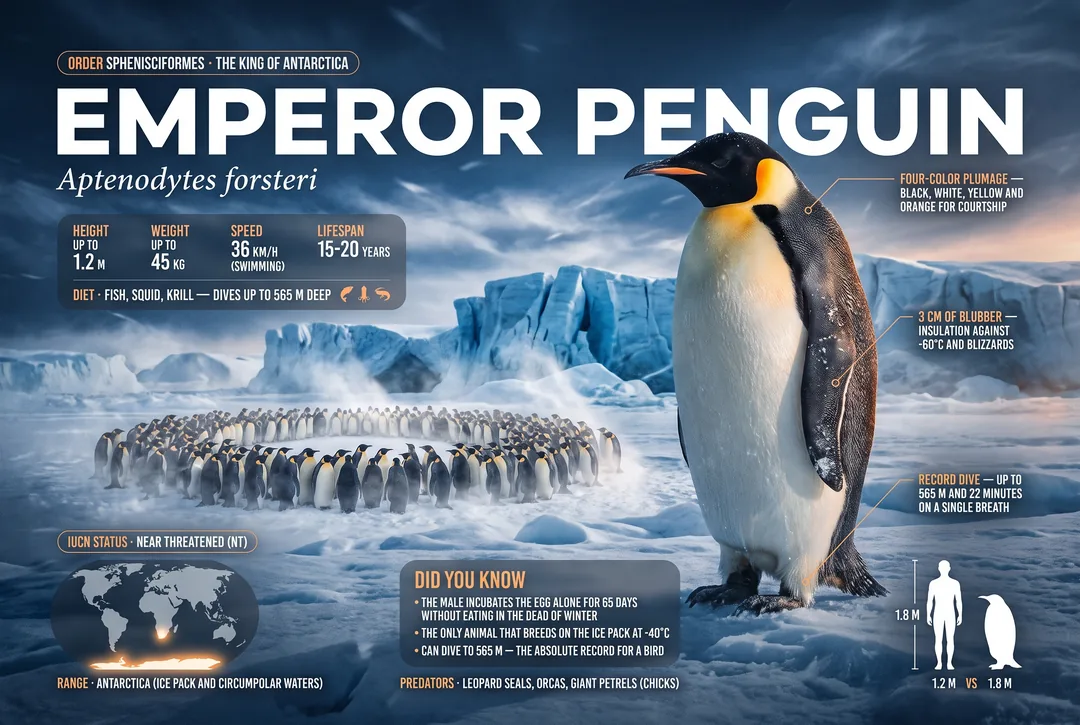
IDENTITY CARD
| Classification | Order Sphenisciformes, family Spheniscidae |
| Scientific name | Aptenodytes forsteri (Gray, 1844) |
| Size | Up to 1.22 m standing — the tallest living penguin |
| Weight | 22 to 45 kg depending on season (male at start of incubation ~40 kg; end ~23 kg) |
| Speed | 6-9 km/h swimming; bursts up to 15 km/h |
| Lifespan | 15 to 20 years in the wild (record: ~50 years in captivity) |
| Depth | Record: 565 m — the deepest diving bird in the world |
| Diet | Fish (mainly Antarctic silverfish), krill, squid |
| IUCN Status | Near Threatened (NT) — population declining, vulnerable to sea ice loss |
PORTRAIT
There is no reef to drop into, no backroll off a Zodiac into blue water. You reach emperor penguins at the end of the world — after days of navigation through pack ice, aboard an ice-strengthened vessel grinding through leads and pressure ridges, with the temperature falling hour by hour and the light flattening into a white continuum of sky and frozen sea. When the colony finally appears on the horizon, it is not a beach gathering like other penguin species. It is a dark, shifting mass on the bare ice shelf, kilometres from open water, surrounded by nothing but the Antarctic plateau. The approach is by helicopter, weather permitting, and the first thing you register is not the birds themselves but the sound — a vast, polyphonic chorus of trumpeting calls rolling across the ice in the absolute silence of the continent.
Aptenodytes forsteri does not merely tolerate the cold — it breeds in the dead of the Antarctic winter. While every other warm-blooded animal has fled north, the emperor penguin walks 50 to 120 kilometres inland across the sea ice, forms colonies of thousands in temperatures of -60 C and winds exceeding 200 km/h, and raises its single chick through four months of polar night. It is the species that inspired Luc Jacquet's March of the Penguins (2005), and for good reason: no other bird on Earth has pushed the limits of survival this far. The emperor penguin did not adapt to one of the harshest environments on the planet — it chose the harshest moment within it.
Beneath the surface, the same bird becomes something else entirely. The emperor penguin is the deepest-diving bird ever recorded — 565 metres, at pressures of 57 atmospheres, in total darkness. Routine foraging dives reach 100 to 300 metres, with breath-holds of up to 22 minutes. Its solid, non-pneumatized bones resist compression; its blood carries a high-affinity haemoglobin that wrings every molecule of oxygen from each breath; its muscles are loaded with myoglobin at concentrations that would cause kidney failure in most mammals. Where divers see a waddling, stoic figure on the ice, physiologists see a supreme athlete — one that spends most of its working life in a world no human diver can follow.
HOW TO RECOGNIZE IT
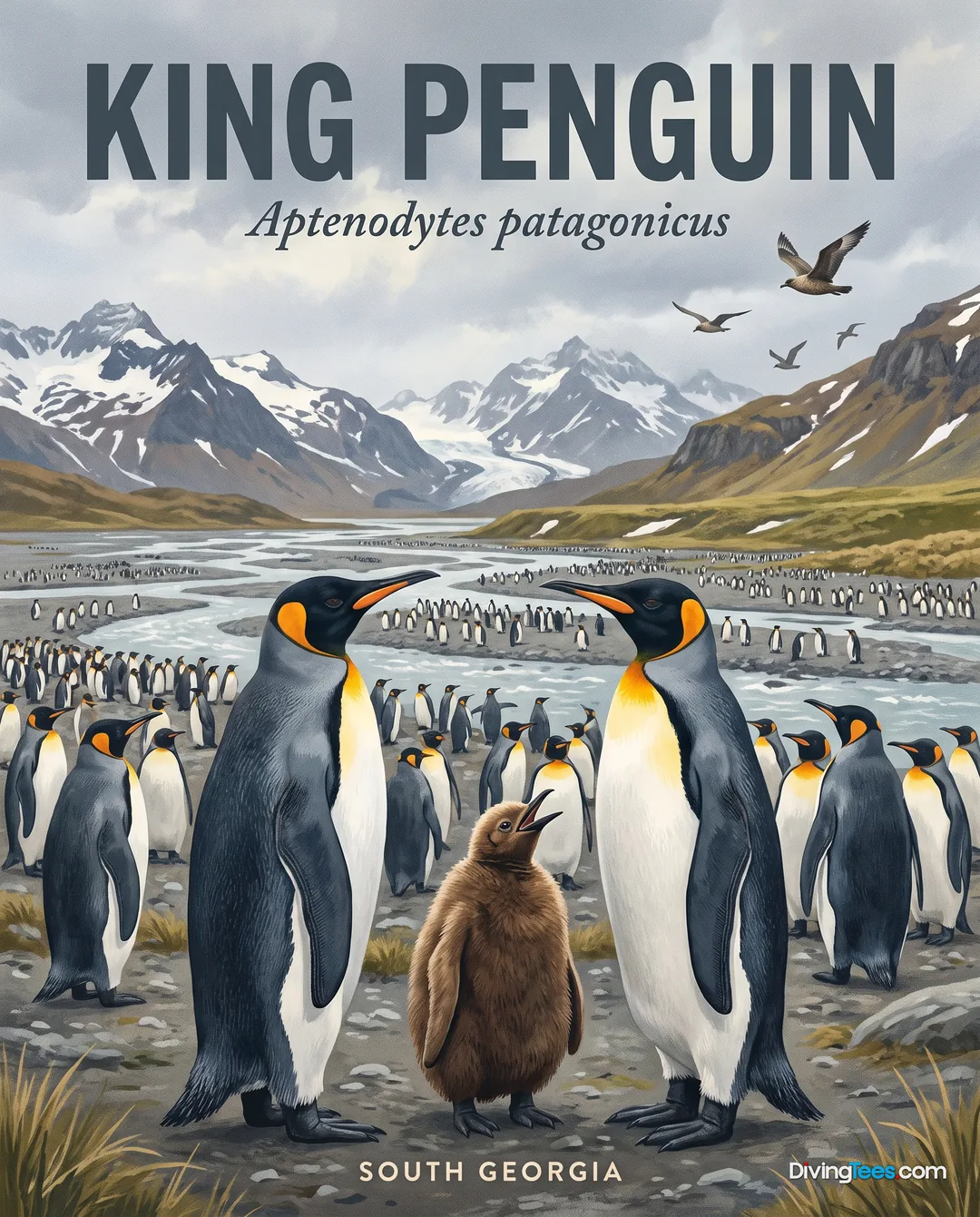
The emperor penguin is unmistakable by size alone. Standing 1.10 to 1.22 metres tall, it towers over every other penguin species — including the king penguin, which reaches only 95 cm.
The head markings are the clearest field mark at distance. Two teardrop-shaped auricular patches of yellow-orange sweep down from behind the eye and blend gradually into the white of the upper chest. The colour is paler and less vivid than the king penguin's intense golden-orange — more of a diffuse lemon-yellow fading at the edges. The back is blue-grey slate, the belly pure white, and the long, thin bill carries a distinctive pinkish-orange stripe along the lower mandible — duller and more muted than the king penguin's brighter mandible stripe.
The chicks are entirely different. Covered in silver-grey down, they wear a striking black-and-white face mask — a bold pattern unlike the uniform chocolate-brown of king penguin chicks. In large creches of several hundred individuals, they can look like a separate species altogether.
To distinguish from the king penguin in the field: the emperor is markedly larger, its yellow patches are paler and less sharply defined, and its bill is longer and duller. The two species never share a breeding site — the emperor breeds on Antarctic sea ice, the king on sub-Antarctic island beaches.
For subtitles in English: start the video firstthen click the gearat the top right of the video, select “Subtitles/CC”, then “Auto-translate” and choose “English”.
WAY OF LIFE
The emperor penguin has inverted the calendar of every other bird. It breeds in winter, so that its chick hatches and grows during the brief Antarctic summer, when food is most abundant and the sea ice has not yet broken up. The timing is extraordinary: if it bred in summer like most species, the chick would face its most vulnerable months in the dark, starving cold of winter.
Between March and April, adults leave the sea and walk 50 to 120 kilometres inland across the sea ice to reach their colony site — always the same location, year after year, chosen for its stability and shelter from the worst winds. The female lays a single egg in May or June and immediately transfers it to the male. The handover is one of the most precarious moments in the breeding cycle: the egg would freeze solid in less than two minutes if it touched the ice.
The male then incubates the egg on the tops of his feet, sheltered beneath a fold of vascularised belly skin called a brood pouch. For 65 days, he eats nothing. The female, meanwhile, walks back to the sea to feed and will not return until the chick hatches. By the time she does, the male has lost roughly 40 percent of his body weight — from around 40 kg down to 23 kg.
Survival during those 65 days depends on the huddle. Males pack together in a slowly rotating circular formation — no leader, no fixed positions — that functions as a collective thermal system. On the outside, the wind chill can reach -80 C; inside the huddle, temperatures climb above 37 C. The whole mass drifts at roughly 5 centimetres per minute, each bird gradually spiralling from the exposed outer edge toward the warm centre and back out again. Physicists have compared the movement to convection in a fluid — a self-organized phenomenon, not a social hierarchy.
The chick hatches in July or August. From that point, both parents alternate feeding trips for roughly four months, making 150 to 250 dives per day to depths of 100 to 300 metres. The emperor penguin's physiology is built for this: its haemoglobin fixes oxygen more efficiently than that of any other bird, and it can slow its heart rate to as few as 15 beats per minute during deep dives — a profound diving bradycardia that stretches each breath to its absolute limit.
WHERE TO SEE IT
The emperor penguin breeds exclusively on Antarctic sea ice, making it one of the most difficult wildlife species on Earth to observe. There are no casual encounters — every sighting requires a dedicated expedition, careful timing, and a measure of luck with the weather. All visits fall under IAATO (International Association of Antarctica Tour Operators) protocol: a minimum distance of 5 metres from the birds, no food, and strict group size limits on the ice.
Antarctica — Snow Hill Island. This is the most accessible emperor penguin colony in the world, and for most travellers, the only realistic option. Located in the northwestern Weddell Sea, the colony holds between 4,000 and 8,000 breeding pairs. Access is by helicopter from an ice-strengthened expedition vessel — the ship anchors in the pack ice, and small groups are flown to a landing zone near the colony. The window is brutally narrow: late October to mid-November only, when the chicks are large enough to be visible but the sea ice has not yet begun to break up. Even within this window, flights depend entirely on weather — heavy cloud, wind, or poor visibility can cancel every attempt for days. Expect to pay a premium: Snow Hill expeditions are among the most expensive wildlife trips on the planet, and they sell out a year or more in advance.
Antarctica — Ross Sea. The Ross Sea coast and its offshore islands host several emperor colonies, including the historically famous Cape Crozier and Cape Washington populations. These are visited on deep Antarctic voyages departing from New Zealand (typically Invercargill or Bluff), usually in January and February. Sightings are less guaranteed than at Snow Hill — these are primarily landscape and exploration expeditions, not dedicated emperor penguin trips. When conditions allow, passengers may see adults and well-grown chicks on the fast ice or swimming near the ship. The Ross Sea is also the site of the longest-running emperor penguin research, dating back to the heroic age of Antarctic exploration.
South Georgia. South Georgia is the world capital of king penguins, not emperors. The occasional vagrant emperor has been recorded, but these are rare errants — do not plan a trip to South Georgia expecting to see Aptenodytes forsteri. If an emperor does appear among the king penguin colonies, it is an event that makes the expedition log.
Falkland Islands. As with South Georgia, emperor penguins are occasional vagrants to the Falklands — individuals that have strayed far north of their breeding range. Sightings are documented every few years, usually of lone juveniles, and they cannot be relied upon. The Falklands are excellent for gentoo, Magellanic, and rockhopper penguins, as well as a small king penguin colony at Volunteer Point — but not for emperors.
OBSERVATION CALENDAR
| Destination | J | F | M | A | M | J | J | A | S | O | N | D |
|---|---|---|---|---|---|---|---|---|---|---|---|---|
| Antarctica (Snow Hill Island) | ||||||||||||
| Antarctica (Ross Sea) | ||||||||||||
| South Georgia (errants) | ||||||||||||
| Falkland Islands (errants) |
Click each button to show/hide
The emperor penguin has the narrowest observation window of any penguin species. Snow Hill Island is accessible only during a two-to-three-week corridor in late October to mid-November — before that, the sea ice is impenetrable; after, it is too unstable for helicopter operations. Ross Sea voyages run January to February but do not guarantee emperor sightings. In practice, if seeing an emperor penguin colony is your primary goal, Snow Hill in November is the only reliable option — and even then, weather cancels roughly one expedition in three.
CONSERVATION
Aptenodytes forsteri is listed as Near Threatened (NT) on the IUCN Red List, and the trajectory is not encouraging. In October 2022, the United States listed the species as Threatened under the Endangered Species Act — the first time a species was listed primarily on the basis of climate projections rather than observed population decline.
The threat is sea ice. Emperor penguins depend on stable fast ice for their entire breeding cycle — from the March arrival to the December departure of fledged chicks. If the ice breaks up too early, chicks that have not yet developed their waterproof plumage drown or die of hypothermia. This is not a theoretical risk. The Halley Bay colony in the Weddell Sea — formerly one of the largest on the continent, with roughly 25,000 breeding pairs — suffered near-total breeding failure three years running from 2016 to 2019 after the sea ice broke up catastrophically early. Satellite imagery showed almost no surviving chicks.
Climate models project severe consequences. Under current emissions trajectories, an estimated 80 percent of emperor penguin colonies could collapse by 2100 as the Antarctic sea ice season shortens. The species' total population is estimated at 270,000 to 280,000 breeding pairs across roughly 50 colonies — a number that sounds large until you consider that each colony is isolated, site-faithful, and entirely dependent on local ice conditions that are changing faster than the birds can adapt.
The emperor penguin is protected under the Antarctic Treaty System and by CCAMLR (the Commission for the Conservation of Antarctic Marine Living Resources), which regulates fishing in the Southern Ocean. Tourism is governed by IAATO guidelines. But the fundamental threat — the loss of sea ice driven by global warming — lies beyond the reach of any local protection measure. The emperor penguin's future depends almost entirely on global emissions policy.
Organisations to support:
- WWF Antarctic Programme — advocacy for Southern Ocean marine protected areas and emissions reduction
- British Antarctic Survey — long-term monitoring of emperor penguin colonies via satellite and field research
- Antarctic and Southern Ocean Coalition — environmental advocacy for the Antarctic Treaty system
- IAATO — responsible tourism standards in Antarctic regions
3 THINGS YOU PROBABLY DON'T KNOW
1. It dives deeper than most military submarines. The recorded depth of 565 metres places the emperor penguin at 57 atmospheres of pressure, in water that is pitch black and close to freezing. To survive this, its skeleton has evolved solid, non-pneumatized bones — unlike flying birds, whose hollow bones would implode. Its haemoglobin has an unusually high oxygen affinity, and its muscles carry myoglobin at concentrations far exceeding those of other diving birds. The combination allows it to function aerobically at depths where most air-breathing vertebrates would lose consciousness.
2. The huddle is a self-organized thermal machine with no leader. Each penguin in the huddle drifts slowly toward the warm centre, displacing others outward — the entire mass moves at roughly 5 centimetres per minute, rotating like a single organism. The temperature differential between the outer windward edge and the interior can exceed 70 C. No individual controls the movement; the pattern emerges from each bird's simple response to cold. Physicists have modelled the dynamics and found they closely resemble convection currents in a heated fluid — the huddle is, in effect, a living convection cell.
3. France holds the longest-studied colony — and the Oscar. The colony at Dumont-d'Urville station in Terre Adelie, with roughly 3,000 breeding pairs, has been continuously monitored since 1952 — the longest unbroken dataset for any emperor penguin population. It was this colony that Luc Jacquet filmed for March of the Penguins, which won the Academy Award for Best Documentary Feature in 2006. Seven decades of data from Dumont-d'Urville have produced many of the key findings on emperor penguin demography, survival rates, and sensitivity to sea ice variability.
PHOTO AND VIDEO TIPS
Emperor penguin photography is unlike any other wildlife assignment. You are not underwater — you are on ice, shooting from a helicopter landing zone, a Zodiac at the ice edge, or the deck of an expedition vessel. The challenge is not proximity but environment: extreme cold, blinding reflected light, and a window measured in hours rather than days.
Lens. A telephoto in the 100-400 mm range is the workhorse for portraits at the IAATO minimum distance of 5 metres. It isolates individual birds against clean ice backgrounds and captures the fine detail of the auricular patches, the pinkish mandible, and the texture of the plumage. A wide angle — 16-35 mm — is equally important for context: the colony set against icebergs, the endless ice shelf, the huddle as a mass. Some of the most powerful emperor penguin images are wide shots that convey the scale and desolation of the environment.
Exposure. This is the Antarctic light trap. Snow and ice reflect 80 to 90 percent of incoming light, and every camera meter in the world will underexpose the scene — rendering white ice as muddy grey. Overexpose deliberately by +1 to +1.5 EV from the meter reading. Check the histogram constantly: the right edge should be close to clipping on the highlights without actually burning out. In flat overcast light, the problem is worse, because the contrast between bird and background drops and the meter has even less to work with.
Cold management. At -20 C, lithium-ion batteries lose roughly half their capacity. Carry at least two spare batteries and keep them warm against your body — inside a base layer pocket, not in an outer jacket. Bring the camera back to temperature slowly after shooting to avoid internal condensation. Touch bare metal with gloves, not skin. Memory cards are more robust, but fumbling a card change with numb fingers over open ice is a real risk — shoot on the largest card you have and change indoors.
Story. Do not photograph only adults standing on the ice. The moments that tell the emperor penguin's story are the ones most photographers miss in the excitement of arrival: a parent transferring the egg from feet to feet, the chick's head emerging from the brood pouch, a creche of hundreds of silver-grey chicks huddled together, the detail of golden plumage catching light against a pink lower mandible. These images have narrative. A portrait of a standing adult, however sharp, does not.