King Penguin
Aptenodytes patagonicus
The second-largest penguin in the world wears a crown of gold.
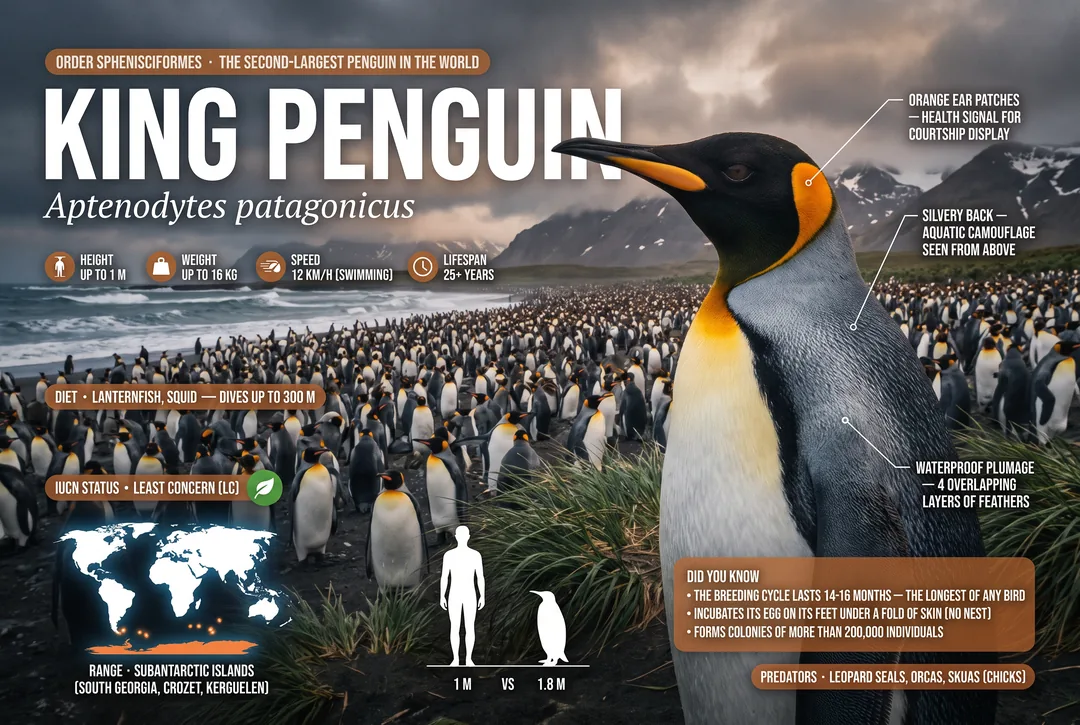
IDENTITY CARD
| Classification | Order Sphenisciformes, family Spheniscidae |
| Scientific name | Aptenodytes patagonicus (Miller, 1778) |
| Size | 85 to 95 cm standing |
| Weight | 9 to 16 kg (varies with breeding stage) |
| Speed | ~8 km/h swimming, bursts up to 12 km/h |
| Lifespan | 25 to 30 years in the wild |
| Depth | Routine dives to 100-200 m, recorded maximum over 300 m |
| Diet | Piscivore — lanternfish (myctophids), small squid, krill |
| IUCN Status | Least Concern (LC) — global population estimated at 3.2 million breeding pairs |
PORTRAIT
You hear it before you see it. From the deck of an expedition vessel, a king penguin colony announces itself as a continuous drone — tens of thousands of overlapping calls, each adult summoning its partner or its chick with a unique vocal signature. Then the beach appears, and the scale hits all at once: a living tide, packed shoulder to shoulder, orange and black, filling every square metre of flat ground to the foot of the moraines.
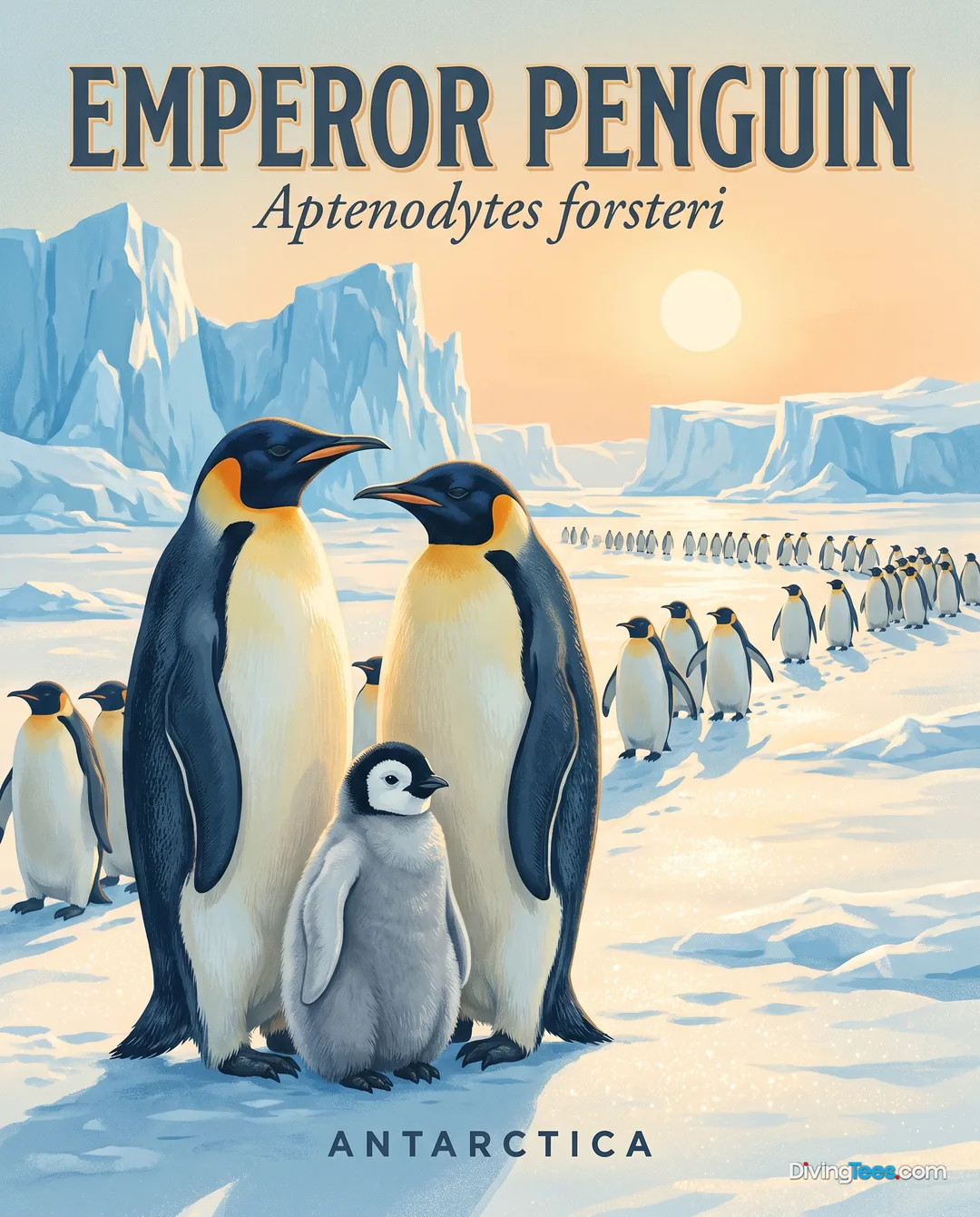
Aptenodytes patagonicus is the second-largest penguin in the world, just behind the emperor penguin, its closest relative. It stands up to 95 cm tall and weighs between 9 and 16 kg depending on the breeding cycle — a cycle so long it constitutes an anomaly in the animal kingdom. Where most birds complete reproduction in a few months, the king penguin needs 14 to 16 months from egg-laying to chick fledging. It is the longest breeding cycle of any bird.
What catches the eye first is the colour. Two auricular patches of intense golden-orange frame the head, extending in a comma along the sides of the neck and blending into a bright yellow bib on the upper chest. The back is slate grey, the belly immaculate white. Seen up close, the lower mandible carries a pinkish-orange stripe — a subtle detail that alone distinguishes it from the emperor penguin, whose bill is duller.
HOW TO RECOGNIZE IT
The king penguin is the only large penguin of the sub-Antarctic islands — its size alone sets it apart from every other species present on the same sites. Standing, it towers 20 to 30 cm above the gentoo penguins and crested penguins that nest nearby.
The vivid orange auricular patches, shaped like inverted drops, are the most immediate field mark. They are visible at several dozen metres and are found on no other sub-Antarctic species. The upper chest is bathed in golden yellow that gradually fades into the white belly — a transition more distinct and vivid than in the emperor penguin, whose yellow tends more toward pale lemon.
The chicks, meanwhile, look nothing like what you would expect. Covered in thick chocolate-brown down that makes them appear larger than their parents, they were long mistaken for a separate species — early naturalists called them "woolly penguins." They keep this down for 10 to 13 months, one of the longest nestling periods in the avian world.
For subtitles in English: start the video firstthen click the gearat the top right of the video, select “Subtitles/CC”, then “Auto-translate” and choose “English”.
WAY OF LIFE
The king penguin does not build a nest. It incubates its single egg on the tops of its feet, sheltered by a warm, vascularised fold of belly skin called a brood pouch. The pair takes turns every two to three weeks: while one adult incubates, the other heads out to sea to feed, sometimes 400 km from the colony.
The 14-to-16-month breeding cycle creates a permanent offset. A pair that successfully breeds one year cannot start again at the same time the following year — it begins later, then later still, until eventually skipping an entire season. In practice, a king penguin successfully raises two chicks in three years at best.
At sea, the king penguin is an exceptional diver. It routinely descends to 100-200 metres to capture lanternfish — small mesopelagic bioluminescent fish that form the bulk of its diet. The recorded depth record exceeds 300 metres, with breath-holds of more than 8 minutes. Between diving bouts, it can spend several days at sea without returning to land.
The colonies are immense. The largest gather more than 100,000 breeding pairs across a few square kilometres of beach and grassy flats — a density that demands remarkable social organisation. Each adult recognises its partner and chick by voice among tens of thousands of simultaneous calls, using one of the most studied systems of individual vocal recognition in the animal kingdom.
WHERE TO SEE IT
The king penguin lives exclusively on sub-Antarctic islands and the southern tip of South America. Access is by expedition vessel, most often departing from Ushuaia, Cape Town, or Hobart. Here are the main destinations:
South Georgia — Salisbury Plain, St Andrews Bay, Gold Harbour. This is the premier destination. South Georgia alone holds more than half the world population of king penguins. Salisbury Plain hosts roughly 250,000 pairs — the largest colony of the species. St Andrews Bay rivals it in size. Gold Harbour, smaller, offers a backdrop of glaciers and mountains that makes it one of the most photographed sites in the Antarctic region. Access is by expedition vessel from the Falklands or Ushuaia, with zodiac landings on the beach.
Falkland Islands — Volunteer Point. The largest Falklands colony, with around 1,500 pairs, is at Volunteer Point on East Falkland. The site is reachable overland from Stanley — a 2-hour drive on tracks — making it one of the rare places in the world where king penguins can be approached without an expedition ship. The birds nest on a white sand beach, just metres from visitors.
Crozet and Kerguelen — French Southern Territories. The Crozet Islands hold the second-largest world population, with over 700,000 pairs spread across several colonies. The Kerguelen archipelago also supports a significant population. Access is extremely restricted: no regular commercial tourism, only the Marion Dufresne, the supply vessel for the French Southern and Antarctic Lands, or rare private expeditions.
Macquarie Island — Australia. A UNESCO World Heritage Site, Macquarie Island is home to roughly 150,000 pairs. It is visited by expedition vessels departing from Hobart (Tasmania) on routes toward Antarctica via the Pacific. Landings are strictly regulated by the Tasmanian government.
Tierra del Fuego — Chile. A small naturally established colony lives in the Parque Pinguino Rey on Chilean Tierra del Fuego, near Porvenir. It is the only mainland colony in South America, established naturally since the 2010s. Access is straightforward from Punta Arenas by ferry. The colony is modest — a few dozen pairs — but it is the most accessible of all.
OBSERVATION CALENDAR
| Destination | J | F | M | A | M | J | J | A | S | O | N | D |
|---|---|---|---|---|---|---|---|---|---|---|---|---|
| South Georgia | ||||||||||||
| Falkland Islands | ||||||||||||
| Crozet / Kerguelen | ||||||||||||
| Macquarie Island | ||||||||||||
| Tierra del Fuego (Chile) |
Click each button to show/hide
King penguins are present at their colonies year-round thanks to their staggered breeding cycle, but expedition vessels only operate during the austral summer (October to March). Peak season (November to January) offers the best weather and the greatest activity within the colonies.
CONSERVATION
Aptenodytes patagonicus is listed as Least Concern (LC) on the IUCN Red List. The global population is estimated at around 3.2 million breeding pairs, increasing over recent decades — a striking contrast with the decline of many other seabirds. The species has largely recovered from the industrial exploitation of the 19th and 20th centuries, when hundreds of thousands of individuals were slaughtered for their oil on sub-Antarctic islands.
Current threats are primarily climatic. Warming of the Southern Ocean is pushing the polar front and the lanternfish schools the species depends on further south. Adults must then travel ever greater distances to feed, which stretches an already extreme breeding cycle and reduces chick survival rates. Modelling published in Nature Climate Change estimates that 70% of the world's king penguin population could be forced to relocate or disappear by the end of the century if warming continues at the current pace.
Predation by skuas (eggs and chicks), fur seals, and orcas (adults at sea) is natural and stable. The introduction of rats and feral cats on some islands was a serious problem, but eradication programmes have made progress — Macquarie was declared rodent-free in 2014 after a 7-year programme.
Expedition tourism, a growing sector, is governed by IAATO (International Association of Antarctica Tour Operators) rules: minimum distance of 5 metres, no food, limited group sizes on shore. These rules work — visited colonies show no decline compared to unvisited colonies.
Organisations to support:
- South Georgia Heritage Trust — ecological restoration of South Georgia (eradication of introduced rats and reindeer)
- BirdLife International — global seabird population monitoring
- TAAF — French Southern and Antarctic Lands — management and protection of Crozet and Kerguelen
- IAATO — responsible tourism standards in Antarctic and sub-Antarctic regions
3 THINGS YOU PROBABLY DON'T KNOW
1. Its chick spends the winter alone, without eating. Chicks born in summer are not large enough to go to sea before winter. They remain in the colony through the coldest months, fed only at long intervals — sometimes just once every two or three months. They lose up to half their body weight and survive on the fat reserves built up during summer. This chick "winter fast," unique among penguins, explains the record-breaking length of the breeding cycle.
2. It dives in total darkness. Lanternfish, its main prey, live in the mesopelagic zone — between 200 and 1,000 metres deep by day, but they migrate toward the surface at night. The king penguin has adapted its strategy: it makes its deepest dives at dawn and dusk, when fish are in transit, and hunts near the surface at night. Its eyes, among the most sensitive in the avian world, are tuned to the bioluminescence of its prey — it literally hunts by the glow of its fish.
3. Early explorers mistook its chick for a different species. When Johann Reinhold Forster described the species during Cook's second voyage in 1775, naturalists long believed that the enormous brown balls of down populating the colonies were a distinct species. The "woolly penguin" appeared in zoological catalogues for decades before the link between adult and chick was established — a misunderstanding aided by the fact that the chicks, puffed up with down, sometimes appear bulkier than the adults.
PHOTO AND VIDEO TIPS
The king penguin is one of the most rewarding wildlife subjects imaginable. It does not flee; it poses — literally. The difficulty is not technical; it is editorial: in a colony of 100,000 individuals, how do you make an image that does not look like everyone else's?
Lens. A telephoto is not essential. At 5 metres — the regulatory minimum — a 70-200 mm frames a tight portrait. But wide angle (24-35 mm) is often more compelling: it incorporates the landscape — glaciers, mountains, beach — and conveys the scale of the colony. That is the lens that produces the memorable images.
Light. The austral summer offers 18 to 20 hours of daylight, with a low sun grazing the horizon at the start and end of the day. These golden hours are long and frequent — a rare luxury in wildlife photography. The orange plumage takes on spectacular radiance. In overcast conditions, diffuse light reveals plumage detail better and eliminates harsh shadows under the bill.
Approach. You do not approach the penguins — you sit down and wait for them to approach you. That is the rule, and it is also the best photographic strategy. A motionless visitor attracts the curiosity of penguins, which often come within a metre. Images taken at penguin height (kneeling or sitting) are incomparably more alive than those taken standing — the gaze is at the same level, and the background becomes sky or mountain instead of ground.
Common mistake. Photographing adults and ignoring the chicks. The brown balls of down are expressive, clumsy, photogenic — and they tell a story that the perfectly groomed adult does not. Interactions between adults and chicks (feeding, vocal recognition, first steps toward the sea) are the most powerful moments of a colony visit.