Great White Shark
Carcharodon carcharias
The ocean's most feared apex predator has more to fear from us than we do from it.
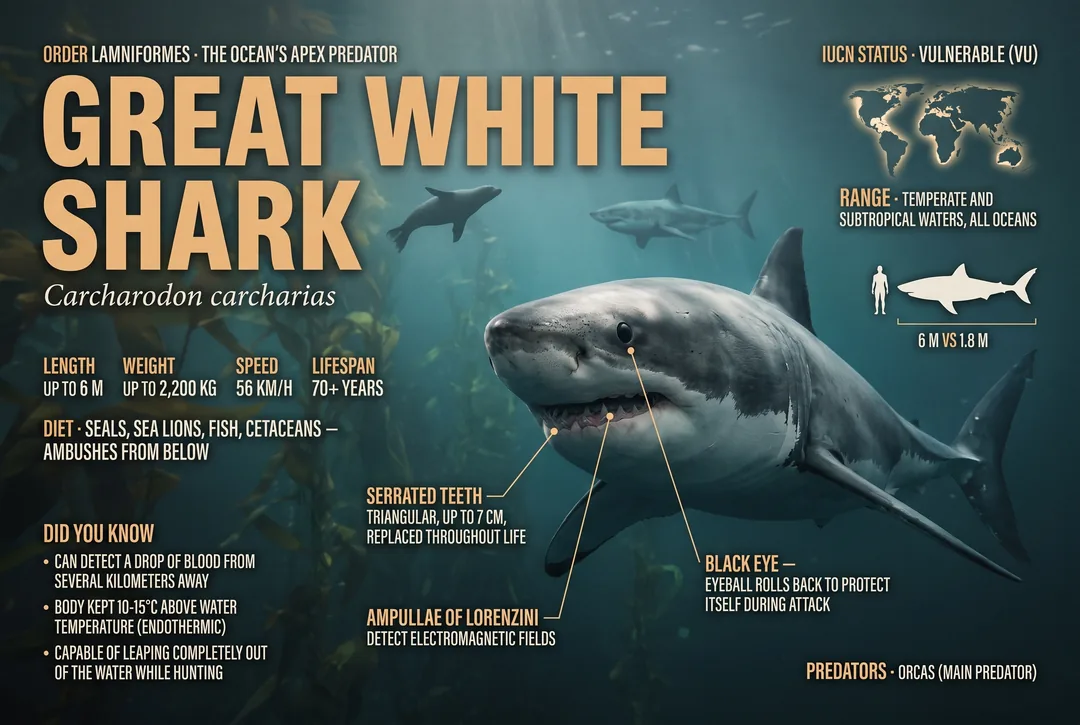
IDENTITY CARD
| Classification | Order Lamniformes, family Lamnidae |
| Scientific name | Carcharodon carcharias (Linnaeus, 1758) |
| Size | Up to 6 m (typical observed range: 3.5-4.5 m) |
| Weight | Up to 2,200 kg |
| Speed | Up to 56 km/h in attack |
| Lifespan | 70 years and more (estimates up to 100 years) |
| Depth | Surface to 1,200 m, but hunts primarily between 0 and 50 m |
| Diet | Predator — seals, sea lions, fish, cetaceans, turtles |
| IUCN Status | Vulnerable (VU) — fragmented populations declining in several regions |
PORTRAIT
You can dive an entire lifetime without seeing a single one. Yet no other marine animal occupies as much mental space in a diver's mind. The great white shark is the fish everyone knows without ever having seen it — and the one almost nobody describes accurately.
Carcharodon carcharias is not the mindless monster of Hollywood. It is a calculating, patient predator of surgical efficiency. Its favoured hunting method: the vertical ambush. It spots its prey from the depths — a seal at the surface, a dark silhouette against the bright sky — and strikes from below at a speed that can exceed 50 km/h. The impact is often enough to launch both bodies out of the water. This breaching, spectacular and terrifying, is the great white's signature move.
But the animal is also a long-distance swimmer. Individuals fitted with satellite tags have crossed entire ocean basins — a male nicknamed Nicole travelled from South Africa to Australia and back, covering 22,000 km in 9 months. Outside of the hunt, the great white is a measured animal, conserving its energy and spending most of its time cruising slowly through the temperate waters of the globe.
HOW TO RECOGNIZE IT
The great white shark is immediately identifiable. Its fusiform body, massive and powerful, carries the most famous countershading in the animal kingdom: slate grey to dark brown on the back, immaculate white on the belly. The line of demarcation is sharp, irregular, and unique to each individual — used for photo-identification.
The head is conical, the snout pointed. The eyes are black, with no nictitating membrane — to protect them during an attack, the great white rolls its eyeballs backward, exposing a white protective layer. This reflex explains the striking images of sharks with "white eyes" at the moment of the bite.
The teeth are triangular, serrated like saws, 5 to 7 cm long. They are replaced throughout the animal's life — an individual can produce over 20,000 teeth in 70 years. The upper jaw is not fused to the skull: it detaches forward during the bite, increasing the reach and power of the grip.
The caudal fin is crescent-shaped and nearly symmetrical — a hallmark of fast swimmers — and the first dorsal fin, tall and triangular, is the most iconic image in all of marine wildlife.
For subtitles in English: start the video firstthen click the gearat the top right of the video, select “Subtitles/CC”, then “Auto-translate” and choose “English”.
WAY OF LIFE
The great white shark is a solitary and territorial animal. Gatherings are rare and always tied to a concentrated food source — a seal colony, a whale carcass. At these sites, a hierarchy establishes itself quickly: the largest eat first, and interactions between individuals play out through subtle body language — parallel swimming, intimidation charges, tail slaps at the surface.
Diet changes with age. Juveniles (under 3 m) feed primarily on fish and small sharks. The switch to marine mammals — seals, sea lions, elephant seals — occurs around 3-4 metres, when the jaw is powerful enough to handle thick-furred prey.
Reproduction is poorly understood. Gestation lasts approximately 12-18 months. Litters contain 2 to 14 pups, which practise oophagy in utero — they feed on unfertilised eggs produced by the mother. Newborns measure 1.2 to 1.5 m and are immediately independent. Sexual maturity is not reached until around 26 years in males and 33 years in females — one of the latest in the animal kingdom.
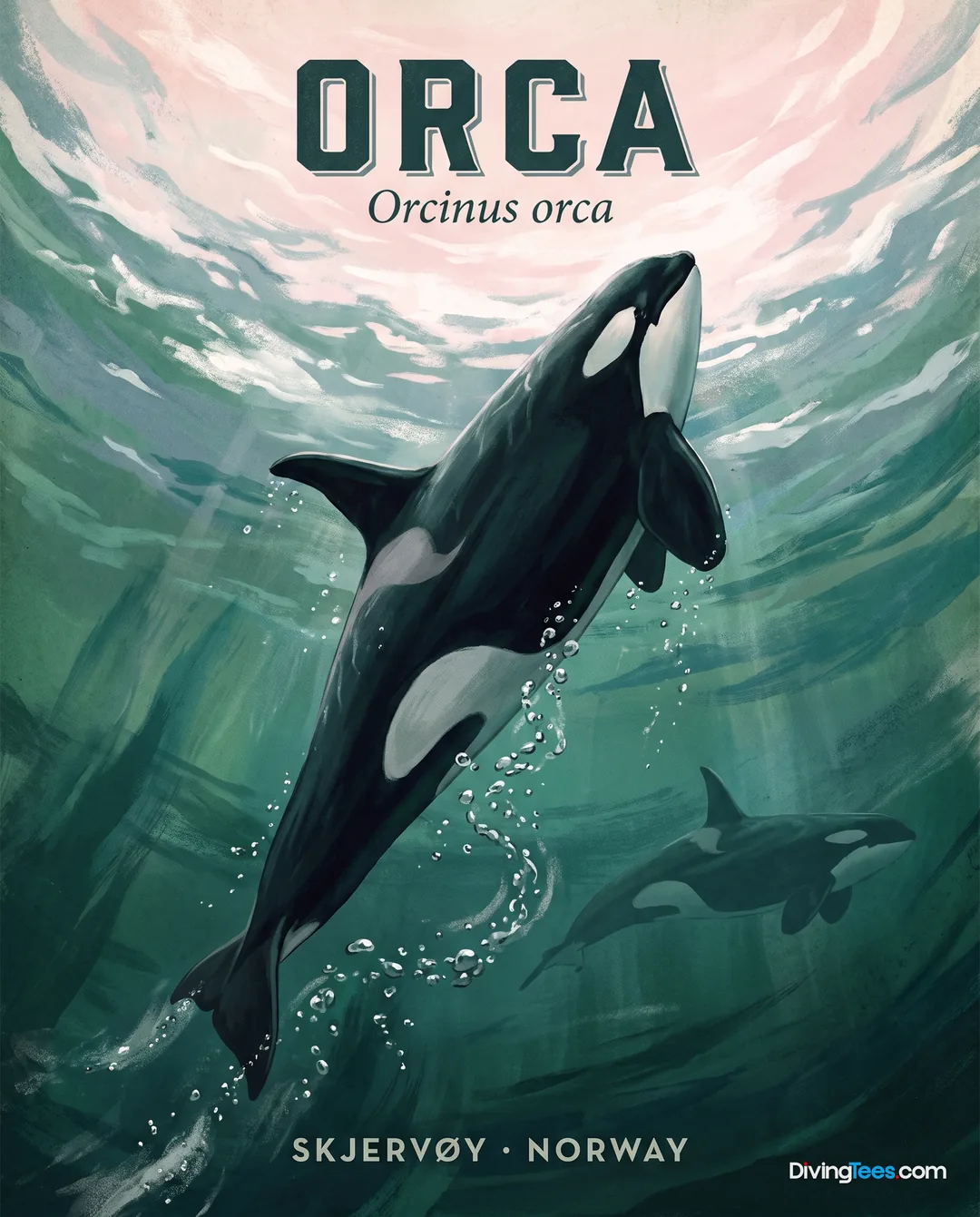
Its only confirmed natural predator: the orca. In South Africa, a pair of orcas dubbed Port & Starboard has systematically hunted and killed great whites, consuming only their liver, which is rich in squalene. Since these attacks, the great whites have deserted False Bay — a dramatic demonstration that even the apex predator can know fear.
WHERE TO SEE IT
The great white shark inhabits temperate and subtropical waters, rarely the tropics. Observation is almost exclusively done from a cage — an approach that divides the diving community, but which remains the only realistic way to observe this animal safely.
South Africa — Gansbaai and False Bay. The Cape was long the world capital of the great white. Gansbaai, two hours from Cape Town, is the historic cage-diving site, with Dyer Island and Shark Alley for encounters with individuals measuring 3 to 5 metres. Since 2017, great whites have become rare here: a pair of shark-hunting orcas drove them away, and cage trips now mostly meet bronze whaler sharks. False Bay (Simon's Town) once offered spectacular breaching on the seals of Seal Island, but orca predation has reduced sightings since 2017.
Mexico — Isla Guadalupe. This isolated volcanic island, 240 km off Baja California, offers exceptional visibility (30-40 m) and large individuals. Accessible by 3-5 day liveaboard, from August to November. The cage dive takes place at 10-12 m depth — a radically different experience from the surface cage.
Australia — Neptune Islands and Port Lincoln. The Neptune Islands, off South Australia, are the country's premier site. Trips depart from Port Lincoln, with both surface and deep cages. Visibility is often lower than at Guadalupe, but the interactions are intense — Australian great whites are among the most curious in the world.
New Zealand — Stewart Island. Less well known, the southern reaches of New Zealand are home to a resident population of great whites that feeds on fur seal colonies. Trips are infrequent and conditions tough, but the encounters are among the most wild and least touristy on the planet.
OBSERVATION CALENDAR
| Destination | J | F | M | A | M | J | J | A | S | O | N | D |
|---|---|---|---|---|---|---|---|---|---|---|---|---|
| South Africa (Gansbaai) | ||||||||||||
| Mexico (Guadalupe) | ||||||||||||
| Australia (Neptune Is.) | ||||||||||||
| New Zealand |
Click each button to show/hide
CONSERVATION
Carcharodon carcharias is listed as Vulnerable (VU) on the IUCN Red List. The species is protected in most countries where it occurs — South Africa (1991), Australia (1999), New Zealand (2007), the United States (via the Endangered Species Act). It is listed on Appendix II of CITES.
The global population is estimated at fewer than 3,500 individuals — a figure comparable to the wild tiger. The threats: bycatch in industrial fishing, poaching for jaws and fins (a great white jaw can sell for 50,000 dollars), degradation of the seal colonies it depends on for food, and chemical pollution (heavy metals, PCBs).
The great white kills an average of 5 people per year worldwide — fewer than vending machines, cows, or coconuts. Humans, on the other hand, kill roughly 100 million sharks per year, all species combined. The imbalance of terror is total.
Organisations to support:
- Shark Spotters — surveillance and protection programme in Cape Town
- Marine Dynamics — research and responsible cage diving at Gansbaai
- OCEARCH — global tagging and satellite tracking programme
- Shark Research Institute — worldwide attack database and conservation programme
3 THINGS YOU PROBABLY DON'T KNOW
1. It is warm-blooded (or nearly so). The great white shark is one of the few endothermic fish. Thanks to a counter-current heat exchange system (the rete mirabile), it maintains its muscles, brain, and viscera at 10-15 degrees C above the surrounding water temperature. This ability allows it to hunt effectively in waters as cold as 12 degrees C — where a tropical shark would be slowed to the point of helplessness.
2. It can leap entirely out of the water. The great white's breaching is one of the most impressive spectacles in nature. The animal accelerates vertically from 20-30 m depth, strikes a seal at the surface at over 40 km/h, and sometimes rockets 3 metres above the water — two tonnes of muscle suspended in mid-air. This behaviour has been documented regularly only in South Africa (False Bay) and is linked to a hunting strategy specific to Cape fur seals.
3. Orcas scare it. Since 2017, two orcas nicknamed Port and Starboard (recognisable by their tilted dorsal fins) have killed at least eight great whites in False Bay, surgically extracting the liver from each victim. The result: great whites entirely deserted the area, with some not returning for 4 years. An apex predator fleeing before another: proof that even Carcharodon carcharias has something to fear.
PHOTO AND VIDEO TIPS
Great white shark photography is almost always cage photography. This imposes specific technical constraints.
Lens. Wide angle (14-24 mm) for the surface cage, where the distance to the shark is short (1-3 m). For the deep cage, a versatile zoom (24-70 mm) allows varied compositions without changing lenses. With a GoPro, the native field of view is perfect for the surface cage.
Bars. The main challenge. Aim between the bars, not through them — autofocus will lock onto the metal if the shark is more than 2 m away. Switch to manual focus or single-point AF. The ideal shot: the shark passes parallel to the cage, one bar on each side of the frame, the subject sharp between the two.
Split shot. The half-and-half image (half air, half water) with the shark below the surface and the boat or mountain above is the signature image. It requires a wide-angle dome port, a relatively calm sea, and a shark at the surface — three conditions rarely met simultaneously. At Guadalupe, the visibility makes it possible; at Gansbaai, the turbidity complicates things.
Light. In South Africa, the water is often green and turbid — minimise the distance between subject and lens. At Guadalupe, the crystalline blue visibility allows spectacular wide shots. In both cases, keep the sun behind you for front-lit illumination of the animal.
Classic mistake. Firing burst after burst without looking. The great white passes, the diver empties the memory card — and discovers back on the boat that 200 photos are blurred or poorly framed. Better to wait for the pass, anticipate the trajectory, and trigger at the right moment.