Humpback Whale
Megaptera novaeangliae
A song that crosses the ocean, a 30-tonne leap out of the water — the humpback whale is the most spectacular giant of the seas.
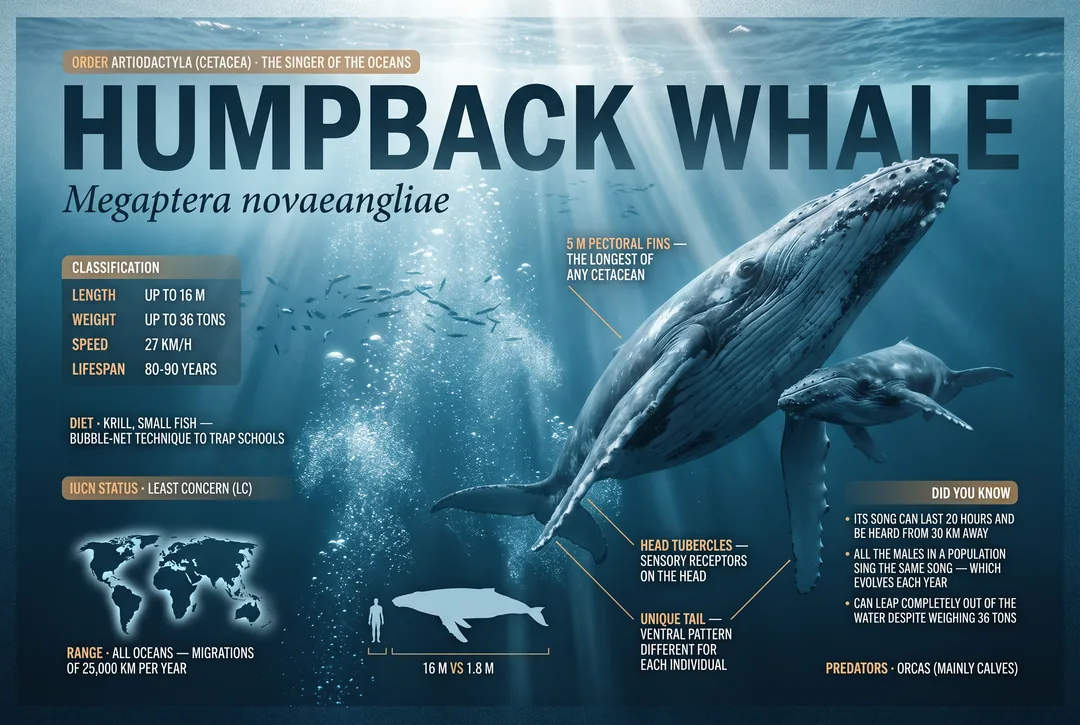
IDENTITY CARD
| Classification | Order Artiodactyla, suborder Cetacea, family Balaenopteridae |
| Scientific name | Megaptera novaeangliae (Borowski, 1781) |
| Size | Up to 16 m (adult average: 12-14 m) |
| Weight | Up to 36 tonnes |
| Speed | Up to 27 km/h in bursts (typical cruising speed much slower) |
| Lifespan | 45 to 50 years on average (some documented individuals beyond that) |
| Depth | Surface to approximately 200 m, spending most of its time in the top 30 meters |
| Diet | Krill and small pelagic fish (herring, capelin, sand lance), filtered through its baleen plates |
| IUCN Status | Least Concern (LC) — one of the great success stories of marine conservation |
PORTRAIT
Few underwater spectacles rival the arrival of a humpback whale. Twelve meters of black-and-white mass gliding through the blue, one eye that seems to seek out the diver, then the blow rising to crack the surface somewhere in the distance — everything about this animal commands respect without ever causing alarm. Megaptera novaeangliae literally means "big-winged New Englander," a name bestowed for its oversized pectoral fins, the longest of any cetacean.
It is also the most spectacular cetacean at the surface. The breach — a full-body leap — propels up to 40 tonnes clear of the ocean in a spray of white water visible from kilometers away. No one knows for certain why humpback whales breach so often: long-distance communication, dislodging parasites, simple play, or a display of reproductive fitness. All these hypotheses circulate, and none has been definitively settled.
But what truly sets this species apart is its song. Males produce complex sonic sequences, structured into themes and phrases, that can last more than thirty minutes and repeat for hours. The song evolves from one year to the next and spreads from one population to another across the ocean — a cultural phenomenon documented in very few non-human species.
HOW TO RECOGNIZE IT
The silhouette is stocky, the dark back marked by a characteristic hump in front of the dorsal fin — the feature that gives the species its common name. The pectoral fins, white or mottled, reach up to a third of the body length: no other cetacean displays such proportions. The head bears rows of tubercles, round protuberances each housing a hair follicle, a trait unique among the Balaenopteridae.
The most reliable identification marker is the underside of the tail fluke. Its pattern of black and white — scalloped edges, spots, scars — is unique to each individual, much like a fingerprint. Scientists have been cataloguing these patterns since the 1970s to track populations across the species' entire range, a non-invasive method that has become the gold standard for studying great cetaceans.
For subtitles in English: start the video firstthen click the gearat the top right of the video, select “Subtitles/CC”, then “Auto-translate” and choose “English”.
WAY OF LIFE
The humpback whale undertakes the longest migration known for any mammal: some individuals travel more than 8,000 km between their polar feeding grounds, rich in krill and small fish, and their tropical breeding grounds, poor in food but with warm waters suited to calving. For several months, the adults eat virtually nothing, living off fat reserves accumulated in summer.
On the feeding grounds, some populations employ a remarkable cooperative hunting technique: the bubble net. A group of whales encircles a school of fish by blowing columns of bubbles from depth, creating a curtain that concentrates the prey before the whales surge upward in unison, mouths agape, to engulf them. This technique is learned and passed on between individuals — one of the rare documented cases of cultural transmission among cetaceans.
Breeding takes place in tropical waters, where males sing and compete for access to females. Gestation lasts approximately eleven months, and the calf, already 4 to 5 meters long at birth, nurses on its mother's milk — extraordinarily rich in fat — for about a year before weaning.
WHERE TO SEE IT
The humpback whale frequents every ocean on the globe, from polar waters to tropical seas, depending on the season. Here are the most renowned destinations for an encounter:
Tonga. One of the rare places in the world where guided in-water swimming with humpback whales is permitted. From July to October, females come to give birth and nurse in the calm waters of the archipelago — an encounter at the surface, in a wetsuit and fins, without scuba tanks.
Silver Bank, Dominican Republic. A marine sanctuary off the Samana Peninsula where several thousand humpback whales gather to breed from January to March. Access is strictly regulated, limited to a small number of licensed operators.
Reunion and Madagascar (Sainte-Marie). From July to September, humpback whales arriving from the Antarctic follow the western Indian Ocean coastline to give birth. Sainte-Marie, off Madagascar, has been a historic observation site since the 1990s.
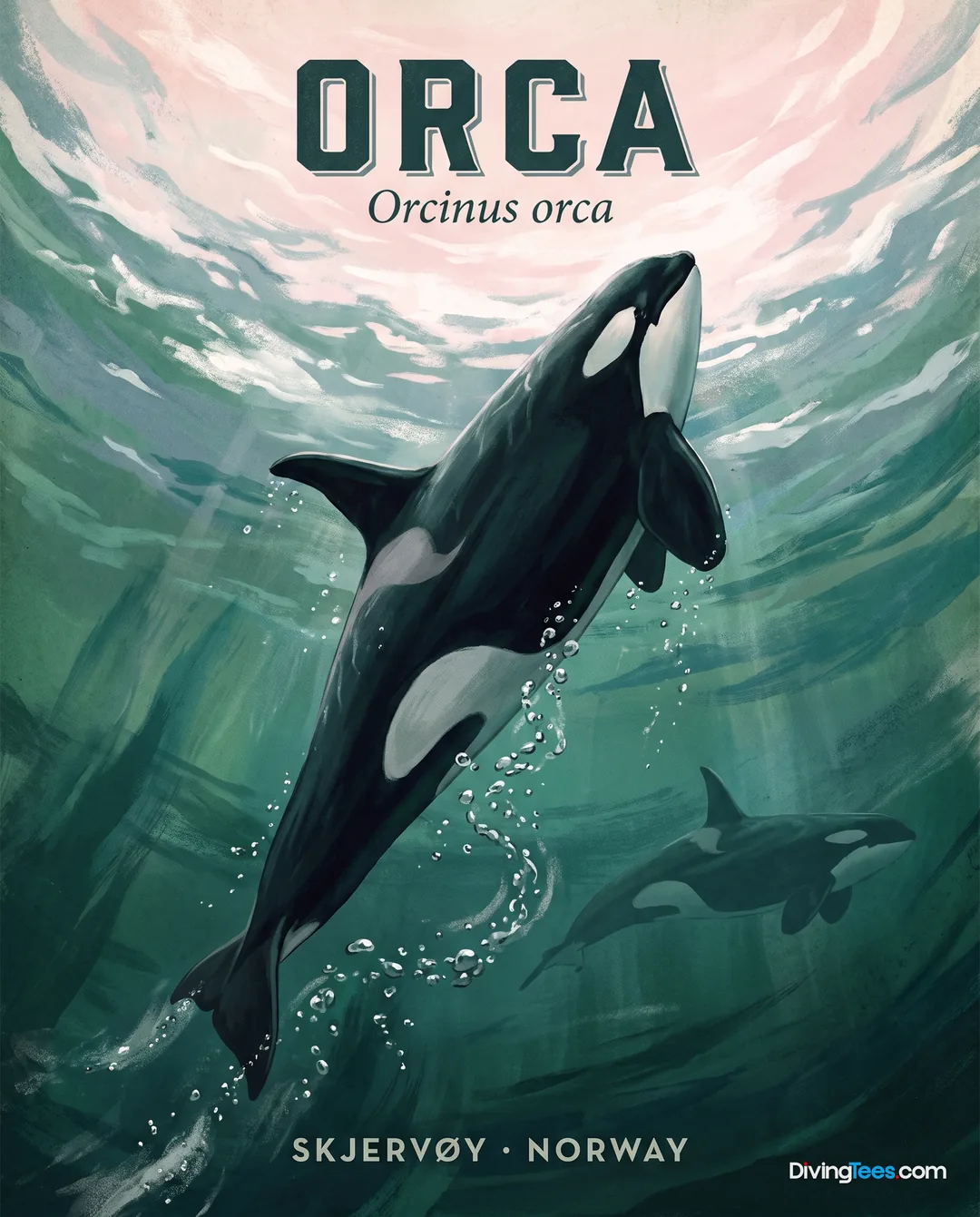
Norway — northern fjords. From November to January, the immense herring schools wintering in the fjords of northern Norway (Skjervoy, Tromso region) draw humpback whales and orcas side by side — one of the rare locations where both species can be seen hunting together.
Hawaii. From December to April, several thousand humpback whales migrate from Alaska to breed in the warm waters of the archipelago, particularly around Maui, Lanai, and Molokai — one of the largest breeding concentrations in the world.
Antarctica — Antarctic Peninsula and Weddell Sea. From November to March, the austral summer draws humpback whales to their feeding grounds, where they gorge on krill before the return migration to the tropics.
Iceland. From May to August, the rich waters of Faxafloi Bay and Eyjafjordur host humpback whales in their feeding phase, just a short distance from Reykjavik or Husavik.
OBSERVATION CALENDAR
| Destination | J | F | M | A | M | J | J | A | S | O | N | D |
|---|---|---|---|---|---|---|---|---|---|---|---|---|
| Tonga | ||||||||||||
| Silver Bank (Dominican Rep.) | ||||||||||||
| Reunion / Madagascar | ||||||||||||
| Norway (northern fjords) | ||||||||||||
| Hawaii | ||||||||||||
| Antarctica | ||||||||||||
| Iceland |
Click each button to show/hide
CONSERVATION
Megaptera novaeangliae is classified as Least Concern (LC) on the IUCN Red List — a rare status for a great cetacean, and one of the great success stories of marine conservation. The species was hunted relentlessly for more than a century: some Southern Hemisphere populations lost over 95 % of their numbers before the international commercial whaling moratorium was adopted in 1986. Since then, most populations have recovered spectacularly, with some now approaching their pre-whaling levels.
Current threats remain real: ship strikes on heavily trafficked shipping lanes, bycatch in fishing gear (nets, lobster traps), underwater noise pollution that disrupts communication and echolocation, and climate change affecting the distribution of the krill their summer diet depends upon. A few isolated populations, such as the one in the Arabian Sea, remain critically endangered despite the species' overall recovery.
Responsible divers and swimmers keep their distance, never pursue the animal, always leave a clear escape route, and follow the instructions of licensed operators — especially at sites where guided in-water encounters are permitted.
Organizations to support:
- International Whaling Commission (IWC) — the regulatory and monitoring body for great cetacean populations
- Pacific Whale Foundation — research and education on Pacific humpback whales, notably in Hawaii
- Ocean Alliance — scientific research on whales and ocean pollution
- WWF — Cetacean program — habitat protection and action against ship strikes and bycatch
3 THINGS YOU PROBABLY DON'T KNOW
1. The longest song in the animal kingdom — and it changes every year. Only males sing, in structured sequences of thirty minutes or more, repeated for hours without interruption. The song evolves from one season to the next and spreads between neighboring populations, sometimes across thousands of kilometers — a cultural transmission phenomenon documented in very few animal species.
2. It fishes with a bubble net, as a team. Some populations, particularly in Alaska, have developed a collective hunting technique: several whales blow columns of bubbles in a circle beneath a school of fish, creating a curtain that traps the prey before they surge upward in synchrony, mouths wide open. This technique is learned from one individual to another — it is not innate everywhere.
3. The longest migration ever recorded for a mammal. A satellite-tracked female traveled more than 8,000 km between Central America and Antarctica. Other tracking studies have logged over 10,000 km in a single season, between American Samoa and the Antarctic Peninsula — an absolute record for any mammal, in any environment.
PHOTO AND VIDEO TIPS
The humpback whale can be photographed both at the surface and underwater, and the two exercises call for different gear.
Lens. Underwater or while snorkeling (Tonga, Silver Bank), a wide angle is essential: 14-16 mm on a camera body, or the native field of a GoPro. For boat-based shots — blow, breach, tail fluke slipping below the surface — a 100-400 mm telephoto remains the most versatile choice, as the safety distance imposed by regulations (typically 100 m) rules out wide-angle framing.
Light. While snorkeling, natural light is more than sufficient down to 10-15 m, where most mothers and calves spend their time. Backlighting, with the sun behind the photographer, brings out the silhouette and the fluke patterns without overexposing the water.
Approach. Never swim directly toward the animal or cut across its path. Best practice is to drift parallel to the whale, in silence, and let it decide the distance. Mothers with calves are particularly sensitive to human presence — the slightest commotion can end the encounter.
Common mistake. Trying to capture the breach at just the right moment from the boat. A breach is unpredictable and lasts less than three seconds: it is better to frame wide, shoot in burst mode, and accept that you will miss three-quarters of the leaps rather than systematically botching the framing by zooming in too late.