Bottlenose Dolphin
Tursiops truncatus
The most studied cetacean on the planet recognizes itself in a mirror, calls its companions by name — and uses tools.
IDENTITY CARD
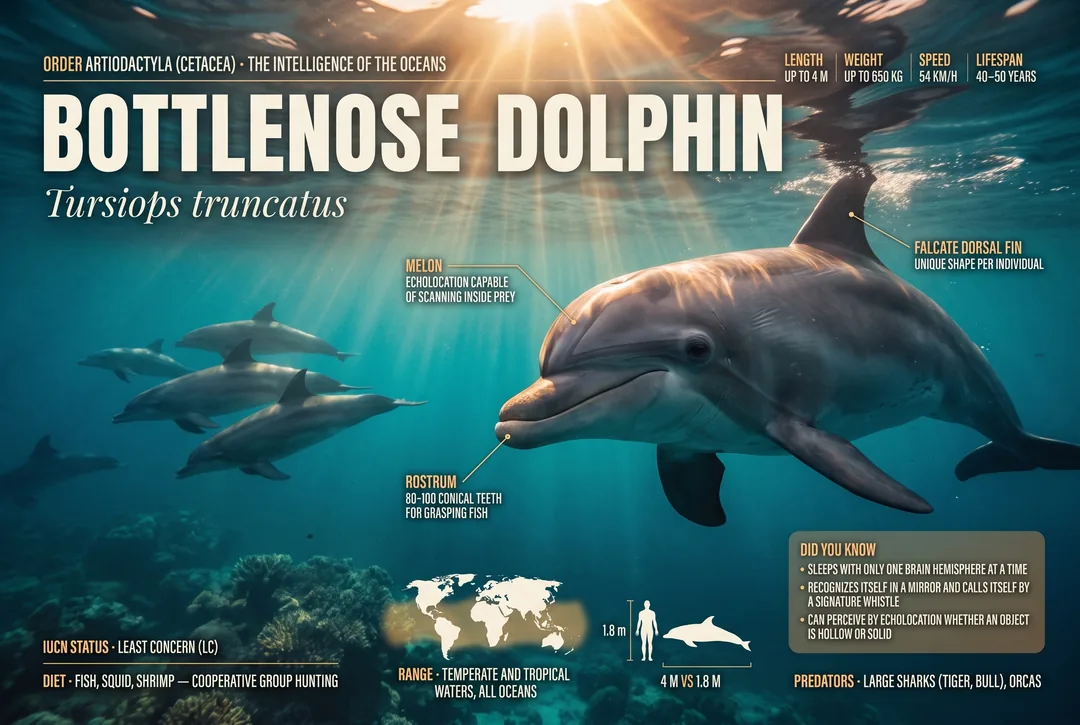
| Classification | Order Artiodactyla (infraorder Cetacea), family Delphinidae |
| Scientific name | Tursiops truncatus (Montagu, 1821) |
| Size | 2-4 m (typical observed range: 2.5-3.5 m; males slightly larger) |
| Weight | 150-650 kg |
| Speed | Up to 35 km/h burst, 5-11 km/h cruising |
| Lifespan | 40-50 years (females often live longer; record: 60+ years) |
| Depth | Surface to 300 m in regular use, exceptional dives beyond 500 m |
| Diet | Opportunistic carnivore — fish, cephalopods (squid, cuttlefish), crustaceans; diet varies by population and local hunting technique |
| IUCN Status | Least Concern (LC) globally — but several local populations are threatened or declining |
PORTRAIT
It is the dolphin everyone knows without necessarily being able to name. The dolphin of Flipper, of aquariums, of nature documentaries — and, paradoxically, the one whose mental complexity remains most underestimated. The bottlenose dolphin is the most studied cetacean on Earth. More than sixty years of continuous research, thousands of scientific papers, populations tracked individual by individual across three generations. And each decade delivers a discovery that pushes the boundary a little further between animal cognition and what was once thought to be exclusively human.
Tursiops truncatus recognizes itself in a mirror — a test that most primates fail. It uses tools: in Shark Bay, Western Australia, certain females pluck marine sponges and wear them on their rostrum like a glove to probe the sand without injury, a behaviour passed from mother to daughter for at least one hundred and seventy years. It possesses a signature whistle — a unique acoustic signal that each individual develops in its first months of life and keeps for its entire existence, which its companions use to call it. In other words: it has a name.
Underwater, the encounter is disarmingly natural. The bottlenose dolphin has neither the crushing majesty of the humpback whale nor the aura of the great white shark. It arrives out of curiosity, circles the diver, fixes its gaze with one appraising eye, sometimes lingers, often moves on. But anyone who has met that gaze knows it was not looking at an obstacle — it was looking at someone.
HOW TO RECOGNIZE IT
The bottlenose dolphin is fairly straightforward to identify once three criteria are in mind: size, rostrum and colour. It is a medium-to-large dolphin — noticeably more robust than a common dolphin or an Atlantic spotted dolphin, but far smaller than an orca. The body is sturdy, streamlined, muscular.
The rostrum is short and clearly demarcated from the forehead by a crease: it is the truncated beak that gives the animal its characteristic profile and its scientific name (truncatus). The melon — the rounded fatty mass on the forehead — is prominent and smooth.
The colouring is understated: slate grey on the back, lightening progressively to a white or pinkish belly. No bands, no spots, no dramatic pattern — unlike the common dolphin with its striking yellow-and-grey hourglass flanks. The dorsal fin, set in the middle of the back, is falcate (sickle-shaped), tall and well-defined. On older individuals it often carries notches and scars that serve for photo-identification — each dorsal is unique, much like the spots of a whale shark.
For subtitles in English: start the video firstthen click the gearat the top right of the video, select “Subtitles/CC”, then “Auto-translate” and choose “English”.
WAY OF LIFE
The bottlenose dolphin is a social animal. It lives in groups of 2 to 15 individuals in coastal waters, sometimes in aggregations of several hundred offshore. The social structure follows a fission-fusion model: sub-groups form, split and recombine over the course of hours and days, depending on the activity — hunting, resting, playing, travelling. It is the same social model found in chimpanzees and bonobos, and it demands considerable social memory.
Males form alliances of two or three individuals, sometimes stable across decades, cooperating to court or defend females. These alliances can themselves join into second-order coalitions — a level of political complexity found, in the rest of the animal kingdom, only among the great apes.
Hunting is where the collective intelligence of the bottlenose dolphin is on fullest display. In Florida, groups drive fish against walls of mud that they create themselves by slapping the surface with their flukes — prey, trapped inside the ring of silt, leap out of the water directly into the jaws of dolphins waiting on the other side. In South Carolina, they push schools of mullet against the shore and literally beach themselves to grab stranded fish. In Mauritania, they herd fish toward the nets of local fishermen — an interspecific cooperation documented since the nineteenth century.
The bottlenose dolphin's echolocation is among the most sophisticated in the animal kingdom. It emits trains of high-frequency clicks via the melon, which focuses the sound into a directional beam, and analyses the echoes returned by objects and prey. The system is precise enough to detect a fish buried beneath the sand at several metres' distance, and to distinguish two objects of similar size but different composition — a feat that most military sonars struggle to replicate.
Reproduction is seasonal in temperate waters, more spread out in the tropics. Gestation lasts 12 months. The calf is born tail-first and swims immediately to the surface for its first breath. It stays with its mother for 3 to 6 years — one of the longest weaning periods among cetaceans — during which it learns hunting techniques, the vocalisations of the group and the social codes of its community.
WHERE TO SEE IT
The bottlenose dolphin is one of the most widely distributed cetaceans on the planet — found in every temperate and tropical sea, from the coasts of Scotland to the reefs of Polynesia. Two main ecotypes exist: the coastal form, sedentary and often easy to access, and the pelagic (offshore) form, larger, rarer and harder to approach. The destinations below offer regular, organised encounters:
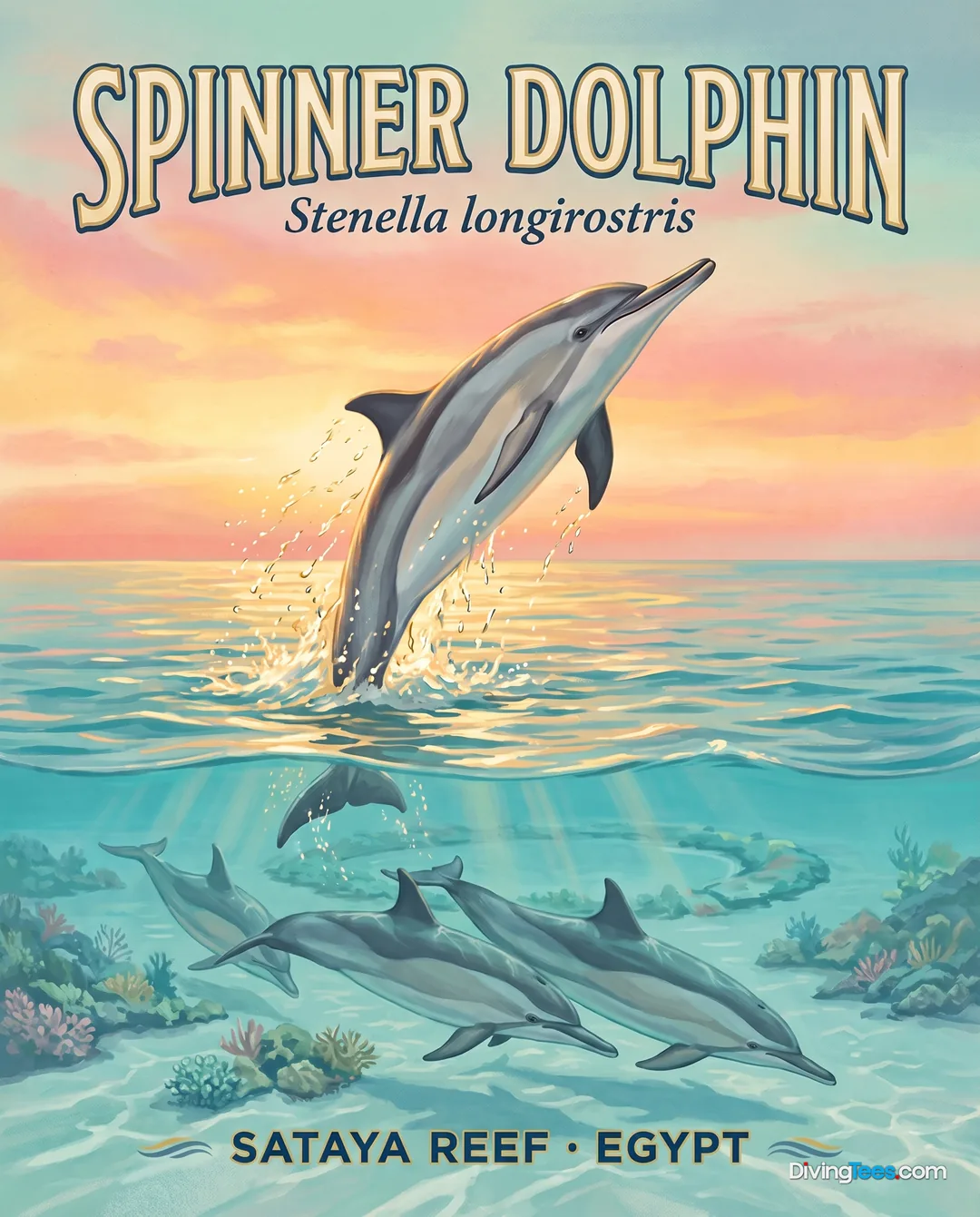
Red Sea — Egypt (Sataya and Samadai). The reef at Sataya, south of Marsa Alam, hosts a resident community of spinner dolphins (Stenella longirostris, often in the company of Tursiops) and bottlenose dolphins. The reef at Samadai, known as Dolphin House, is an enclosed lagoon where a resident pod rests during the day — access is regulated by zones (an exclusion zone where the dolphins rest, a snorkelling observation zone, a boat zone) to minimise disturbance. These two sites rank among the most accessible and reliable open-water cetacean encounters on Earth.
Bahamas — Bimini. The shallow waters of the Grand Bahama Bank, between Bimini and White Sand Ridge, host a resident population of Atlantic spotted dolphins (Stenella frontalis) and bottlenose dolphins, studied since 1985 by the Wild Dolphin Project. The white sand bottom at 5-10 m depth, crystal-clear water, and dolphins accustomed to human presence make it one of the finest destinations in the world for observing them in natural conditions — in snorkelling, on the animals' own terms.
Azores — Faial, Pico, Sao Miguel. The archipelago is a pelagic crossroads where bottlenose dolphins, common dolphins, spotted dolphins and sperm whales converge from May to October. Bottlenose dolphins are present year-round, with regular observations from whale-watching boats and in snorkelling. The volcanic setting, deep water just a few miles offshore, and the diversity of cetacean species make it a destination unique in Europe.
Galapagos. Bottlenose dolphins are resident in the archipelago, often encountered by boat between the islands or on dives at Gordon Rocks, Cousin's Rock and Kicker Rock. They share the waters with Galapagos sea lions, mobula rays and, from June to November, whale sharks and hammerhead sharks. The encounter is less predictable than at a dedicated site like Sataya, but it unfolds within an ecosystem of extraordinary richness.
Ningaloo — Western Australia. Ningaloo Reef, celebrated for its whale sharks and manta rays, also harbours a coastal population of bottlenose dolphins, regularly spotted during snorkelling excursions along the reef. Further south, in Shark Bay, the Monkey Mia population is among the most studied in the world — it is there that sponge use as a tool was first documented.
Hawaii. The coastal waters around the main islands host resident bottlenose dolphins, but the most spectacular encounter involves their cousins: the spinner dolphins (Stenella longirostris), the famed spinners that rest in shallow bays by day and whose twisting leaps are among the most photographed spectacles in the Pacific. US regulations prohibit swimming with spinners within a 45 m radius — a measure necessary to protect their resting phases.
OBSERVATION CALENDAR
| Destination | J | F | M | A | M | J | J | A | S | O | N | D |
|---|---|---|---|---|---|---|---|---|---|---|---|---|
| Red Sea (Sataya / Samadai) | ||||||||||||
| Bahamas (Bimini) | ||||||||||||
| Azores | ||||||||||||
| Galapagos | ||||||||||||
| Ningaloo (Australia) | ||||||||||||
| Hawaii |
Click each button to show/hide
CONSERVATION
Tursiops truncatus is classified Least Concern (LC) on the IUCN Red List at the global level — a status that reflects the breadth of its range and the overall size of its populations, but which masks very different local realities. Several coastal populations are in marked decline, and some — such as the bottlenose dolphins of the Moray Firth in Scotland or those of the Gulf of Corinth — number fewer than 200 individuals.
The threats are multiple and often cumulative. Chemical pollution — PCBs, heavy metals, pesticides — concentrates in the blubber of top predators and is transmitted from mother to calf via milk; European populations rank among the most contaminated on the planet. Underwater noise pollution — shipping traffic, military sonar, offshore drilling — directly interferes with echolocation and communication, the two pillars of the species' social life. Bycatch in fishing nets remains a major cause of mortality in many regions. And captivity, though declining in several countries, continues to sustain a global industry that still captures wild individuals.
The species is protected by numerous international agreements: CITES (Appendix II), the Convention on Migratory Species (CMS), and ACCOBAMS for the Mediterranean and the Black Sea. In the Red Sea, Egypt's regulations at Samadai and Sataya — exclusion zones, boat quotas, scuba diving prohibited in resting areas — are a model for the management of wildlife tourism.
The responsible diver never chases a dolphin, never attempts to touch it, never blocks its path. The rule is simple: let the animal come, and let it go.
Organisations to support:
- Whale and Dolphin Conservation (WDC) — international campaigns against captivity and hunting
- Wild Dolphin Project — field research on Bahamas dolphins since 1985
- Dolphin Biology and Conservation — Mediterranean and Red Sea population studies
- PADI AWARE — citizen science and sighting reports
3 THINGS YOU PROBABLY DON'T KNOW
1. It uses tools — and the behaviour is cultural. In Shark Bay (Western Australia), certain female bottlenose dolphins pluck marine sponges from the seabed and wear them on their rostrum like a protective glove before probing the sand for buried fish. The behaviour was first documented in 1984 and is practised by a sub-group of roughly thirty related females. Genetic analysis has shown that it is transmitted from mother to daughter through social learning — not through genes. It is one of the clearest cases of animal culture ever documented outside of primates.
2. It calls its companions by name — and remembers those names for twenty years. Each bottlenose dolphin develops in its first months a unique signature whistle, distinct from those of its mother and every other individual in its group. Its companions use the whistle to summon it at a distance — and the dolphin responds. In 2013, a University of Chicago study demonstrated that individuals separated for more than twenty years still reacted to the signature whistle of a former group companion, but not to unfamiliar whistles. It is the longest social memory ever measured in a non-human animal.
3. Flipper changed the world — and not necessarily for the better. The television series Flipper (1964-1967) turned the bottlenose dolphin into a global icon and probably did more for the species' popularity than decades of research. But it also fuelled an aquarium boom in the 1970s and 1980s, as audiences wanted to see "Flipper" up close. Ric O'Barry, the show's trainer, spent the rest of his life fighting dolphin captivity after the death of Kathy, one of the five dolphins that played the title role — he believes she let herself die. His campaign inspired the documentary The Cove (2009), winner of the Academy Award for Best Documentary Feature, which exposed the dolphin captures at Taiji in Japan.
PHOTO AND VIDEO TIPS
The bottlenose dolphin is a fast, curious, unpredictable subject — the opposite of the whale shark that glides slowly past the lens. The key is to be ready before it arrives.
Lens. Wide angle is essential. In a housing: 10-17 mm fisheye or 14-20 mm rectilinear. The encounter distance is often shorter than expected — the dolphin comes to the diver, not the other way around. On a GoPro or similar: the native field of view works well, and video stabilisation compensates for finning motion.
Speed. The bottlenose dolphin swims fast and changes direction without warning. For stills, a minimum shutter speed of 1/500 s is needed to freeze motion, 1/1000 s for tight turns. For video, 60 fps yields usable slow-motion sequences that convey the fluidity of movement far better than jerky 24 fps footage.
Light. Most encounters take place in the top 10 metres, often while snorkelling. Natural light is abundant. Flash is rarely useful and can disturb the animal — best avoided. For portrait shots (eye, rostrum), low-angle morning sunlight delivers the finest results, with highlights on the grey skin that reveal texture.
Approach. Never swim toward a dolphin. Get into position, stay calm, and let it come. Curious dolphins often make several passes around the diver — the best image almost always comes on the second or third approach, when the animal has drawn closer and the photographer has found a rhythm.
Classic mistake. Chasing the animal with frantic finning. Guaranteed result: a dolphin pulling away, a breathless photographer, and a series of blurry fluke shots. The bottlenose dolphin swims at 35 km/h — no swimmer will catch it. The only strategy that works is stillness.