Minke Whale
Balaenoptera acutorostrata
The smallest of the baleen whales — and the most curious.
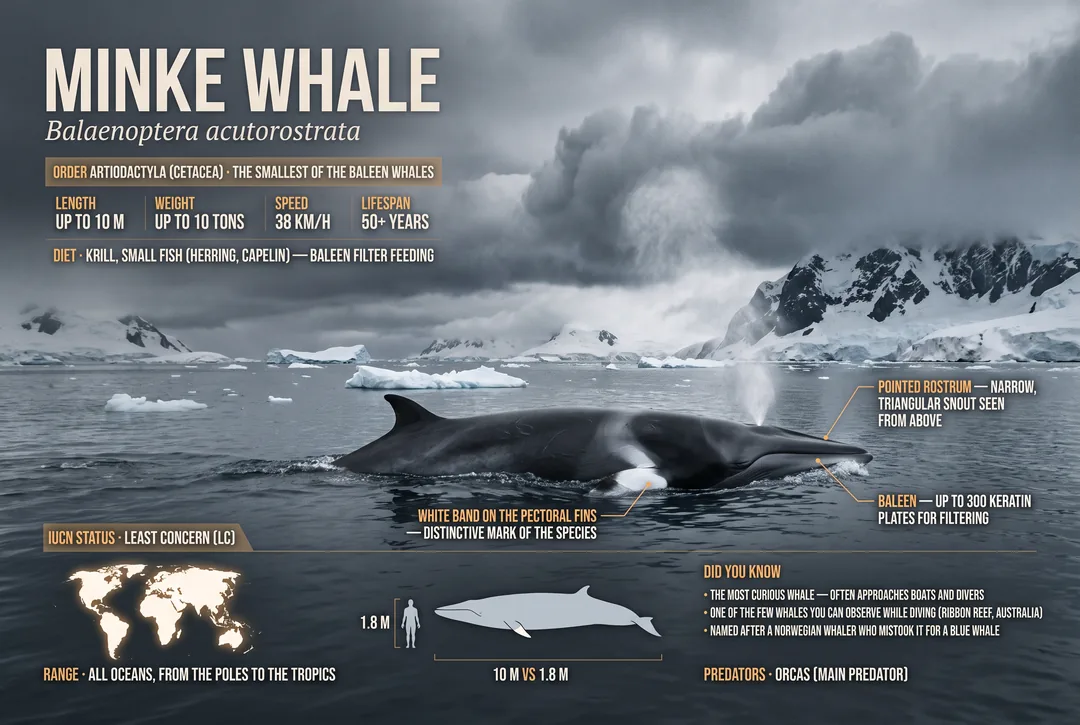
IDENTITY CARD
| Classification | Order Cetacea, family Balaenopteridae |
| Scientific name | Balaenoptera acutorostrata (Lacepede, 1804) |
| Size | 7-10 m (dwarf subspecies: 5-8 m) |
| Weight | 5-10 tonnes |
| Speed | Up to 30 km/h burst, 5-15 km/h cruising |
| Lifespan | 40-50 years (estimates up to 60 years) |
| Depth | Surface to 300 m, most commonly observed between 0 and 50 m |
| Diet | Filter feeder with baleen — krill, small pelagic fish (herring, sand eels, capelin), copepods |
| IUCN Status | Least Concern (LC) — global population estimated at several hundred thousand individuals |
PORTRAIT
The minke whale is the kind of whale you do not expect to meet. It lacks the crushing majesty of the humpback and the surreal bulk of the blue whale. It is compact, fast, elusive — and yet, when it decides to approach, it can display a disarming curiosity. It comes to investigate boats. It circles divers. It comes back.
Balaenoptera acutorostrata is the smallest of the baleen whales, at 7 to 10 metres and 5 to 10 tonnes. That is modest for a mysticete — barely more than a large orca — but enough to make the encounter, when it happens, unforgettable. The animal is fast, agile, capable of tight turns and sudden bursts of speed. It hunts alone or in small groups, often close to shore, in waters that the great rorquals do not frequent.
Two recognised species exist: the common minke whale (B. acutorostrata), found in all oceans, and the Antarctic minke whale (B. bonaerensis), confined to southern waters. A third form, the dwarf minke whale, inhabits the tropical waters of the Southern Hemisphere — it is the one snorkellers encounter on the Great Barrier Reef.
HOW TO RECOGNIZE IT
The minke whale is distinguished from other rorquals by its modest size and its pointed, narrow snout, V-shaped when viewed from above — a trait that earned it its scientific name, acutorostrata, "sharp snout." The head carries a single longitudinal ridge, characteristic of all balaenopterids.
The most reliable marker is the white transverse band on the pectoral fins, present in the Northern Hemisphere common form. It is a clear, visible signal even in murky water, found on no other whale. The back is dark grey to black, the flanks lighter, the belly white. The ventral pleats — around fifty — extend from the throat to the navel.
At the surface, the minke whale is discreet. Its blow is small (1-2 m), often invisible in calm conditions, and the dorsal fin — tall, falcate, set at the posterior third of the body — appears almost simultaneously with the blow, distinguishing it from larger rorquals whose backs roll past for a long time before the fin shows. It almost never raises its fluke when diving.
For subtitles in English: start the video firstthen click the gearat the top right of the video, select “Subtitles/CC”, then “Auto-translate” and choose “English”.
WAY OF LIFE
The minke whale is an opportunist. Where the great rorquals follow the predictable migration routes of krill swarms, this one exploits varied coastal resources — herring, sand eels, capelin, krill — and adapts to whatever the season and geography offer. It turns up in Norwegian fjords, along the Scottish coast, in the Antarctic, and on tropical reefs off Queensland with equal nonchalance.
Its feeding technique is that of all rorquals: lunge feeding. The animal accelerates toward a school of prey, opens its mouth to nearly 90 degrees, engulfs a mass of water and fish that the dilated ventral pleats can hold, then closes its mouth and forces the water out through the baleen. The operation takes seconds. Some individuals hunt in spirals, others herd fish against the surface or underwater cliffs.
Reproduction is poorly understood. Mating likely occurs in winter in warm waters, with gestation lasting about 10 months. A single calf is born, already measuring 2.5 metres. Nursing lasts 5 to 6 months. Females breed every one to two years — a rapid pace for a cetacean, which partly explains the species' resilience.
WHERE TO SEE IT
The minke whale is cosmopolitan, present in every ocean from the tropics to the polar ice. Here are the destinations where encounters are most likely and most memorable:
Great Barrier Reef — Ribbon Reefs (Australia). This is THE world spot for an in-water minke whale encounter. Each year from June to July, dwarf minke whales travel along the Ribbon Reefs north of Cairns and spontaneously approach snorkellers. Liveaboard dive boats moor on the reefs and wait: it is the whales that come to the swimmers, not the other way around. The encounter is snorkelling only — scuba is not permitted with the whales. The individuals are curious, playful, and some stay around the boat for hours. It is one of the rare opportunities in the world to swim with a baleen whale in 25 C water and 30 m visibility.
Iceland — Husavik and Akureyri. Skjalfandi Bay, off Husavik, is one of the best whale-watching sites in Europe. The minke whale is the most frequently observed species from May to October, often within a few dozen metres of the boat. The low-angle light of high latitudes, snow-capped mountains in the background, and the frequent presence of humpback whales complete the picture.
Norway — Lofoten and Tromso. The fjords of northern Norway are hunting grounds for minke whales in winter and spring, drawn by the herring schools that concentrate there. Tromso offers whale-watching trips from November to January, in the spectacular setting of the polar night and the northern lights — with minke whales, orcas, and humpback whales hunting the same herring shoals. The Lofoten provide summer observations, from May to September, amid fjords and mountain peaks.
Antarctica — expedition cruises. The Antarctic minke whale (B. bonaerensis) is the most abundant cetacean in southern waters. Expedition cruises to the Antarctic Peninsula, from November to March, regularly encounter groups of minke whales in channels between the icebergs. The animal is less wary there than elsewhere, sometimes approaching zodiacs among the pack ice.
OBSERVATION CALENDAR
| Destination | J | F | M | A | M | J | J | A | S | O | N | D |
|---|---|---|---|---|---|---|---|---|---|---|---|---|
| Great Barrier Reef (Ribbon Reefs) | ||||||||||||
| Iceland (Husavik) | ||||||||||||
| Norway (Tromso) | ||||||||||||
| Norway (Lofoten) | ||||||||||||
| Antarctica (Peninsula) |
Click each button to show/hide
CONSERVATION
Balaenoptera acutorostrata is listed as Least Concern (LC) on the IUCN Red List. It is the only great cetacean never to have been globally threatened — its population is estimated at several hundred thousand individuals. But that relatively favourable status masks a more nuanced reality.
The minke whale is the last great cetacean still commercially hunted. The International Whaling Commission (IWC) imposed a moratorium on commercial whaling in 1986, but three countries continue:
- Japan resumed commercial whaling in 2019 after withdrawing from the IWC. The annual quota targets minke whales in Japanese waters. The country had previously hunted the species in the Antarctic under the guise of "scientific research" for over thirty years.
- Norway objected to the moratorium from 1993 and hunts common minke whales in the northeast Atlantic. The annual quota exceeds 1,000 individuals, though actual catches are lower.
- Iceland resumed whaling in 2003, targeting both minke whales and fin whales. Minke whale catches there have declined in recent years.
Other threats are those facing all coastal cetaceans: accidental capture in fishing nets, ship strikes, underwater noise pollution that disrupts communication and navigation, and climate change that shifts prey distribution.
The responsible observer maintains a 100-metre distance by boat and never pursues the animal. When snorkelling on the Great Barrier Reef, the rule is reversed: you enter the water and stay passive — it is the whale that chooses whether to approach.
Organisations to support:
- Minke Whale Project — research and photo-identification programme on the Ribbon Reefs
- WDC — Whale and Dolphin Conservation — campaigns against commercial whaling
- IWC — International Whaling Commission — international cetacean management body
- Sea Shepherd — direct action against illegal whaling
3 THINGS YOU PROBABLY DON'T KNOW
1. Its name comes from a blunder. Legend has it that an 18th-century Norwegian sailor named Meincke, serving on a whaling crew, mistook a minke whale for a blue whale and announced the catch with great fanfare. The mistake, deemed monumental by the crew, gave the animal its name in Norwegian (minkehval), then in every language — a mocking nickname that became the official name.
2. It is one of the only baleen whales you can approach while snorkelling. On the Ribbon Reefs of the Great Barrier Reef, dwarf minke whales spontaneously approach swimmers, sometimes to within two metres, and stay for tens of minutes. This behaviour of active curiosity — the animal coming to the diver — is exceptional among mysticetes and makes this one of the most moving encounters in the marine world. The season lasts only a few weeks in June--July, and boat berths are booked a year in advance.
3. It can leap clear of the water like a dolphin. Despite weighing 7 to 10 tonnes, the minke whale is the most acrobatic of the rorquals. It is capable of full breaches — the entire body out of the water — with a frequency matched only by the humpback whale among the great whales. Whether these leaps serve communication, parasite removal, or pure play remains unknown.
PHOTO AND VIDEO TIPS
The minke whale is a demanding subject. It is faster, more unpredictable, and smaller than other great whales — which makes photographing it both harder and more rewarding.
Surface (whale watching). The animal surfaces briefly and without warning. A moderate zoom (70-200 mm) is the best compromise between reach and responsiveness. Burst mode is essential: the blow and dorsal fin are visible for only a few seconds. Position yourself at the bow, on the downwind side, and keep the camera to your eye at all times. The minke whale tends to resurface in the same area — spot the first blow and anticipate the second.
Snorkelling (Great Barrier Reef). Wide angle is imperative. With a GoPro: the native field of view and stabilisation are sufficient, and 4K video delivers exceptional results. In a housing: fisheye or a 14-16 mm rectilinear. Light is abundant (0-10 m depth, clear tropical water) and natural colours are superb — no flash needed. The difficulty is emotional, not technical: when an 8-metre whale comes to look you in the eye at 2 metres, you have to remember to press the shutter.
Common mistake. Swimming toward the whale. On the Great Barrier Reef, the passive in-water interaction rule is strict: you enter the water, you stay at the surface, you do not fin toward the animal. The minke whale is curious — if you stay still, it comes. If you chase it, it leaves. Patience is the best setting.