Sloth
Bradypodidae & Choloepidae
The slowest mammal on earth carries a forest on its back — and swims better than you might imagine.
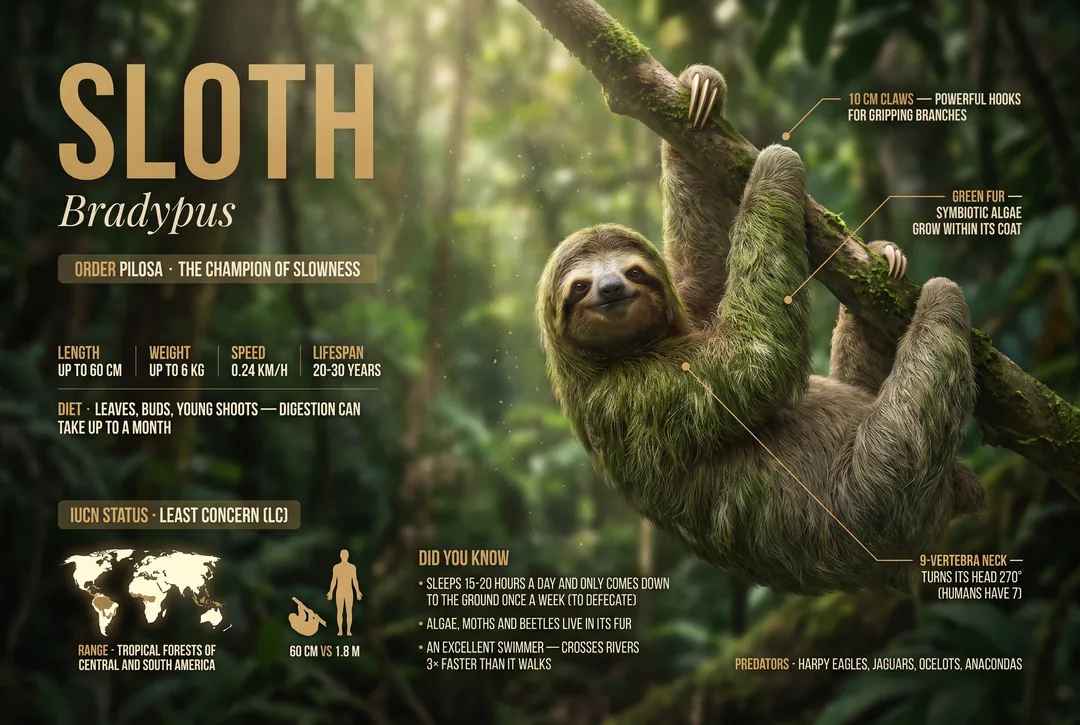
IDENTITY CARD
| Classification | Order Pilosa, families Bradypodidae (three-toed sloths) and Choloepidae (two-toed sloths) |
| Scientific name | 6 living species — 4 three-toed (Bradypus), 2 two-toed (Choloepus) |
| Size | 50-75 cm (body), 6-8 cm tail (Bradypus) |
| Weight | 3.5-8 kg |
| Speed | 0.27 km/h maximum in trees — slowest mammal on earth |
| Lifespan | 20-30 years in the wild, up to 40 in captivity |
| Diet | Folivore — leaves, buds, young shoots; some fruit and flowers in Choloepus |
| Habitat | Canopy of tropical rainforests, Central and South America |
| IUCN Status | Least Concern (LC) for most species — Critically Endangered (CR) for the pygmy three-toed sloth (Bradypus pygmaeus) |
PORTRAIT
It is not underwater — and that is precisely why it deserves its place here. The sloth is the animal divers encounter between dives, hanging from a branch above the trail to the dock, or curled in the canopy of a seaside lodge. In Central and South America, it is as much a part of the scenery as the toucan or howler monkey — often the first wild mammal a traveller spots, provided they think to look up.
Its slowness is not a flaw: it is a survival strategy refined over millions of years. The sloth moves at 0.27 km/h at best — a determined snail barely does less. This ultra-low metabolism allows it to survive on calorie-poor leaves that almost no other mammal could exploit. Its compartmentalized stomach takes up to a month to digest a single meal. It sleeps fifteen to twenty hours a day, descends to the ground only once a week to defecate, and spends the rest of its existence hanging upside down with hooked claws locked onto a branch. It has made laziness into an art form — and the art form into a fortress.
From a distance, it looks like a clump of moss. Up close: a round face, a permanent smile drawn by the shape of the muzzle, and fur that hosts an entire ecosystem — green algae, fungi, moths, beetles. A miniature jungle riding on the back of a mammal, moving through the canopy at a pace that makes the rest of the world seem frantic.
HOW TO RECOGNIZE IT
The most common confusion is not with another animal but between the two sloth families. The distinction comes down to one word: fingers.
Three-toed sloth (Bradypus): three claws on the front paws. A round face with a dark eye mask and a light forehead band — the classic "smiling" sloth of social media. A short but visible tail. Strictly diurnal, smaller (3.5-5 kg), and eats only leaves. Most commonly seen in Costa Rican parks. Its head turns 270 degrees thanks to extra cervical vertebrae — eight or nine, where nearly all other mammals, from mice to giraffes, have exactly seven.
Two-toed sloth (Choloepus): two claws on the front paws, but three on the rear — the name is technically misleading. A more elongated snout, no distinct facial mask. Nocturnal, larger (6-8 kg), with a more varied diet that includes leaves, fruit, flowers, and the occasional insect. Harder to spot by day, often curled in a ball deep in tangles of lianas.
Both families share the same hanging silhouette, the same hooked claws, and the same unusual fur — which grows in reverse, from belly to back, so that rain runs off when the animal hangs upside down. It is one of those adaptations so elegantly obvious that you wonder why every arboreal mammal did not think of it.
For subtitles in English: start the video firstthen click the gearat the top right of the video, select “Subtitles/CC”, then “Auto-translate” and choose “English”.
WAY OF LIFE
The sloth is almost entirely arboreal. It eats, sleeps, mates, and gives birth in the trees. The only exception is its weekly ground descent to defecate — a risky, energy-expensive journey that exposes the animal to predators and has puzzled biologists for decades. The best current hypothesis: moths living in the sloth's fur lay their eggs in the ground feces; larvae develop in the dung, then climb back onto the animal and fertilize the algae growing in its coat. A mutualism strange enough to justify the risk.
That fur is a world unto itself. Green algae colonize each hair, providing camouflage so effective that a sloth in the canopy is nearly invisible from below. More than 80 species of moths, beetles, and fungi have been found in a single sloth's coat — some exist in no other habitat on Earth. The sloth is not just a passive host: it is a walking ecosystem, a mobile terrarium suspended thirty metres above the forest floor.
The surprise is water. Despite its terrestrial slowness, the sloth is a competent swimmer. It crosses rivers and stretches of open sea at roughly three times its tree speed, using its long arms as oars. In Bocas del Toro, Panama, sloths regularly swim between the islands of the archipelago. Divers returning by boat sometimes spot them in open water — an image that does not leave you. The sloth can also hold its breath for up to 40 minutes by slowing its heart rate to one-third of its resting pace.
WHERE TO SEE IT
Costa Rica — Manuel Antonio and Tortuguero. Manuel Antonio National Park is the most reliable site in the world for the brown-throated three-toed sloth (Bradypus variegatus). The trails are short, the canopy is low, and local guides carry spotting scopes calibrated to find animals that look exactly like branches. Tortuguero, on the Caribbean side, offers both families in a mangrove-and-canal setting where boat-based observation is the norm.
Panama — Bocas del Toro and Isla Bastimentos. The only place on Earth where you can see sloths swimming between islands. A resident population on Isla Bastimentos lives minutes from dive sites — morning sloth walk, afternoon reef dive, a combination no other destination in the world can offer.
Ecuador — Amazon lodges. Yasuni, Cuyabeno, and the Napo River lodges provide observations from suspended walkways above the forest canopy — eye-level encounters with animals that spend their lives in the treetops.
Colombia — Tayrona National Park. Both sloth families are present. The transition from coastal forest to coral reef takes under an hour — jungle in the morning, underwater by noon.
Sanctuaries. The Sloth Sanctuary in Cahuita, the Jaguar Rescue Center in Puerto Viejo (Costa Rica), and the Aiunau Foundation in Colombia are rehabilitation centres where visits fund conservation. They are not zoos — the animals are destined for release.
OBSERVATION CALENDAR
| Destination | J | F | M | A | M | J | J | A | S | O | N | D |
|---|---|---|---|---|---|---|---|---|---|---|---|---|
| Costa Rica (Manuel Antonio) | ||||||||||||
| Costa Rica (Tortuguero) | ||||||||||||
| Panama (Bocas del Toro) | ||||||||||||
| Ecuador (Amazon) | ||||||||||||
| Colombia (Tayrona) |
Click each button to show/hide
CONSERVATION
Most sloth species are classified as Least Concern by the IUCN. Bradypus variegatus and Choloepus hoffmanni maintain stable populations in large, contiguous forest blocks. Sloths are not commercially hunted — the meat is considered inedible, and captured animals die quickly in captivity.
The critical exception is the pygmy three-toed sloth (Bradypus pygmaeus), endemic to a single island — Isla Escudo de Veraguas, Panama. Fewer than 100 adults survive on 4.3 square kilometres of red mangrove forest. Mangrove destruction and unregulated construction threaten its sole habitat. It is one of the most endangered mammals on the planet.
For all species, the primary threat is deforestation. A sloth cannot cross a road or an open field — it is simply too slow. Forest fragmentation isolates populations as effectively as ocean channels. In Costa Rica, power lines are the leading non-natural cause of sloth mortality: hundreds die each year by electrocution while attempting to cross gaps in the canopy.
For the responsible traveller: never touch a wild sloth, never feed it, and never pay for a captive selfie — the practice fuels wildlife trafficking and condemns animals to short, miserable lives.
Organisations to support:
- Sloth Conservation Foundation — research, education, and habitat protection
- Fundacion Aiunau — sloth rehabilitation in Colombia
- Toucan Rescue Ranch — wildlife rehabilitation in Costa Rica
- Rainforest Trust — protecting tropical forests worldwide
3 THINGS YOU PROBABLY DON'T KNOW
1. Its fur is a miniature forest. A single sloth can harbour more than 950 beetles and moths — a mammal record. Green algae colonize each hair, creating a micro-habitat that exists in no other environment on Earth. Researchers have isolated novel antifungal and antiparasitic chemical compounds from this ecosystem. The sloth may carry medically useful molecules on its back without ever moving fast enough to deliver them.
2. It swims three times faster than it walks. On the ground: 0.15 km/h. In water: over 0.5 km/h, using its long arms as oars and crossing wide rivers and stretches of sea. At Bocas del Toro, sloths have been filmed swimming hundreds of metres in open water between islands. They can also hold their breath for up to 40 minutes by reducing their heart rate to one-third of its resting value — a feat that would impress most freedivers.
3. Giant sloths existed — and they were enormous. The sloth's ancestors, the ground sloths, included Megatherium — an animal that weighed up to 4 tonnes and stood 6 metres tall on its hind legs, roughly the size of an elephant. They roamed South America until approximately 10,000 years ago, their disappearance coinciding with the arrival of humans on the continent. Some Patagonian caves still bear their claw marks on the walls — grooves carved by animals that vanished before the pyramids were built.
PHOTO AND VIDEO TIPS
The sloth is simultaneously easy and frustrating. Easy: it does not move. Frustrating: it does not move — and it lives in the canopy, backlit, tangled in branches, thirty metres above you.
Lens. A telephoto is non-negotiable. 70-200 mm is the minimum for a usable frame; 100-400 mm is ideal for capturing face details — the permanent smile, the green algae threading through the fur, the curve of the hooked claws gripping a branch.
The challenge is contrast. A small, dark mammal against a blazing tropical sky. Shoot in the early morning (6-8 a.m.) or late afternoon, when the light is low and warm and the canopy glows rather than burns. At midday, expose for the animal and let the background blow out — trying to hold both will produce a silhouette.
Flash. Do not use flash in the canopy. The sloth's eyes are adapted to dim, dappled light, and its low metabolism means it cannot simply turn away from a stimulus that stresses it. Beyond ethics, flash produces flat, grey images that erase the very textures — moss, algae, the grain of the fur — that make sloth portraits worth taking. Natural light always gives incomparably better results.
The shot to wait for. A three-toed sloth descending head-first toward the camera, one arm reaching for the next branch, face turned toward the lens with that unmistakable smile. The green algae on its back catching a shaft of morning light. Behind it, nothing but forest. The image says everything about slowness, adaptation, and a life lived entirely in the vertical — and it requires no caption.