

The Craft House
★★★★
Google 5/5 (194 reviews)
73 km away as the crow flies
Cornwall · United Kingdom · Atlantic
Max. depth · 22 mExplore the scattered remains of a WWI cargo steamer resting on a sandy seabed between 16 and 22 metres.
For subtitles in English: start the video firstthen click the gearat the top right of the video, select “Subtitles/CC”, then “Auto-translate” and choose “English”.
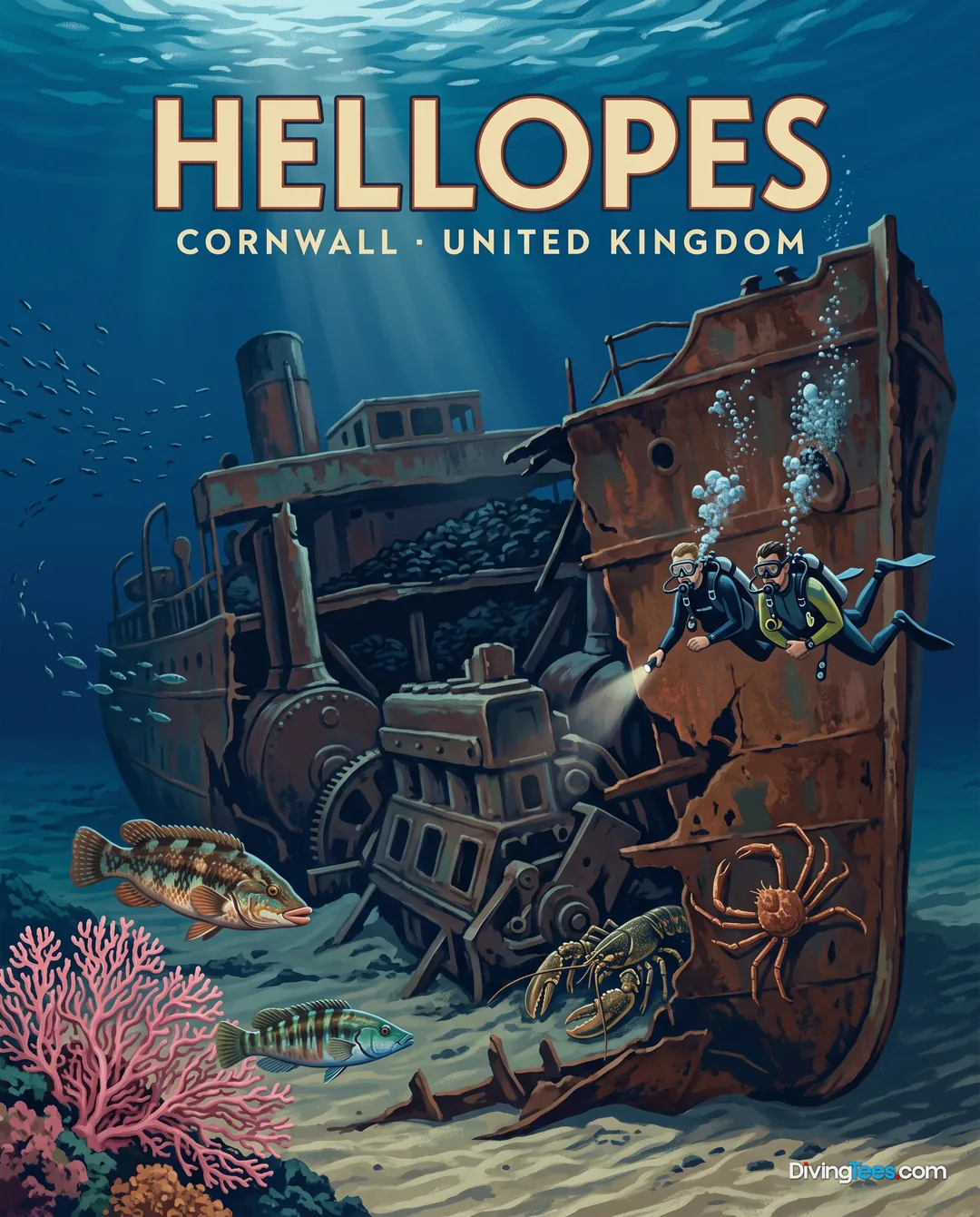
The SS Volnay is a WWI-era cargo steamer lying on a sandy seabed, located off the coast near Porthallow. Unlike a vertical hull that stands upright, this wreck has a low-relief profile, with much of its structure having broken up over time. You will find yourself navigating a debris field where large structural components still rise above the sandy bottom. This scattered layout requires you to move through the site by following the remains of the vessel rather than searching for a single, intact silhouette.
As you descend to the site, the topography is defined by a mix of structural pieces and loose, silty sand. Parts of the wreck are partially buried in the seabed, creating an uneven terrain that changes the way you approach the debris. The depth is relatively shallow, ranging from 16 to 22 metres, which allows for a manageable descent and a more relaxed exploration of the wreckage. You will need to be mindful of your buoyancy to avoid stirring up the silt that surrounds the broken components.
The layout of the wreck means that you are not just looking at a ship, but at a complex site of historical debris. The cargo-carrying nature of this steamer is evidenced by the way the wreckage is spread across the seabed. Some sections of the structure remain distinct, while others have become part of the local landscape, partially submerged in the silt. This creates an interesting environment for those interested in the archaeology of maritime wrecks in the British Channel.
The marine life here is typical of the Cornish coast and finds plenty of shelter among the structural pieces. You can expect to encounter Ballan wrasse (Labrus clathratus) weaving through the debris and Tompot blenny (Parablennius cuscus) settled near the sandy patches. Larger fish, such as Pollack, often move through the area, adding life to the scene. The structural complexity of the SS Volnay provides various nooks and crannies for resident species to inhabit.
Crustaceans are a regular presence amongst the metal and stone remnants of the wreck. Both Common lobster (Homarus gammarus) and Spiny lobster (Palinurus elephas) utilize the crevices provided by the scattered wreckage for protection. Watching these species navigate the narrow gaps between the debris and the seabed is a highlight of the site. The combination of the wreck structure and the sandy substrate creates an ideal habitat for these bottom-dwelling animals.
Visibility at the SS Volnay generally ranges between 5 and 10 metres. While the water can be clear, the presence of silt around the wreck means you must manage your movement carefully to maintain these conditions. Once you are settled and your buoyancy is stable, the visibility allows for a clear view of the structural details and the surrounding marine life. Careful navigation through the silt-prone areas is essential to ensure the site remains clear for you and subsequent divers.
Accessing the site is most easily done via boat, with departures typically from Porthkerris, Porthoustock, or Falmouth. Because the wreck is relatively shallow, it is a common destination for local club boats and commercial charters. You will usually descend via a shot line or a buoyed drop to ensure a precise arrival on the wreckage. The short boat journey makes it an accessible option for divers looking for a wreck excursion in the Cornwall region.
The SS Volnay has a depth of 16 to 22 metres. It is an advanced level site with wreck experience recommended due to the silt and topography. Current is light and generally slack at all states of the tide, though conditions can vary slightly with the tide state. Visibility is typically 5-10 metres. The site is best when sea conditions are settled.
You should choose Volnay when sea conditions are settled. The site is best in calmer conditions, while current is light and generally slack at all states of the tide. Tide state can still cause slight variation, so you should expect conditions to change a little during your dive.
Volnay is an advanced-level dive, and wreck experience is recommended. The scattered wreckage, uneven topography, and loose silty sand require careful movement and buoyancy control. You will follow the remains through a debris field rather than explore one intact hull, while avoiding disturbance to the surrounding silt.
Volnay lies between 16 and 22 metres on a sandy seabed. The current is light and generally slack at all states of the tide, although it can vary slightly with the tide state. Visibility is typically 5 to 10 metres, and careful movement helps keep silt from reducing it.
At Volnay, you can explore a World War One-era cargo steamer debris field, with structural pieces rising from the sand and other sections partly buried in silt. Ballan wrasse, Tompot blenny, Pollack, Common lobster, and Spiny lobster use the wreckage, crevices, and sandy patches for shelter.