Martinique Plongée
Google 5/5 (564 reviews)
26 km away as the crow flies
Les Trois Ilets · Martinique · Caribbean
Max. depth · 60 mExplore the historic Roraima, a nearly 120-meter cargo ship resting at 60 meters, draped in 'white-haired' corals and teeming with marine life, offering a unique glimpse into a preserved moment from the 1902 Mont Pelée eruption.
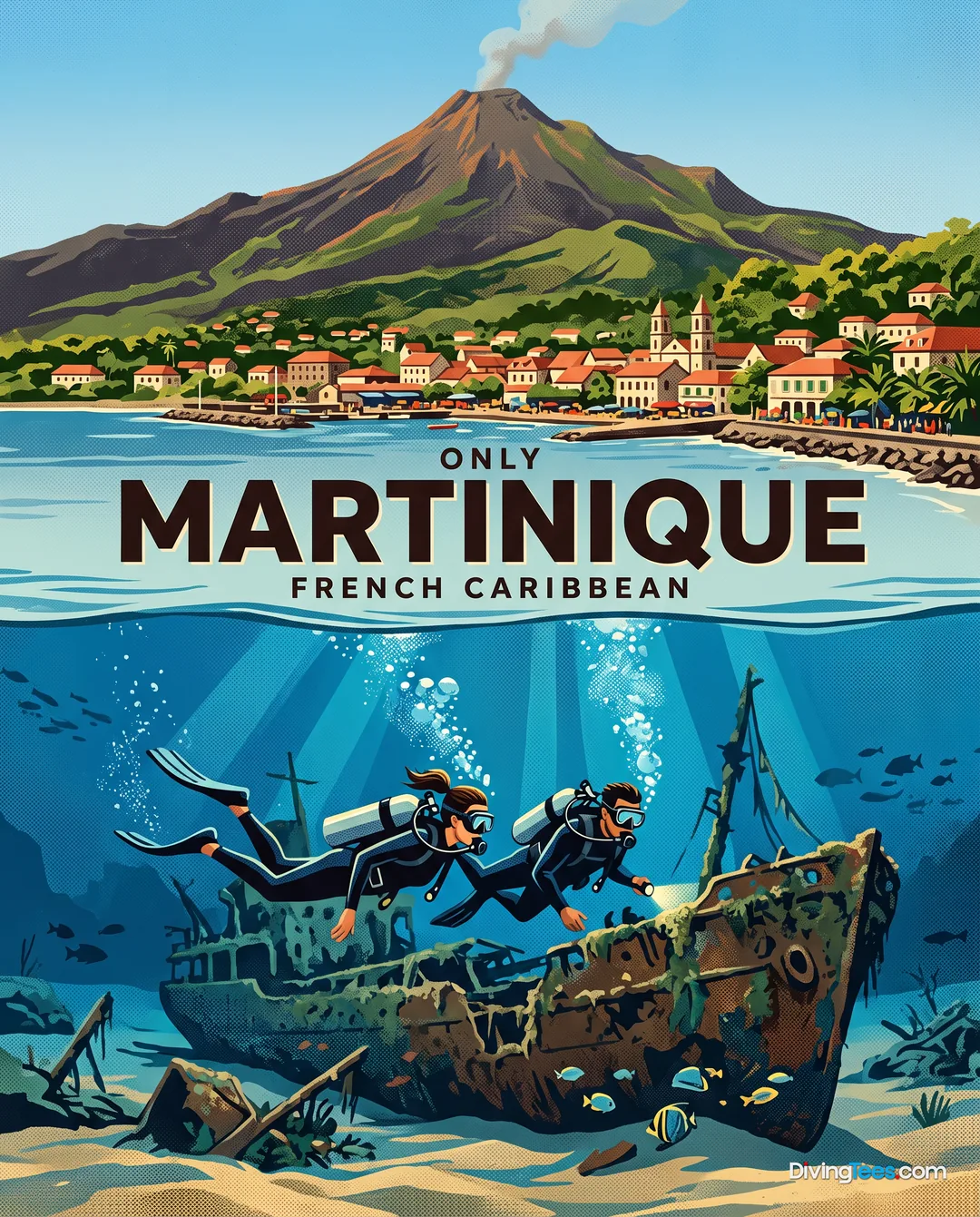
Dropping down to the Épave du Roraima is a descent into history, a journey to a nearly 120-meter cargo ship resting on a sandy bottom at 60 meters within the historic bay of Saint-Pierre. This isn't just any wreck; it's a site that demands respect and a technical approach, promising an exploration so rich that a single dive barely scratches the surface. As you approach the massive structure, the scale of the vessel immediately becomes apparent, setting the stage for what awaits. The Roraima, a steamship measuring an impressive 120 meters from bow to stern, is one of the most substantial wrecks in the area, its sheer mass creating a distinct underwater landscape.
Descending upon such a large vessel allows you to appreciate the scale of its demise, as the sheer size dictates a dive plan focused on specific sections rather than attempting to cover the entire wreck in one go. As you descend, the dark hull slowly resolves from the blue. The historical context of the Roraima adds another layer to the dive experience; this isn't just a sunken ship, it's a preserved moment in time from the devastating volcanic eruption of Mont Pelée in 1902. Understanding this history brings a unique perspective to your exploration. The silent hulk below tells a story that reaches beyond mere marine biology, offering a tangible link to a powerful natural event and human endeavor.
The first feature to greet you is the imposing étrave (bow), still equipped with its enormous anchor chain, a testament to the ship's last moments. As you move along its length, the Épave du Roraima reveals itself in three distinct, yet still connected, sections, with a slight sag in the central area. The structural integrity in many parts allows for a sense of the vessel's original grandeur, despite its deep-water repose. Progressing further, you'll discover remarkably preserved elements that offer glimpses into the ship's past life. The coursives (passageways) remain largely intact, the main deck is discernible, and the base of the chimney still stands. Even remnants of the mast provide a sense of the ship's former verticality, offering unique perspectives for exploration and photography.
Delving into the interior of the Roraima is like stepping into a frozen moment in time. The entrepont (tweendeck) and the salle des machines (engine room) are accessible for those properly trained, revealing fascinating machinery and architectural details. The cargo holds, too, tell a story, with everyday vestiges suspended in the stillness of the deep.
Jacques-Yves Cousteau himself christened this site 'the white-haired wreck' ('l'épave aux cheveux blancs'), a name that perfectly encapsulates its character. The Roraima is draped in long, flowing virgularia, a type of soft coral, giving the entire structure an ethereal, almost spectral appearance. This unique biological coating creates an atmosphere unlike any other deep wreck. Beyond the 'white hair,' the flora surrounding the wreck is spectacular, a vibrant ecosystem thriving in the depths. Red chimney sponges stand out with their vivid hue, while white and orange gorgonians intertwine with tortuous corals, all bearing the subtle marks of the site's enduring history. These formations add layers of color and texture to the already captivating metal framework.
The marine life here is equally impressive, drawn to the complex shelter and rich ecosystem the wreck provides. You will encounter barracudas observing from a distance, while dense bancs de poissons (schools of fish) swirl around the structure. Angelfish (poissons anges), trumpetfish (poissons trompettes), lizardfish (poissons lézards), and large brown meagre (grosses sorbes) navigate the remains, creating a dynamic underwater spectacle. While not a coral garden, the wreck itself acts as an artificial reef, attracting various species. You will observe adaptations to this low-light, deeper environment. Movement here is generally more deliberate, allowing for careful inspection of structural elements and inhabitants that have made the Roraima their home.
The Épave du Roraima is a deep dive, resting at a maximum depth of 60 meters on a sandy bottom. Due to its depth and the technical skills required for such an exploration, this dive is strictly reserved for experienced technical divers (Plongeur confirmé / plongée technique), or those with an N3 or PE60 certification. Ambient light diminishes quickly, requiring careful attention to gauges and dive lights. Currents are typically manageable, but prudence is always advised when exploring significant structures at depth. Plan your gas appropriately for extended bottom times at these depths.
Épave du Roraima is a deep, technical wreck dive reserved for experienced technical divers and divers holding N3 or PE60 certification. Exploring the accessible tweendeck, engine room, and cargo holds requires appropriate training. Ambient light fades quickly, so you need to monitor your gauges carefully and carry suitable dive lights.
Épave du Roraima rests on a sandy bottom at 60 meters. This depth makes it a demanding technical dive, with quickly diminishing ambient light and a need for careful gas planning. The wreck is extensive, so your plan should focus on selected sections rather than attempting to cover the entire ship.
Currents at Épave du Roraima are typically manageable, but prudence remains important around the substantial wreck structure and its depth. You should plan your gas carefully for extended bottom times and maintain careful attention while moving around the bow, anchor chain, passageways, deck, and other preserved sections.
At Épave du Roraima, you can explore the imposing bow, anchor chain, passageways, deck, engine room, and cargo holds. Long virgularia cover the wreck like white hair, alongside red chimney sponges, white and orange gorgonians, and tortuous corals. Barracudas, schools of fish, angelfish, trumpetfish, lizardfish, and large brown meagre may also appear.