
AegeanSeals Diving Center
Google 5/5 (171 reviews)
Greece · Mediterranean
Concrete wrecks, rocky shallows, reef habitats and boat trips across Euboea make Chalcis a practical base for exploring beyond the harbour.
For subtitles in English: start the video firstthen click the gearat the top right of the video, select “Subtitles/CC”, then “Auto-translate” and choose “English”.
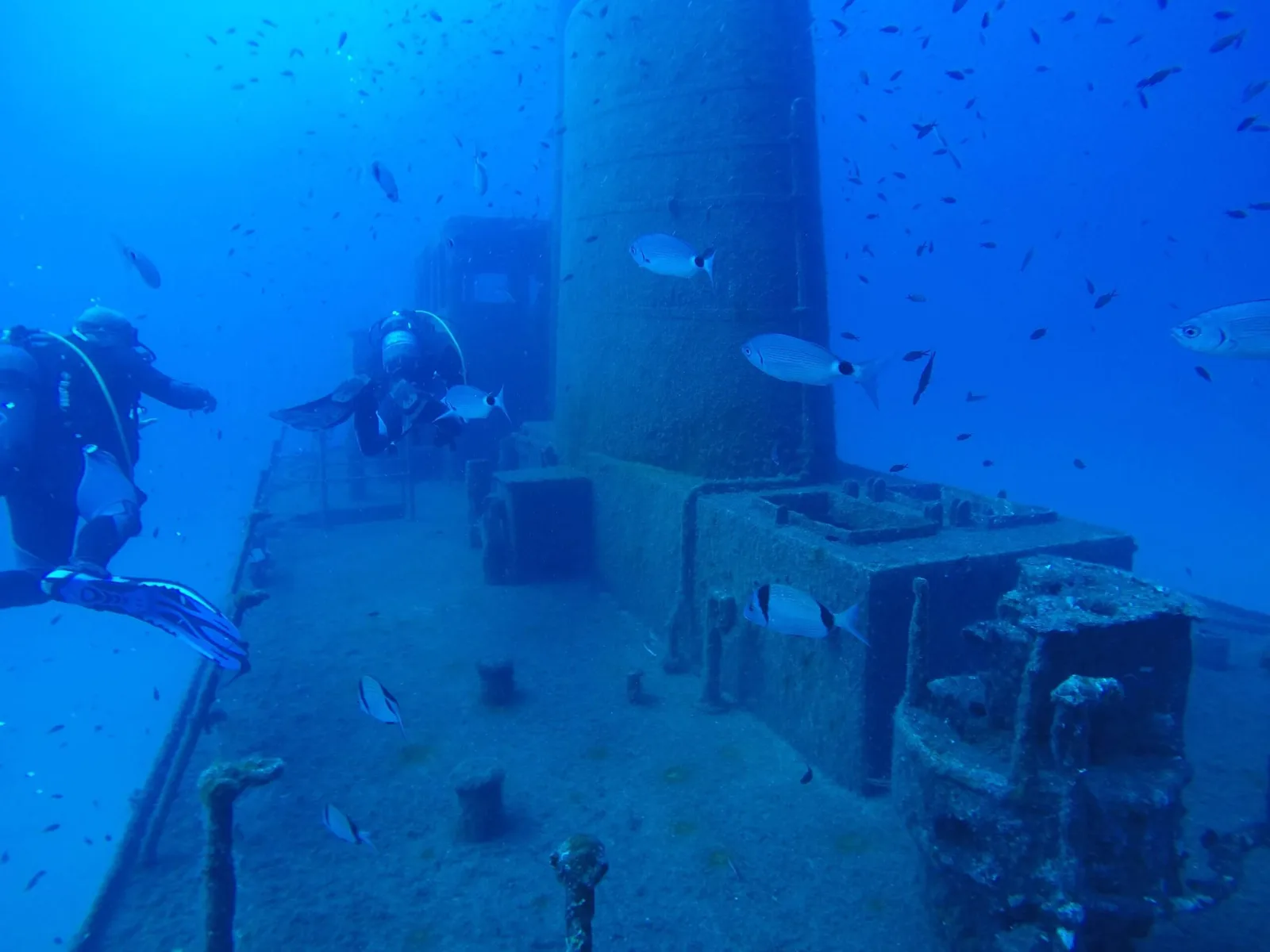
The concrete wreck Pioneer I gives Chalcis its most recognisable underwater landmark, but it is not a dive resort built around one harbour. Chalcis is an urban base on Euboea, connected directly to mainland Greece, with local centres arranging shore dives and boat outings towards reefs, cavities and wrecks around the island. That makes it useful for a land-based holiday, particularly if you want diving alongside beaches, villages, bridges, waterfront walks and cultural visits rather than a week confined to a small port.
Expect mixed diving rather than one repeatable local format. Sites around Euboea combine reef, rocky shallows, cavities and wrecks, with access either from the coast or by boat. The important distinction is geographical: names grouped under Chalcis can refer to sites well beyond the city, so a day on the water may involve a regional transfer rather than a quick departure from the harbour. Pioneer I, in the Lichadonisia islets, is a separate outing. Its concrete hull is associated with rich marine life, but the surrounding rocky shallows and strong currents make it a more serious proposition than its shallow position suggests. Ask whether a wreck trip means an exterior tour or penetration, and treat any downcurrent movement or drift dive as a briefing point, not an assumption.
The underwater appeal lies in the combination of habitats rather than a promised list of named animals. Reefs, cavities and wreck structure provide the places to look, while Pioneer I is specifically associated with rich marine life around its concrete hull. On a wreck dive, attention shifts between the artificial surfaces, openings and nearby rocky shallows; on a reef or cavity dive, the terrain itself becomes the subject. There is no particular seasonal animal encounter around which to build the trip. Plan for the established May to October diving window, then judge the day’s wildlife by the site chosen, its exposure and the conditions rather than expecting a fixed migration or a guaranteed species sighting.
May, June, September and October are the most sensible months for Chalcis. They fall within the broader May to October season used for diving around Euboea, while leaving the hottest and busiest part of a Greek summer outside your main planning window. These are useful months for a land-based itinerary because the centres can combine local shore work with boat days and longer road transfers around the island. There is no need to invent a single perfect week: conditions vary between sheltered coastal sites and exposed regional outings. For Pioneer I, check the current and traffic situation on the day, whatever month you choose.
Chalcis can suit a first discovery dive, a beginner’s sheltered session or a certified diver looking for reefs, cavities and wrecks. The deciding factor is the individual site, not the destination label. Stronger current exposure and rocky shallows around Pioneer I call for appropriate experience and a careful briefing. If you intend to enter the wreck rather than view it from outside, bring the relevant Wreck Diver qualification or its equivalent. BSAC, PADI and SSI divers should all clarify the centre’s requirements before booking a penetration dive.
From London Heathrow, Gatwick or Manchester, the journey is built around reaching Athens and then continuing by road. Chalcis is connected to mainland Greece by bridges, so there is no compulsory ferry and no domestic flight for the final approach. Allow for the road transfer after your flight, with traffic affecting the journey. Once in Chalcis, centres are within the city, but accommodation may be in different neighbourhoods and there is no standard shuttle arrangement to rely on. For outlying Euboean sites, plan a car journey or an organised boat outing in advance, and confirm exactly where the day begins rather than assuming every departure is from the town waterfront.
The first question to ask is not which site is famous, but where that day’s boat or road trip actually goes. Chalcis catalogues can cover widely separated parts of Euboea, so confirm the real meeting point, transfer time and whether the dive is coastal or boat-based. Do not treat every site sold under the Chalcis name as local. Keep Pioneer I as a separate regional excursion, and ask specifically about current strength, rocky shallows and maritime traffic. A shallow wreck is not automatically an easy wreck there. Establish whether you will remain outside or make a penetration, and whether a Wreck Diver qualification is required. If your priority is reefs and wrecks away from town, make sure the planned outing has a boat rather than assuming the harbour provides access. Leave a non-diving day for a long northern or southern Euboean transfer instead of trying to fold it into a short local outing.
Organise the stay as a land-based schedule of day outings. Use Chalcis for local shore diving, boat departures and evenings around the waterfront, then reserve separate days for distant Euboean reefs, cavities or wrecks. Accommodation-to-centre arrangements depend on the neighbourhood, so sort out the daily transfer rather than assuming you can walk everywhere. Non-divers have beaches, coastal villages, island scenery, bridges and cultural visits to fill the surface interval. A boat trip to the Lichadonisia can also work for sightseeing or snorkelling, conditions and traffic permitting.
Hello, I'm Marina, DivingDeal.com's AI assistant. I guide you through destinations, areas and countries.
Thinking about the whole trip and the flights? Talk it over with Edith →
Marina is an AI. Some links are affiliate links: DivingDeal may earn a commission, at no extra cost to you. Bookings are made with the partner.
Plan your Chalcis diving between May and October. May, June, September and October are sensible choices for a land-based itinerary, combining local shore dives with boat days and longer road trips around Euboea. Conditions differ between sheltered coastal sites and exposed outings, so check the day’s conditions before diving.
Chalcis can suit a first discovery dive, a beginner’s sheltered session or a certified diver exploring reefs, cavities and wrecks. Pioneer I requires more care because rocky shallows and strong currents surround the wreck. If you plan to enter it, confirm the centre’s requirements and hold an appropriate Wreck Diver qualification or equivalent.
Diving around Chalcis combines reefs, rocky shallows, cavities and wrecks across Euboea. Pioneer I, a concrete wreck among the Lichadonisia islets, is associated with rich marine life around its hull. Your experience will depend on the chosen site, exposure and conditions, rather than a fixed animal encounter or guaranteed species sighting.
Use Chalcis as a land-based base for local shore dives, boat departures and separate outings to distant Euboean reefs, cavities and wrecks. Confirm each meeting point, transfer time and whether the dive is coastal or boat-based. Arrange accommodation-to-centre transport, allow for road journeys, and keep time for beaches, villages, bridges and cultural visits.