Deep-Sea Anglerfish
Lophius piscatorius / suborder Ceratioidei
The ugliest fish in the ocean fishes with a rod, turns invisible — and in the abyss, the male fuses with his mate forever.
IDENTITY CARD
| Classification | Order Lophiiformes, families Lophiidae (common anglerfish) and Ceratiidae (deep-sea anglerfish) |
| Scientific names | Lophius piscatorius (Linnaeus, 1758) — common anglerfish / Ceratias holboelli, Melanocetus johnsonii, and ~170 species of ceratioids |
| Size | Common anglerfish: up to 2 m / Deep-sea anglerfish: a few centimetres (free-living male) to 1.2 m (female Ceratias holboelli) |
| Weight | Common anglerfish: up to 57.7 kg / Deep-sea anglerfish: a few grams (male) to ~50 kg |
| Lifespan | 20-25 years (L. piscatorius) / Poorly known for abyssal species |
| Depth | Common anglerfish: 20 to 1,000 m / Deep-sea anglerfish: 300 to 5,000 m |
| Diet | Ambush predator — fish, crustaceans, cephalopods |
| IUCN Status | Least Concern (LC) for L. piscatorius — significant fishing pressure / Data Deficient (DD) for most abyssal species |
PORTRAIT
It takes a moment to see the anglerfish. Flattened against the bottom like a carpet of mud and rock, its disproportionate head, gaping mouth bordered by skin fringes that break up its outline, it merges so perfectly with the substrate that the diver often passes over it without noticing. And that is exactly what it wants. Lophius piscatorius — the common anglerfish, the one that French fishmongers call "lotte" and the British call "monkfish" — is an absolute ambush predator. It chases nothing. It waits, motionless, and waggles the lure at the end of a long stalk that earned it its Latin name: piscatorius, the fisherman.
That stalk is the illicium: the first ray of its dorsal fin, repurposed by evolution into a genuine fishing rod. At its tip dangles a fleshy lure, the esca, which the anglerfish waggles like a worm to attract fish and crustaceans within range of its jaws. When prey approaches, the mouth opens in milliseconds — one of the fastest suction strikes in the animal kingdom — and a vacuum sucks the victim in whole. The stomach is extensible: the anglerfish can swallow a fish nearly as large as itself.
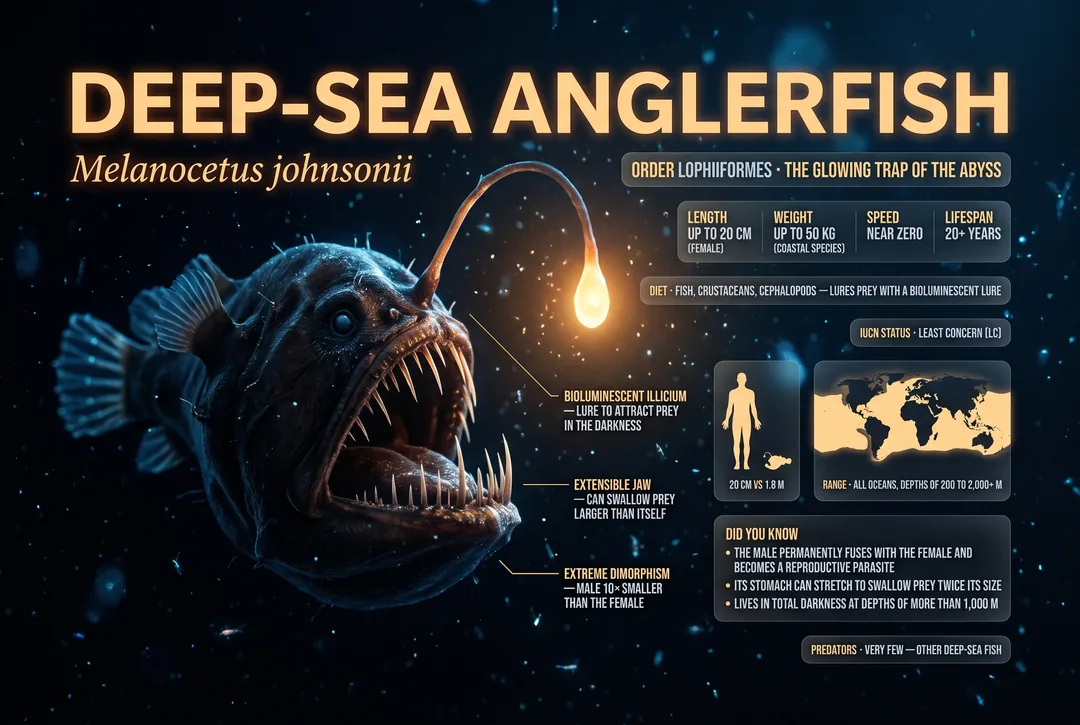
But the common anglerfish, spectacular as it is, is only the temperate chapter of a far larger order. In the abyss, beyond all sunlight, its cousins of the suborder Ceratioidei have taken the concept to its extreme: their esca no longer mimics a worm — it produces its own light. These deep-sea anglerfish, black, globular, mouths bristling with translucent fangs, have become the icon of the deep ocean. Their bioluminescence, their extreme sexual dimorphism, and their reproductive mode without parallel in the living world make them one of the most extraordinary animals on the planet — and one of the least known.
HOW TO RECOGNIZE IT
The common anglerfish resembles nothing else. Viewed from above, it is almost circular: an enormous head — making up two thirds of the body — followed by a tapered trunk and a narrow tail. The mouth is terminal, facing upward, bordered by rows of sharp, inward-pointing teeth. The lower jaw, prognathous, projects beyond the upper. The skin is bare, scaleless, covered in flaps and fringes that mimic the algae and debris of the bottom. Colouring varies from brown-green to mottled grey, perfectly matched to the rocky and sandy bottoms of the northeast Atlantic. The pectoral fins, broad and fleshy, function like short legs: the anglerfish "walks" along the bottom more than it swims. The illicium, thread-like, rises from the top of the skull. A 1.5 m adult has the footprint of a coffee table — and the stillness of a rock.
Underwater, it is the stillness that betrays the animal — paradoxically, because you only notice it if you stop yourself. Look for the eyes: two small protruding globes, often the only visible elements, perched on top of the flattened head. The body outline is lost in the skin fringes, but the illicium, if deployed, traces a thin, mobile stalk above the substrate. An experienced diver also spots the slit of the mouth, sometimes half-open, wide as an arm.
In the deep-sea anglerfish, the portrait changes completely. The body is globular and black, often gelatinous, without scales. The mouth is enormous, capable of opening far beyond the head's width. The teeth, long and transparent, fold inward to imprison prey. The esca glows with a bluish or greenish light in total darkness. And the sexual dimorphism is the most extreme in the animal kingdom: the female Ceratias holboelli reaches 1.2 m; the free-living male does not exceed 14 cm — nearly ten times smaller.
For subtitles in English: start the video firstthen click the gearat the top right of the video, select “Subtitles/CC”, then “Auto-translate” and choose “English”.
WAY OF LIFE
The common anglerfish is sedentary. It occupies a territory on the bottom — rock, gravel, coarse sand, sometimes mud — between 20 and 500 m depth in the northeast Atlantic, from Iceland to Senegal, and in the Mediterranean. It hunts by ambush, sometimes for hours, motionless and nearly indistinguishable from the substrate. Its diet is opportunistic: flatfish, cod, small sharks, cuttlefish, lobsters — anything that passes within jaw range and fits in the mouth. Anglerfish have been found with seabirds in their stomachs.
The reproduction of Lophius piscatorius is remarkable for its discretion. The female lays a long gelatinous ribbon — the "egg veil" — that can measure up to 10 m long and 60 cm wide, containing more than a million eggs. This veil floats in open water, transparent and nearly invisible, then disintegrates within days as the larvae hatch. The larvae are pelagic for several months before settling on the bottom to adopt their parents' benthic lifestyle.
But it is in the abyss that the reproduction of Lophiiformes reaches a degree of singularity without parallel in the living world. For ceratioid anglerfish, finding a mate in the vast darkness of the deep ocean is an existential challenge. The evolutionary solution is radical: the male, tiny, is equipped with an overdeveloped sense of smell to detect the female's pheromones in absolute darkness. When he finds her — after weeks of wandering — he bites her and never lets go. Enzymes dissolve his lips and her skin. The tissues fuse. The circulatory systems connect. The male loses his eyes, his fins, his digestive tract, most of his brain. He becomes a permanent parasite, nourished by the female's blood, reduced to a pair of gonads that release sperm when the female's hormones signal ovulation. Some females carry up to eight fused males on their bodies — so many sperm reservoirs available on demand. It is the only known example of such radical sexual parasitism in the animal kingdom: an extreme evolutionary compromise in the face of the impossibility of finding a partner in the abyss.
WHERE TO SEE IT
The common anglerfish frequents the entire temperate northeast Atlantic and the Mediterranean. The deep-sea anglerfish, meanwhile, live in every ocean on the globe — but far beyond any recreational reach. Here are the destinations where a diver can reasonably hope to encounter Lophius piscatorius:
Brittany, France — Finistere and the Molene archipelago. The rocky bottoms of northern Finistere, between Ouessant, the Molene archipelago, and the Crozon peninsula, harbour a resident anglerfish population. They are encountered between 20 and 40 m, resting on the granite substrate, often near kelp forests. The variable Atlantic visibility makes each sighting all the more memorable. Summer offers the best diving conditions, but encounters are possible from April.
Norway — fjords and Lofoten. The fjords of central and northern Norway — Sognefjorden, Trondheimfjorden — and the waters of the Lofoten Islands rank among the best sites in the world for observing anglerfish in natural conditions. Cold, nutrient-rich water favours encounters at accessible depths, sometimes as shallow as 15 m. Cold-water diving demands a drysuit and solid experience, but the reward is commensurate: large anglerfish on spectacular seabeds.
Cornwall and Scotland, UK. The southwest coast of England (Cornwall, Devon) and the west coast of Scotland offer regular dives on grounds where the anglerfish is resident. Wrecks and rocky reefs between 20 and 35 m are the best territories. The season runs from May to October, peaking in summer when visibility is at its best.
Mediterranean — Croatia, Malta, Corsica. In the Mediterranean, it is mainly Lophius budegassa (the blackbellied angler, closely related to the common anglerfish) that is encountered, at depths of 30 to 60 m on sandy-muddy bottoms. Croatian Adriatic waters, Malta's drop-offs, and Corsican seabeds offer occasional but realistic sightings for the patient diver.
And the abyss? The bioluminescent anglerfish of the families Ceratiidae, Melanocetidae, and Himantolophidae live between 300 and 5,000 m depth, well beyond recreational diving. They have only been observed alive by submersibles and ROVs — the footage from MBARI (Monterey Bay Aquarium Research Institute) and the Schmidt Ocean Institute counts among the most famous in marine biology. It is one of the rare animals the diver will never see in person — but will talk about for a lifetime.
OBSERVATION CALENDAR
| Destination | J | F | M | A | M | J | J | A | S | O | N | D |
|---|---|---|---|---|---|---|---|---|---|---|---|---|
| Brittany (France) | ||||||||||||
| Norway (fjords) | ||||||||||||
| Cornwall (UK) | ||||||||||||
| Scotland (west coast) | ||||||||||||
| Mediterranean (Croatia) |
Click each button to show/hide
CONSERVATION
Lophius piscatorius is listed as Least Concern (LC) on the IUCN Red List, but this status should not obscure a more nuanced reality. The species is one of the most heavily exploited in the northeast Atlantic: its flesh, marketed as "monkfish" or "lotte," is prized in gastronomy — and bottom trawling, which catches it in large quantities, is its primary cause of mortality. ICES (International Council for the Exploration of the Sea) issues annual quota recommendations, but landings regularly exceed scientific advice.
The deep-sea anglerfish face threats of a different nature. Deep-sea trawling, though increasingly regulated, continues to rake the bottom beyond 800 m in some areas. Climate change is altering the thermal stratification of the deep ocean, with consequences still poorly understood for the distribution of bathypelagic species. Microplastic pollution now reaches the deepest trenches.
The diver who encounters a common anglerfish can contribute to its knowledge by reporting the observation — location, depth, estimated size — to citizen science programmes. Any encounter with an ambush predator imposes a simple rule: do not disturb it. Approach slowly, stay above the bottom without stirring up sediment, never try to make it move for a better photograph. The anglerfish that flees has lost its hunting post — and may not find it again.
Organisations to support:
- ICES — International Council for the Exploration of the Sea — scientific management of anglerfish stocks in the northeast Atlantic
- Deep Sea Conservation Coalition — protection of deep ecosystems against trawling
- Marine Stewardship Council — sustainable fishery certification, including anglerfish
- PADI AWARE — citizen science and underwater observation reporting
3 THINGS YOU PROBABLY DON'T KNOW
1. The monkfish on your plate is this animal. The monkfish fillet served in restaurants — white, firm flesh, boneless — comes from Lophius piscatorius. On the fishmonger's slab, only the tail is usually displayed, already beheaded: the head, deemed too repulsive for sale, actually represents two thirds of the animal. Few diners, when ordering roasted monkfish, picture the flattened, fringed predator that was crouching on the Atlantic floor a few days earlier.
2. It manufactures light — but not its own. In deep-sea anglerfish, the glow of the esca is not produced by the fish itself. It comes from symbiotic bacteria of the genus Photobacterium, housed in a specialised organ at the tip of the lure, which emit light through a chemical reaction involving luciferin. The anglerfish controls the emission by modulating blood flow to the organ: more blood, more oxygen for the bacteria, more light. It is a collaboration tens of millions of years old between a fish and a bacterium, on the floor of a sunless ocean.
3. The parasitic male gives up everything — except one thing. When the male of a ceratioid anglerfish fuses with the female, he loses nearly all of his organs: eyes, brain (mostly), intestine, kidneys, fins. His body shrinks to a small swelling on the female's flank, fed by her blood. Only the gonads survive and continue to grow. The female can carry up to eight of these vestigial males simultaneously. For the graft to hold without immune rejection, the male had to lose, over the course of evolution, most of his adaptive immune system — a discovery made in 2020 that astounded immunologists as much as ichthyologists.
PHOTO AND VIDEO TIPS
The common anglerfish is a formidable subject because it is invisible. The difficulty is not technical — it is finding it. Once spotted, it does not move, which leaves all the time in the world to compose.
Lens. Macro or medium macro (60 mm, 100 mm) for head details, the illicium, and the skin fringes. Wide angle (14-17 mm) if the animal is large and you want the context of the seabed. In temperate water, the anglerfish rarely exceeds 1 m at depths accessible by recreational diving — the 60 mm is often the best compromise.
Lighting. The temperate seabeds where the anglerfish lives are dark and greenish. Two strobes are essential to restore the true colours — browns, greens, oranges — that natural light no longer shows beyond 15 m. Position the strobes on either side, angled outward to avoid backscatter in particle-laden water.
Approach. The anglerfish is motionless and relies on its camouflage. Approach very slowly, without stirring up sediment — buoyancy control is critical. Favour a lateral or frontal approach. Avoid positioning yourself directly above: the diver casts a shadow that can trigger flight. The ideal working distance is 30 to 60 cm for a portrait of the head and lure.
Common mistake. Not seeing the animal. The anglerfish's camouflage is so effective that experienced divers swim over it without noticing. Look for the eyes — two small protruding globes, often the only elements that betray its presence. And never try to make it move: a displaced anglerfish is one more photograph and one fewer hunt for the animal. A local guide accustomed to temperate seabeds makes all the difference.