Sailfish
Istiophorus platypterus
The fastest fish in the ocean hunts in packs, deploys its dorsal sail as a tactical weapon — and can exceed 110 km/h.
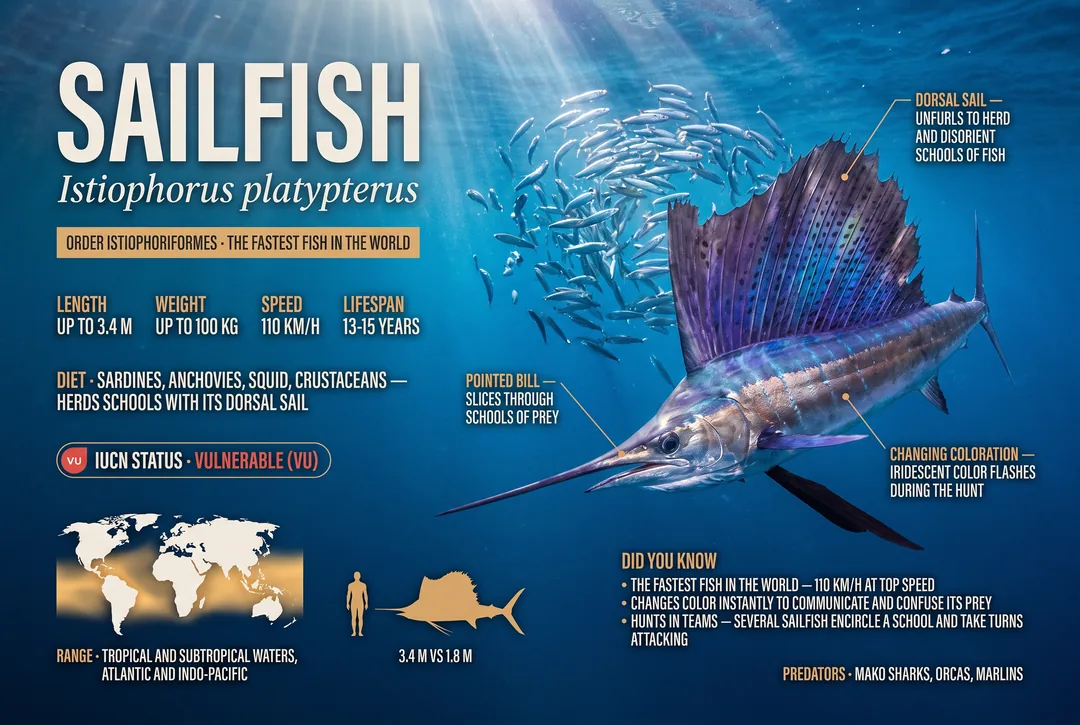
IDENTITY CARD
| Classification | Order Istiophoriformes, family Istiophoridae |
| Scientific name | Istiophorus platypterus (Shaw, 1792) |
| Size | 2.4-3.4 m (record: 3.8 m) |
| Weight | 25-100 kg (record: 128 kg) |
| Speed | Up to 110 km/h — the fastest fish in the ocean |
| Lifespan | 10-15 years |
| Depth | Surface to 200 m, typically 0-30 m during hunts |
| Diet | Carnivore — sardines, anchovies, mackerels, squid, small tunas |
| IUCN Status | Vulnerable (VU) |
PORTRAIT
The sailfish is the ocean's speed machine. With recorded bursts of 110 km/h, Istiophorus platypterus is officially the fastest fish on Earth — and likely the fastest aquatic vertebrate, ahead of the blue marlin and the mako shark. Its body is a lesson in hydrodynamics: fusiform, laterally compressed, covered in minute scales that reduce friction, with a sword-like rostrum and a tapered lower jaw that cleave the water like the bow of a racing yacht.
But it is not the speed that makes the sailfish unique — it is the sail. The dorsal fin, immense (it spans nearly the entire length of the back), unfurls like a fan when the animal hunts, turns, or intimidates a rival. It can reach a height greater than the body's width. During a chase, the sailfish folds it into a dorsal groove to become a flawless hydrodynamic missile, then deploys it abruptly to brake, pivot, and herd the prey school.
For divers, the sailfish is a pelagic encounter of the highest order. It frequents neither reefs nor the seabed — it lives in open water, in the blue, and the observation windows are limited to a handful of sites worldwide where sardine runs or prey concentrations bring hunting packs within reach of mask and snorkel.
HOW TO RECOGNIZE IT
The sailfish is instantly identifiable by its sail-shaped dorsal fin — no other pelagic fish possesses one so tall and so long. The body is cobalt blue to blue-black on the back, silver on the flanks, with roughly twenty rows of electric-blue dots that appear and vanish with the animal's level of excitement. The rostrum (the extension of the upper jaw) is long, thin, and round in cross-section — unlike the marlin's, which is shorter and thicker, and the swordfish's, which is flat like a blade.
The pelvic fins are extremely long and slender — nearly as long as the pectorals. The tail is deeply forked, a rigid crescent typical of speed swimmers. The whole composes a streamlined silhouette without equivalent in the marine world.
In motion, the sailfish changes color. The bright blue lateral bars intensify during the hunt — a visual signal that may serve to coordinate the group's attack or to disorient prey. This chromatic display, visible underwater, is one of the most arresting phenomena one can witness while freediving.
For subtitles in English: start the video firstthen click the gearat the top right of the video, select “Subtitles/CC”, then “Auto-translate” and choose “English”.
WAY OF LIFE
The sailfish is a pelagic predator of open water. It spends its life in the upper layers of the ocean, generally between the surface and 50 m, tracking concentrations of small schooling fish — sardines, anchovies, mackerels. Solitary or in small groups outside hunting periods, it gathers in packs of 10 to 70 when a prey school is located.
The hunting technique is spectacular and documented in detail. The sailfish encircle the sardine school and compress it into a dense sphere (the bait ball) at the surface. Then, taking turns, an individual charges through the ball at full speed, slashing laterally with its rostrum — not to impale the prey (that would be inefficient) but to stun and disorient them. The animal then slows, turns, and swallows the dazed fish that float in the aftermath. Meanwhile, the rest of the group maintains compression of the school. It is cooperative hunting with role-sharing, filmed in its entirety for the first time by a BBC team off Cancun in 2012.
The rostrum plays a dual role. Beyond the lateral strike, it is covered in sensory cells that detect the electric fields of prey in murky water — a version of the system better known in sharks.
Reproduction takes place in warm waters. The female releases up to 4.8 million pelagic eggs per spawning event — a staggering figure that offsets massive juvenile mortality. Growth is rapid: a sailfish reaches 1.2 m in its first year.
WHERE TO SEE IT
The sailfish is a pelagic animal — it is not "dived" in the conventional sense. Freediving observations (snorkeling or breath-hold) at sardine run sites account for virtually all documented encounters.
Isla Mujeres — Mexico (Yucatan). The world reference. From January to March, hundreds of sailfish converge off Isla Mujeres and Isla Contoy to hunt schools of sardines (Sardinella aurita). Specialized operators ferry snorkelers into the current, into the middle of the action. It is the only destination on Earth where one can swim with 20, 30, or 50 sailfish hunting simultaneously — an experience of raw nature without equal.
Sardine Run — South Africa. From May to July, the sardine migration along the KwaZulu-Natal coast draws sailfish among dozens of predators (dolphins, sharks, whales, gannets). The sardine run is one of the greatest wildlife spectacles on the planet, but conditions are unpredictable — cold currents, variable visibility, no guarantee of encountering sailfish specifically.
Indonesia — Cenderawasih Bay (West Papua). An emerging destination. Sailfish are observed around traditional fishing platforms (bagans), where they come to hunt small fish attracted by the nocturnal lights.
Oman — Musandam. The deep waters of the Strait of Hormuz harbor a resident population. Observations are mainly while snorkeling from dhows, between October and March.
Atlantic — Florida (Stuart, Palm Beach). The east coast of Florida sees the passage of Atlantic sailfish from November to March. Freediving encounters are possible but depend on sea conditions and the presence of bait balls.
OBSERVATION CALENDAR
| Destination | J | F | M | A | M | J | J | A | S | O | N | D |
|---|---|---|---|---|---|---|---|---|---|---|---|---|
| Isla Mujeres (Mexico) | ||||||||||||
| Sardine Run (South Africa) | ||||||||||||
| Cenderawasih (Indonesia) | ||||||||||||
| Oman (Musandam) | ||||||||||||
| Florida (Stuart) |
Click each button to show/hide
CONSERVATION
Istiophorus platypterus has been classified as Vulnerable (VU) on the IUCN Red List since 2022. Populations have declined by 30 to 50% in certain regions over the past three generations, primarily due to fishing.
The sailfish is a major game fishing trophy. Although catch-and-release is becoming more widespread, post-release mortality is estimated at 10-15% — a fish exhausted by a 30-minute fight is vulnerable to predators and physiological stress. Commercial fishing with drift nets and longlines kills thousands of sailfish each year as bycatch, principally in the Indian Ocean and the western Pacific.
The snorkeling ecotourism with sailfish at Isla Mujeres is a model for the economic valuation of a living species. A sailfish generates infinitely more revenue as a tourist attraction than as a landed catch — a conservation argument that local communities have internalized, with strict regulations on the number of boats and approach distances.
Organizations to support:
- International Game Fish Association (IGFA) — promotion of catch-and-release and sustainable fishing
- Billfish Foundation — research and conservation of billfish
- NOAA Fisheries — monitoring of Atlantic stocks
- Ocean Foundation — marine conservation and protection of pelagic species
3 THINGS YOU PROBABLY DON'T KNOW
1. It changes color in real time during a hunt. The sailfish possesses specialized pigment cells — chromatophores and iridophores — that allow it to flash or extinguish its electric-blue lateral bars in a fraction of a second. Research conducted in 2014 off Mexico suggests these flashes serve to communicate with other members of the hunting pack and to disorient sardines — a biological traffic signal in the open ocean.
2. Its rostrum is not a lance — it is a club. Contrary to popular imagery, the sailfish does not spear its prey. Slow-motion analysis (1,000 frames per second) has shown that it strikes laterally, like a fencer, at speeds up to 100 km/h. The rostrum, covered in abrasive microstructures (denticles), stuns, slashes, and disorients the sardines — but almost never pierces them. It is a percussive weapon, not a perforating one.
3. It can deploy its sail to "catch" more sunlight. The sailfish's dorsal fin is not purely hydrodynamic. When the animal swims at the surface, the unfurled sail increases its body surface exposed to the sun — which may help warm its muscles before a hunt. This passive thermoregulation mechanism, combined with a countercurrent heat exchange system in the eyes and brain, makes the sailfish a "partial warm-blood" — a decisive advantage for speed in cold water.
PHOTO AND VIDEO TIPS
The sailfish is photographed while snorkeling, not on scuba. It is a discipline unto itself — speed, endurance, reflexes.
Lens. Wide angle is mandatory — fisheye or rectilinear 10-17 mm (full frame). The sailfish passes within 2 meters in the chaos of the bait ball — a telephoto is unusable. The fisheye with dome port is the standard among professionals on this subject.
Autofocus. Continuous AF (continuous tracking). The scene is too fast and too chaotic for manual focus. Preset the AF on the central zone and keep the shutter held down in burst mode. Accept a 95% discard rate — the remaining 5% will be among the best nature images of your life.
Shutter speed. 1/1000 s minimum, ideally 1/2000 s. Everything happening before the lens is moving at 20 to 60 km/h. Motion blur is the enemy — push the ISO without hesitation.
Position in the water. Stay at the surface, mask in the water, fins at the ready. Do not dive toward the bait ball — the sailfish hunt upward. The best angle is slightly from below, with the sailfish crossing the sardine school between the photographer and the lit surface. The signature image: a sailfish with sail deployed, blue bars ablaze, slicing through the wall of sardines with the sun as backlight.
Ethics. Never touch a sailfish. Do not interfere with the bait ball. Respect the distances set by local operators. The sailfish is a wild animal in the act of predation — the spectacle is all the more extraordinary for being unrehearsed.