Flying Fish
Exocoetidae
It does not truly fly — but its 400-metre glide above the waves, wings spread at 70 km/h, is more than enough to fool any predator.
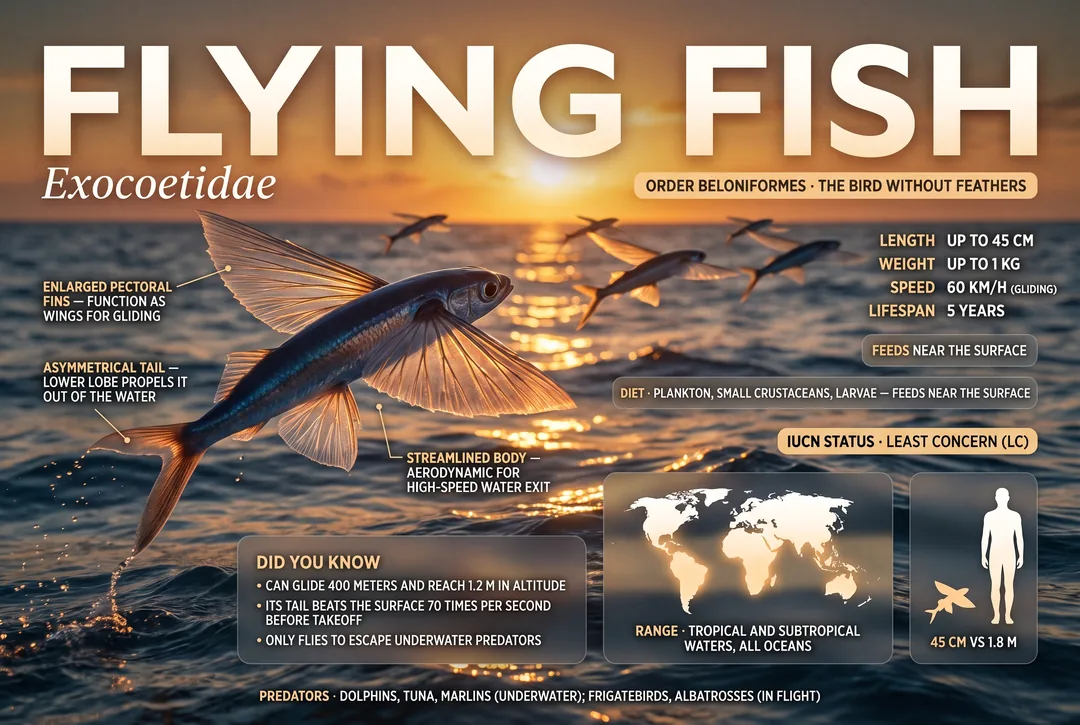
IDENTITY CARD
| Classification | Order Beloniformes, family Exocoetidae |
| Scientific name | Family Exocoetidae (Risso, 1827) — approximately 70 species in 7 genera |
| Size | 15-30 cm depending on species, up to 45 cm (Cheilopogon pinnatibarbatus) |
| Weight | 50-500 g |
| Speed | Up to 70 km/h gliding, 55 km/h underwater |
| Lifespan | 4-5 years |
| Depth | 0-20 m — strictly epipelagic species |
| Diet | Omnivore — plankton, copepods, small crustaceans, fish larvae |
| IUCN Status | Not Evaluated (NE) for the majority of species |
PORTRAIT
The flying fish is one of the ocean's most otherworldly apparitions. From the deck of a dive liveaboard, somewhere between two islands, a squadron of silver silhouettes suddenly bursts from the surface and glides 50, 100, sometimes 400 metres above the waves — wings outstretched like oversized dragonflies — before touching down and vanishing beneath the blue. The spectacle is so strange it has inspired legends in every tropical maritime culture on earth.
The "flight" of the flying fish is not powered flight — it lacks the pectoral muscles to beat its wings. It is a glide, initiated by an explosive underwater acceleration (the fish beats its caudal fin at over 70 strokes per second), followed by a launch at the surface and a sustained glide on its unfurled pectoral fins — rigid, asymmetric, and aerodynamically efficient. Some species (the "four-wingers") also deploy enlarged pelvic fins as rear lifting surfaces, giving them even greater stability in the air.
For divers, the flying fish is not a dive subject. It is a bonus between dives — the animal you see from the surface, between two sites, a reminder that the ocean is full of wonders even above the waterline.
HOW TO RECOGNIZE IT
The flying fish is identifiable in flight: no other fish glides above the surface over such distances. Its pectoral fins, disproportionately large relative to its body (spanning up to 70% of total body length when deployed), are the key diagnostic feature.
Two main groups exist:
- Two-winged (Exocoetus) — two "wings" (pectoral fins only). Shorter, more direct flight. The genus Exocoetus is most common in the Atlantic.
- Four-winged (Cheilopogon, Cypselurus, Hirundichthys) — four "wings" (pectorals plus enlarged pelvics). Longer, more stable flight, with directional changes possible. The genus Cheilopogon dominates in the Indo-Pacific.
Underwater, the flying fish is a small, silvery, streamlined fish with large dark eyes. It swims in dense schools in the surface layers. The caudal fin is asymmetric — the lower lobe is longer than the upper, providing the final thrust at takeoff (the lower lobe stays in the water and vibrates to extend the flight).
Species are distinguished by the number of pectoral rays, the shape of the pelvic fins, and the colouration of the wings — often transparent with dark or coloured markings visible in flight.
For subtitles in English: start the video firstthen click the gearat the top right of the video, select “Subtitles/CC”, then “Auto-translate” and choose “English”.
WAY OF LIFE
The flying fish is strictly epipelagic — it lives in the top 20 metres of the water column, in open ocean, rarely near the coast. It feeds on plankton and small crustaceans filtered at the surface or captured in the first few metres.
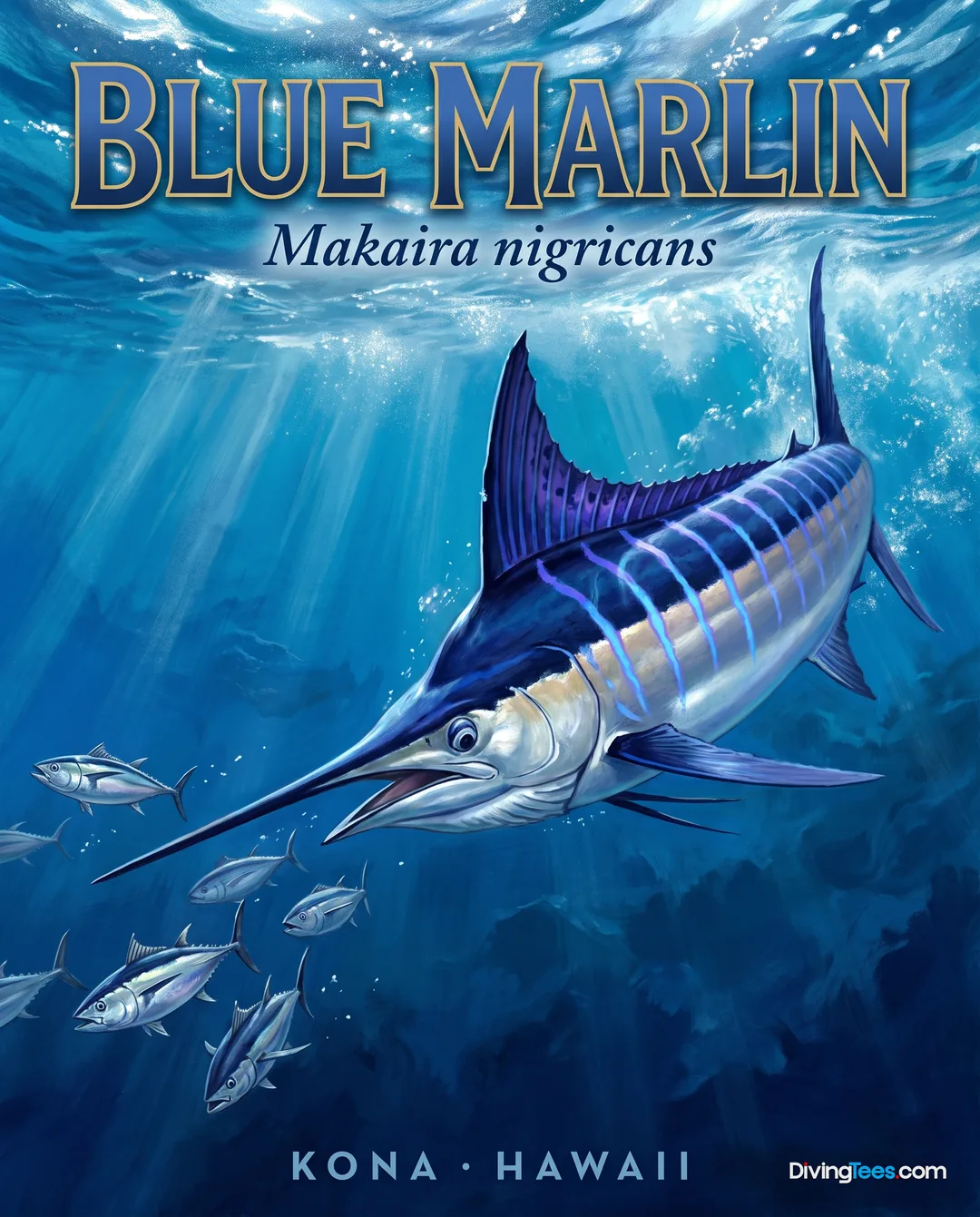
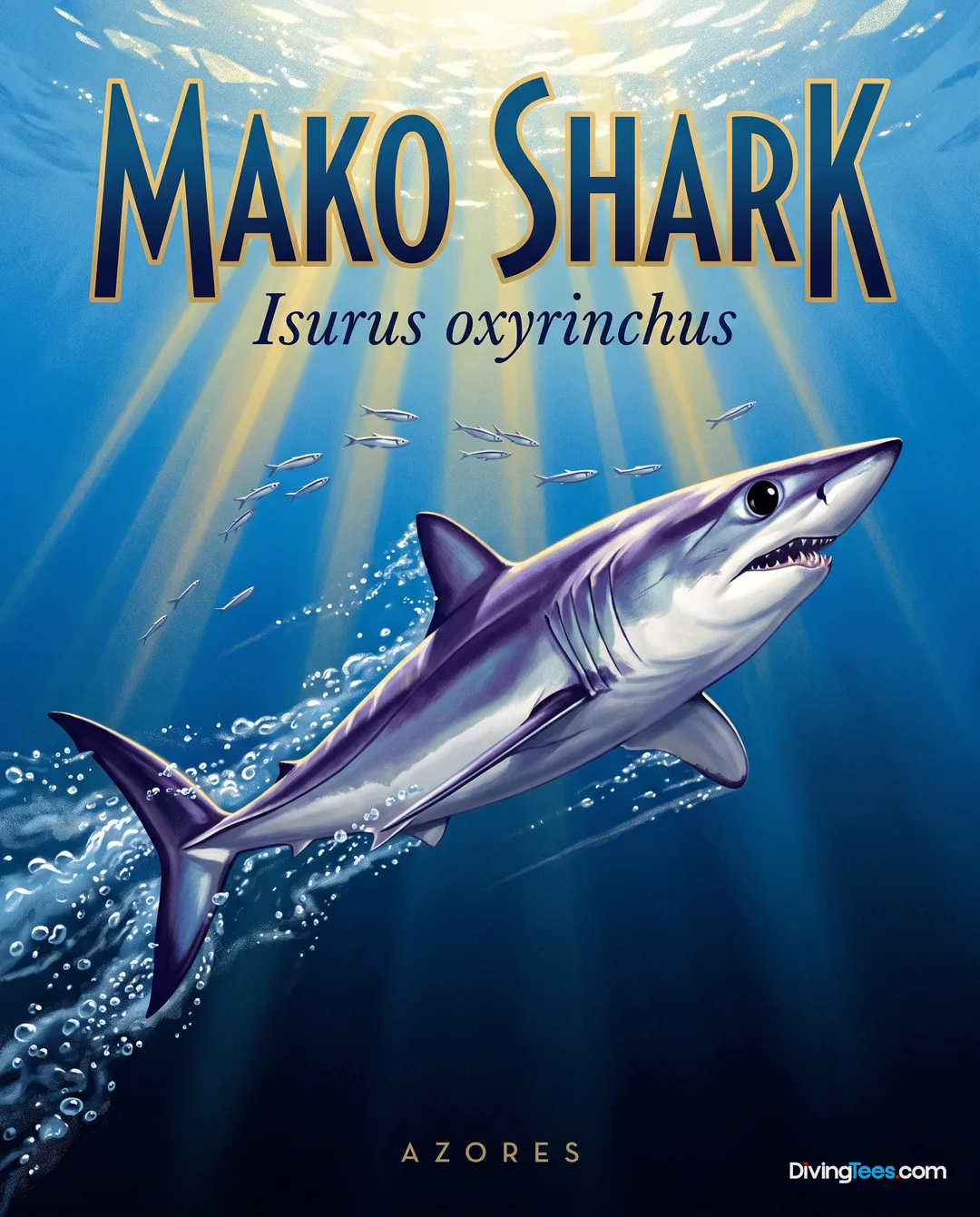
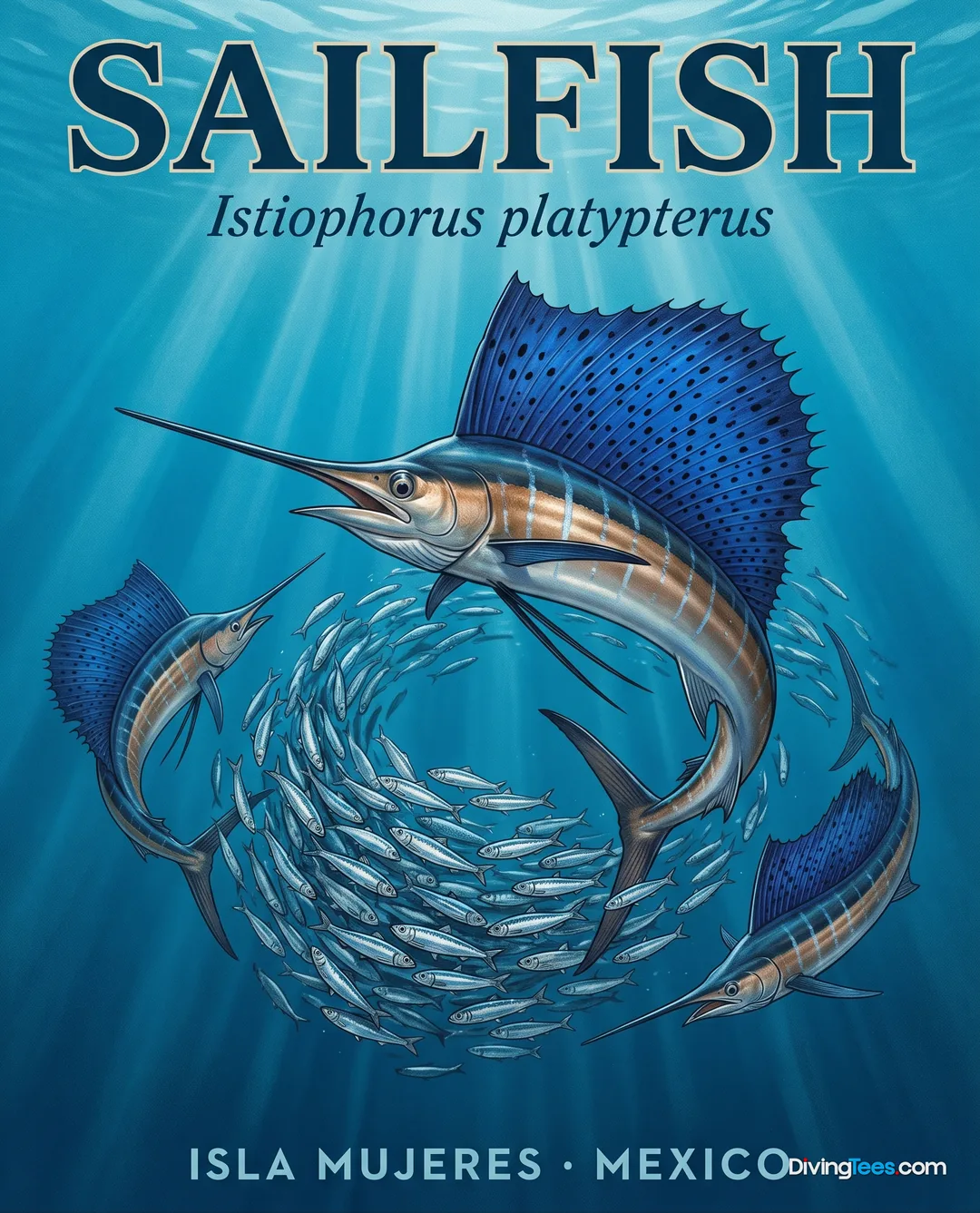
Flight is an anti-predation adaptation. The flying fish appears on the menu of virtually every pelagic predator: tuna, mahi-mahi, blue marlin, sailfish, mako sharks, and even seabirds that catch them mid-glide. The glide allows the fish to exit the water column long enough for the predator to lose track — 5 to 10 seconds of flight is enough to shake off a tuna at full speed.
The mechanics of flight are remarkable. The fish accelerates underwater to 55-60 km/h by beating its caudal fin (up to 70 beats per second), then breaks the surface at a 15-45 degree angle and unfurls its pectoral fins. The longer lower lobe of the caudal fin continues vibrating in the water during the takeoff phase, adding lift. Once airborne, the fish can reach 1.2 m altitude, glide 50 to 400 m, and chain multiple flights by touching the water with the tip of its tail to regain speed — a technique called taxiing — with up to 12 consecutive bounces documented.
Reproduction takes place in open water. The eggs, equipped with long adhesive filaments, attach to floating algae (sargassum), debris, and even boat rigging. This habit has been exploited by fishermen in the Caribbean and Pacific, who float fibre mats to collect eggs and juveniles.
WHERE TO SEE IT
The flying fish is not observed while diving — it is observed from the surface, by boat, in all tropical and subtropical waters worldwide. It is a companion of the crossing, not a dive site objective.
Barbados — Caribbean. The island calls itself "land of the flying fish." Hirundichthys affinis is the national fish, appearing on the coat of arms, coins, and every restaurant menu. Flying fish fishing is a century-old tradition. Boat crossings between dive sites on the west coast are punctuated by takeoffs.
French Polynesia — Rangiroa, Fakarava. Crossings between the motus of the Tuamotu atolls traverse stretches of open water where flying fish schools are ever-present. Polynesian fishermen traditionally catch them with dip nets, attracted by torches at night.
Maldives. Dhoni crossings between dive sites in the atolls feature daily flying fish displays. The most common species is Cheilopogon sp., recognizable by its four wings and long glides.
Japan — Yakushima, Amami-Oshima. The flying fish (tobiuo) is a traditional Japanese delicacy, served as sashimi, tempura, and dried. The southern islands of Japan (Yakushima, Amami) are the main fishing centres. Flying fish roe (tobiko) is a sushi classic worldwide.
Mediterranean. Exocoetus volitans is present in the Mediterranean, though less abundant than in tropical waters. Sightings are more frequent in the eastern basin (Greece, Turkey, Cyprus) and off the North African coast.
OBSERVATION CALENDAR
| Destination | J | F | M | A | M | J | J | A | S | O | N | D |
|---|---|---|---|---|---|---|---|---|---|---|---|---|
| Barbados | ||||||||||||
| French Polynesia | ||||||||||||
| Maldives | ||||||||||||
| Japan (Yakushima) | ||||||||||||
| Mediterranean |
Click each button to show/hide
CONSERVATION
The majority of flying fish species are not evaluated by the IUCN. Their abundance in open ocean, vast tropical and subtropical range, and high fecundity place them at low risk of global extinction.
Local threats do exist. Artisanal fishing, particularly in Barbados, Japan, and Indonesia, harvests significant quantities. In Barbados, catches dropped by 80% between the 1980s and 2000s, likely due to overfishing combined with shifting currents (the fish migrates in response to sea surface temperature). Light pollution at sea attracts flying fish toward boats at night, where they are easily captured — a traditional technique that is becoming industrial in parts of Southeast Asia.
Plastic pollution is an emerging threat. Flying fish eggs, which cling to floating debris, now attach in large numbers to plastic fragments — exposing embryos to chemical contaminants and transporting invasive species across thousands of kilometres.
Organizations to support:
- FAO — Food and Agriculture Organization of the United Nations — monitoring of global fisheries
- Ocean Conservancy — combating ocean plastic pollution
- CRFM (Caribbean Regional Fisheries Mechanism) — Caribbean stock management
- Pelagic Fisheries Research Program (Hawaii) — pelagic species research
3 THINGS YOU PROBABLY DON'T KNOW
1. It can chain 12 flights without going back underwater. The flying fish does not make a single glide — it can touch the surface with the tip of its asymmetric tail, vibrate to regain speed (taxiing), and take off again immediately. Documented observations record 12 consecutive bounces, covering a total distance of over 400 metres and a flight duration of 45 seconds. For a human, that would be the equivalent of sprinting 400 metres and then gliding for 4 kilometres.
2. Its eggs are in your sushi. Those small, crunchy, slightly salty orange beads that adorn California rolls and gunkan in sushi restaurants worldwide are flying fish eggs — tobiko. Nearly all tobiko consumed globally comes from Japanese and Indonesian fisheries. The coloured variants (green, black, red) are tinted with wasabi, cuttlefish ink, or chili.
3. The US military studied its flight to design missiles. In the 1940s, the US Navy filmed and analysed flying fish flight to understand the principles of sea-skimming flight. The research contributed to the development of sea-skimming anti-ship missiles and hydrofoils. NASA has also studied the hydrodynamics of the asymmetric caudal fin for applications in marine propulsion.
PHOTO AND VIDEO TIPS
The flying fish is photographed from the deck of a boat — this is surface photography, not underwater photography.
Lens. Telephoto 100-400 mm. The fish passes fast (70 km/h) and low (rarely above one metre). A stabilized zoom is virtually essential. On a smartphone, results will be poor — the subject is too small and too fast.
Settings. Minimum shutter speed 1/2000 s, continuous AF, high-speed burst. Motion blur is the enemy. Don't hesitate to push ISO — tropical light is generous. Shutter priority mode (S/Tv) is preferred.
Position. Stand at the stern or side of the boat, facing the direction of travel. Flying fish often take off in reaction to the bow wave — they launch laterally, offering the best profile views with wings fully spread. Backlighting (sun behind the subject) creates beautiful translucent silhouettes.
Video. Slow motion is spectacular. At 240 frames per second, you can clearly see the underwater tail-beating, the takeoff, the wing deployment, and the surface bounces. It is the most rewarding format for this subject.