Blue Marlin
Makaira nigricans
The gladiator of the open ocean can weigh a tonne, leap three metres out of the water — and nobody knows exactly where it sleeps.
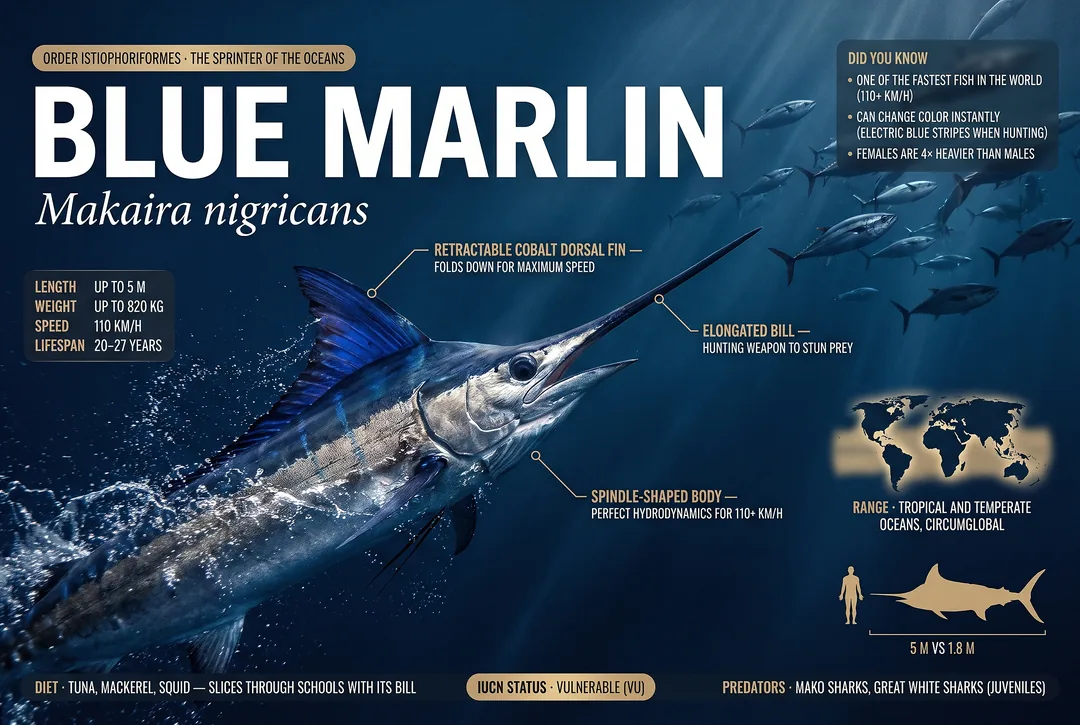
IDENTITY CARD
| Classification | Order Istiophoriformes, family Istiophoridae |
| Scientific name | Makaira nigricans (Atlantic) / Makaira mazara (Indo-Pacific) |
| Size | Females up to 5 m, males 2.5-3.5 m |
| Weight | Females up to 900 kg (IGFA record: 636 kg), males 100-180 kg |
| Speed | 80-100 km/h in sprint |
| Lifespan | Females 20-27 years, males 15-18 years |
| Depth | Surface to 1,000 m, hunts mainly 0-200 m |
| Diet | Carnivore — tuna, bonito, mackerel, squid, dorado |
| IUCN Status | Vulnerable (VU) |
PORTRAIT
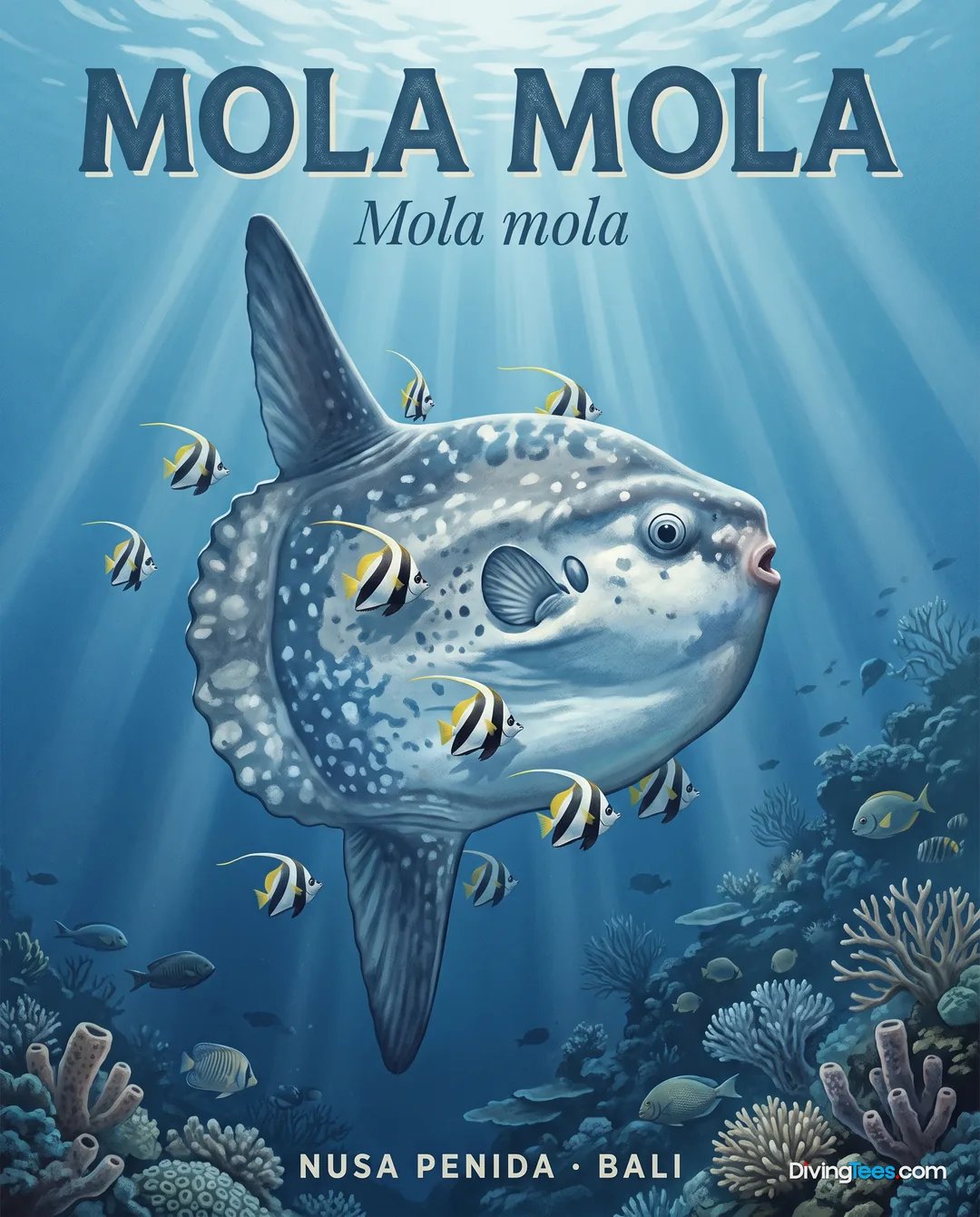
The blue marlin is the largest istiophorid and one of the largest bony fish on Earth. A female can exceed five metres and approach a tonne — among teleosts, only the ocean sunfish rivals it for sheer mass. The sexual dimorphism is spectacular: males rarely exceed 180 kilograms, making the female four to five times heavier than her mate. Everything about the animal is built for speed and power — a massive but hydrodynamic body, a rigid crescent tail convergent with those of tuna and mako sharks, and a cobalt-blue dorsal fin that folds neatly into a groove along the back during sprints.
For divers, the blue marlin is a holy grail. It does not frequent reefs or coastlines. It does not linger. It inhabits the open ocean, crossing entire ocean basins in a season, and the number of documented underwater encounters by divers can be counted on the fingers of one hand. Most people who see a blue marlin see it from a boat — breaching during a fight, or tailwalking across the surface in a display of raw, explosive athleticism. The lucky few who encounter one while snorkelling on a bait ball describe the experience in terms usually reserved for religious conversion.
There is a reason Hemingway wrote about this fish. The blue marlin occupies a singular place in the human imagination — a creature of the deep open water that is simultaneously one of the most powerful animals alive and one of the most difficult to see, let alone photograph, beneath the surface.
HOW TO RECOGNIZE IT
At sea, the blue marlin is identifiable by size alone. No other istiophorid approaches a tonne. The back is deep cobalt blue, the flanks bright silver, and when the animal is excited or hunting, approximately 15 pale blue vertical bars appear along the body — a display visible only to those close enough to see it, which means almost nobody.
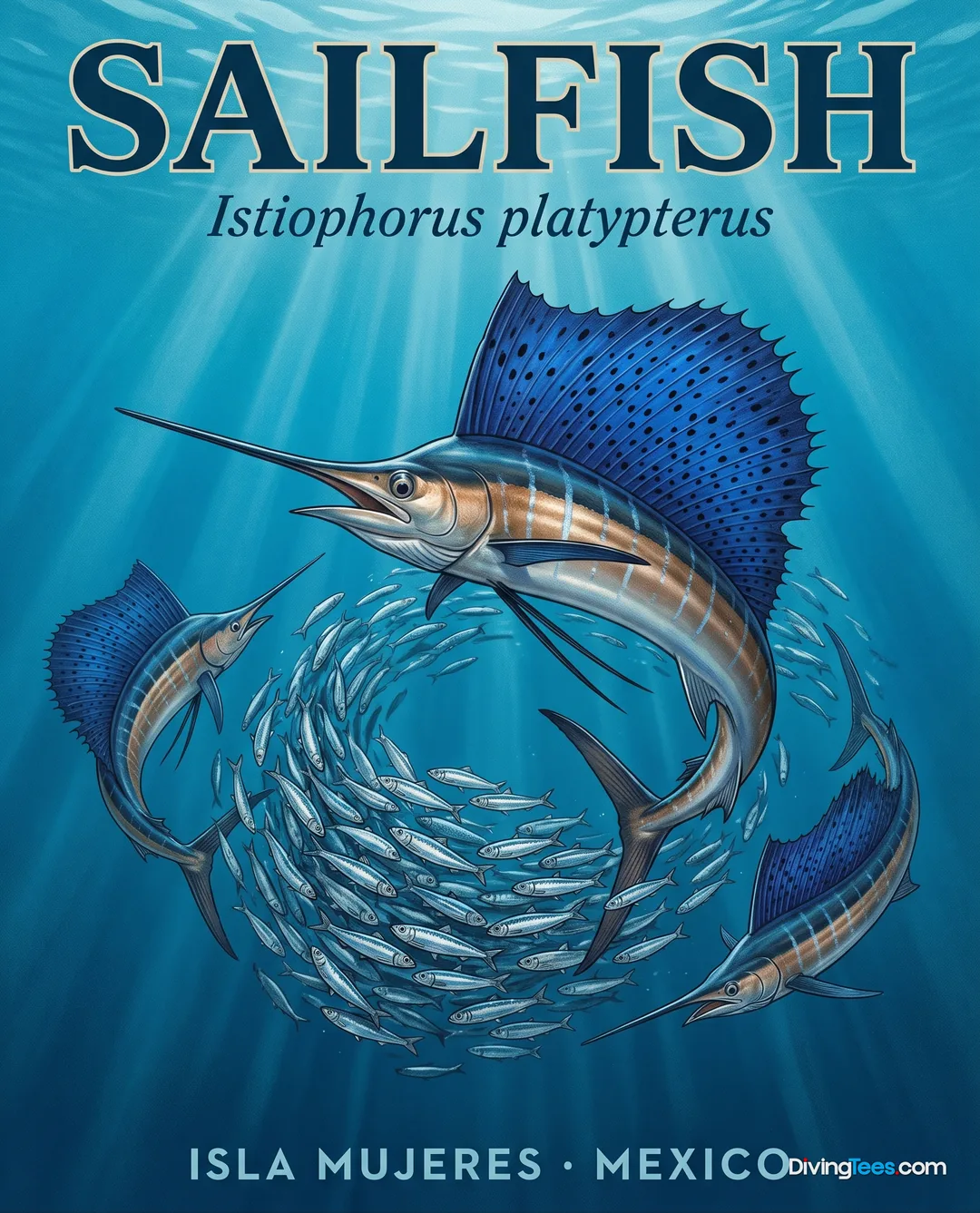
The dorsal fin is pointed and relatively low — much less than half the body height, a key distinction from the sailfish, whose enormous sail-like dorsal is its defining feature. The rostrum (bill) is long and round in cross-section, distinguishing it from the swordfish, whose bill is flat and blade-like. The white marlin is much smaller (rarely exceeding 80 kg) with foldable pectoral fins. The striped marlin is also smaller and more heavily marked.
In motion, the blue marlin folds its dorsal fin flat, holds its body rigid, and drives forward with short, turbine-like beats of its crescent tail. During hunting or when hooked, it tailwalks — leaping clear of the water and skipping across the surface on its tail, sometimes three metres above the waves.
For subtitles in English: start the video firstthen click the gearat the top right of the video, select “Subtitles/CC”, then “Auto-translate” and choose “English”.
WAY OF LIFE
The blue marlin is a solitary pelagic predator that covers thousands of kilometres each year, following warm currents across entire ocean basins. Satellite-tagged individuals have been tracked from the Caribbean to the Azores, to Madeira, to the coast of West Africa — transatlantic crossings of 6,000 kilometres or more.
Hunting occurs from the surface down to 200 metres, using the same lateral rostrum-strike technique as the sailfish but on a vastly larger scale: the marlin charges into a school of tuna or mackerel, slashing with its bill to stun or kill prey before circling back to feed. Telemetry data reveal regular dives to 500-800 metres — forays into the deep scattering layer to take squid — with records exceeding 1,000 metres. To maintain visual acuity and reaction speed in these cold, dark depths, the blue marlin possesses a remarkable adaptation: a rete mirabile (counter-current heat exchanger) that keeps its brain and eyes 10 to 15 degrees C above the ambient water temperature. It is, in effect, a warm-blooded hunter in a cold-blooded body.
Reproduction is prodigious. A single female can release up to seven million pelagic eggs in a spawning season — among the highest fecundities of any bony fish. Growth is explosive: a juvenile can reach 45 kilograms within its first year. Males mature at 2 to 4 years, females at 3 to 5.
WHERE TO SEE IT
Azores, Portugal. The premier destination for blue marlin in the Atlantic. The largest specimens are caught here from June to October, with a strong tradition of catch and release. The volcanic archipelago sits at the crossroads of Atlantic currents, concentrating pelagic predators in extraordinary numbers.
Cabo Verde. From March to June, Cabo Verde produces some of the largest blue marlin in the world — fish exceeding 400 kilograms are taken regularly. The warm, deep waters off the islands are a major spawning area.
Kona, Hawaii. Home to the Pacific species Makaira mazara and the Hawaiian International Billfish Tournament, running since 1959. Blue marlin are present year-round, with peak activity from July to October. The deep water close to shore makes Kona uniquely accessible.
Cancun and Isla Mujeres, Mexico. During the warm season, blue marlin patrol the waters off the Yucatan Peninsula. On rare occasions, snorkellers on bait balls off Isla Mujeres have encountered blue marlin feeding alongside sailfish — one of the most extraordinary wildlife spectacles in the ocean.
Cairns, Australia. From September to December, the waters near the Great Barrier Reef host the closely related black marlin (Istiompax indica) in one of the world's great game-fishing congregations.
OBSERVATION CALENDAR
Click each button to show/hide
CONSERVATION
The blue marlin is classified as Vulnerable (VU) on the IUCN Red List. Atlantic populations have declined by more than 60 percent since the 1960s. Pacific populations show a similar trajectory, though the data are less complete.
The threat is almost exclusively fishing. Commercial longline fleets targeting tuna and swordfish take enormous numbers of blue marlin as bycatch — the marlin strikes the bait meant for other species, and by the time it is hauled aboard, it is often dead or dying. Sport fishing adds additional pressure. Catch-and-release practices are growing in the recreational fleet, but post-release mortality remains significant — studies estimate 5 to 35 percent of released fish do not survive, depending on fight duration, water temperature, and handling.
The International Commission for the Conservation of Atlantic Tunas (ICCAT) manages blue marlin quotas in the Atlantic and has reduced allowable catches by 75 percent since 2000. Enforcement, however, remains uneven across member nations, and illegal, unreported catches continue to erode the population.
Organisations to support:
- The Billfish Foundation — research and advocacy for billfish conservation worldwide
- IGFA (International Game Fish Association) — promotes catch-and-release and sustainable sport fishing
- Oceana — campaigns to reduce bycatch in commercial longline fisheries
3 THINGS YOU PROBABLY DON'T KNOW
1. Its brain works warm, like a mammal's. The rete mirabile — a network of counter-current blood vessels behind the eye — keeps the blue marlin's brain and retinas 10 to 15 degrees C warmer than the surrounding water. This is not a minor metabolic quirk: it gives the marlin the visual acuity and neural processing speed of a warm-blooded predator in the lightless, near-freezing depths below 500 metres. It hunts in the dark with the reaction time of a falcon.
2. A single female can produce seven million eggs in one season. This is among the highest fecundities recorded in any bony fish — a classic r-strategy in which survival depends on sheer numbers. The paradox is that this reproductive strategy, which evolved to absorb natural predation, makes the species acutely vulnerable to the targeted removal of breeding adults by industrial fishing.
3. The world record will probably never be broken. Jay de Beaubien's 636-kilogram blue marlin, caught off Kona, Hawaii, in 1982, has stood for over four decades. Not because anglers have stopped trying, but because fish that size are now extraordinarily rare. Average catch size has been declining across every fishery for decades — the most visible, most measurable marker of a species in retreat.
PHOTO AND VIDEO TIPS
From a boat. This is how virtually all blue marlin photography happens. A telephoto lens in the 70-200 mm or 100-400 mm range captures tailwalking, breaching, and surface strikes. Shutter speed must be 1/2000s or faster to freeze the explosive action. Continuous autofocus is essential — the animal's movements are violent and unpredictable.
In the water. Underwater encounters are so rare that no standard technique exists. On the exceptional occasions when a snorkeller meets a blue marlin on a bait ball, the only advice is: wide-angle or fisheye, burst mode, and accept that luck is the only factor that matters. Point, shoot, and hope.
Slow motion. Video shot at 240 to 1,000 frames per second reveals what the eye cannot see: the lateral strike of the rostrum through a school of baitfish, the precise angle of the bill, the way the body rotates. This footage has transformed scientific understanding of billfish hunting mechanics.
Ethics. In catch-and-release sport fishing, the fish's survival takes absolute priority over photography. Fast, efficient release is the standard — never hold a blue marlin out of the water for a photograph, and minimise fight duration. The animal's life is worth more than any image.