Mako Shark
Isurus oxyrinchus
The fastest shark in the ocean never slows down.
IDENTITY CARD
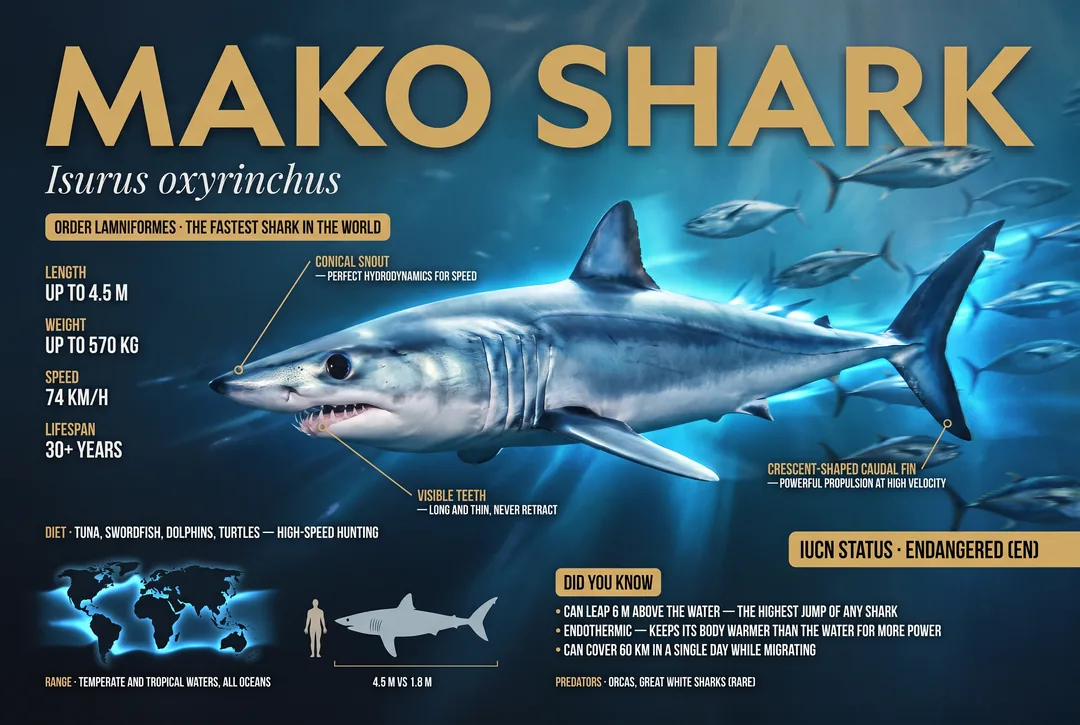
| Classification | Order Lamniformes, family Lamnidae |
| Scientific name | Isurus oxyrinchus (Rafinesque, 1810) |
| Size | Up to 4 m (average: 2.5-3.2 m) |
| Weight | Up to 570 kg (average: 60-135 kg) |
| Speed | Up to 74 km/h — the fastest shark in the world |
| Lifespan | 28-35 years |
| Depth | Surface to 740 m, most commonly 0-150 m |
| Diet | Pelagic predator — bony fish (tuna, swordfish, bonito), cephalopods, other sharks |
| IUCN Status | Endangered (EN) — global population declining |
PORTRAIT
Some sharks are admired. Others are feared. The mako is respected. It is a biological missile — a torpedo-shaped body sheathed in deep metallic blue, driven by a propulsion system that makes it, at 74 km/h, the fastest shark on the planet. It lacks the mass of a great white and the dark mystique of a tiger shark, but no other shark combines speed, intelligence and raw grace in such concentrated form.
Isurus oxyrinchus — the shortfin mako — belongs to the family Lamnidae, alongside the great white and the porbeagle. Like its relatives, it possesses a thermoregulatory system almost unheard of in fish: a network of counter-current heat exchangers called the rete mirabile keeps its muscles, eyes and brain up to 7 degrees C above the surrounding water temperature. The advantage is decisive — muscles permanently warm, permanently ready, even in cold water where its prey are sluggish. Sport fishermen have long known the mako for its speed, its fighting spirit and its spectacular leaps — sometimes clearing 6 metres above the surface. Ernest Hemingway made it the antagonist in The Old Man and the Sea, and the image of the shark that never lets go has clung to the species ever since.
But for the diver, the mako is a different proposition entirely. This is an open-ocean animal. It does not cruise a reef or glide along a wall. You have to go looking for it — offshore, in open blue water, often with bait in the current. And when it arrives, it arrives fast.
HOW TO RECOGNIZE IT
The mako is unlike any other shark, provided you see it long enough to look. The snout is conical, pointed, almost aerodynamic — the Greek oxyrinchus means "sharp nose." The body is fusiform, hydrodynamic, carrying not a gram of excess: every line has been drawn by 45 million years of selection for speed.
The colouration is unmistakable. A deep metallic blue covers the dorsal surface and flanks, giving way to immaculate white below. The demarcation is sharp, almost cut with a knife — a perfect countershading that renders the animal nearly invisible whether seen from above (blue on blue) or below (white against the bright surface). In clear water under sunlight, the intensity of that blue is something no photograph truly captures.
The teeth are the second giveaway. Fine, curved and non-serrated, they protrude from the jaw even when the mouth is closed — a permanent, unsettling grin. This is a predator that does not crush but impales and tears. The pectoral fins are short relative to the body — hence the common name shortfin — and the caudal fin is a near-symmetrical crescent, a trait shared with tuna and swordfish, its favourite prey and its rivals in speed.
For subtitles in English: start the video firstthen click the gearat the top right of the video, select “Subtitles/CC”, then “Auto-translate” and choose “English”.
WAY OF LIFE
The mako is a solitary open-ocean wanderer. Pelagic and migratory, it covers staggering distances: one tagged individual crossed 7,500 km from the United States to Portugal. It follows currents, warm water masses (12-25 degrees C preferred) and concentrations of prey — primarily fast fish such as tuna, bonito, mackerel and swordfish.
Its diet tells you everything about what it is. Hunting a swordfish means pursuing a 200 kg animal capable of 100 km/h, armed with a razor-sharp rostrum. Rostrum scars are frequently found on captured makos — evidence that these duels are routine and violent. To win them, the mako attacks from below, targeting the caudal peduncle of its prey to strip away propulsion before consuming it.
Reproduction is slow, which largely explains the species' vulnerability. Females reach sexual maturity around 18 years of age, males around 8. Gestation lasts 15 to 18 months. Each litter contains 4 to 25 pups (average 12), already measuring 70 cm at birth. The species is ovoviviparous with oophagy: the most developed embryos feed on unfertilised eggs inside the uterus — an intrauterine cannibalism shared with the great white.
The mako is also one of the few sharks to breach. These leaps — up to 6 metres above the surface — appear linked either to hunting (disorienting prey) or to parasite removal. Fishermen know them all too well: a hooked mako jumps, again and again, until it breaks free or exhausts itself.
WHERE TO SEE IT
The mako is not a reef shark. Observing it underwater requires heading offshore, usually aboard a specialised vessel with a controlled baiting protocol. Chance encounters exist but are rare and brief — the mako does not linger. These are the destinations where dedicated operators run trips or where open-water sightings are well documented:
Azores — offshore banks. The Portuguese archipelago has become one of the best destinations in the world for mako diving. The deep, tuna-rich waters off Faial, Pico and Sao Miguel attract makos from June to October. Several operators offer cage dives or free-swimming encounters with controlled bait. Open-water visibility is often excellent (20-30 m), and encounters with individuals of 2.5 to 3.5 m are regular.
South Africa — offshore from Cape Point. The western Cape coast, bathed in the cold, nutrient-dense Benguela Current, supports a resident mako population. Trips depart from Simon's Town or Hout Bay, often combined with blue shark sightings. The season runs from November to June, peaking February to April. Waters are cold (14-18 degrees C) and visibility variable (5-15 m), but encounters are frequent and individuals often large.
New Zealand — Poor Knights Islands. The temperate waters off the North Island host seasonal makos from January to May. The Poor Knights Islands, a protected marine reserve, provide a spectacular setting. Operators from Tutukaka and Whitianga run open-water trips. New Zealand is one of the few places where makos are regularly observed in relatively coastal waters.
Mexico — Baja California. The waters off Cabo San Lucas and Magdalena Bay, in the California Current, concentrate makos from October to March. The region is also known for marlin and swordfish — the mako's favourite prey. Several operators from La Paz and Cabo San Lucas run dedicated outings.
USA — Rhode Island and Montauk. The northeastern US coast, from Montauk (Long Island) to Point Judith (Rhode Island), is a historical mako hotspot. The season is short — June to September — but concentrations can be dense, drawn by schools of mackerel and bluefin tuna riding the Gulf Stream. Local operators primarily cater to sport fishing, but a few open-water observation trips exist.
OBSERVATION CALENDAR
| Destination | J | F | M | A | M | J | J | A | S | O | N | D |
|---|---|---|---|---|---|---|---|---|---|---|---|---|
| Azores (Faial/Pico) | ||||||||||||
| South Africa (Cape Point) | ||||||||||||
| New Zealand (Poor Knights) | ||||||||||||
| Mexico (Baja California) | ||||||||||||
| USA (Rhode Island/Montauk) |
Click each button to show/hide
CONSERVATION
Isurus oxyrinchus has been listed as Endangered (EN) on the IUCN Red List since 2019. That same year it was placed on Appendix II of CITES, and it appears on Appendix I of the Convention on Migratory Species (CMS). These protections are recent — and they came late.
The mako is the most heavily fished pelagic shark in the world. Its flesh, marketed as "veal of the sea" in Europe, is prized across the continent and in Asia. Its fins command high prices on Asian markets. And sport fishing, which preferentially targets the largest reproductive individuals, compounds the pressure on a species whose reproduction is already desperately slow: a female does not begin breeding until age 18, and produces only one litter every three years.
In the North Atlantic, the population has declined by approximately 50% over three generations. ICCAT, the body that manages tuna and associated species in the Atlantic, took years to impose binding quotas despite repeated scientific advice. Measures adopted in 2021 — mandatory release of live individuals — represent progress, but enforcement on the high seas remains difficult to control.
Bycatch is a major threat: the mako is frequently caught on longlines set for tuna and swordfish. Even when released, an individual exhausted by hours of fighting on a line faces high post-release mortality.
A diver who encounters a mako at sea encounters an animal in danger. Every sighting is a privilege — and one more argument for protecting a species whose value alive, for ecotourism, infinitely exceeds its value dead on a market slab.
Organisations to support:
- Shark Trust — campaigns for pelagic shark protection in the Atlantic and Mediterranean
- IUCN Shark Specialist Group — scientific population assessment and management recommendations
- Shark Spotters — South African shark-human coexistence programme
- PADI AWARE — citizen science programme and sighting reports
3 THINGS YOU PROBABLY DON'T KNOW
1. It sees in the dark — and in colour. The mako possesses an exceptional density of rod cells in its retina, giving it formidable night vision. But unlike most sharks, it also has cone cells — meaning it probably distinguishes colours, a decisive advantage for spotting the flash of a tuna in the deep blue. Combined with the endothermy that keeps its eyes above ambient temperature, it commands a visual system without equal among sharks.
2. It is closer to the great white than you might think. Genetic analysis has shown that the mako and the great white shark are very close cousins within the Lamnidae family. Their common ancestor lived approximately 45 million years ago. The two species share endothermy, intrauterine oophagy and an intelligence unusual among sharks: experiments in captivity have shown that the mako learns to distinguish geometric shapes and modifies its behaviour in response to rewards — a cognitive level comparable to that of marine mammals.
3. Its nose is an aerodynamic masterpiece. The conical shape of the mako's snout is not merely aesthetic. Researchers have demonstrated that the dermal denticles covering its skin are flexible and rise when swimming, reducing drag by approximately 10%. This discovery has inspired aeronautical engineering research — the mako's skin is literally being studied for the design of more efficient aircraft coatings.
PHOTO AND VIDEO TIPS
The mako is one of the most difficult and most rewarding underwater subjects. Its speed and unpredictability make it a permanent technical challenge — but a successful shot of a mako in open water is an image few photographers can show.
Lens. Wide angle is mandatory: 15-20 mm rectilinear or fisheye in a housing. The temptation of a telephoto is strong — the animal is often at distance — but the mako gives no warning when it closes in. If a close pass comes and you are shooting at 70 mm, you will frame nothing but a blurred flank. With a fisheye, you will have the entire animal in frame even at 2 metres.
Light. Mako encounters take place in open water, often between 5 and 20 metres. Natural light is your best ally for rendering the metallic blue of the dorsal surface. Strobes are useful for close-ups, but beware of the reflection off the smooth skin — dial down the power or use a diffuser. Backlighting produces spectacular silhouettes, especially with the crescent tail carved against the blue.
Approach. You do not approach a mako — you make yourself available and let it come. Most dive encounters use surface bait: the shark circles, approaches, departs. Close passes are brief — often 2 to 5 seconds. The reflex to cultivate: be in shooting position before it arrives, not when it passes. Pre-set your focus, pre-frame in the likely direction, and wait.
Video. The mako was made for video. Its speed, the fluidity of its movements and its sudden changes of direction produce naturally cinematic sequences. Shoot at 60 fps minimum — slow motion reveals details (pectoral flex, eye rotation) invisible in real time. Stabilisation is essential.
Classic mistake. Chasing the shark. The mako cruises at 25-30 km/h. A diver, even finning flat out, tops 3 km/h. Any pursuit is not only futile but counterproductive: the agitation drives the animal away. Stay still, let it make the circles, and make the most of every pass.