



Plongée à Hamanasi Adventure & Dive Resort
Google 4.9/5 (783 reviews)
Belize · Americas
Ancient stalactites, a circular blue-hole formation and dives beyond thirty metres define Hopkins for divers prepared to manage depth carefully.
For subtitles in English: start the video firstthen click the gearat the top right of the video, select “Subtitles/CC”, then “Auto-translate” and choose “English”.
Hopkins is a Belize base for divers drawn to serious depth and unusual geology rather than a purely shallow reef holiday. The defining underwater encounter is Lighthouse Reef Atoll & Blue Hole, where a circular geological formation drops steeply and ancient stalactites appear at depth. This is a destination for a diver who enjoys planning the dive as carefully as the sightseeing: buoyancy, gas reserves and no-decompression limits matter as much as the formations themselves.
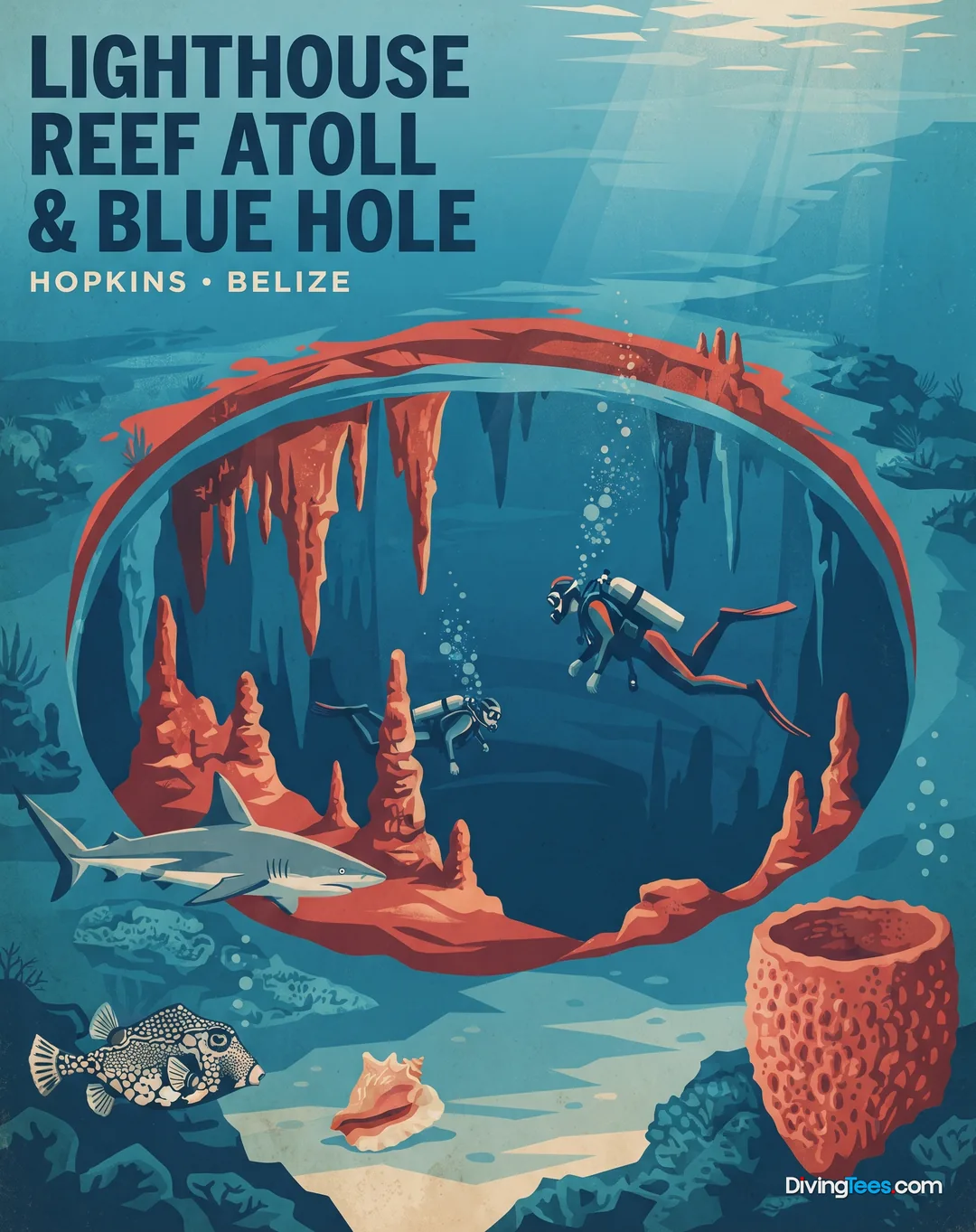
The named dive profile is dominated by depth and geology. Lighthouse Reef Atoll & Blue Hole centres on the circular Blue Hole formation, with the dive taking experienced recreational divers beyond thirty metres and towards a stated maximum of forty metres. The visual reward is not a wall of named marine life but the chance to inspect ancient stalactite formations in an underwater geological setting. Solid buoyancy control helps here, both for precise depth management and for avoiding contact with fragile formations. The supplied profile does not establish a current pattern or typical visibility figures, so those should not be assumed when planning the dive. This is a deep outing requiring proper gas management and a clear no-decompression plan, rather than an improvised extension of a shallow reef dive.
The strongest documented encounters around Hopkins are geological rather than animal-led. At Lighthouse Reef Atoll & Blue Hole, the feature to look for is the ancient stalactite formation, encountered during a deep descent through the circular Blue Hole. That gives the dive a very different character from a shallow reef circuit: attention shifts to structure, depth and the changing perspective of the formation. No seasonal species or named marine animals are supplied for this destination, so the reliable reason to come is the underwater geology itself. Divers should judge the site by the quality of that deep, physical encounter, not by expecting a particular animal at a particular time of year.
The measured pattern gives two useful planning windows. The sea is at its calmest from August to December, making that the more logical period when a deep site and controlled descent are the priority. Rainfall is measured lowest from January to May, which may suit travellers who place more weight on generally drier conditions. These are different advantages rather than a single perfect season: choose the calmer window for the water, or the drier window for the wider holiday. The available measurements do not attach a separate wildlife season to Hopkins.
This coast is exposed to sargassum strandings, whose intensity varies greatly from year to year. To find out more, see the “Sargassum alert” panel on this page.
This destination suits Advanced Open Water divers and their equivalents, with real deep-diving experience rather than only classroom certification. Operators may also expect a minimum number of logged dives before accepting a diver for the Blue Hole profile. PADI and SSI divers should bring evidence of appropriate advanced and deep training; BSAC members should likewise carry documentation showing comparable experience. Anyone uncomfortable with buoyancy, depth or gas planning will find the forty-metre ceiling a poor place to consolidate those skills.
From London Heathrow, Gatwick or Manchester, the journey to Hopkins needs to be assembled around the available routing into Belize rather than treated as a simple direct hop to the village. The important practical point is to protect the onward connection: allow enough margin between international and domestic or ground movements, and do not build a demanding dive immediately after a disrupted travel day. Hopkins itself is the destination base, so the final leg must be planned as part of the transfer rather than left to chance on arrival. Keep the confirmed routing, connection times and local transfer arrangements together before leaving the UK; the supplied destination material does not establish a single airport, journey duration or fixed local transport pattern.
Treat Lighthouse Reef Atoll & Blue Hole as a planned deep dive, not as a sightseeing add-on. The decisive preparation is a conservative no-decompression profile, enough gas for the depth and buoyancy control that remains reliable beyond thirty metres. A diver carrying an Advanced Open Water or equivalent qualification should also be ready to demonstrate recent logged experience if the deep profile is subject to an operator minimum. Do not assume that reaching the stated forty-metre recreational maximum is the objective: the ancient stalactites are the point, and the dive should be shaped around seeing them without turning depth into a target. Because the measured calm-water window runs from August to December, that period makes the most sense for divers who want the least uncertainty from the sea. Those travelling between January and May may instead value the lower rainfall.
A Hopkins stay is best organised around the demands of the deep Blue Hole outing, with enough time to arrive settled and to keep the dive from becoming a rushed travel-day commitment. Divers who prefer lower rainfall can use January to May; those prioritising calmer water should look to August through December. The rest of the stay can remain flexible, since the supplied material gives no further named underwater fauna or shore programme to structure around.
Hello, I'm Marina, DivingDeal.com's AI assistant. I guide you through destinations, areas and countries.
Thinking about the whole trip and the flights? Talk it over with Edith →
Marina is an AI. Some links are affiliate links: DivingDeal may earn a commission, at no extra cost to you. Bookings are made with the partner.
Your last day stays dry: no diving in the 18-24 hours before a flight, the perfect window to see the destination from another angle.
 Culture
⏱ 8 h · ★ 5.0 (29 reviews)
from £209$280€250
see on Viator ↗
 Adventure
⏱ 6 h · ★ 5.0 (8 reviews)
from £141$188€168
see on Viator ↗
 Culture
⏱ 7 h · ★ 5.0 (6 reviews)
from £175$234€209
see on Viator ↗
 Nature
⏱ 5 h · ★ 4.5 (25 reviews)
from £95$127€114
see on Viator ↗
Ratings and reviews collected by Viator and Tripadvisor.
Choose August to December if calmer measured seas matter most for the deep Blue Hole outing. January to May has lower measured rainfall and may suit you if drier conditions matter more. These windows offer different planning advantages, and no separate wildlife season is established for Hopkins.
You should have Advanced Open Water certification or equivalent, along with real deep-diving experience. Operators may require a minimum number of logged dives for the Blue Hole profile. Bring evidence of advanced and deep training, and be ready to demonstrate reliable buoyancy, gas management and no-decompression planning.
At Lighthouse Reef Atoll and Blue Hole, you can explore a circular geological formation and encounter ancient stalactites during a deep descent. The attraction is the underwater geology and changing perspective of the formation, rather than named marine life or a particular seasonal animal encounter.
Organise your stay around a planned deep Blue Hole dive, allowing time to arrive settled rather than diving after a demanding travel day. Confirm your routing, connections and local transfer arrangements before leaving the UK. Keep gas planning, buoyancy control, no-decompression limits and recent experience in focus.