Scalloped Hammerhead Shark
Sphyrna lewini
A head sculpted by evolution to see in 360 degrees — and sense what no other shark can perceive.
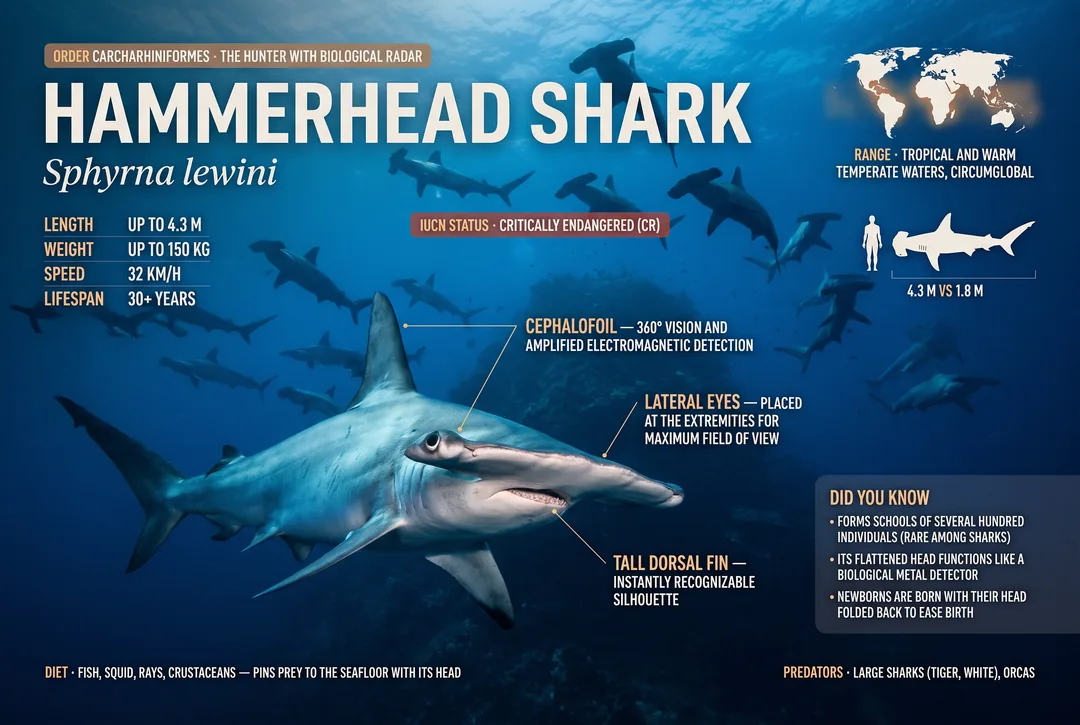
IDENTITY CARD
| Classification | Order Carcharhiniformes, family Sphyrnidae |
| Scientific name | Sphyrna lewini (Griffith & Smith, 1834) |
| Size | Up to 4.3 m (typical observed range: 2.5-3.5 m) |
| Weight | Up to 150 kg |
| Speed | ~32 km/h in bursts |
| Lifespan | 30 years and beyond |
| Depth | Surface to over 500 m, but most commonly observed between 20 and 40 m |
| Diet | Generalist predator — pelagic fish, cephalopods, rays, crustaceans |
| IUCN Status | Critically Endangered (CR) — severe population decline since the 1990s |
PORTRAIT
There is one silhouette every diver recognizes before it even comes into focus: the shape that materializes out of the open blue, flattened head sweeping side to side, gliding in single file with dozens of others just like it. The scalloped hammerhead shark looks like nothing else in the ocean — and that is precisely what makes the encounter unforgettable.
Sphyrna lewini owes its profile to the cephalofoil, that lateral expansion of the skull that carries the eyes and nostrils out to its extremities. Far from being a mere anatomical curiosity, this structure is a masterpiece of sensory engineering: it grants the shark near-panoramic vision and dramatically amplifies its ability to detect the faintest electric fields emitted by prey, including those buried beneath the sand. The hammer is not a hydrodynamic handicap — it is a hunter's advantage.
What strikes the diver who encounters this species is also its schooling behavior, exceedingly rare among sharks of this size. Off certain rocky pinnacles in the eastern Pacific, aggregations of several hundred individuals form in midwater, spiraling slowly above the reef. Swimming among — or more precisely at the edge of, since the animal remains wary — one of these schools is an experience few other underwater encounters can match.
HOW TO RECOGNIZE IT
The cephalofoil of the scalloped hammerhead is distinct from its relatives: the leading edge is rounded and slightly scalloped at the center, without the deep indentations of the great hammerhead (Sphyrna mokarran) or the nearly straight profile of the smooth hammerhead (Sphyrna zygaena). It is this gently undulating contour, shaped like a rounded delta wing, that gives the species its scientific epithet — lewini, from the crescent-shaped horn.
The body is streamlined, grey-bronze to grey-brown on the dorsal side, white below, with the tip of the pectoral fin often darkened. The first dorsal fin is tall and falcate, noticeably larger than that of the smooth hammerhead — a useful marker when distinguishing the two species in mixed schools, which does occur at certain sites.
Underwater, identification often happens at range, before any detail becomes clear: the formation swimming with the head oscillating gently from side to side — a sweeping motion that optimizes electrosensory detection — gives the species away from the first meters of visibility.
For subtitles in English: start the video firstthen click the gearat the top right of the video, select “Subtitles/CC”, then “Auto-translate” and choose “English”.
WAY OF LIFE
The scalloped hammerhead is one of the few large sharks that is truly social. Adult females in particular form schools numbering in the hundreds near seamounts and isolated volcanic pinnacles — a behavior researchers attribute to a combination of thermoregulation, predator avoidance, and social signaling linked to reproduction. Hierarchy within the school appears to be negotiated through posture and relative positioning, a behavior documented extensively in the Galapagos.
At night, these schools break apart: each shark hunts alone, often in deeper water, guided by its amplified electroreceptors to locate buried prey — rays, flatfish, cephalopods — before rejoining the school at dawn.
The species is viviparous: embryos develop connected to the mother via a yolk-sac placenta, with litters typically numbering 15 to 30 pups after a gestation of nine to ten months. Remarkably, newborns emerge with their cephalofoil folded backward against the body, still supple like unmolded cartilage — an adaptation that eases delivery, unfolding and stiffening within hours of birth. Nursery grounds are found in shallow coastal waters, mangroves, and sheltered bays, far from the seamounts where adults form their schools.
WHERE TO SEE IT
The scalloped hammerhead inhabits warm-temperate and tropical waters worldwide, but its spectacular aggregations occur at only a handful of sites, nearly all associated with isolated seamounts swept by strong currents.
Galapagos — Wolf and Darwin. The world's benchmark site. The schools patrolling off these two northern islands of the archipelago are among the densest known, particularly in open water beyond the wall. Diving here is reserved for advanced levels — sustained currents, drift entries, depth, and blue-water exposure are the norm.
Cocos Island, Costa Rica. This remote national park, 500 km offshore, is the other great sanctuary of the eastern Pacific. Bajo Alcyone and Dirty Rock are renowned for their schools, observable year-round but densest from June to November. Accessible only by multi-day liveaboard.
Malpelo, Colombia. A rocky islet isolated in the open Pacific, a UNESCO World Heritage Site. The walls of La Nevera and El Fantasma attract large schools, in current conditions among the most demanding in the region.
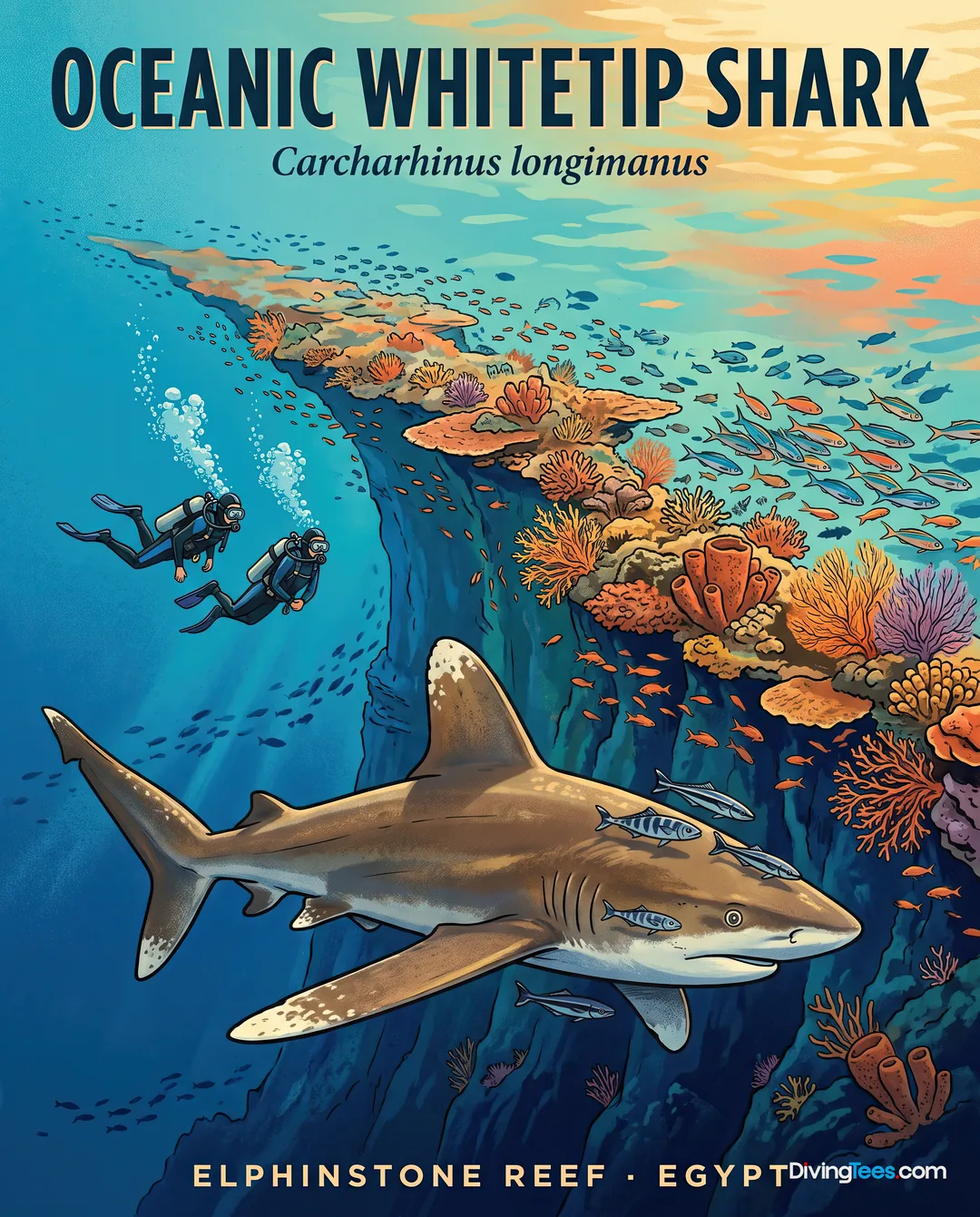
Red Sea — Egypt. The Brothers (Big Brother and Little Brother), Daedalus Reef, and Elphinstone form the legendary triangle where scalloped hammerheads cruise in open water off the walls, typically in the early morning hours. Sightings are seasonal, concentrated from June to September.
Layang Layang, Malaysia. This remote atoll in the South China Sea, nicknamed "the pearl of Borneo," is one of the few sites in Southeast Asia where the species gathers in numbers, along the north wall between April and June.
Rangiroa, French Polynesia. In the Tiputa Pass, scalloped hammerheads are observed at depth, often at the edge of visibility, mainly from December to March — an encounter rarer and more fleeting than in the Galapagos, but sought after by divers in the region.
OBSERVATION CALENDAR
| Destination | J | F | M | A | M | J | J | A | S | O | N | D |
|---|---|---|---|---|---|---|---|---|---|---|---|---|
| Galapagos (Wolf/Darwin) | ||||||||||||
| Cocos Island (Costa Rica) | ||||||||||||
| Malpelo (Colombia) | ||||||||||||
| Red Sea (Brothers/Daedalus) | ||||||||||||
| Layang Layang (Malaysia) | ||||||||||||
| Rangiroa (French Polynesia) |
Click each button to show/hide
CONSERVATION
Sphyrna lewini is classified as Critically Endangered (CR) on the IUCN Red List — the highest threat level before extinction in the wild. The species has been listed on Appendix II of CITES since 2013, a protection secured precisely because of the pressure exerted by the shark fin trade.
The primary threat remains targeted fishing for the shark fin market: the species' distinctive cephalofoil makes its fins particularly identifiable and prized on Asian markets, turning it into one of the most targeted species in the trade. Added to this are massive bycatch losses in the nets and longlines of industrial tuna fisheries, and the degradation of coastal mangroves that serve as nurseries — habitat already under pressure across most tropical regions.
The schooling behavior that makes the species so magnificent for divers is also its vulnerability: aggregations concentrated around a small number of known seamounts are easy targets for organized fishing, and the decline of certain regional populations exceeds 90% since the 1990s.
The responsible diver keeps a respectful distance, avoids sudden movements that would scatter the school, and never pursues a lone individual that has broken away to observe the divers — a curiosity behavior best left to unfold without interference.
Organizations to support:
- MigraMar — research and satellite tracking of eastern Pacific hammerhead sharks, Galapagos to Malpelo
- Fins Attached — protection of hammerhead populations in the Galapagos
- Save Our Seas Foundation — funding elasmobranch research projects worldwide
- PADI AWARE — citizen science program, sighting reporting
3 THINGS YOU PROBABLY DON'T KNOW
1. Its head sees what yours never will. Thanks to the wide spacing of its eyes at the two extremities of the cephalofoil, the scalloped hammerhead commands a binocular field of vision in nearly every direction, including above and below — an optical advantage no conventionally-headed shark possesses. Some studies even suggest near-complete 360-degree stereoscopic vision.
2. It is born with its head folded. To ease delivery, scalloped hammerhead embryos develop with their cephalofoil folded backward against the body, still pliable. In the hours following birth, the structure unfolds and gradually stiffens until it assumes the characteristic adult shape.
3. Its schools have a social hierarchy. The aggregations of several hundred individuals observed at the Galapagos and Cocos Island are not passive clusters: researchers have documented dominance postures and preferential positions within the school, negotiated through precise swimming movements — social behavior of a sophistication rare among sharks, a family otherwise renowned for solitary ways.
PHOTO AND VIDEO TIPS
The scalloped hammerhead is a demanding subject: skittish, often encountered in open water at the edge of visibility, in currents that leave little time to adjust settings.
Lens. Wide angle is mandatory, ideally a fisheye 8-15 mm in a housing, to capture both the school's silhouette and the blue depth of field that gives the scene its scale. On an action camera, choose a non-cropped wide-angle mode.
Light. The species typically cruises between 20 and 40 meters, a depth where red has already largely vanished from the spectrum. A slight white balance adjustment or a red filter in video mode restores contrast to the grey skin without distorting the blue of the water. Flash is counterproductive at this distance — it illuminates only the suspended particles between the lens and the animal.
Approach. Never swim toward the school: the species is nervous and disperses at the slightest frontal movement. The best approach is to position yourself upcurrent, motionless or in a slow drift, and let the school come naturally into your field of view. Staying low against the wall rather than hanging in open water reduces the silhouette perceived as threatening.
Classic mistake. Chasing the school the moment it moves away. This reflex, almost always futile against animals that are faster and far more energy-efficient, accelerates the dispersal and ruins the rest of the dive. Better to settle in and wait: an undisturbed school often returns to the same wall within minutes.