Bull Shark
Carcharhinus leucas
The only shark that swims up rivers — and the most feared predator of shallow waters.
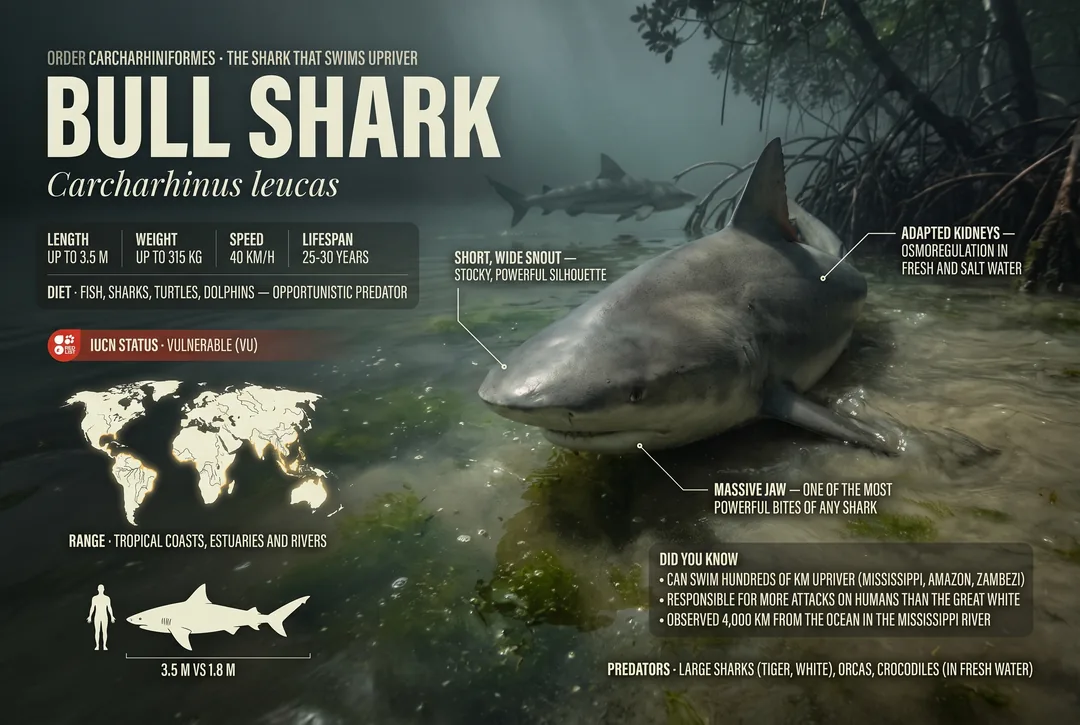
IDENTITY CARD
| Classification | Order Carcharhiniformes, family Carcharhinidae |
| Scientific name | Carcharhinus leucas (Muller & Henle, 1839) |
| Size | Up to 3.5 m (typical observed range: 2.1-2.4 m) |
| Weight | Up to 315 kg (average: 95-130 kg) |
| Speed | ~18 km/h burst, ~5 km/h cruising |
| Lifespan | 25-30 years (estimates up to 32 years) |
| Depth | Surface to 150 m, but most commonly observed between 1 and 30 m |
| Diet | Opportunistic predator — bony fish, other sharks, rays, turtles, crustaceans, cephalopods, marine mammals |
| IUCN Status | Near Threatened (NT) — formerly Vulnerable, reassessed in 2020 |
PORTRAIT
The bull shark does not deal in subtlety. Where other sharks cruise the open ocean, this one patrols estuaries, river mouths, turbid lagoons and harbour channels — sometimes in less than a metre of water. It is the shark of places where nobody expects a shark. And that, precisely, is what makes it both fascinating and feared.
Carcharhinus leucas is the only truly euryhaline shark: it moves from salt water to fresh water with no apparent physiological strain. It has been documented more than 4,000 km up the Mississippi, in Lake Nicaragua, in the Zambezi, the Ganges, the Brisbane River and South Africa's Breede River. Its kidneys and rectal gland continuously adjust the concentration of its internal fluids — a feat of osmoregulation that virtually no other shark possesses.
That unique ability gives the bull shark access to an immense territory, but it has also cemented its reputation. Together with the great white shark and the tiger shark, it ranks among the three species implicated in the highest number of incidents with humans. Its preferred hunting grounds — warm, shallow, low-visibility coastal waters — are also the waters where swimmers and surfers congregate. Underwater, however, encounters tell a different story entirely: the bull shark is a powerful, direct, impressive animal, and divers who spend time with it regularly describe a readable predator whose behaviour is easier to decode than that of many pelagic species.
HOW TO RECOGNIZE IT
The bull shark earns its name. Its body is stocky, heavy-set, with a short, rounded snout that gives it a distinctive silhouette — that of a bull. The head is broad and flattened, lacking the streamlined profile of reef sharks. The lower jaw carries thin, pointed teeth designed for gripping; the upper jaw wears broad, triangular, serrated teeth built for slicing — a devastatingly effective combination across a wide range of prey.
Underwater, sheer bulk is the tell. A 2.5-metre bull shark is noticeably thicker than a grey reef shark of the same length. The back is dark grey, the belly white, with no distinguishing marks — no stripes, no spots, no pattern. The pectoral fins are broad and triangular. The first dorsal fin is tall; the second is conspicuously smaller. The fin tips are often darker on juveniles, but this trait fades with age.
The absence of any distinctive marking is, paradoxically, the best identification criterion: a large, stocky, plain grey shark with a rounded snout in shallow coastal waters is very likely a bull shark.
For subtitles in English: start the video firstthen click the gearat the top right of the video, select “Subtitles/CC”, then “Auto-translate” and choose “English”.
WAY OF LIFE
The bull shark is an opportunistic, solitary predator. It hunts at dawn and dusk, in waters where turbidity works in its favour. Its diet is among the broadest of any shark: bony fish, other sharks (including juveniles of its own species), rays, turtles, seabirds, dolphins, crustaceans. In fresh water it also takes freshwater fish, and in Africa, juvenile hippopotami have been found in stomach contents.
Its ability to live in fresh water is not an accident of biology — it is a reproductive strategy. Females ascend estuaries and rivers to give birth in brackish or fresh water, where large marine predators are absent. Juveniles spend their first years growing in these riverine nurseries, relatively sheltered, before heading out to sea. The species is viviparous placental: gestation lasts 10 to 11 months and produces litters of 1 to 13 pups, measuring 55 to 80 cm at birth.
The home range of an adult bull shark is relatively small for a shark of its size. Telemetry studies show strong site fidelity: many individuals return season after season to the same coastal areas, which explains the regularity of dive-site observations at certain locations.
WHERE TO SEE IT
The bull shark inhabits all tropical and subtropical coastlines worldwide, but a handful of destinations offer reliable encounters, often managed by specialist operators:
Mexico — Playa del Carmen (Quintana Roo). From November to March, bull sharks gather in coastal waters off Playa del Carmen at depths of 18 to 25 metres. Most dives are conducted without a cage and without baiting, with groups of 5 to 20 individuals sighted regularly. It is now one of the most accessible bull shark destinations in the world — clear water, light current, and experienced operators.
Fiji — Beqa Lagoon. The Shark Reef Marine Reserve, off Pacific Harbour, is one of the planet's most celebrated shark diving sites. Bull sharks are present year-round, alongside tiger sharks, grey reef sharks and whitetip reef sharks. Dives are managed and include a controlled shark feed, guaranteeing close-range observations. Depth: 20-30 m.
South Africa — Aliwal Shoal and Protea Banks (KwaZulu-Natal). Ragged-tooth sharks share these waters with bull sharks from December to May. Diving conditions are athletic — cool water, current, variable visibility — but the shark density is exceptional. Some operators offer baited dives.
Africa — Zambezi and tributaries. The bull shark is known here as the "Zambezi shark." It is encountered in the estuary and upstream, as well as along the Mozambican coast. Structured dive observations are rare in this region, but it is here that the species was first described and its freshwater adaptation is best documented.
USA — Jupiter (Florida). From December to April, waters off Jupiter Inlet concentrate migrating bull sharks. Local operators run drift dives at 20-25 m depth, with regular encounters. The proximity to Palm Beach and Miami makes it the most accessible North American destination for the species.
OBSERVATION CALENDAR
| Destination | J | F | M | A | M | J | J | A | S | O | N | D |
|---|---|---|---|---|---|---|---|---|---|---|---|---|
| Mexico (Playa del Carmen) | ||||||||||||
| Fiji (Beqa Lagoon) | ||||||||||||
| South Africa (Aliwal Shoal) | ||||||||||||
| Mozambique (south coast) | ||||||||||||
| Florida (Jupiter) |
Click each button to show/hide
CONSERVATION
Carcharhinus leucas is classified Near Threatened (NT) on the IUCN Red List following its 2020 reassessment, after more than a decade listed as Vulnerable. The status change does not reflect an improvement in population numbers: it reflects a better understanding of the species' actual range, which turned out to be larger than previously thought.
The threats remain severe. The bull shark is one of the most heavily fished sharks in the world, both through targeted catches — for its fins, meat and liver oil — and as bycatch in coastal nets, where captures are massive because the species lives precisely where fisheries operate. Its biology makes it particularly vulnerable: late sexual maturity (8-10 years for females), modest litter sizes, and a biennial reproductive cycle.
Coastal urbanisation and the degradation of estuaries are destroying its natural nurseries — juveniles that once grew up in brackish water are losing their habitat. River pollution, dams and channel dredging fragment its freshwater corridors. In Australia, the shark net programmes in Queensland and New South Wales capture hundreds of bull sharks every year, most of them fatally.
The diver who encounters a bull shark follows the fundamentals: no sudden movements, no dominant position (never swim above the animal), no direct flash, and a distance of 3 to 5 metres. A bull shark approaching head-on deserves heightened attention — it is exploratory behaviour, not necessarily aggressive, but it calls for a calm, lateral response.
Organisations to support:
- Shark Foundation — shark research and education, conservation project funding
- Fiji Shark Studies — tagging and population monitoring in Beqa Lagoon
- Save Our Seas Foundation — elasmobranch research project funding
- PADI AWARE — citizen science programme, sighting reports
3 THINGS YOU PROBABLY DON'T KNOW
1. It has been found 4,200 km from the sea. Bull sharks have been caught in the Mississippi at Alton, Illinois, more than 1,800 km from the river mouth. In the Amazon, specimens have been reported at Iquitos, Peru — 4,200 km from the Atlantic. In Nicaragua, a resident population lives permanently in Lake Nicaragua (Lake Cocibolca), 170 km from the coast, commuting to the Caribbean Sea via the San Juan River.
2. It is probably responsible for the most famous shark attack in history. In July 1916, a series of attacks in New Jersey — four dead in twelve days — terrorised the Eastern Seaboard and inspired, sixty years later, Peter Benchley's novel Jaws. Long attributed to a great white shark, the attacks partly took place in a brackish estuary (Matawan Creek) — a habitat incompatible with the white shark but perfectly suited to the bull shark. Most experts today consider that at least the Matawan Creek attacks were the work of a Carcharhinus leucas.
3. Its blood contains more urea than any coastal shark. To survive in fresh water, the bull shark halves the concentration of urea and TMAO in its blood — an adjustment that would take most cartilaginous fish days. The bull shark does it in hours. Its kidneys then produce urine twenty times more dilute than in seawater, and its rectal gland virtually stops secreting salt. It is one of the most remarkable physiological adaptations of any elasmobranch.
PHOTO AND VIDEO TIPS
The bull shark is not the easiest subject. It often inhabits low-visibility waters, frequents depths where ambient light fades, and lacks the passive curiosity of the whale shark — the photographer must work with an animal that decides the distance itself.
Lens. Wide angle, as with any shark. In a housing: 10-17 mm fisheye or 14-16 mm rectilinear. The bull shark is a stocky animal — a lens that is too tight will not do justice to its mass. On a GoPro, the native field of view works, but turbid waters demand a macro diopter for close-up detail shots (snout, teeth, eye).
Light. Bull shark dives typically take place between 18 and 30 m, in particle-laden water. Video lights are all but indispensable for recovering colour (the grey back turns dull blue-green without supplementary lighting). For stills, an external strobe on long arms limits backscatter — the bane of coastal waters.
Approach. Stay low. The bull shark often passes at the same level as the diver or slightly above: settling on or near the bottom and letting the animal come is the best strategy. Never swim toward it head-on. Lateral passes at 3-5 metres yield the strongest frames — the full profile of the shark, side-lit, with the blue (or green) water as a backdrop.
Classic mistake. Overexposing the white belly. The contrast between the dark grey back and the white underside is sharp: metering on the back burns out the belly; metering on the belly drowns the back in shadow. Expose for the mid-tones of the flank, then recover in post-processing.