


Summer-Salt Dive Center
Google 5/5 (497 reviews)
Costa Rica · Americas
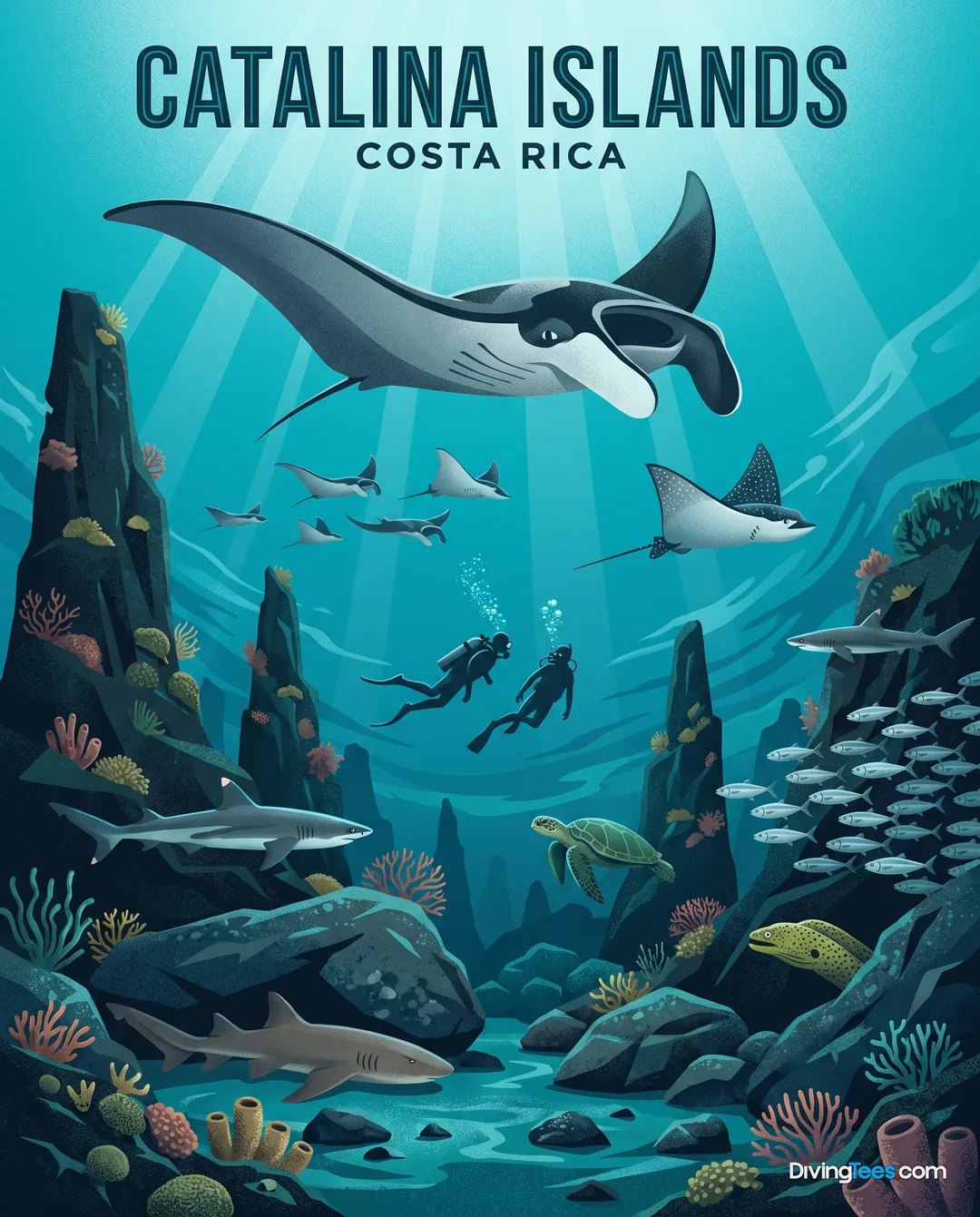
Volcanic rock formations, fish schools, rays and several shark species shape boat diving from Playa Flamingo towards the Catalina Islands.
For subtitles in English: start the video firstthen click the gearat the top right of the video, select “Subtitles/CC”, then “Auto-translate” and choose “English”.
Playa Flamingo is a coastal base for boat diving rather than a single, self-contained dive site. From the bay, day boats head towards the rocky islands and underwater relief of the Papagayo sector, with the Catalina Islands providing the clearest sense of the local character: volcanic formations, schooling fish and pelagic visitors. The arrangement suits divers who prefer a land-based holiday, short repeated outings and the option of sharing a beach stay with a non-diver.
The diving is built around volcanic rock, exposed underwater peaks and mixed rock-and-sand seabeds. Catalina Islands sites can begin at roughly ten metres and continue to around twenty metres or deeper, keeping many dives within normal recreational limits while leaving room for more demanding profiles. Conditions are not fixed: current may be moderate or strong on exposed sections, and the northern Pacific can change the practical value of a boat departure from one day to the next. This is mainly day-boat diving, with short transfers from the local coast and different sites reached according to conditions. Good buoyancy matters over uneven rock and sand, particularly when suspended particles reduce the view. Nitrox is useful for repeated, moderate recreational profiles, though it does not remove the need to allow for changing current and a sensible surface interval.
The Catalina Islands are the main draw for divers wanting life around volcanic underwater peaks. Large schools of fish gather around the formations, while rays pass over the rock and sand. The nutrient-rich water also attracts pelagic visitors, including several shark species. These encounters are not presented as a narrowly timed migration spectacle; they are part of the character of the island dives whenever the boat can reach them. The exact experience depends on exposure, current and the chosen section of reef. Divers should therefore expect to spend time reading the water, holding position around the relief and keeping a useful distance from passing animals rather than searching a flat, predictable reef for one particular species.
December to May is the drier period on the local record, making it the most practical window for organising a stay around repeated boat departures and coastal days. It is not a guarantee of calm water: the decisive factor remains the state of the northern Pacific on the day. A flexible booking is therefore more useful than a tightly packed schedule, especially for travellers making the journey for Catalina Islands. Keeping several consecutive days available gives the weather more room to work in your favour, while the drier season also leaves more scope for beach and land-based plans when diving is postponed.
This coast is exposed to sargassum strandings, whose intensity varies greatly from year to year.
The area is suitable for all levels, and Open Water certification is enough for the more straightforward Catalina Islands dives. Advanced Open Water, or comparable experience, becomes useful where exposure and current are stronger. BSAC divers should judge the sites by their logged experience and current-handling ability rather than by the agency name. A calm, well-controlled diver will get more from the volcanic relief than someone who is still struggling with buoyancy over rock and sand. Nitrox is worth considering for repeated day-boat profiles.
From London Heathrow, London Gatwick or Manchester, the journey continues overland after arrival in Costa Rica. The route to Playa Flamingo runs by road from Liberia and then along the coastal road into the bay; there is no dedicated internal flight or compulsory ferry for the diving itself. The practical constraint comes after the international journey: road transfers need to be allowed for before the first boat outing, and departures are arranged locally according to the sea state. Once in the Playa Flamingo area, accommodation near the beach or bay usually keeps the dive base within walking distance. Elsewhere in the local area, a short taxi or transfer may be needed. The boat is then the regular link to the Papagayo and Catalina sectors, rather than a long liveaboard crossing.
Build the diving around a weather margin, not a fixed run of departures. Consecutive days are valuable here because a change in northern Pacific conditions can affect the boat before it affects the appeal of the coastline itself. Do not book Playa Flamingo expecting a single-site holiday: the useful way to read the area is as a coastal starting point for shifting trips towards Papagayo, volcanic islets and Catalina Islands. Leave room for a dive-free coastal day if a boat is cancelled. Over mixed rock and sand, careful weighting and buoyancy are more useful than carrying extra equipment; particles lifted from the bottom can quickly spoil the view. Nitrox makes sense for repeated moderate profiles when surface intervals are short, but it is a convenience rather than a solution to current. Travelling with a non-diver is easiest when staying close to the bay, so separate beach and boat days do not depend on long transfers.
A four- to seven-day stay gives the boat schedule some breathing room and allows several outings towards the neighbouring island and coastal sites. Mornings can be given to diving, with the bay and Guanacaste coast providing straightforward alternatives when the sea does not cooperate. Non-divers have beaches, coastal trips and marine wildlife outings to fill the same days. Before flying home, a quiet coastal day is more suitable than adding strenuous travel or an altitude-based activity.
Hello, I'm Marina, DivingDeal.com's AI assistant. I guide you through destinations, areas and countries.
Thinking about the whole trip and the flights? Talk it over with Edith →
Marina is an AI. Some links are affiliate links: DivingDeal may earn a commission, at no extra cost to you. Bookings are made with the partner.
Your last day stays dry: no diving in the 18-24 hours before a flight, the perfect window to see the destination from another angle.
 Adventure
⏱ 5 h · ★ 5.0 (78 reviews)
from £1,483$1,983€1,771
see on Viator ↗
 Nature
⏱ 7 h · ★ 5.0 (20 reviews)
from £135$181€162
see on Viator ↗
 Nature
⏱ 2 h · ★ 5.0 (421 reviews)
from £83$111€99
see on Viator ↗
 City
City⏱ 1 day · ★ 5.0 (3 reviews)
from £30$40€35
see on Viator ↗
Ratings and reviews collected by Viator and Tripadvisor.
The drier period from December through May is the most practical time to organise repeated boat departures and coastal days. Conditions can still change with the northern Pacific, so you should keep your schedule flexible. Several consecutive days allow more room for weather-related changes and postponed outings.
Playa Flamingo suits divers of all levels, and Open Water certification is enough for more straightforward Catalina Islands dives. Advanced Open Water or comparable experience is useful where exposure and current are stronger. Good buoyancy and calm control help you manage uneven volcanic rock, sand and suspended particles.
Diving around Playa Flamingo leads towards volcanic formations and exposed underwater peaks, especially around the Catalina Islands. Large schools of fish gather around the relief, while rays cross rock and sand. Nutrient-rich water also attracts several shark species and other pelagic visitors, depending on conditions and the selected site.
Plan Playa Flamingo as a land-based boat-diving holiday, keeping consecutive days available rather than booking every departure tightly. Stay near the beach or bay for convenient access to the dive base, and allow road-transfer time after arriving in Costa Rica. Keep a coastal day available if sea conditions cancel a boat.