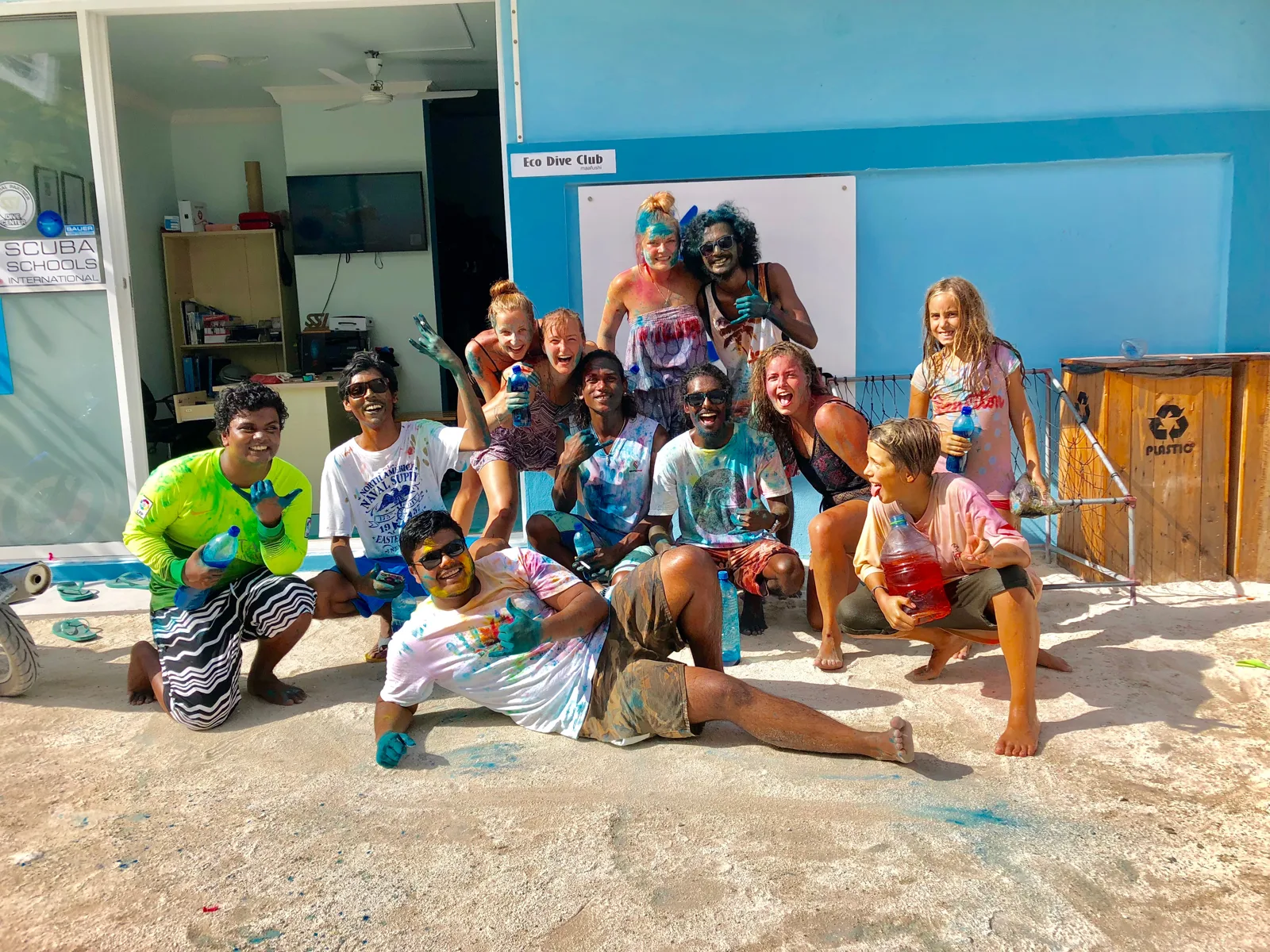

Eco Dive Club Maafushi, Ahmed Nihaal
Google 4.9/5 (184 reviews)
Maldives · Indian Ocean
Passes swept by current, dark wrecks, reef sharks, turtles and occasional manta rays make Maafushi a practical base for southern Malé Atoll diving.
For subtitles in English: start the video firstthen click the gearat the top right of the video, select “Subtitles/CC”, then “Auto-translate” and choose “English”.
Grey reef sharks and whitetip reef sharks are the signature encounters around Maafushi, but the setting matters just as much as the animals. From this inhabited island, day boats head for kandu passes, thilas, drop-offs and wrecks across the southern Malé Atoll. Some dives are sheltered enough for newer divers, while others put you into moving water with tuna, trevally and eagle rays. Maafushi suits a five- to seven-day stay that leaves room for several boat days, changing sea conditions and time above water on an island where diving is part of local life rather than the entire holiday.
The diving is mainly boat-based, with the terrain changing from sheltered reef sections to exposed channels, thilas, drop-offs and wrecks. In a kandu, the tide decides the dive: a moderate flow can become a fast drift dive, with sharks, rays, tuna and trevally holding in the blue or along the edge of the reef. Expect to check the current direction before entering, then let the boat recover the group after the drift rather than trying to swim back to the start point. Conditions are not identical from one outing to the next, and the centre may switch between a sheltered site and a stronger pass. Visibility is commonly 15 to 30 metres, best from December to April, although plankton, wind, swell and current can reduce it. Advanced Open Water is useful for deeper sites and passes, while Nitrox suits repeated boat diving.
Grey reef sharks and whitetip reef sharks are possible throughout the year, with the current in the kandus often concentrating them where the reef edge falls away. Green turtles and hawksbill turtles are regular encounters, while Napoleon wrasse appear occasionally. Eagle rays are most at home on the current-swept sites, and schools of trevally and tuna add movement to the blue-water sections. Manta rays are the seasonal draw from May to November, when plankton-rich water can bring them to particular sites. That same plankton may make the water less clear, so a manta trip is a trade-off between wildlife and visibility. None of these sightings is guaranteed, and repeating boat days gives the tide, site and conditions more chances to line up.
December to April is generally the most comfortable period for diving from Maafushi. The north-east monsoon usually brings calmer seas, less troublesome wind and better visibility, making boat transfers and current dives easier to manage. May to November is the rainy season and the south-west monsoon can bring more wind, rain, swell and stronger-feeling current. It is also the period when plankton may attract manta rays on selected sites, although the water can become less transparent. There is no need to rule out the rainy season, but choose it for the possibility of mantas rather than for consistently calm conditions, and allow spare days when the sea has a say.
Maafushi can suit beginners when the day’s plan is explicitly sheltered, but a pass with moderate or strong current is a different proposition. Ask what sort of dive is planned before booking, rather than assuming every boat outing is suitable. Advanced Open Water is useful for deeper sites and passes, and a Drift Diver speciality is relevant to repeated kandu dives. Recent experience in moving water matters more than simply holding a qualification. Confident divers should still expect the current to determine the route, the exit and sometimes the length of the dive.
From London Heathrow, London Gatwick or Manchester, the journey continues from Malé International Airport to Maafushi by speedboat, normally taking about 30 to 45 minutes depending on the service and route. A booking is usually needed, and the timetable should be checked before departure rather than assumed. The public ferry leaves from Villingili terminal in Malé and takes about 90 minutes, but its limited operating days and lack of Friday service make it a poor connection to build tightly around an international flight. There is no road or domestic flight to Maafushi. Once on the island, accommodation and dive centres are generally close enough to reach on foot, with no normal need for a taxi or road transfer.
Treat every kandu as a tide-led dive, not a named attraction with a fixed recipe. Before boarding, ask which way the current is expected to run, where the boat will recover divers and whether the site includes a downcurrent or turbulence zone. If you are new to Maafushi, ask plainly whether the programme is a sheltered reef or an exposed pass. A personal surface marker buoy is particularly useful on drift dives, as is thermal protection suited to repeated immersions. Book several diving days if mantas or pelagics are the priority, since plankton, current and sea state can change the result. Morning departures usually mean fewer boats on nearby sites. Do not rely on the public ferry as a guaranteed flight connection, and leave a non-diving margin before departure rather than scheduling the final deep dive close to the flight home.
Maafushi works best as a flexible island stay rather than a tightly packed diving itinerary. Five to seven days allows several boat outings, a spare day for wind or swell, and time for the island itself. Centres and accommodation are usually within walking distance, so the daily routine is simple: walk to the boat, return to the island, then choose between a beach afternoon, local sightseeing or another water activity. Non-divers can go snorkelling, kayaking, paddleboarding or on a manta excursion when conditions suit, while a final day without immersion leaves room before flying.
Hello, I'm Marina, DivingDeal.com's AI assistant. I guide you through destinations, areas and countries.
Thinking about the whole trip and the flights? Talk it over with Edith →
Marina is an AI. Some links are affiliate links: DivingDeal may earn a commission, at no extra cost to you. Bookings are made with the partner.
Choose Maafushi from December to April for calmer seas, less troublesome wind and generally better visibility. From May to November, plankton may attract manta rays to selected sites, but rain, wind, swell, stronger-feeling current and reduced transparency are more likely. Allow spare days if you travel during the rainy season.
Maafushi can suit beginners when the plan uses sheltered reefs, but kandu passes may involve moderate or strong current. Ask about the planned site before booking. Advanced Open Water is useful for deeper sites and passes, while recent moving-water experience matters. A Drift Diver speciality is relevant to repeated pass dives.
Around Maafushi, you may encounter grey reef and whitetip reef sharks, green and hawksbill turtles, eagle rays, tuna and trevally. Napoleon wrasse appear occasionally, while manta rays may visit selected sites from May to November when plankton is present. Sightings depend on the tide, site and conditions, so they are not guaranteed.
Plan a flexible island stay with several boat days, spare time for changing sea conditions and time above water. Speedboats connect Malé International Airport with Maafushi, while the public ferry has limited operating days. Accommodation and dive centres are generally walkable, and you should leave a non-diving margin before your flight home.