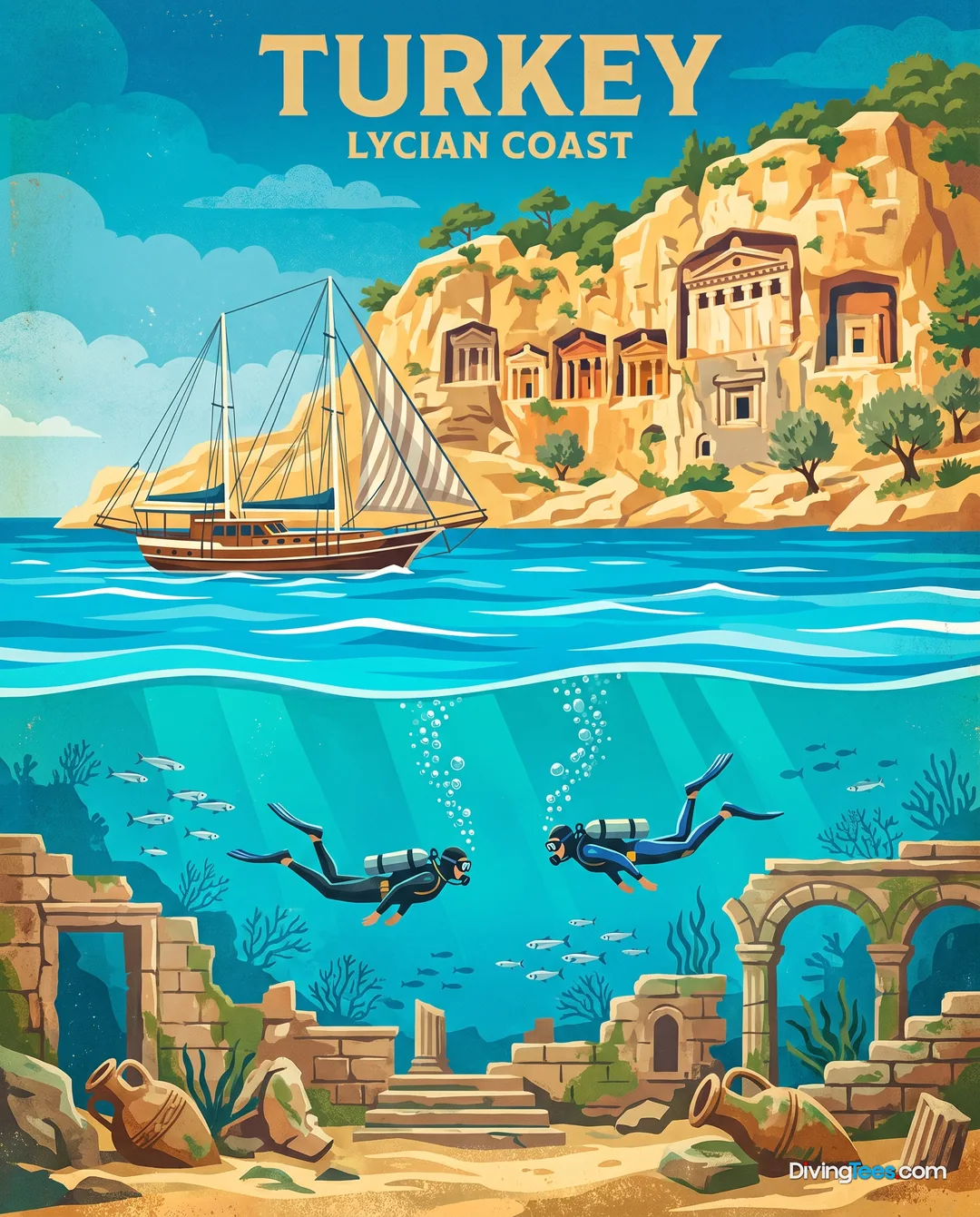
Türkiye · Mediterranean
Diving Kovan Adasi: Amphorae, Anchors and Rock Canyons
Amphorae and stone anchors lie among rock walls, a narrow canyon reaches 20 metres, and Flying Fish adds a deep Italian aircraft wreck.
What makes this destination special
- Amphorae and anchors scattered between seven and 30 metres
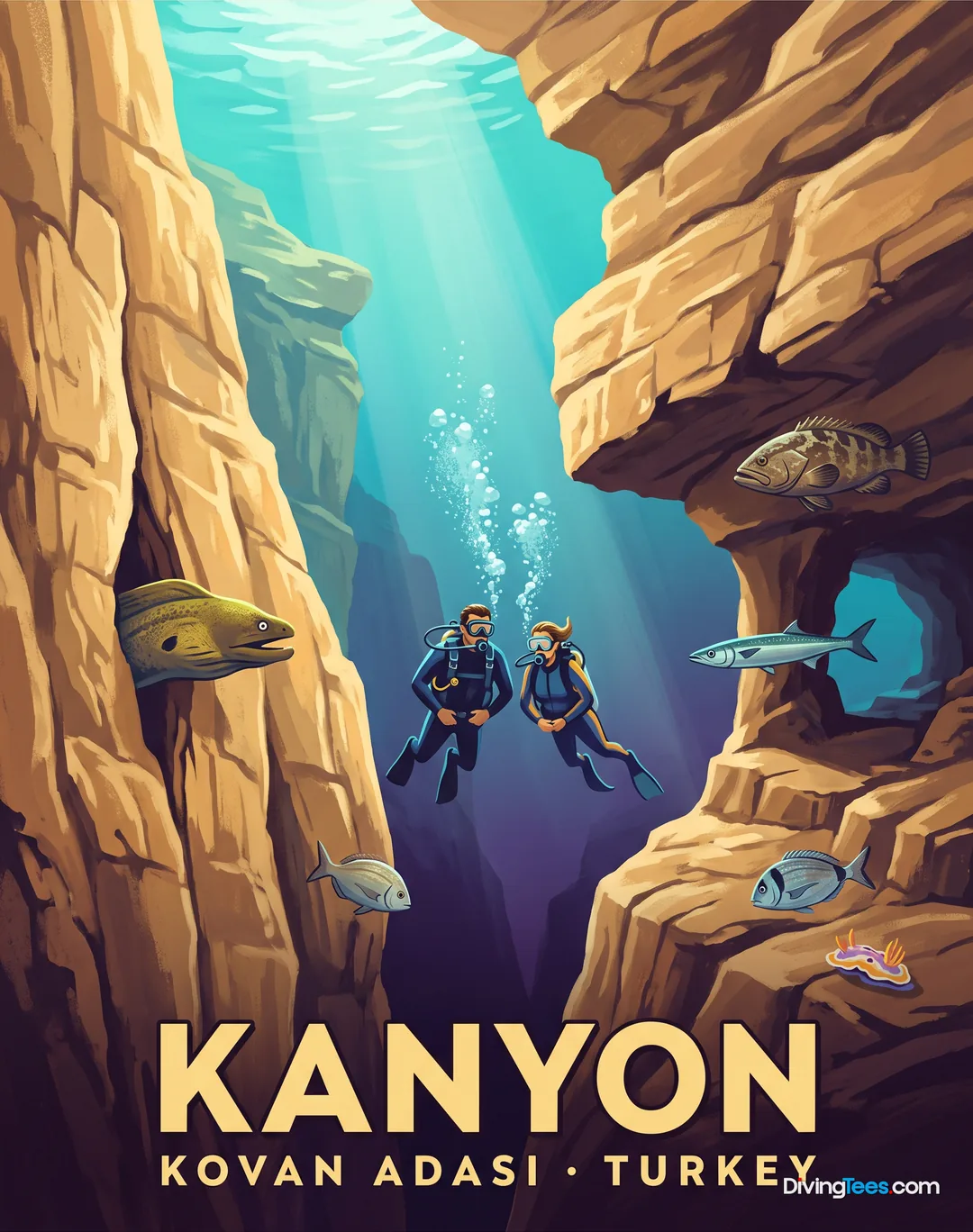
- A narrow canyon descending towards the Dimitri wreck
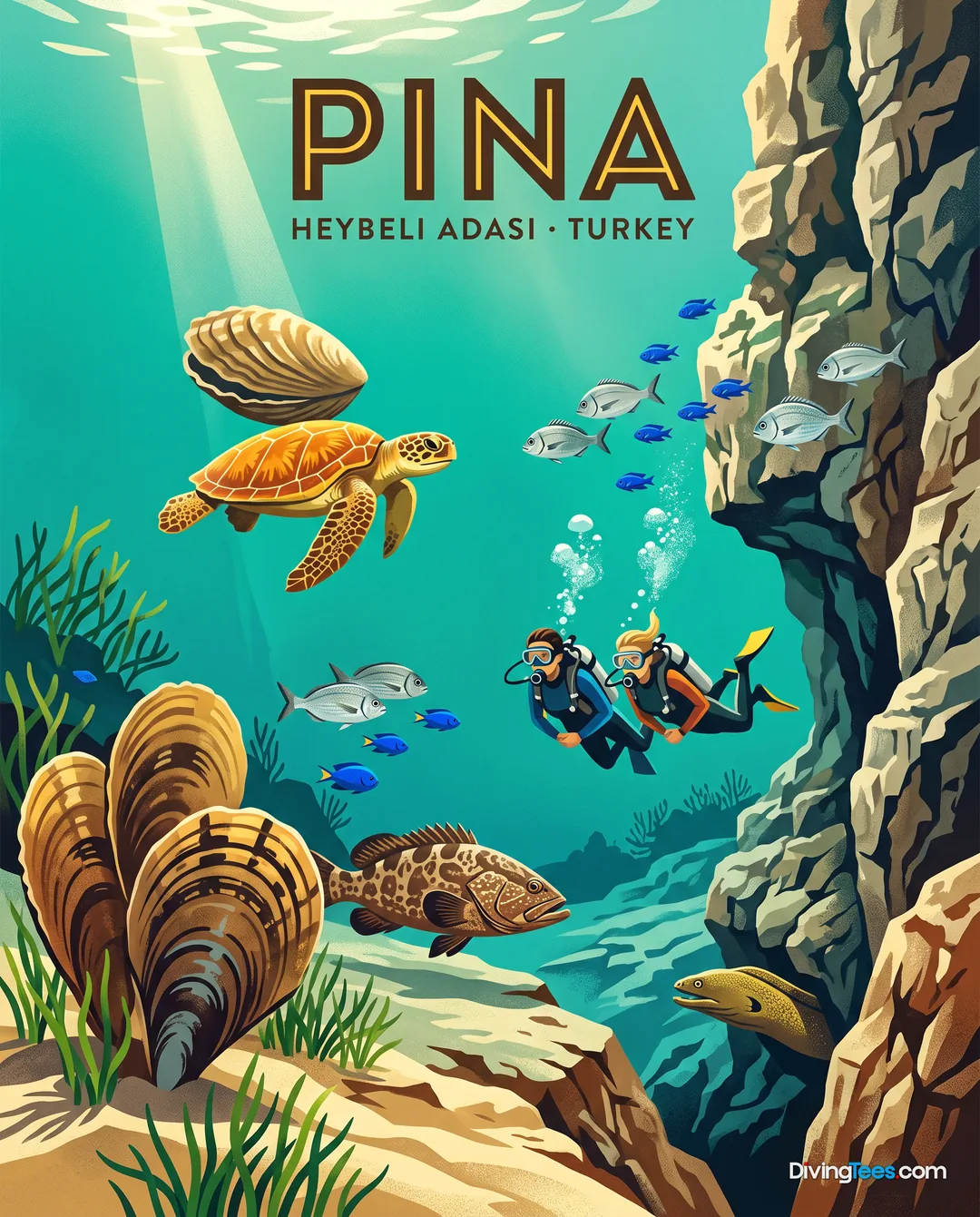
- Pina’s shallower reef for a gentler second dive
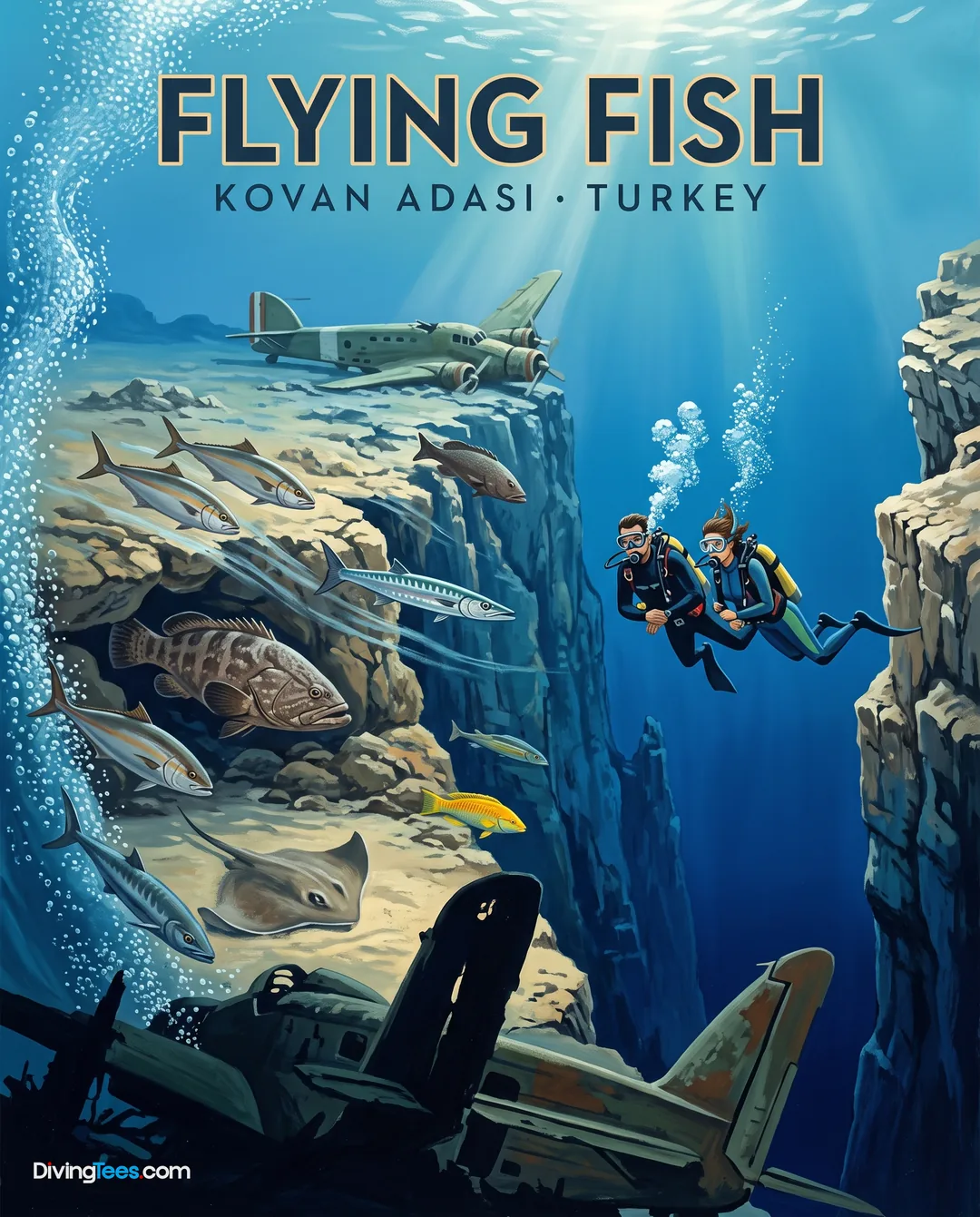
- Flying Fish’s deep Italian aircraft wreck
- Rock walls, fissures and marine growth
- Variable currents across the archipelago’s exposed sites
- Calmest boat conditions from June to November
Overview
Kovan Adasi is a boat-diving area south of Kaş, where underwater archaeology sits alongside Mediterranean rock scenery. Amphorae, broken and intact, and stone or metal anchors appear between roughly seven and 30 metres. A narrow canyon drops towards the Dimitri wreck, while nearby Pina and Flying Fish change the character of a day on the water. It suits divers who want to stay ashore in Kaş, then use the same harbour base to explore several distinctly different underwater settings.
Diving here
The diving moves between rock walls, fissures, a coastal canyon, drop-offs and shallow reef. At Kovan, the archaeological interest lies in amphorae and anchors spread through the rocky terrain, rather than in a single enclosed wreck. The canyon associated with the Dimitri reaches down through a tight crack to about 20 metres, where buoyancy and fin control matter. Currents are variable, so a calm-looking surface does not guarantee an identical underwater plan. Flying Fish needs particular care: a shallow reef sits above an Italian aircraft wreck at considerable depth, giving the dive two very different profiles. Pina provides a more forgiving shallow option. These are boat dives from Kaş, normally arranged as a day out with more than one immersion and enough surface time between them.
Three dives not to miss
The underwater wildlife
Expect the visual interest to come from marine growth fixed to rock, canyon walls and archaeological objects, with macrofauna among the crevices. Amphorae may be whole or broken, and anchors can be seen in both stone and metal, their setting as important as their shape. The terrain gives small creatures places to shelter, particularly around fissures and the edges of the reef, although Kovan is not presented as a destination built around named seasonal animals. June to November is the calmer window for reaching these sites by boat, while the drier period extends from May into October. In practical terms, that favours repeated dives around the archipelago and relaxed time on deck, rather than a trip planned around a particular migrant species.
Possible underwater encounters

When to go
Plan Kovan Adasi between June and November, when the sea is generally at its calmest for the boat journey from Kaş. May to October brings the lowest rainfall, making the long days on the water more comfortable and reducing the chance that a wet-weather change disrupts the schedule. November remains within the calmer measured period, but sits beyond the driest part of the year. The reason to favour this window is logistical as much as underwater: Kovan, Pina and Flying Fish are reached by boat, and a steadier sea makes it easier to combine the archaeological sector with a shallower reef or a deeper option without forcing the whole day around rough conditions.
Level required
Kovan suits all levels when the planned site matches the diver’s training and experience. The shallower reef and archaeological terrain can work for recreational divers, while the canyon demands tidy buoyancy in confined space. Flying Fish is different: the aircraft wreck lies deep below its upper reef and is not a beginner’s dive. Advanced training is useful there, alongside experience with depth, gas planning and the effects of narcosis. BSAC, PADI and SSI divers should check the exact profile offered before booking rather than treating every Kovan-area dive as equivalent.
On the ground
From London Heathrow, London Gatwick or Manchester, travel by air to a regional airport, then continue overland to Kaş. The final leg is a road transfer, so allow sensible time between the flight, any connection and the onward journey rather than planning a same-day boat departure tightly. Kovan Adasi has no passenger service of its own. Diving starts from Kaş harbour on a dive boat, not from a public ferry, and the international crossing to Meis is not the normal route to the sites. Once in Kaş, the town is compact: depending on where you stay, the harbour and dive operation are usually reachable on foot or with a short local ride.
Local tips
Ask exactly which sector is planned before you board. Kovan, Kanyon, Pina and Flying Fish are not interchangeable names for one profile: one may mean archaeology and rock walls, another a shallow reef, and Flying Fish may involve the deep aircraft wreck rather than the reef above it. For a first outing, pairing Kovan’s amphorae and anchors with Pina is a more sensible introduction than making the deep Flying Fish wreck the sole objective. Bring exposure protection suited to repeated dives if the boat’s supply is not right for the season. In the canyon, hold a steady position without brushing the walls or attached growth. Treat every amphora, anchor and fragment as an archaeological object: look, photograph if permitted, and leave it exactly where it lies. Do not confuse Flying Fish’s shallow reef with permission to descend to the wreck without the appropriate training and experience.
Planning your stay
Use Kaş as the base for the whole stay. The town puts the harbour, boats and centres within a short walk or local ride, while the island itself is chiefly a place to dive and swim. A day ashore can take in Lycian scenery, coastal walking and ancient remains. Non-divers can join a boat outing for swimming and snorkelling, or explore Kaş while the dive boat is away. Kovan also fits a broader archipelago itinerary with Pina and Flying Fish.
Hello, I'm Marina, DivingDeal.com's AI assistant. I guide you through destinations, areas and countries.
Thinking about the whole trip and the flights? Talk it over with Edith →
Marina is an AI. Some links are affiliate links: DivingDeal may earn a commission, at no extra cost to you. Bookings are made with the partner.
Map of hotels, dive sites and dive centres in Kovan Adasi
Things to do in Kovan Adasi beyond diving
Your last day stays dry: no diving in the 18-24 hours before a flight, the perfect window to see the destination from another angle.
 Culture
Daily Boat Trip from Demre to Kekova
⏱ 7 h · ★ 5.0 (23 reviews)
from £71$95€85
see on Viator ↗
 Nature
Saklikent Gorge By Safari Cars from Kas Kalkan (All included)
⏱ 8 h · ★ 5.0 (205 reviews)
from £34$46€41
see on Viator ↗
 City
Turkish Meze Cooking Class and Market Experience
⏱ 3 h
from £67$90€80
see on Viator ↗
Ratings and reviews collected by Viator and Tripadvisor.
Frequently asked questions about Kovan Adasi
When should you visit Kovan Adasi for suitable boat conditions?
Choose June to November for Kovan Adasi, when conditions are generally more settled for reaching the sites by boat from Kaş. May to October is the drier period, making long days on the water more comfortable. This window also helps combine archaeological dives with a shallower reef or deeper option.
What diving experience do you need for Kovan Adasi?
Kovan Adasi can suit recreational divers when the planned site matches their training and experience. The archaeological terrain and shallower reef are approachable options, while the canyon requires controlled buoyancy in confined space. Flying Fish is different, with a deep aircraft wreck requiring appropriate training, depth experience, gas planning and awareness of narcosis.
What can you see while diving at Kovan Adasi?
At Kovan Adasi, you can see whole and broken amphorae, stone and metal anchors, rock walls, fissures and marine growth. A narrow canyon descends towards the Dimitri wreck, while Pina offers a shallower reef. Flying Fish combines a shallow reef with a deep Italian aircraft wreck, and crevices shelter macrofauna.
How should you plan a stay for diving at Kovan Adasi?
Base yourself in Kaş, where the harbour, boats and dive centres are reachable on foot or by a short local ride. Arrange Kovan Adasi as a boat-diving day with surface time between immersions, and confirm the planned sector beforehand. Combine the area with Pina or Flying Fish, while allowing sensible time for your flight and road transfer.