Nurse Shark
Ginglymostoma cirratum
The most peaceful shark on the reef sleeps in piles and hunts by night.
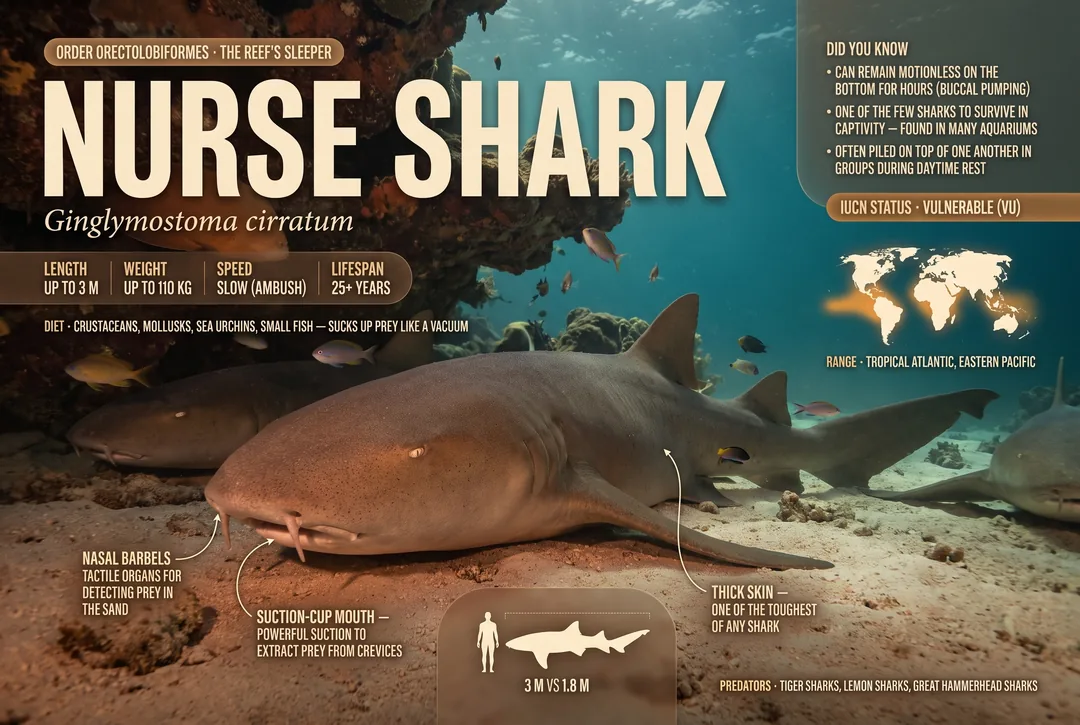
IDENTITY CARD
| Classification | Order Orectolobiformes, family Ginglymostomatidae |
| Scientific name | Ginglymostoma cirratum |
| Size | Up to 4.3 m (average 2.5-3 m) |
| Weight | Up to 150 kg |
| Speed | ~2.5 km/h cruising |
| Lifespan | 25 to 35 years (up to 40 in captivity) |
| Depth | Surface to 130 m, usually 1-12 m |
| Diet | Benthic — small fish, crustaceans, molluscs, sea urchins, octopus, squid |
| IUCN Status | Vulnerable (VU) — declining, especially in the western Atlantic |
PORTRAIT
This is the shark you almost step on before you see it. Lying motionless on the sand, its colour a perfect match for the bottom, the nurse shark barely registers as an animal at all — just another patch of reef floor, until a fin twitches or a barbel stirs. Ginglymostoma cirratum is the most harmless shark most divers will ever encounter, and often the first: a bottom-dweller so placid that beginners routinely mistake its stillness for indifference. It is anything but indifferent. It is simply waiting for dark.
By day, nurse sharks sleep in groups beneath coral overhangs and ledge undercuts, sometimes in piles of a dozen or more, stacked like driftwood. They are among the very few sharks capable of buccal ventilation — actively pumping water over their gills — which means they can breathe without swimming. This is why they can lie motionless for hours while most sharks must keep moving or suffocate. When night falls, the transformation is total: a nurse shark hunts alone, sweeping the reef with its barbels, generating one of the most brutal suction forces of any shark to extract prey from crevices. The audible clacking of its jaws on shell and rock is one of the signature sounds of a Caribbean night dive.
For divers, the nurse shark is a gift. It lives where beginners learn — shallow, warm, clear water — and it tolerates close approach with a patience no other shark matches. But that tolerance has a limit, and the consequences of crossing it are disproportionate: a provoked nurse shark bites down with pavestone teeth that lock like a vise, and more than one diver has learned this lesson in an emergency room, with the shark's jaws still attached to their hand.
HOW TO RECOGNIZE IT
The nurse shark's body is massive and almost cylindrical, tapering to a broad, flat head with a short, rounded snout. Two small barbels flank the mouth on the underside — sensory organs used for both chemical detection and prey location. The mouth itself is small and ventral, designed for suction rather than biting in the open-water sense.
Two dorsal fins sit far back on the body, and they are nearly the same size — an unusual feature that helps distinguish the nurse shark from most other species. The caudal fin is long, approximately one-quarter of the total body length, with a horizontal trailing upper lobe and no pronounced lower lobe. In profile, the tail looks like a slow, heavy rudder.
Colour ranges from brown-yellow to grey-brown, with a uniform, somewhat mottled appearance. Juveniles carry dark spots and sometimes faint banding that fades as they grow. In the water, the overall impression is of a large, brown, inert shape on the bottom — easy to overlook, easy to approach, and easy to photograph once found.
For subtitles in English: start the video firstthen click the gearat the top right of the video, select “Subtitles/CC”, then “Auto-translate” and choose “English”.
WAY OF LIFE
The nurse shark is profoundly sedentary. Its home range typically spans only a few square kilometres of reef, and individuals show strong site fidelity — returning to the same sleeping ledges day after day, sometimes for years. During the day, groups rest in physical contact with one another, individuals overlapping in a tolerance for crowding that would be unthinkable in most shark species.
At night, the nurse shark becomes a solitary hunter. Its barbels function as combined chemoreceptors and tactile probes, sweeping the substrate for buried or hidden prey. When it locates a target — a conch in its shell, a crab wedged in a crevice — it generates one of the strongest suction forces measured in any shark, powerful enough to pull a conch clean out of its shell. The clacking sound this produces is audible underwater from several metres away.
Reproduction is ovoviviparous. Mating is vigorous and sometimes violent: the male seizes the female's pectoral fin in his jaws and holds on, leaving visible bite scars. After a gestation of approximately six months, the female gives birth to 20 to 30 pups, each 25 to 30 centimetres long. Sexual maturity is reached only at 15 to 20 years of age — a slow reproductive rate that makes the species vulnerable to overfishing.
WHERE TO SEE IT
Belize — Shark Ray Alley, Hol Chan Marine Reserve. The most famous nurse shark encounter in the world. In shallow water barely 2 to 3 metres deep, nurse sharks and stingrays gather at a former fisherman's cleaning station. Accessible to snorkellers and divers alike, with visibility that rarely disappoints.
Bahamas — Exumas and Compass Cay. Nurse sharks congregate around the marina docks at Compass Cay in water so shallow you can observe them from the dock itself. An effortless encounter in crystalline Bahamian water.
Curacao. Shore diving at sites like Playa Lagun and Watamula regularly produces nurse shark sightings in 30-metre-plus visibility. The island's easy access and warm water make it an underrated destination for the species.
Maldives. Nurse sharks rest under thilas and in kandhus throughout the atolls. Night diving in the Maldives is one of the best ways to observe their hunting behaviour — the suction feeding and the distinctive clacking sound.
Florida Keys. The most common shark species in John Pennekamp Coral Reef State Park and Looe Key. Sightings are reliable from May through September, with encounters possible year-round.
Fernando de Noronha, Brazil. A UNESCO World Heritage archipelago with strict environmental regulations. Nurse sharks are regularly encountered on the reefs, in some of the most pristine conditions anywhere in the Atlantic.
OBSERVATION CALENDAR
| Destination | J | F | M | A | M | J | J | A | S | O | N | D |
|---|---|---|---|---|---|---|---|---|---|---|---|---|
| Curacao |
Click each button to show/hide
CONSERVATION
The nurse shark was classified as Data Deficient on the IUCN Red List for years — a bureaucratic limbo that delayed meaningful protection while populations declined. It is now listed as Vulnerable (VU), with significant population decreases documented across the western Atlantic.
The species' biology makes it uniquely exposed to human pressure. Nurse sharks live in exactly the same shallow coastal waters where humans build, fish, and play. Their extreme site fidelity means that when a reef is destroyed or degraded, the local population has nowhere to go — unlike pelagic species that can shift their range. They are hunted for leather, meat, and liver oil, and taken as bycatch in commercial nets. And their reproductive rate is painfully slow: 20 to 30 pups every two years, with no individual reaching maturity before the age of 15.
The species' docile reputation has also created a paradox of conservation. Because nurse sharks tolerate human proximity, they are sometimes treated as toys — ridden, grabbed by the tail, held for photographs. This is both harmful to the animals and dangerous to the people involved. A nurse shark's bite, when provoked, involves pavestone-like teeth that lock together. Cases have been documented in which a shark was transported to an emergency room still attached to the victim's limb. The rule is simple: admire, photograph, never touch.
Organisations to support:
- Shark Trust — elasmobranch conservation across Europe and beyond
- Belize Audubon Society — manages Hol Chan Marine Reserve
- PADI AWARE — citizen science and shark conservation
- Bahamas National Trust — protects marine habitats across the Bahamas
3 THINGS YOU PROBABLY DON'T KNOW
1. It vacuums its prey like a hoover. The nurse shark generates one of the strongest suction forces of any shark — powerful enough to extract a conch from its shell or yank a crab from a crevice. The rapid inhalation produces a distinctive clacking sound that carries underwater and is one of the telltale signs of a nurse shark hunting on a night dive.
2. It can stay motionless for hours. Thanks to buccal ventilation — the ability to pump water over its gills while stationary — the nurse shark is one of the rare sharks that can breathe without swimming. It exploits this to sleep on the bottom for hours at a time, in groups that pile on top of one another with a casualness that would seem impossible in any other shark species.
3. Its bite is a trap that does not open. The nurse shark's teeth are small, flat, and arranged in a mosaic pattern that locks together under jaw pressure. When provoked into biting, the jaw clamps shut and stays shut. There are documented cases of nurse sharks being transported to hospital emergency rooms still attached to a diver's limb — the only way to release the grip was surgical intervention. It is, by a wide margin, the strongest argument for the diving community's most basic rule: look but never touch.
PHOTO AND VIDEO TIPS
Lens. The nurse shark is an ideal beginner subject: it does not move, it lives in shallow water, and it does not flee. A wide-angle lens (10-17 mm fisheye or equivalent) is perfect for group shots under ledges. For portraits — the barbels, the eye, the texture of the skin — switch to a macro or short telephoto.
Light. Natural light works well in the shallows where nurse sharks rest, but strobes or video lights bring out the warm brown and gold tones of the skin that would otherwise render as a muddy grey. Side lighting creates texture and separates the animal from the substrate.
Night diving. The best action photography of nurse sharks happens after dark. A powerful video light (2,000+ lumens) reveals the hunting behaviour — the sweeping barbels, the suction strike, the cloud of disturbed sand. Set a fast shutter speed (1/200s minimum) to freeze the action.
Approach. Get down to the bottom and approach from the side, at the shark's eye level. Move slowly, avoid sudden fin kicks that disturb sediment.
Classic mistake. Shooting from above. A nurse shark photographed from directly overhead is a flat brown rectangle — the least interesting angle on one of the most photogenic reef sharks. Get low, get level, and let the animal fill the frame.