Manatee
Trichechus manatus
The gentle giant of shallow waters doesn't dive — it grazes.
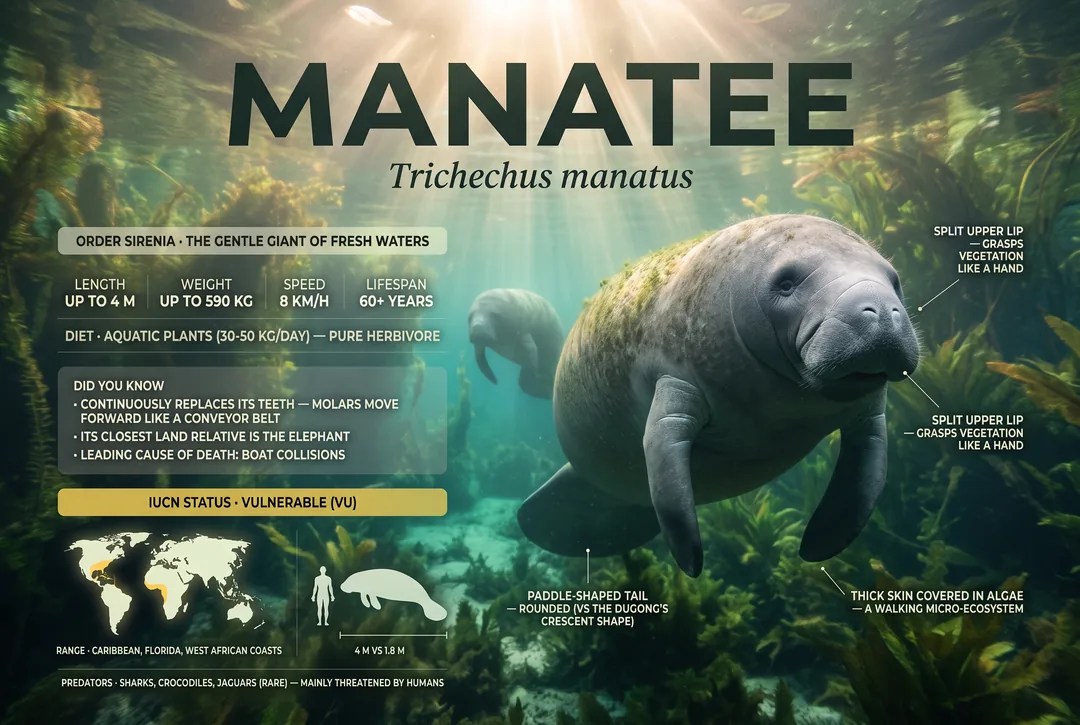
IDENTITY CARD
| Classification | Order Sirenia, family Trichechidae |
| Scientific name | Trichechus manatus (Linnaeus, 1758) |
| Size | Up to 4 m (average: 2.8-3.5 m) |
| Weight | 400-600 kg (up to 1,500 kg) |
| Speed | 5-8 km/h cruising, bursts up to 25 km/h |
| Lifespan | 40-60 years in the wild |
| Depth | 0 to 10 m, rarely deeper; must surface to breathe every 3-5 minutes (up to 20 minutes at rest) |
| Diet | Herbivore — seagrass, algae, water hyacinth, mangrove leaves (up to 50 kg/day) |
| IUCN Status | Vulnerable (VU) — population stable to slightly increasing in Florida, declining elsewhere |
PORTRAIT
You don't encounter a manatee. You discover one. It has been there for a while, motionless in the crystalline water of a Florida spring or a Belizean channel, grey as the bottom, barely visible. Then it moves, turns one eye toward the snorkeller, and the realisation dawns that this round, slow, improbable mass is a marine mammal — the only herbivore in the ocean that is not a dugong.
Trichechus manatus — the West Indian manatee, also called the Antillean manatee. The order Sirenia takes its name from the sirens of Greek mythology. Christopher Columbus, spotting three manatees off what is now the Dominican Republic in January 1493, noted that they "were not as beautiful as they are depicted." The body is a soft torpedo shape, neckless, with a flat spatula-shaped tail and a prehensile snout bristling with vibrissae.
What the manatee lacks in grace, it makes up for in gentleness. No marine mammal is as peaceable. It does not flee, does not charge, does not bite. It grazes, sleeps, surfaces to breathe, and starts again — six to eight hours of feeding each day, running on one of the slowest metabolisms in the animal kingdom.
HOW TO RECOGNIZE IT
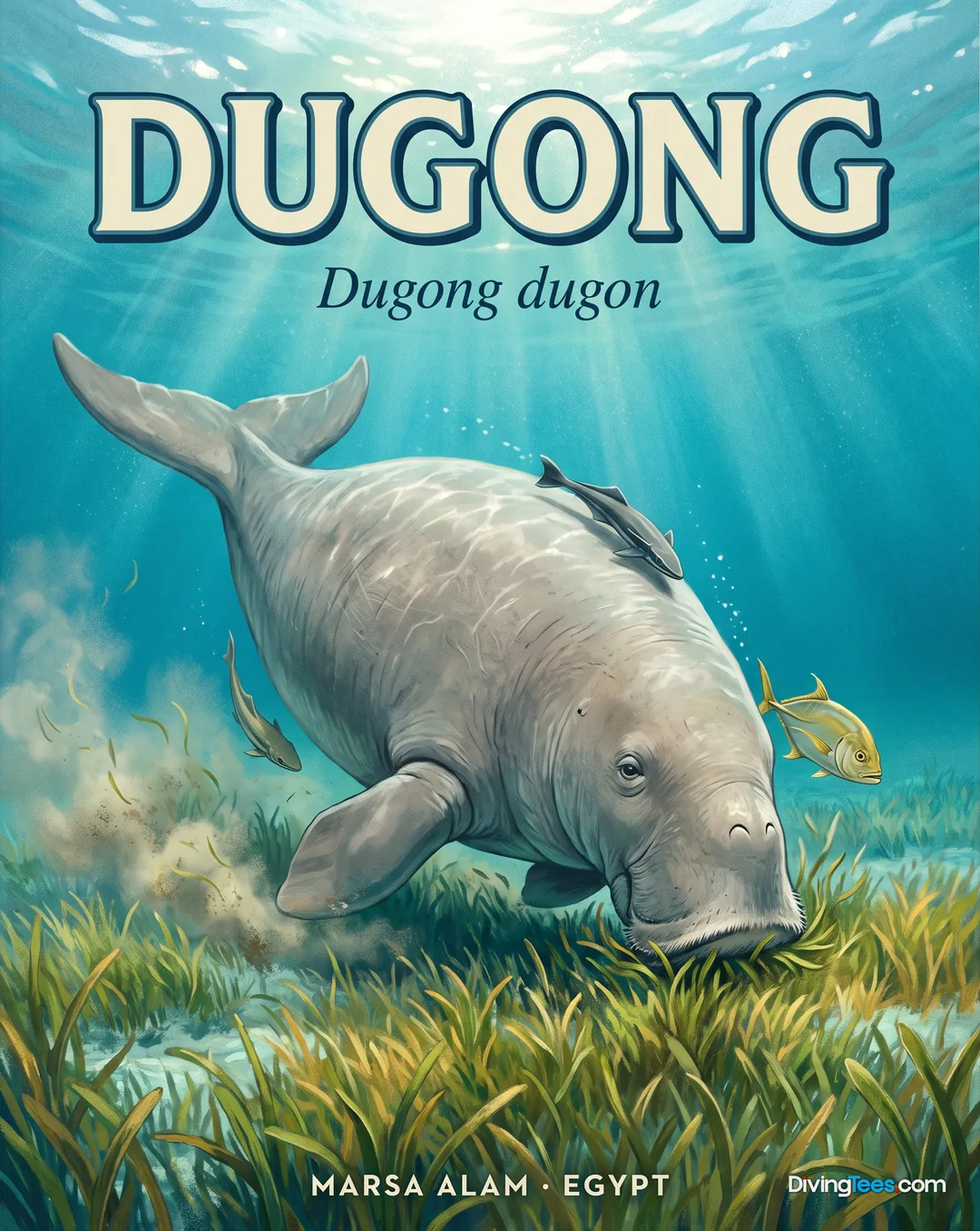
The manatee can only be confused with the dugong, but the two never share the same range. Its fusiform body is grey to grey-brown, often covered with epiphytic algae and barnacles. The skin is thick, wrinkled, and scattered with sparse hairs.
Short pectoral flippers carry vestigial nails — a legacy of its terrestrial ancestor and its kinship with elephants. The tail is rounded and paddle-shaped, distinct from the dugong's fluked, dolphin-like tail. A typical adult measures about 3 m and weighs 500 kg. The snout features a prehensile upper lip, and the eyes, though small, are remarkably expressive.
For subtitles in English: start the video firstthen click the gearat the top right of the video, select “Subtitles/CC”, then “Auto-translate” and choose “English”.
WAY OF LIFE
Manatees inhabit shallow waters: estuaries, coastal lagoons, slow-moving rivers, mangrove creeks, and freshwater springs. They consume 30 to 50 kg of vegetation daily, grinding it down with teeth arranged on a horizontal conveyor belt — a system called polyphyodonty, where worn teeth at the front are continuously replaced by new ones growing in from the back.
Their metabolism operates at roughly one quarter of what would be expected for an animal their size. This makes them acutely sensitive to cold: water below 20 degrees Celsius triggers hypothermia syndrome. Every winter, Florida's manatees migrate to warm-water refuges — natural springs and power plant outflows — to survive.
Gestation lasts 12 to 14 months and produces a single calf, which stays with the mother for two years. The interval between births is three to five years — a slow reproductive rate that makes population recovery painfully gradual.
WHERE TO SEE IT
Florida — Crystal River and Homosassa. From November to March, hundreds of manatees congregate in the warm springs of Citrus County. Snorkelling is permitted and visibility reaches 10-15 m in the spring-fed waters. This remains the world's most accessible and reliable manatee encounter.
Belize — Caye Caulker and Swallow Caye Wildlife Sanctuary. A resident population of around 30 manatees inhabits these protected waters year-round, with sightings peaking from May to September.
Mexico — Cenotes, Xcaret, and Sian Ka'an. Manatees frequent the freshwater cenotes and coastal lagoons of the Yucatan Peninsula.
West Africa — Senegal, Guinea-Bissau, Cameroon. The African manatee (T. senegalensis) inhabits river systems and coastal waters along the West African coast, though sightings are far less predictable.
Amazonia — Brazil, Peru, Colombia. The Amazonian manatee (T. inunguis), an entirely freshwater species, inhabits the Amazon basin's flooded forests and slow rivers.
OBSERVATION CALENDAR
Click each button to show/hide
CONSERVATION
The West Indian manatee is classified as Vulnerable (VU) on the IUCN Red List, with an estimated global population of around 13,000 individuals — more than half of them in Florida. There, the population has risen from a few hundred in the 1970s to over 7,500 today, a genuine conservation success story.
But the threats remain severe. Boat strikes are the leading cause of non-natural mortality in Florida — propeller scars are so common that researchers use them to identify individual animals. Seagrass loss, entanglement in fishing nets, poaching, and red tide events all take their toll. In 2021-2022, more than 1,100 manatees died in Florida alone, victims of starvation after pollution destroyed the seagrass beds of the Indian River Lagoon.
The rule for snorkellers in Florida is strict and simple: remain passive. Stay still and let the manatee decide whether to approach. Touching a manatee is a federal offence, punishable by fines of up to $50,000.
Organisations to support:
- Save the Manatee Club — advocacy and habitat protection
- Sea to Shore Alliance — research, rescue, and rehabilitation
- Clearwater Marine Aquarium — rescue and veterinary care
- Wildtracks Belize — manatee rehabilitation in Central America
3 THINGS YOU PROBABLY DON'T KNOW
1. Its closest living relative is the elephant. Manatees, elephants, and hyraxes belong to the superorder Afrotheria, sharing a common ancestor from 50-60 million years ago. The vestigial nails on the manatee's flippers, its continuously replacing teeth, and its DNA all point back to that shared heritage.
2. Tiny brain, real intelligence. A manatee's brain weighs just 300-400 g for a 500 kg body — one of the lowest brain-to-body ratios among mammals. Yet manatees learn, memorise, and respond to training. The likely explanation: with no natural predators as adults, there has been no selective pressure to evolve a larger brain.
3. It inspired the myth of mermaids. The entire order Sirenia is named after the sirens of Greek legend. Columbus's diary entry from 1493 remains the most famous sighting: "They are not as beautiful as they are said to be."
PHOTO AND VIDEO TIPS
Lens. Wide angle — 10-17 mm fisheye or 16-35 mm — captures the full body and the environment. For close-ups of the wrinkled snout, a 60 mm macro delivers striking portraits.
Light. In the freshwater springs of Florida, natural light is spectacular. Shafts of morning sun piercing the crystal-clear water create some of the most iconic manatee images ever taken. The first hour after sunrise is the golden window.
Approach. Passivity is everything. Float motionless at the surface and let the manatee come to you. Touching is illegal in the United States, with fines up to $50,000 under the Marine Mammal Protection Act.
Classic mistake. Kicking toward the animal. The manatee will not come back, and the fins stir up sediment that ruins visibility for every snorkeller downstream.