Dugong
Dugong dugon
The only strictly herbivorous marine mammal is also the one that made sailors believe they saw women in the water.
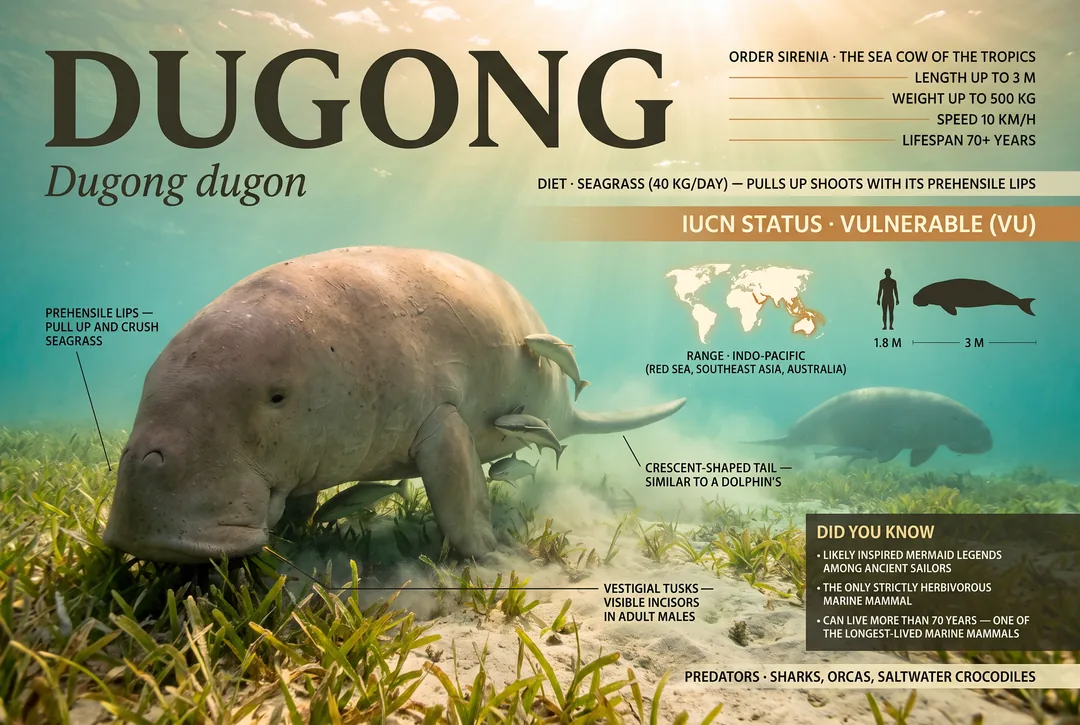
IDENTITY CARD
| Classification | Order Sirenia, family Dugongidae |
| Scientific name | Dugong dugon (Muller, 1776) |
| Size | 2.4-3 m (maximum recorded: 4.06 m) |
| Weight | 250-600 kg |
| Speed | ~10 km/h cruising, bursts to 22 km/h |
| Lifespan | 70+ years (oldest known specimen: 73 years) |
| Depth | Generally 1-10 m, sometimes down to 39 m |
| Diet | Strictly herbivorous — seagrasses (Halophila, Halodule, Zostera) |
| IUCN Status | Vulnerable (VU) — population declining |
PORTRAIT
It is found in less than a metre of water, a few strokes from shore, grazing the bottom the way a cow works a pasture. The dugong is an improbable animal: a 300-kilogram marine mammal with a torpedo-smooth body, a pig-like snout, and a diet made up entirely of grass. It hunts nothing, flees almost nothing, and spends most of its waking hours face-down in the sand, pulling up marine phanerogams — the flowering plants that carpet the sandy floors of tropical lagoons.
Dugong dugon is the sole living representative of the family Dugongidae. Its closest terrestrial relative is not the seal, nor the whale, but the elephant. The two lineages diverged roughly 60 million years ago, and the sirenians — the order to which the dugong belongs — descend from terrestrial herbivores that returned to the ocean during the Eocene. That kinship still reads in the anatomy: the dugong possesses dense, heavy bones (pachyostosis, a natural ballast that helps it stay on the bottom), vestigial nails at the tips of its pectoral fins, and a dentition that, in males, produces short tusks — upper incisors that pierce the lip in adulthood.
It is also the dugong that spawned the legend of the mermaid. Sailors of the Middle Ages and the Renaissance, glimpsing a grey shape at the surface nursing its young in a vertical position with its head above water, believed they were seeing a woman. The word siren endured, and Linnaeus himself named the order Sirenia as a nod to the confusion. Christopher Columbus, passing three "mermaids" off Hispaniola in 1493, noted in his journal that they were "not as beautiful as depicted." He had most likely seen manatees, the Atlantic cousins of the dugong.
HOW TO RECOGNIZE IT
The dugong looks like nothing else underwater. Its body is fusiform, uniformly grey, lighter on the belly, and entirely free of scales, visible hair (a few tactile bristles dot the snout) and dorsal appendages — no dorsal fin, unlike the manatee. The tail is notched into a crescent, like a dolphin's, and constitutes the most reliable marker for immediately distinguishing it from the manatee, whose tail is a rounded paddle.
The snout is the most striking organ. Broad, flat, angled downward at nearly 70 degrees, it works like a seagrass shovel. The upper lip is thick, prehensile, split into two muscular lobes that grip tufts of grass and wrench them from the substrate. The animal is often seen advancing slowly, snout buried in the sand, trailing clouds of suspended sediment and leaving regular furrows in the meadow — the famed "feeding trails" that biologists map by drone to estimate population activity.
Adult size sits between 2.4 and 3 metres — roughly the length of a two-person canoe. Underwater, in clear water, the silhouette is visible from a distance: a grey cylinder, without angles, with almost no apparent movement, hovering a few centimetres above the bottom. The animal is slow, deliberate, and disarmingly calm.
For subtitles in English: start the video firstthen click the gearat the top right of the video, select “Subtitles/CC”, then “Auto-translate” and choose “English”.
WAY OF LIFE
The dugong is a bottom grazer. It feeds almost exclusively on seagrasses, with a marked preference for species high in nitrogen and low in fibre — Halophila ovalis and Halodule uninervis appear in every study. An adult consumes between 25 and 40 kg of vegetation per day, which obliges it to spend up to eight hours daily browsing. It sometimes tears up the entire plant, roots and all, creating rejuvenation patches in the meadow: the young shoots that recolonise these bare plots are more nutritious than the old growth — a mechanism ecologists term "cultivation grazing."
Breathing governs all activity. The dugong surfaces every one to five minutes for a quick inhalation — a brief, almost inaudible exhalation, sometimes accompanied by a small jet of spray. Long dives, up to twelve minutes, are rare and reserved for travelling. This dependence on the surface explains why the animal stays in shallow water, generally below 10 metres, and rarely more than a kilometre from shore.
Reproduction is slow. Sexual maturity is reached between 9 and 17 years; gestation lasts 13 to 15 months; and the female gives birth to a single calf, which she nurses for 14 to 18 months. The interval between births ranges from three to seven years. This pace makes the dugong one of the marine mammals slowest to rebuild its populations — a critical consideration for conservation.
The dugong is gregarious without being truly social. It is typically encountered alone or in small groups of two to six individuals, most often a mother and calf. Large gatherings of several hundred, documented in Australia and the Persian Gulf, are feeding aggregations tied to seagrass availability, not stable social structures.
WHERE TO SEE IT
The dugong occupies the warm coastal waters of the Indo-Pacific, from East Africa to Vanuatu, by way of the Persian Gulf, the Indian subcontinent and Southeast Asia. Its range spans more than 40 countries, but actual distribution is fragmented: the animal depends on intact seagrass beds and shallow water, two conditions that are increasingly rare. The destinations below offer the highest chances of encounter:
Egypt — Marsa Alam (Abu Dabbab). The most reliable rendezvous on the planet for divers. Abu Dabbab Bay, south of Marsa Alam, hosts a resident dugong — often the same individual observed over months — that grazes the bay's seagrass between 2 and 6 metres of depth. Access is from the beach, by snorkelling or scuba. Encounters are near-daily in the morning, when the animal feeds. Red Sea visibility, frequently exceeding 20 metres, makes every observation exceptional.
Philippines — Coron and Busuanga (Palawan). The seagrass beds of northern Palawan harbour a dugong population that is still poorly counted but regularly sighted. Sites around Coron, Busuanga and Caluit Bay offer snorkelling encounters in calm, shallow water. Sightings are less predictable than at Abu Dabbab but possible year-round, with a peak from January to May.
Vanuatu. The archipelago holds one of the last significant populations in the South Pacific. Dugongs are protected there by traditional taboos in several communities, a factor that has contributed to their persistence. Observations take place mainly in the shallow lagoons of Efate and Epi, snorkelling from small local boats.
Mozambique — Bazaruto. The Bazaruto Archipelago, off Inhambane, shelters the last viable dugong population in East Africa — estimated at a few hundred individuals. The seagrass beds fringing the islands offer snorkelling encounters, but sightings are unpredictable and reaching the sites requires local logistics. The best season runs from May to November, during the dry months.
Australia — Shark Bay. The largest dugong population in the world lives off Western Australia's coast. Shark Bay, a UNESCO World Heritage Site, hosts approximately 10,000 individuals — close to 10% of the estimated global population. Observations are by snorkelling over the bay's grassy shallows, or by boat. Monkey Mia, known for its dolphins, is the most common access point. The best season is the austral summer, from October to March.
OBSERVATION CALENDAR
| Destination | J | F | M | A | M | J | J | A | S | O | N | D |
|---|---|---|---|---|---|---|---|---|---|---|---|---|
| Egypt (Marsa Alam) | ||||||||||||
| Philippines (Coron) | ||||||||||||
| Vanuatu | ||||||||||||
| Mozambique (Bazaruto) | ||||||||||||
| Australia (Shark Bay) |
Click each button to show/hide
CONSERVATION
Dugong dugon is classified Vulnerable (VU) on the IUCN Red List, but the global label masks dramatic local disparities. Some populations — New Caledonia, Japan (Okinawa), Madagascar — hover at the brink of functional extinction, with only a few dozen individuals remaining. The worldwide population is estimated at roughly 100,000, of which more than 80% live in Australian waters. Everywhere else, the decline is continuous.
The species is listed under Appendix I of CITES (international trade prohibited) and under the Convention on Migratory Species (CMS), which has established a specific memorandum of understanding covering the entire range.
The threats are cumulative and synergistic. The destruction of seagrass meadows — through coastal dredging, agricultural runoff, sediment loading and warming waters — is the leading cause of decline: without grass, there is no dugong. Bycatch in fishing nets (seine nets, gillnets, trawls) kills thousands of individuals each year across Southeast Asia. Traditional hunting, still practised in some Pacific and Asian communities, adds to the toll. Boat strikes are a growing cause of mortality in busy coastal zones.
The species' extremely slow reproductive pace — one calf every three to seven years — means that any excess mortality, even modest, takes decades to offset. That is the fundamental trap of dugong conservation: the animal reproduces so slowly that populations almost never bounce back.
The responsible diver cuts the engine at a distance, never pursues the animal, and never positions themselves between a mother and her calf. When snorkelling, the approach is passive — let the dugong come, or not.
Organisations to support:
- Dugong & Seagrass Conservation Project — CMS programme covering the entire range
- Marine Megafauna Foundation — research on Mozambican populations
- Sea Shepherd — anti-poaching operations in the Indo-Pacific
- Reef Check — seagrass health monitoring
3 THINGS YOU PROBABLY DON'T KNOW
1. Its closest living relative is the elephant. The dugong belongs to the order Sirenia, whose common ancestors with the proboscideans (elephants) date back to the Eocene, roughly 60 million years ago. The two lineages still share anatomical traits: extremely dense bones (the dugong has almost no marrow in its ribs), vestigial nails, and in males, tusks — short upper incisors that protrude in older adults. The other closest living "cousin" is the hyrax, a small African mammal the size of a rabbit.
2. It mows seagrass meadows — and the meadows are better for it. When the dugong tears up marine grasses, roots and all, it creates bare patches that are quickly recolonised by young shoots more nutritious and more productive than the old growth. This phenomenon, called "cultivation grazing," has been measured by ecologists since the early 2000s. Without grazers, seagrass beds age, become weighed down with epiphytes, and lose productivity. The dugong is, in a sense, the gardener of its own pantry.
3. Its giant cousin vanished 250 years ago — in just 27 years. Steller's sea cow (Hydrodamalis gigas), the largest sirenian that ever lived (up to 9 metres and 10 tonnes), inhabited the cold waters of the North Pacific around the Commander Islands. Discovered by the naturalist Georg Steller in 1741, the species was exterminated by fur hunters by 1768 — less than three decades after its scientific description. Unable to dive, slow, docile, it allowed itself to be harpooned without fleeing. It has become the emblem of extinction through overexploitation.
PHOTO AND VIDEO TIPS
The dugong is a paradoxical underwater subject: immensely photogenic because of its rarity and gentleness, but technically tricky because of its habitat — shallow water, sandy bottom, harsh light, an animal that hugs the seabed.
Lens. Wide angle or rectilinear fisheye. In a housing: 10-17 mm on APS-C, 14-20 mm on full frame. On an action camera (GoPro or similar): the native field of view works, and stabilised 4K video delivers the best results — the dugong lends itself to video more than to stills, because it is the slow movement and the repeated trips to the surface that tell the story.
Light. The animal grazes between 1 and 6 metres: natural light is generally plentiful — often too plentiful. Reflections off the sandy bottom easily overexpose the pale belly. Underexposing by half a stop relative to the automatic metering avoids blown highlights. Flash or video lights are seldom needed and risk startling the animal.
Approach. This is the critical point. The dugong is shy but not panicked: it tolerates a human presence provided it is calm, slow and predictable. Lie on the bottom at 3-4 metres from the animal and wait for it to approach while grazing. Never swim toward it, never position yourself above it, never block its path to the surface — it must be able to breathe. The finest images are those where the animal forgets the photographer and resumes feeding.
Classic mistake. Finning after the dugong as it moves away. The sand kicked up by fins ruins visibility in seconds, and the animal, sensing the commotion, accelerates. Better to stay put and wait for its return — the Abu Dabbab dugongs, for instance, follow predictable grazing circuits and often pass the same spot twice.