Proboscis Monkey
Nasalis larvatus
The primate with the impossible nose is the best swimmer of all monkeys — and it lives only on Borneo.
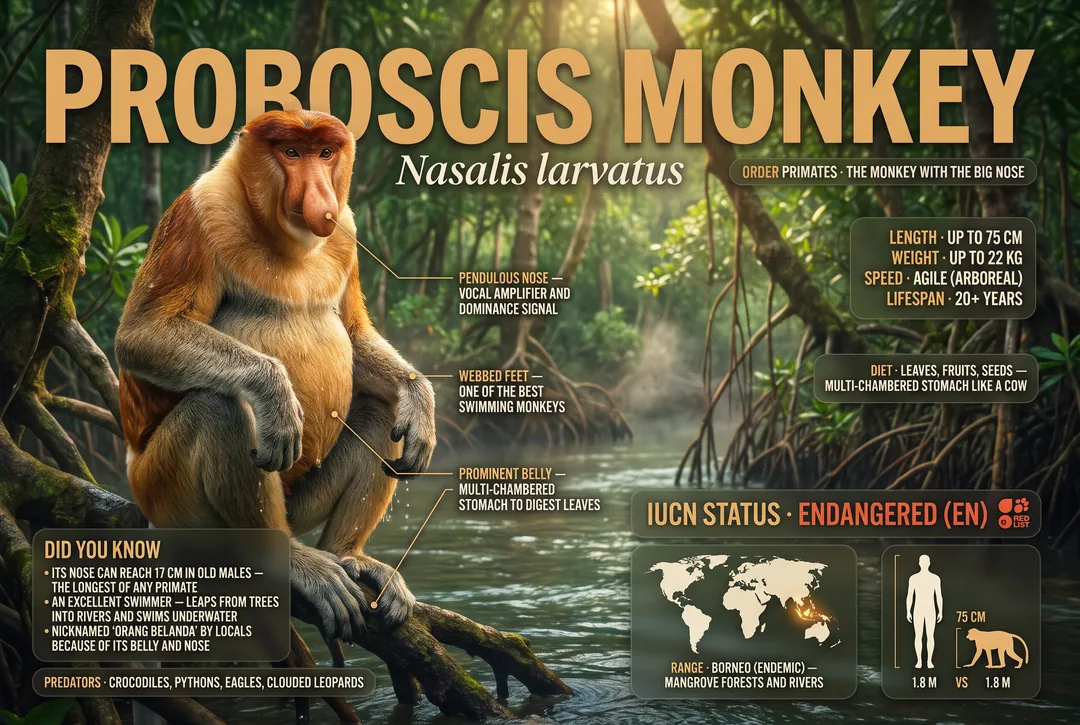
IDENTITY CARD
| Classification | Order Primates, family Cercopithecidae, subfamily Colobinae |
| Scientific name | Nasalis larvatus (Wurmb, 1787) |
| Size | 60-76 cm (body) + 55-75 cm tail; male significantly larger than female |
| Weight | 16-22 kg (male), 7-12 kg (female) |
| Speed | Agile in the trees; swims at ~6 km/h |
| Lifespan | 20-25 years in the wild |
| Depth | Freshwater and brackish diver — capable of swimming 20 m below the surface |
| Diet | Folivore — leaves, seeds, unripe fruit, occasionally flowers and insects |
| IUCN Status | Endangered (EN) — population declined by more than 50% in 40 years |
PORTRAIT
The proboscis monkey has no business being on a diving website. But divers who come to Borneo for Sipadan, Mabul, or Layang-Layang will almost inevitably cross paths with it — and they never forget the encounter. This improbable-looking primate lives in the mangroves and riverine forests that fringe the coasts and rivers of the island, often just a few kilometres from the dive boat jetties.
Nasalis larvatus is the most recognisable monkey on the planet. The adult male sports an enormous, pendulous nose that can exceed 10 cm in length and hangs below the mouth. This fleshy nose flushes red and swells with emotion or excitement. The female, smaller, wears a far more discreet upturned nose. Add a protruding belly, golden-auburn fur on the back and creamy white on the underside, and you have one of the most singular silhouettes in the animal kingdom.
The species is strictly endemic to Borneo — the world's third-largest island, shared between Malaysia (Sabah and Sarawak), Indonesia (Kalimantan), and Brunei. It is found nowhere else. It occupies a very specific habitat: mangrove forests, peat swamp forests, and riverine forest along waterways, rarely more than a few kilometres from the coast or a river.
HOW TO RECOGNIZE IT
The proboscis monkey cannot be mistaken for any other primate. The adult male's nose alone is enough for identification — no other monkey in the world carries a nasal appendage of this size. In young males and females, the nose is smaller and upturned, but the overall silhouette remains unique: a round, bloated belly, long arms, and a thick-based tail.
The fur is bicoloured. The back, shoulders, and crown are rufous to orange-brown. The belly, inner limbs, and lower back are cream-white to light grey. The face is bare, pinkish to reddish, framed by a ruff of pale hair. The feet and hands are slate grey.
At distance, in the canopy, it is often size that gives the proboscis monkey away. The male is one of the largest monkeys in Southeast Asia — only the orangutan is bigger. Groups also betray themselves by sound: the dominant male produces a powerful nasal call, amplified by the resonance chamber of his nose, that carries several hundred metres through the forest.
For subtitles in English: start the video firstthen click the gearat the top right of the video, select “Subtitles/CC”, then “Auto-translate” and choose “English”.
WAY OF LIFE
The proboscis monkey is a gregarious animal. It lives in groups of 10 to 30 individuals organised around a dominant male and several females with their young. Bachelor males form separate bands. In the evening, multiple groups converge on the same sleeping trees at the water's edge — a spectacle that naturalists and photographers come to observe from boats.
The diet is primarily folivorous. Leaves make up 50 to 70% of the food intake, supplemented by seeds, unripe fruit, and occasionally flowers or insect larvae. The proboscis monkey avoids ripe fruit: their sugar content triggers excessive fermentation in its specialised stomach, which can be fatal. This diet requires a complex digestive system — a multi-chambered stomach comparable in principle to that of ruminants. It is this perpetual bacterial fermentation that gives the proboscis monkey its characteristic pot belly.
But it is in the water that the proboscis monkey truly astounds. It is the best swimmer of all primates. Its hind feet are partially webbed — an adaptation unique among monkeys — and it swims with ease in open water, regularly crossing river channels 20 metres wide or more. It can dive and swim underwater for around twenty metres. Groups cross rivers single file, sometimes leaping from an overhanging branch with a resounding belly flop. Crocodiles are the chief danger during these crossings — the proboscis monkey chooses its crossing points with care.
The male's spectacular nose is no evolutionary accident. It plays a dual role: sexual signal (females prefer males with the largest noses) and acoustic amplifier (the nose acts as a resonance chamber that increases the volume and modifies the timbre of the male's alarm and rallying calls). Studies show that nose size correlates positively with testis size and the number of females in the harem — a direct indicator of reproductive success.
WHERE TO SEE IT
The proboscis monkey lives only on Borneo, in coastal and riverine forests. Here are the most accessible destinations, several of which combine naturally with a diving trip:
Bako National Park (Sarawak, Malaysia). Sarawak's oldest national park, accessible by a 40-minute boat ride from Kuching, is the most reliable site for wild proboscis monkey observation. Coastal trails pass through mangrove forests and beaches where groups descend in the late afternoon. The park is home to around 275 proboscis monkeys — an exceptional density for a small area (27 km2). Observation is on foot, often at less than 10 metres.
Kinabatangan River (Sabah, Malaysia). Sabah's longest river flows through one of the last intact alluvial forests on Borneo. Sunrise and sunset boat cruises offer near-guaranteed sightings of proboscis monkeys gathered in sleeping trees along the riverbank. The Kinabatangan is also one of the rare places where you can observe proboscis monkeys, orangutans, pygmy elephants of Borneo, and hornbills in the same day. Lodges at Sukau and Bilit are the main access points.
Labuk Bay Proboscis Monkey Sanctuary (Sabah, Malaysia). Forty-five minutes from Sandakan, this semi-wild sanctuary has feeding platforms where proboscis monkeys appear at feeding times (9:30 AM and 2:30 PM). Observation is easy and close-range — ideal for photography. The feeding approach is debated among naturalists, but the site has contributed to the protection of the surrounding mangrove forest.
Tanjung Puting (Central Kalimantan, Indonesia). This national park, best known for its orangutans and the Camp Leakey rehabilitation centre, also supports a significant proboscis monkey population. Cruises aboard traditional klotok boats on the Sekonyer River allow observation of both species. The proboscis monkey appears in late afternoon in the riverside trees.
Combining diving and proboscis monkeys. Divers visiting Sabah for Sipadan or Mabul can easily add a 2-3 day excursion on the Kinabatangan (transfer via Sandakan). Those exploring Sarawak (Tunku Abdul Rahman marine park, WWII wrecks) can combine with Bako from Kuching. Borneo is the only destination in the world where you can dive pristine reefs in the morning and watch a monkey swim in the afternoon.
OBSERVATION CALENDAR
| Destination | J | F | M | A | M | J | J | A | S | O | N | D |
|---|---|---|---|---|---|---|---|---|---|---|---|---|
| Bako National Park | ||||||||||||
| Kinabatangan | ||||||||||||
| Labuk Bay | ||||||||||||
| Tanjung Puting | ||||||||||||
| Sipadan diving |
Click each button to show/hide
Proboscis monkeys are resident and visible year-round. The dry season (March--October) offers the best observation conditions: easier trail access, clear sightlines through the canopy, and more concentrated gatherings at water sources. The rainy season (November--February) makes travel harder (flooded trails, swollen rivers) but sightings remain possible, particularly at Labuk Bay where feeding runs year-round. Sipadan welcomes divers 12 months a year.
CONSERVATION
Nasalis larvatus is listed as Endangered (EN) on the IUCN Red List. Its population has declined by at least 50% over the past 40 years. An estimated 7,000 to 25,000 individuals remain in the wild — an imprecise figure that reflects the difficulty of censusing a primate that lives in dense, flooded forest. The species is listed in Appendix I of CITES (international trade prohibited) and protected under Malaysian and Indonesian law.
The primary threat is habitat destruction. Borneo's mangrove and swamp forests are being converted at an alarming rate into oil palm plantations, aquaculture ponds, and urban areas. The proboscis monkey does not adapt to secondary forest or plantations — when its habitat disappears, it disappears with it. Forest fragmentation isolates populations and prevents genetic exchange.
Poaching, though less extensive than for other species, exists: the proboscis monkey is hunted for its meat in some regions of Kalimantan and captured alive for the illegal exotic animal trade. Forest fires, recurring in El Nino years, are an episodic but devastating threat.
Organisations to support:
- Danau Girang Field Centre — research and conservation on the Kinabatangan, proboscis monkey population monitoring
- Borneo Nature Foundation — peatland forest protection in Kalimantan
- WWF Borneo — forest corridor programmes connecting isolated populations
- Sarawak Forestry Corporation — national park management, including Bako
3 THINGS YOU PROBABLY DON'T KNOW
1. Its nose is an acoustic amplifier. The male proboscis monkey's nose is not just a sexual ornament — it is an instrument. CT scan studies have shown that the nasal cavity functions as a resonance chamber that amplifies the male's vocalisations, increasing their range and altering their timbre. The larger the nose, the farther the call carries and the more females the male attracts. It is one of the most spectacular examples of sexual selection in primates — the equivalent, in a sense, of the peacock's tail.
2. It has webbed feet. The proboscis monkey is the only primate with partially webbed feet — a membrane of skin partially connects the toes, as in waterfowl. This adaptation, unique among monkeys, makes it a remarkably efficient swimmer. It crosses river channels 20 metres wide, dives underwater to escape predators, and leaps from branches several metres high to hit the water with a belly-flop that startles every first-time observer.
3. Ripe fruit can kill it. The proboscis monkey's digestive system is so specialised for leaf fermentation that ripe fruit, rich in simple sugars, triggers excessive fermentation in its compartmentalised stomach. The resulting gas can cause fatal bloating. This is why the proboscis monkey eats only green or unripe fruit — a dietary requirement that zoos took years to understand, with captive mortality rates remaining high until feeding protocols were corrected.
PHOTO AND VIDEO TIPS
The proboscis monkey is a terrestrial subject — or more precisely, an arboreal and riverine one. For the diver combining an underwater trip with a forest excursion, a few basics apply.
Lens. A 100-400 mm telephoto is essential. The proboscis monkey perches in the canopy at 15-30 metres above ground; even at Bako, where distances are short, a powerful zoom is needed to isolate the face and nose. On a Kinabatangan river cruise, a 200-600 mm is ideal — the boat allows approach to 10-15 metres without disturbing the animals.
Light. The best moments are sunrise (6-8 AM, when groups leave their sleeping trees) and late afternoon (4-6 PM, when they return). Golden light on the auburn fur produces the most striking images. Midday, the monkeys rest in the dense canopy — the light is insufficient and subjects sit motionless in shadow.
Approach. From a boat, cut the engine and drift. On foot (Bako), walk slowly and silently — the proboscis monkey is less skittish than most Borneo primates, but a sudden movement sends the entire group fleeing. Dominant males generally tolerate an observer as long as they stay on the ground; attempting to climb or waving your arms triggers flight.
Common mistake. Forgetting shutter speed. The proboscis monkey leaps from branch to branch and plunges into the water without warning — 1/1000 s is the minimum to freeze the motion. In dark understorey, push the ISO rather than lowering the shutter speed.