Ragged-tooth Shark
Carcharias taurus
With teeth jutting in every direction and the look of a brute, it is nonetheless one of the most placid sharks on the reef — and one of the most endangered.
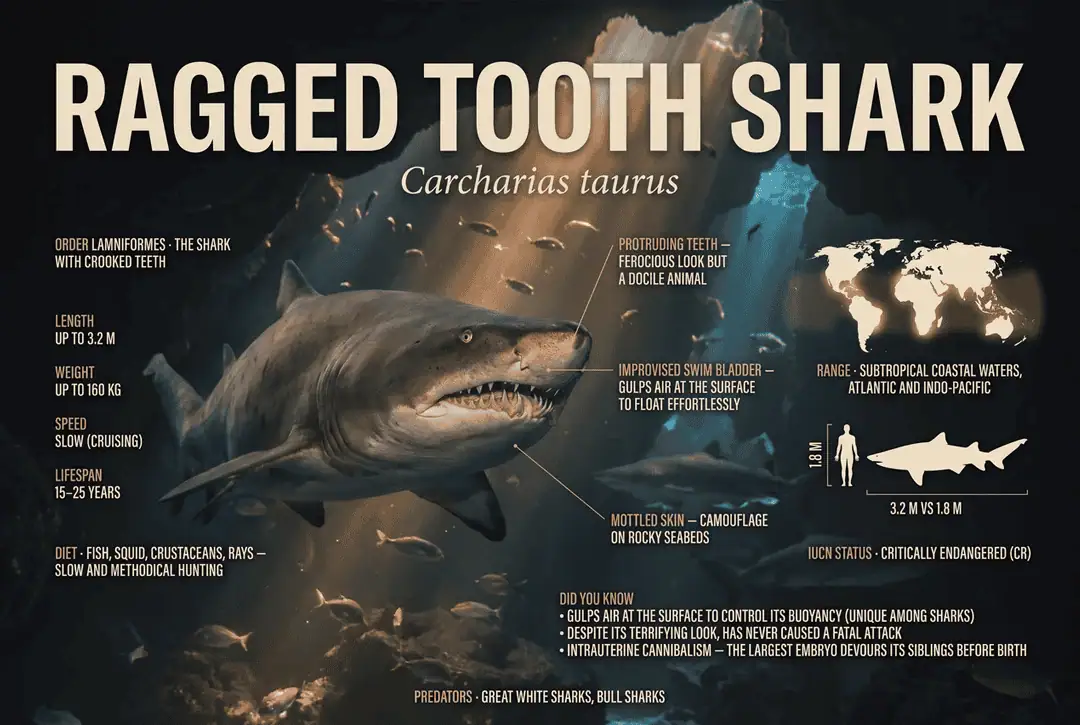
IDENTITY CARD
| Classification | Order Lamniformes, family Odontaspididae |
| Scientific name | Carcharias taurus (Rafinesque, 1810) |
| Size | 2-3.2 m, up to 3.6 m |
| Weight | 90-160 kg, up to 230 kg |
| Speed | Slow swimmer — 5-8 km/h cruising |
| Lifespan | 25-35 years |
| Depth | 1-190 m, usually 15-40 m |
| Diet | Carnivore — bony fish, rays, small sharks, squid, crustaceans |
| IUCN Status | Vulnerable (VU) globally — Critically Endangered (CR) in some regional populations |
PORTRAIT
A walking paradox. Jagged teeth protruding in every direction even when the mouth is closed, small piggy eyes set deep in a blunt skull, a massive body that fills a cave entrance — the ragged-tooth shark looks like the creature that swallows divers whole in bad movies. Yet Carcharias taurus is one of the most harmless sharks a diver will ever meet: docile, slow, tolerant, content to be approached to within a metre without so much as a flinch. Those spectacular teeth, fearsome as they appear, are slender spikes adapted for snagging slippery fish — not cutting, not tearing, not threatening anything larger than a mackerel.
It is the only shark known to surface-gulp air and store it in its stomach, using the trapped bubble as a buoyancy aid. This allows the ragged-tooth to hover motionless in the water column — suspended, weightless, like an underwater blimp drifting in a slow current. No other shark does this. The result is an animal that hangs in the blue with an eerie stillness, mouth slightly ajar, teeth on full display, looking far more menacing than it has any reason to.
A bewildering number of common names follow this animal around the world: sand tiger shark in American English, grey nurse shark in Australia, ragged-tooth shark in South Africa. Three names, three continents, one animal — and it is endangered everywhere it lives.
HOW TO RECOGNIZE IT
The ragged-tooth shark has a distinctive silhouette that, once learned, is unmistakable. The body is massive, flattened below, with a slightly humped back. Two dorsal fins of nearly equal size — a characteristic of the Lamniformes — rise from the back without the dramatic size difference seen in most sharks. The snout is short and flattened. The eyes are small, with no nictitating membrane.
But the most immediate diagnostic is the teeth. Long, narrow, sharply pointed teeth in multiple staggered rows protrude visibly from the closed mouth, giving the animal its common name and its reputation. No other shark displays its dentition so openly. The body colour runs from brown-grey to sand-brown on the back, fading to white on the belly. Adults often show scattered reddish-brown spots on the flanks — another useful identification mark. The caudal fin is asymmetric, with the upper lobe notably longer.
Behaviour completes the identification. The ragged-tooth hovers or remains stationary, often in groups. It swims slowly, mouth slightly open, with a calm indifference to divers that borders on contempt. It does not flee. If anything, it seems mildly curious about why you are in its cave.
For subtitles in English: start the video firstthen click the gearat the top right of the video, select “Subtitles/CC”, then “Auto-translate” and choose “English”.
WAY OF LIFE
The ragged-tooth shark is primarily a nocturnal predator. During the day, it rests in reef crevices, caves, and overhangs, typically in groups of five to thirty individuals — stacked in rows, hovering side by side, barely moving. At night, it becomes an active hunter, pursuing bony fish, rays, small sharks, and squid through the reef structure. Its feeding technique relies on rapid suction: a sudden expansion of the mouth creates a vacuum that draws prey inward, and the cage of interlocking teeth ensures nothing escapes.
The air-storage behaviour is unique among the roughly 500 known shark species. The ragged-tooth rises to the surface, gulps a mouthful of air, and stores it in its stomach. The trapped bubble provides enough lift to achieve neutral buoyancy, allowing the shark to hover effortlessly without swimming — an extraordinary energy-saving adaptation for an animal that spends much of its day motionless.
Reproduction pushes the limits of what seems biologically possible. The female has two uteri, and in each one, the most extreme form of prenatal cannibalism in the animal kingdom unfolds. This is adelphophagy: the first embryo to develop functional teeth — at around five months of gestation — devours every one of its siblings. From dozens of fertilised eggs, exactly two pups are born. One per uterus. Gestation lasts nine to twelve months, newborns measure approximately one metre, and sexual maturity is not reached until six to seven years. With a maximum of two pups every two to three years and a limited lifespan, this is one of the slowest-reproducing sharks in the world.
WHERE TO SEE IT
The ragged-tooth shark is found in warm-temperate and subtropical waters on several continents, but major aggregation sites are few. The species is sedentary and site-faithful, which makes it predictable for divers — and vulnerable to local threats.
Aliwal Shoal (South Africa). The most famous ragged-tooth dive site in the world. Located off the town of Umkomaas on the KwaZulu-Natal coast, Aliwal Shoal hosts breeding aggregations from June to November. The site known as "Cathedral" — a series of deep overhangs and swim-throughs — shelters groups of ten to forty individuals hovering shoulder to shoulder in the gloom. The diving is accessible (18-27 m), the visibility variable but often good (10-20 m), and the experience unforgettable.
North Carolina wrecks (USA). The "Graveyard of the Atlantic" — the waters off Cape Hatteras and Cape Lookout, where currents and sandbars have sunk hundreds of ships over the centuries. WWII submarine and freighter wrecks here host aggregations of twenty to fifty ragged-tooth sharks from June to November. The animals treat the rusting hulks as artificial reefs, hovering inside cargo holds and engine rooms in eerie scenes that seem staged for photographers.
Fish Rock Cave, New South Wales (Australia). The heart of the southwestern Pacific population — estimated at roughly 1,500 individuals, the species' most imperilled regional group. Fish Rock Cave, off South West Rocks, is the primary aggregation site, where strict conservation regulations govern every dive. The animals are present year-round, with peaks tied to breeding cycles.
Fernando de Noronha (Brazil). A resident population frequents the reef and wreck sites of this volcanic archipelago, 350 kilometres off the Brazilian coast. Encounters are possible throughout the year, with peaks from September to April.
OBSERVATION CALENDAR
| Destination | J | F | M | A | M | J | J | A | S | O | N | D |
|---|---|---|---|---|---|---|---|---|---|---|---|---|
| Aliwal Shoal (South Africa) | ||||||||||||
| North Carolina (USA) | ||||||||||||
| Australia (Fish Rock) | ||||||||||||
| Brazil (Fernando de Noronha) |
Click each button to show/hide
CONSERVATION
Carcharias taurus is listed as Vulnerable (VU) on the IUCN Red List globally, but the picture is far worse at the regional level. The eastern Australian population — roughly 1,500 individuals — is classified as Critically Endangered, hovering at numbers so low that every individual matters.
The ragged-tooth shark's docility and sedentary habits made it catastrophically easy to exploit. For decades, it was targeted by net fishing, sport fishing, and spearfishing at its known aggregation sites — places where dozens of sharks gathered predictably, year after year, in the same caves and overhangs. The population crashed.
Australia was the first country in the world to give legal protection to a shark species, listing the grey nurse shark under New South Wales law in 1984. South Africa followed in 2000. The United States listed it as a species of concern in 1997. But recovery is agonisingly slow: with a maximum reproductive output of two pups every two to three years, late sexual maturity, and a limited lifespan, the mathematics of population recovery are brutal. A residual and deeply ironic threat persists: shark nets deployed off South African and Australian beaches to protect swimmers from bull sharks and great whites continue to catch and kill the harmless ragged-tooth shark as bycatch.
Organisations to support:
- Grey Nurse Shark Trust — dedicated to conservation of the Australian population
- South African Shark Conservancy — research and protection of South African shark populations
- Shark Research Institute — global shark research and conservation
- OCEARCH — open-source shark tracking and research
3 THINGS YOU PROBABLY DON'T KNOW
1. The firstborn devours its siblings in the womb. Adelphophagy — the most extreme case of prenatal cannibalism in the animal kingdom. In each of the female's two uteri, the first embryo to develop teeth, at around five months of gestation, systematically eats every other embryo. From dozens of fertilised eggs, exactly two pups emerge. One per uterus. The survivors are born large, well-nourished, and already accomplished predators.
2. It is the only shark that gulps air to float. The ragged-tooth shark rises to the surface, swallows a bubble of air, and stores it in its stomach. The result is neutral buoyancy — the ability to hover motionless in the water column without expending energy on swimming. No other shark among the roughly 500 known species has evolved this strategy. It is the reason you find them hanging like dirigibles in cave entrances, barely moving, mouth agape.
3. Its chaotic teeth are actually a perfect trap. Those long, narrow, inward-curving teeth form a cage. A fish that enters the mouth cannot back out — the teeth interlock behind it like the wicker walls of a traditional fish trap. The design is ancient, efficient, and unchanged for millions of years. What looks like dental chaos is, in fact, precision engineering.
PHOTO AND VIDEO TIPS
The ragged-tooth shark is a dream subject — motionless, tolerant, photogenic, and imposing enough to fill any frame. The challenge is not getting close (it lets you) or getting it to stay (it will) but managing the low-light environments where it lives.
Lens. Two approaches work. A wide-angle fisheye in the 10-17 mm range captures the ambiance: a group of five to ten sharks hovering in a cave, rocky walls closing in from the sides, diver silhouetted above. This is the classic "cathedral" shot and it requires wide glass. For portraits, switch to a moderate zoom — 28-60 mm equivalent — and fill the frame with the head. A front-on portrait of the open mouth, teeth chaotically arrayed, lit from the side, is the most iconic image of this species.
Light. Flash is mandatory. The ragged-tooth lives in overhangs, caves, and wrecks where ambient light is scarce. Powerful strobes placed laterally — never directly overhead — spotlight the teeth and throw dramatic shadows across the body. The classic composition is a slight upward angle, the shark filling the upper frame, teeth lit from two o'clock, the blue of the open water glowing behind.
Approach. Slow, calm, horizontal. The ragged-tooth does not flee, but it does reposition if crowded. Approach at the shark's level, not from above, and stop at one to two metres. Exhale normally — bubble-shy behaviour is minimal in this species. Wait. The animal will often drift closer on its own, especially in current, presenting better angles than you could have engineered.
Group shots. At sites like Aliwal Shoal's Cathedral, where ten to forty sharks occupy a single overhang, the temptation is to shoot the whole group. Resist — or at least complement it with singles and pairs. A wall of sharks impresses, but two sharks hovering side by side in a beam of light tells a story.