Thresher Shark
Alopias pelagicus / Alopias vulpinus
Half of this shark is a weapon: its tail.
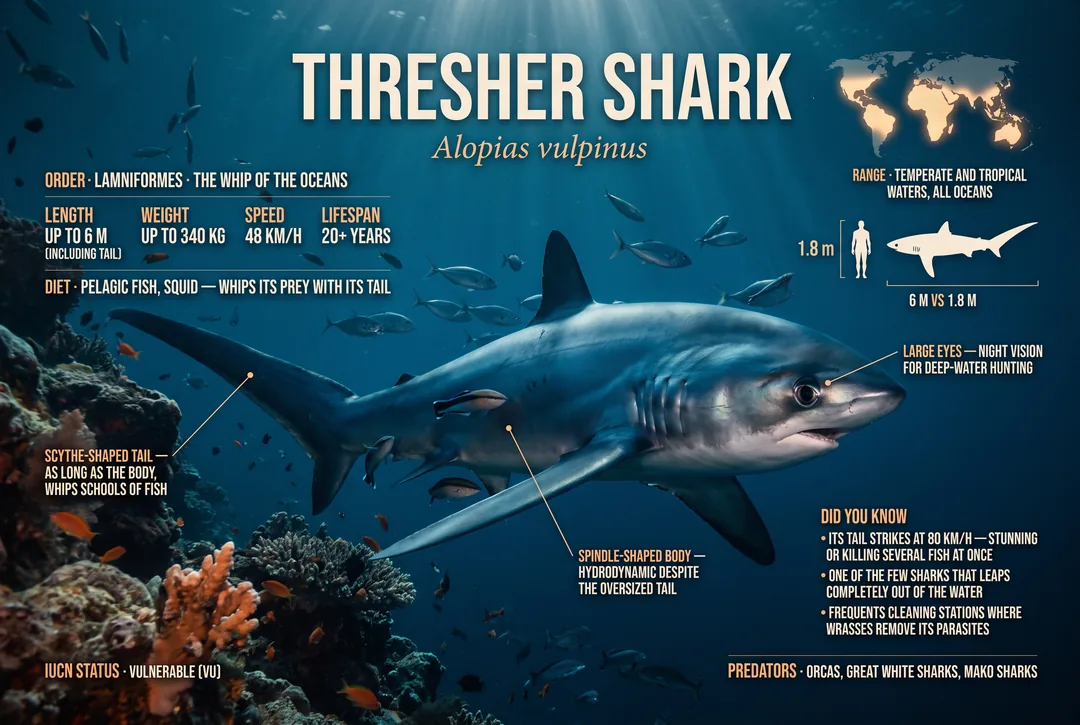
IDENTITY CARD
| Classification | Order Lamniformes, family Alopiidae |
| Scientific names | Alopias pelagicus (pelagic thresher), Alopias vulpinus (common thresher), Alopias superciliosus (bigeye thresher) |
| Size | 3 to 6 m depending on species (half of which is the tail) |
| Weight | 70 to 230 kg (A. vulpinus up to 350 kg) |
| Speed | Up to 50 km/h burst during tail strike |
| Lifespan | 20 to 50 years depending on species |
| Depth | Surface to 500 m; divers observe them at 15-40 m |
| Diet | Active predator — small pelagic fish (sardines, mackerel, herring), squid |
| IUCN Status | A. pelagicus: Endangered (EN) — A. vulpinus: Vulnerable (VU) — A. superciliosus: Vulnerable (VU) |
PORTRAIT
You can wait an hour in the dark for this animal. Pre-dawn, kneeling on a sandy plateau at thirty metres, torch off, breathing as quietly as your regulator allows, watching the cleaning station and willing something to appear. Most mornings at Monad Shoal, something does — a shape that looks wrong at first, impossibly elongated, gliding out of the blue with a tail that trails behind it like a banner longer than the body itself. It stays thirty seconds, maybe a minute. Then it is gone, and the reef feels emptier than before. The thresher shark is one of the ocean's most singular animals — shy, fast, deep-dwelling, and so wary that seeing one requires not just the right site but the right morning, the right current, and the willingness to sit still in near-darkness.
That trailing silhouette is no accident of proportion. The upper lobe of the caudal fin is as long as the rest of the shark — a flexible whip of two to three metres that is not ornamental but operational. The thresher hunts by herding schools of sardines or mackerel into a tight ball, accelerating toward them, and striking with its tail at speeds exceeding 80 km/h. The blow lands in a tenth of a second. The shockwave alone stuns or kills multiple fish, which the shark then circles back to collect. This extraordinary behaviour was first filmed in the wild by the Thresher Shark Research and Conservation Project off Malapascua in the Philippines — footage that rewrote what science understood about how sharks feed.
Then there are the eyes. Disproportionately large for a pelagic predator, they give the thresher a look that is almost gentle — curious, watchful, nothing like the fixed stare of a reef shark passing at arm's length. In the bigeye thresher, A. superciliosus, the eyes are enormous, angled upward, adapted to hunting in the crepuscular twilight of deep water where most light comes from above. It is a face that stays with you longer than the tail does — surprisingly expressive for an animal you may never see again.
HOW TO RECOGNIZE IT
There is no mistaking a thresher shark. The silhouette is unique in the ocean: a compact, muscular body that tapers into an absurdly long upper caudal lobe, often matching the entire length of the animal from snout to tail base. The head is short and the snout rounded, with large, alert eyes set forward. The first dorsal fin is small, the pectoral fins long and falciform. Colouration runs from gray-blue to gray-brown on the back, transitioning sharply to white on the belly — a clean demarcation line visible even in poor light.
The three species are distinct. Alopias pelagicus, the pelagic thresher, is the smallest at around three metres and the one divers encounter most — it is the species seen at Malapascua, recognisable by its blue-gray colouration and a characteristic white patch above the pectoral fin base. Alopias vulpinus, the common thresher, is the largest, reaching six metres, gray-brown with a longer nose, and favours temperate waters from the Mediterranean to California. Alopias superciliosus, the bigeye thresher, is unmistakable for its enormous upward-facing eyes set in a domed skull — a deep-water specialist and by far the rarest encounter in diving.
For subtitles in English: start the video firstthen click the gearat the top right of the video, select “Subtitles/CC”, then “Auto-translate” and choose “English”.
WAY OF LIFE
The thresher shark is an open-water animal, mainly solitary, spending its days in deep water and approaching shallow reefs only at dawn. Its hunting technique is unique among sharks: the tail-whipping strike, documented in 2013 by researcher Simon Oliver at Malapascua, generates accelerations that exceed anything recorded in other shark species. The upper caudal lobe reaches over 80 km/h in a fraction of a second, producing a pressure wave that stuns prey without requiring the shark to open its jaws.
Cleaning stations are central to the thresher's daily rhythm. At first light, individuals ascend from deep water to visit specific reef plateaus where cleaner wrasses remove parasites from their skin and gills. The shark circles the station, sometimes making several passes over fifteen to twenty minutes before descending again. It is this predictable behaviour that makes diving encounters possible — without the cleaning stations, the thresher would remain a pelagic phantom.
Reproduction is slow and precarious. Threshers are ovoviviparous with oophagy — embryos feed on unfertilised eggs inside the uterus. Litters are tiny: typically two pups, occasionally four, after a gestation of approximately nine months. Sexual maturity arrives late, between eight and fourteen years depending on species. This combination of low fecundity, slow maturation, and small litter size makes the thresher shark extraordinarily vulnerable to overfishing — a population under pressure recovers in decades, not years.
WHERE TO SEE IT
Philippines — Malapascua Island. This is the thresher shark capital of the world, and no other site comes close. Monad Shoal, a submerged plateau at 20-30 metres off the island's southern tip, hosts cleaning stations visited by pelagic threshers almost every morning. Pre-dawn dives depart around 5:00 a.m. — divers descend in darkness and wait at the edge of the plateau as light slowly fills the water. Between December and May, encounter rates reach 80 to 90 percent. Even in the off-season, sightings remain common. The local dive industry has built itself around this single species, and strict protocols govern the dives: limited group sizes, no flash photography aimed at the animals, mandatory distance, and controlled approach angles.
Red Sea — Brothers Islands. The Brothers are two isolated pinnacles rising from deep water in the Egyptian offshore Red Sea, reached by liveaboard from Marsa Alam or Hurghada. Threshers patrol the deeper walls, particularly around Big Brother, where the reef drops steeply into open blue. Encounters are less predictable than at Malapascua — the sharks pass through rather than visit cleaning stations — but the setting is spectacular, and the Brothers offer the chance of seeing threshers alongside oceanic whitetip sharks and hammerheads on the same trip.
Galapagos — Wolf and Darwin Islands. The northernmost islands of the Galapagos archipelago are among the richest pelagic sites on the planet. Thresher sharks are seen here alongside schooling hammerhead sharks, whale sharks, and manta rays, particularly between June and November when nutrient-rich currents attract large aggregations. Encounters with threshers are not guaranteed — they are outnumbered by hammerheads — but when one appears against the backdrop of a hammerhead wall, the image is unforgettable.
Diani Beach — Kenya. An emerging destination on the East African coast, Diani Beach has begun reporting regular thresher shark sightings on its deeper offshore sites. The diving infrastructure is still developing compared to Malapascua, but early accounts suggest a population of pelagic threshers using the area, possibly drawn by the same cleaning-station dynamics observed in the Philippines. For divers willing to explore beyond established circuits, Kenya offers the appeal of a frontier encounter.
OBSERVATION CALENDAR
| Destination | J | F | M | A | M | J | J | A | S | O | N | D |
|---|---|---|---|---|---|---|---|---|---|---|---|---|
| Philippines (Malapascua) | ||||||||||||
| Galapagos (Wolf/Darwin) |
Click each button to show/hide
Thresher sharks are present year-round at established sites, but encounter probability depends heavily on season, current patterns, and water temperature. Malapascua offers the most consistent sightings globally, with pre-dawn dives running every morning regardless of season.
CONSERVATION
All three thresher shark species are listed on the IUCN Red List: A. pelagicus as Endangered, A. vulpinus and A. superciliosus as Vulnerable. The genus is listed on CITES Appendix II since 2016 and on the Convention on Migratory Species.
The primary threat is fishing. Thresher fins are highly valued in the shark fin trade — their large size commands premium prices. But the most insidious killer is bycatch: the thresher's defining feature becomes its death trap. That extraordinary tail tangles in longlines and drift nets with devastating efficiency, and once wrapped, the shark cannot free itself. It drowns, killed by its own anatomy.
The species' biology offers no buffer. Two pups per litter, maturity at eight to fourteen years, and long generation times mean that populations depleted by fishing take decades to recover — if fishing pressure ever eases enough for recovery to begin. Current estimates suggest global populations have declined by 50 to 80 percent over the past three generations.
There is one bright spot. At Malapascua, dive tourism has paradoxically become the species' most effective protector. Monad Shoal, once a fishing ground, is now a de facto marine sanctuary — not because of legislation, but because the economic value of a living thresher shark to the local dive industry vastly exceeds the value of its fins. Strict local rules govern the site: limited numbers of divers, no flash aimed at the animals, no contact, mandatory minimum distance. The model is imperfect and fragile — it depends on continued tourist demand — but it works.
Organisations to support:
- Thresher Shark Research and Conservation Project — Malapascua-based research and community conservation
- Project AWARE — global ocean protection and shark conservation campaigns
- Shark Trust — UK-based shark and ray conservation
- Save Our Seas Foundation — research funding and marine conservation worldwide
3 THINGS YOU PROBABLY DON'T KNOW
1. Its tail strikes faster than a boxer's punch. Filmed for the first time in 2013 off Malapascua, the thresher's overhead tail strike accelerates the upper caudal lobe to over 80 km/h in roughly one-tenth of a second. The impact generates a shockwave powerful enough to stun or kill multiple fish simultaneously — prey the shark never touches with its jaws. No other shark species is known to use its tail as a primary hunting weapon. The mechanics resemble a bullwhip more than a bite.
2. It is warm-blooded. Like the mako shark and the great white shark, the thresher possesses a rete mirabile — a network of blood vessels that acts as a counter-current heat exchanger, keeping muscles, brain, and eyes significantly warmer than the surrounding water. This endothermy gives it sharper vision and faster reflexes in the cold, dark depths where it hunts at dawn and dusk. It also explains the enormous eye size, particularly in A. superciliosus — those eyes are heated instruments, optimised for low-light performance.
3. It is considered harmless to humans — but respect the tail. There is no verified record of a thresher shark biting a diver. Yet historical accounts from commercial fisheries describe crew members injured by tail strikes when hauling nets. One oft-cited but unverified case describes a fisherman decapitated by a caudal blow. Whether apocryphal or not, the story gives an honest measure of the whip's power — and one more good reason not to haul this animal out of the water.
PHOTO AND VIDEO TIPS
The thresher shark is a dream subject and a technical nightmare. It is beautiful, rare, and stays seconds rather than minutes. The light is almost always bad — pre-dawn dives at depth mean you are working in near-darkness with a moving target.
Lens. Wide angle is mandatory. A 10-17 mm fisheye or equivalent rectilinear wide-angle lets you capture the full animal, tail included, even at moderate distance. The thresher's length makes anything tighter than 20 mm a gamble — and the classic mistake is cutting the tail out of frame. The tail is the image. Anticipate the shark's trajectory, frame generously wide, and crop in post-production. A whole animal in a wide shot is worth infinitely more than a tight portrait without the tail.
Lighting. Two video lights of 3,000 lumens or more, positioned wide on long arms to minimise backscatter. At Malapascua, flash is tolerated but should never be aimed directly at the animal — the shark is there for cleaning, and a strobe blast can end the visit. Continuous light gives you the flexibility to adjust angle and intensity without startling the subject.
Approach. Do not move. The best thresher images come from photographers who descend to the edge of the cleaning station, stabilise themselves on the bottom, and wait. The shark comes to the station on its own schedule, makes its rounds past the cleaner wrasses, and leaves. An immobile diver may be rewarded with multiple passes — a fidgeting one gets a tail disappearing into the blue. Buoyancy control matters more here than any piece of equipment.
The shot to get. The full-body profile with the tail trailing into open water behind — the silhouette that makes this animal unlike any other. Better still: the moment of the cleaning pass, with the shark hovering motionless above the reef while tiny wrasses work its gills. That image tells a story about the relationship between predator and cleaner that the tail alone cannot.