
Nha Trang Diving Club
Google 5/5 (534 reviews)
Vietnam · Asia
Three Kings’ rocky pinnacles, soft-coral slopes, swim-throughs and rays make Khanh Hoa a practical boat-diving base from Nha Trang.
For subtitles in English: start the video firstthen click the gearat the top right of the video, select “Subtitles/CC”, then “Auto-translate” and choose “English”.
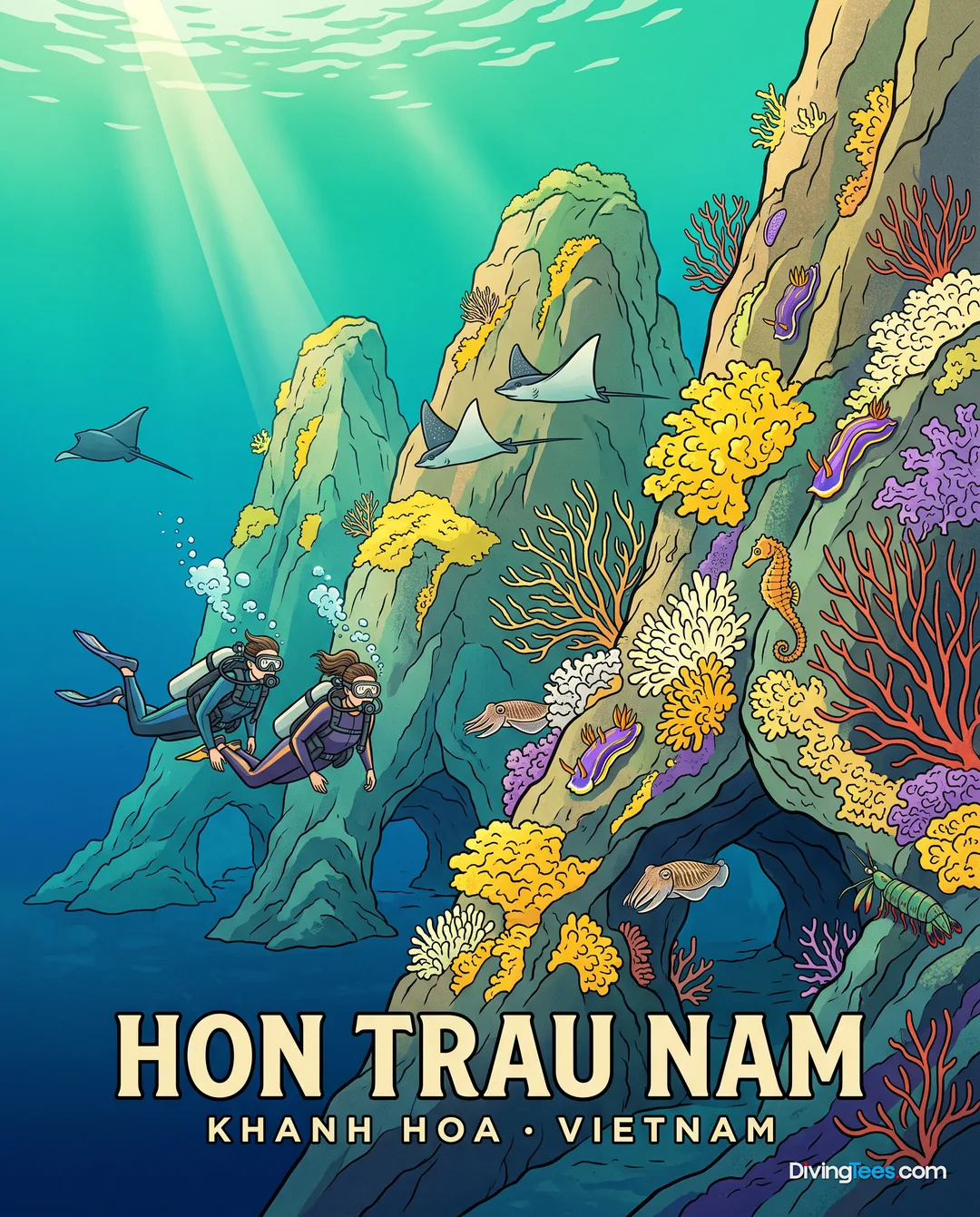
Hon Trau Nam, also known as Three Kings, gives Khanh Hoa its most distinctive underwater shape: three rocky outcrops rising from Van Phong Bay, with reef slopes, small caves and swim-throughs covered in soft corals. The wider Nha Trang coast is a land-based diving area, with boats leaving the mainland for nearby islands and bays. It suits divers who want straightforward day trips, a city stay, and time for beaches or island excursions rather than a liveaboard routine.
Khanh Hoa is primarily boat diving, with the choice between sheltered island sites and more exposed reef terrain. Hon Trau Nam is the clearest example of the latter: its three pinnacles create uneven routes through reef slopes, caves and swim-throughs, with common depths from 20 to 35 metres and a maximum of 40 metres. Currents are variable and may be strong around the rock, so divers need to manage surge and flow rather than simply follow a flat reef. Visibility can range from 5 to 25 metres, making site selection important. A day’s diving normally combines nearby boat-accessed sites, while a multi-day plan gives more chance of finding workable conditions if wind or surface disturbance affects the first choice.
The most clearly documented encounters around the local sites are rays and small macro life, particularly around the complex reef structure of Hon Trau Nam. Soft corals cover the pinnacles, reef slopes and rocky formations, giving the dive its colour even when visibility is modest. The caves and swim-throughs reward a controlled pace: divers can look into shaded openings, work along the coral-covered rock, and pause around the structure rather than covering long distances. There is no reliable seasonal claim for particular animals here, so Khanh Hoa is better approached for its reef scenery, rays and patient macro searching than for a guaranteed seasonal species encounter.
The measured calmest sea period runs from April to October, which is the most sensible window for boat diving when the priority is keeping island departures and exposed sites workable. Rainfall is lowest from January to August, so the earlier part of the year can still be useful for a combined coastal holiday, even though the sea is not at its calmest throughout that period. Conditions can vary between sheltered and open sites, and visibility is not fixed, so a flexible itinerary is more useful than booking a single day around a promised reef view.
Khanh Hoa is suitable for all levels when dives remain on sheltered reef sites and within the diver’s logged experience. Advanced certification becomes useful for deeper or more exposed dives, especially Hon Trau Nam, where 20 to 35 metres is common and current management matters around the pinnacles. PADI, SSI and BSAC divers should check that their qualification and recent experience match the planned profile. Nitrox is helpful for repeated boat days, while divers attempting the deeper sites should be comfortable with gas planning, buoyancy and controlled movement in surge.
From London Heathrow, London Gatwick or Manchester, flights can be arranged with carriers such as Vietnam Airlines, Air France, Lufthansa, KLM, British Airways, Turkish Airlines and Qatar Airways into the Nha Trang area. The important practical point is that the journey does not end at the airport: a road transfer is needed to reach the harbour or the local pickup point, followed by a boat to the islands and reefs. Allow some margin around flight connections and the boat schedule, because departures are organised around harbour operations and weather. Staying in Nha Trang or nearby coastal areas keeps the road transfer simple; the boat is the essential final link rather than an optional excursion.
Treat Hon Mun Marine Protected Area as a specific part of the trip, not as a label covering every island around Nha Trang. Park access rules and fees are handled through local boat arrangements, and anchoring restrictions and the no-contact rule apply within the protected framework. Ask before departure whether the planned dives are in Hon Mun sites or in unprotected coastal snorkelling areas, since the reef quality and expectations may differ. If the coast is stirred up, favour sheltered island sites rather than assuming the day must be cancelled. Keep the schedule flexible across several days, because site choice can make a greater difference than the calendar. Weekday departures may mean less boat traffic. Staying near the harbour avoids a long cross-town transfer, and bringing a preferred reef-safe exposure suit is sensible if rental equipment is limited to basic day-trip sizes. Do not plan Khanh Hoa as a liveaboard destination: the mainland base is part of its usefulness.
Five to seven days works well for Khanh Hoa. The usual rhythm is a mainland stay in Nha Trang or nearby, road transfer to the harbour, then day boats to reefs and islands, with the evening free for the city or coast. Keep at least one flexible day for weather-related site changes, and leave a no-dive mainland day before the flight home. Non-divers have beaches, island-hopping and Nha Trang’s seaside promenades without being tied to a dive-only resort.
Hello, I'm Marina, DivingDeal.com's AI assistant. I guide you through destinations, areas and countries.
Thinking about the whole trip and the flights? Talk it over with Edith →
Marina is an AI. Some links are affiliate links: DivingDeal may earn a commission, at no extra cost to you. Bookings are made with the partner.
Your last day stays dry: no diving in the 18-24 hours before a flight, the perfect window to see the destination from another angle.
 City
City⏱ 6 h · ★ 5.0 (22 reviews)
from £68$90€81
see on Viator ↗
 City
City⏱ 4 h · ★ 4.8 (6 reviews)
from £51$68€61
see on Viator ↗
 Culture
⏱ 4 h · ★ 4.8 (47 reviews)
from £45$60€54
see on Viator ↗
 Culture
⏱ 1 h · ★ 5.0 (1 reviews)
from £6$8€7
see on Viator ↗
Ratings and reviews collected by Viator and Tripadvisor.
April to October is generally the calmer period for boat diving, making island departures and exposed sites more workable. Rainfall is lowest from January to August, which can suit a combined coastal holiday. Because conditions vary between sheltered and open sites, keep your itinerary flexible rather than relying on one planned reef view.
Khanh Hoa suits all levels when you stay on sheltered reef sites within your logged experience. Advanced certification and suitable recent experience are useful for deeper or more exposed dives at Hon Trau Nam, where currents, surge and depths require careful management. You should also be comfortable with buoyancy, gas planning and controlled movement.
Khanh Hoa offers soft corals covering rocky pinnacles, reef slopes and formations, especially around Hon Trau Nam and sites near Whale Island. You may explore caves and swim-throughs, while rays and small macro life are notable encounters around deeper reef structure. The destination is better suited to patient reef and macro searching than guaranteed seasonal species sightings.
Base yourself in Nha Trang or nearby coastal areas for road access to the harbour, then use day boats to reach islands and reefs. A five to seven day stay allows flexible site choices, with at least one weather buffer and a no-dive mainland day before flying. Evenings remain available for beaches, promenades or island excursions.