Goliath Grouper
Epinephelus itajara
The largest bony fish on the Atlantic reef can weigh 400 kg, swallow a reef shark in a single gulp — and regard you with the unhurried calm of a landlord surveying his estate.
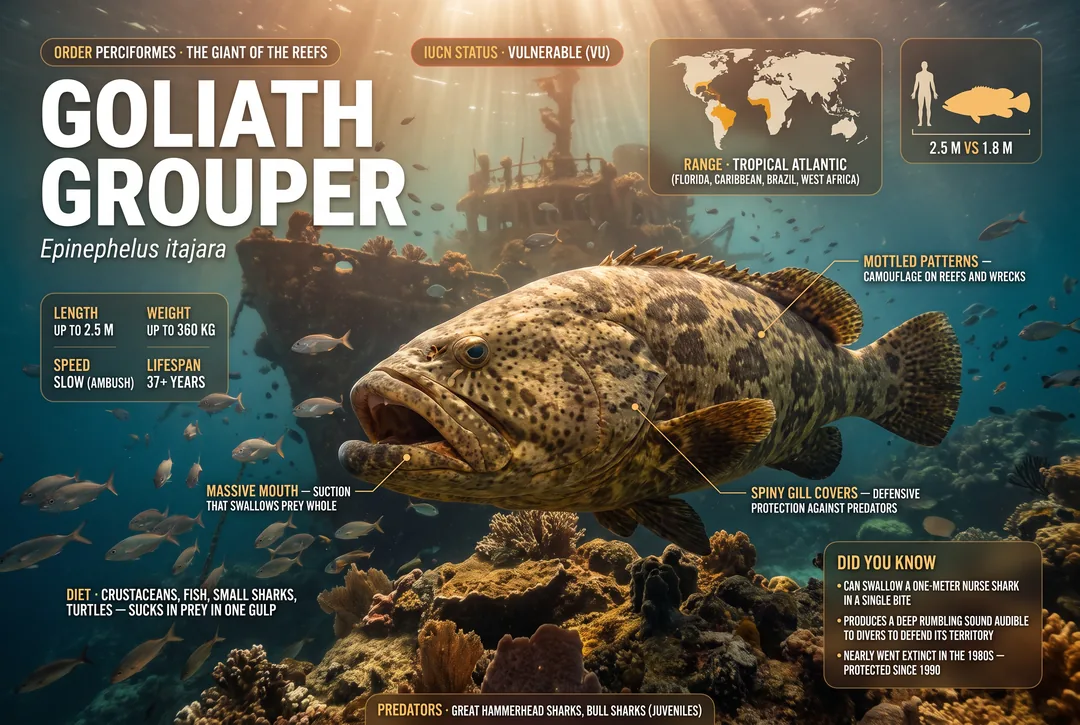
IDENTITY CARD
| Classification | Order Perciformes, family Epinephelidae |
| Scientific name | Epinephelus itajara (Lichtenstein, 1822) |
| Size | Up to 2.5 m |
| Weight | Up to 400 kg (record: 455 kg) |
| Speed | Slow swimmer — short sprints when capturing prey |
| Lifespan | 30-50 years |
| Depth | 1-100 m, generally 5-50 m |
| Diet | Opportunistic carnivore — crustaceans, juvenile sea turtles, rays, small sharks, reef fish, octopus |
| IUCN Status | Vulnerable (VU) |
PORTRAIT
The goliath grouper is the undisputed lord of the Atlantic reef. At 2.5 metres and a potential 400 kg, Epinephelus itajara is the heaviest bony fish a diver will ever encounter on an American reef — and one of the largest groupers on Earth, matched only by the Queensland grouper of the Indo-Pacific. Its silhouette is unmistakable: massive, barrel-bodied, with a cavernous head, a gaping mouth, and two small eyes that fix the diver with sovereign indifference.
The animal is an ambush predator that hunts by suction. Its mouth can open in a fraction of a second, generating a vacuum that drags in the prey, the surrounding water, and everything within a 30-centimetre radius. The mechanism is so powerful that a goliath grouper can rip a lobster out of its burrow, snatch a parrotfish mid-swim, or inhale a small reef shark whole. All of this with no apparent effort — the goliath grouper is the very embodiment of energy economy.
For divers, an encounter with a goliath grouper is a landmark event. The fish does not flee — it has nothing to fear. It approaches, inspects, and sometimes produces a deep, resonant "boom" by contracting specialised muscles against its swim bladder — a low-frequency vibration felt physically in the diver's chest. Part warning, part territorial assertion, and entirely unforgettable.
HOW TO RECOGNIZE IT
Size alone is diagnostic: nothing else on the Atlantic reef approaches two metres and 200 kg. The body is stocky, the head massive, the lower jaw protruding, and the eyes disproportionately small relative to the skull.
Colouration shifts with age and mood. Juveniles (under one metre) display irregular geometric patterns — dark vertical bars on a golden-brown ground, punctuated by bold black spots. Adults tend toward a more uniform olive-brown to grey-brown, marked with dark rounded spots across the head and flanks. The pectoral fins are broad and rounded; the caudal fin is rounded rather than forked — the hallmark of an ambush swimmer, not a cruiser.
In practice, the goliath grouper is often spotted before it is identified: a dark mass wedged into a crevice or tucked beneath an overhang, sometimes trailing a retinue of remoras. The fish turns slowly toward the diver, appraises the situation, and does not move.
For subtitles in English: start the video firstthen click the gearat the top right of the video, select “Subtitles/CC”, then “Auto-translate” and choose “English”.
WAY OF LIFE
The goliath grouper is a sedentary, territorial predator. Adults claim a section of reef — a shipwreck, an artificial reef structure, a rocky overhang — and rarely stray from it except to breed. Their home range may span no more than a few hundred square metres, a fidelity that makes them devastatingly vulnerable to localised fishing pressure.
Feeding relies on the same suction mechanism: a sudden gape of the cavernous mouth creates a vacuum that draws in prey from 30 to 50 cm away. Crustaceans — lobsters and crabs — make up the bulk of the diet, supplemented by reef fish, rays, small sharks, and juvenile sea turtles. Few bony fish can swallow a whole spiny lobster in one strike; the goliath grouper does it routinely.
Reproduction is spectacular. Each year, between August and September in Florida (July to November in the Caribbean), goliath groupers abandon their solitary territories and converge on specific aggregation sites — wrecks, rocky outcrops — by the dozen, sometimes by the hundred. Over a hundred individuals may pack into a confined area, producing an underwater cacophony of booms. Females release eggs into open water, males fertilise them — a brief, concentrated event that is catastrophically vulnerable to a single net. The "boom" itself is a low-frequency vibration (~60 Hz) produced by specialised muscles contracting the swim bladder, audible more than 100 metres away and used for territory defence, intimidation, and spawning communication.
WHERE TO SEE IT
Florida — Jupiter, Palm Beach, Keys. Southeast Florida is the finest destination on the planet for goliath groupers. Artificial wrecks off Jupiter and Palm Beach harbour permanent residents, and the spawning aggregations on Atlantic-coast wrecks (MG-111, Zion Train, Ana Cecilia) between August and October concentrate 40 to 100 individuals on a single site — a spectacle unmatched anywhere in the diving world.
Belize — Turneffe Atoll, Lighthouse Reef. Belize's barrier reef supports a resident population. Encounters are less dramatic than in Florida — lone individuals or small clusters — but the setting, pristine reef and turquoise water, more than compensates. Goliath groupers are frequently sighted near mangrove edges, their juvenile nursery habitat.
Brazil — Fernando de Noronha, Abrolhos. The Fernando de Noronha archipelago and Abrolhos National Marine Park harbour the largest goliath grouper populations in the South Atlantic. Full protection of these areas has driven a remarkable recovery.
Cuba — Jardines de la Reina. One of the last near-intact marine ecosystems in the Caribbean. Goliath groupers are abundant, unafraid, and regularly seen alongside sharks and American crocodiles.
OBSERVATION CALENDAR
| Destination | J | F | M | A | M | J | J | A | S | O | N | D |
|---|---|---|---|---|---|---|---|---|---|---|---|---|
| Florida (Jupiter) | ||||||||||||
| Florida (aggregations) | ||||||||||||
| Belize | ||||||||||||
| Brazil (Fernando de Noronha) | ||||||||||||
| Cuba (Jardines de la Reina) |
Click each button to show/hide
CONSERVATION
Epinephelus itajara is classified as Vulnerable (VU) on the IUCN Red List, reclassified from Critically Endangered in 2023 thanks to sustained conservation efforts — principally in Florida. The species was decimated by spearfishing and line fishing during the 1950s--1980s: its size, its sedentary habits, and its predictable aggregations made it an absurdly easy target.
Fishing for goliath grouper has been banned in Florida since 1990 and in Brazil since 2002. In Florida, the moratorium triggered a spectacular recovery: populations on the most closely monitored sites have multiplied five- to tenfold. So successful was the rebound that in 2023 the Florida Fish and Wildlife Conservation Commission proposed a limited reopening of the fishery — 75 harvests per year — a decision that was suspended after fierce public and scientific outcry.
The fundamental problem is biological. The goliath grouper grows slowly (sexual maturity at 5-7 years), lives a long time (up to 50 years), produces relatively few offspring, and critically, reproduces in dense, localised aggregations — a strategy that means a single net can eliminate an entire generation of a local population.
Organisations to support:
- Reef Environmental Education Foundation (REEF) — participatory grouper surveys
- Florida Fish and Wildlife Conservation Commission — Florida population management
- Grouper Moon Project — spawning-aggregation protection
- Marine Conservation Institute — marine protected areas
3 THINGS YOU PROBABLY DON'T KNOW
1. It produces a "boom" you feel in your chest. Specialised muscles contract the goliath grouper's swim bladder to generate a sound at roughly 60 Hz — audible over 100 metres underwater and felt as a physical vibration in the diver's ribcage, something like a bass hit at a live concert. The fish uses it to defend its territory, to intimidate intruders (divers included), and to communicate with others during spawning aggregations.
2. It eats sharks. The goliath grouper is among the very few bony fish documented consuming sharks. Viral footage has captured individuals inhaling a one-metre reef shark in a single gulp. These are not freak events — stomach-content analyses confirm that small sharks and rays are a regular part of the diet in large adults.
3. Juveniles grow up in mangroves, not on the reef. Young goliath groupers do not settle on the reef until they are five or six years old. Before that, they spend their formative years in coastal mangroves, where the tangle of roots shields them from predators. Destroy the mangroves — through coastal development or shrimp farming — and you destroy the nursery. A grouper without mangroves is a grouper without a future.
PHOTO AND VIDEO TIPS
The goliath grouper is an exceptional photographic subject: big, immobile, photogenic, and cooperative.
Lens. Wide angle — fisheye or rectilinear 10-17 mm. The fish is often less than two metres away, and its sheer bulk calls for a wide framing that includes the environment — wreck structure, reef architecture, a retinue of remoras. A 60 mm portrait works when the animal is perfectly stationary and tolerant of a close approach.
Lighting. Twin strobes at full power, angled laterally. Goliath groupers inhabit dark territory — wreck interiors, overhangs, caverns — and their brown skin absorbs light aggressively. The strobes reveal patterns and colours that ambient light drowns in a muddy uniform brown.
Composition. The signature shot is the head-on portrait — mouth open or closed, small eyes staring straight into the lens. Drop to the animal's eye level (never shoot down from above), and frame the head against the wreck or reef backdrop. During spawning aggregations, wide shots with five, ten, or twenty groupers filling the frame are the images that define a career.
The "boom." On video, capturing the moment a goliath grouper fires its swim bladder is the ultimate prize. You will not see it happen — but you will hear it, and sometimes the camera itself vibrates on the recording. An external microphone with solid low-frequency response makes all the difference.