Napoleon Wrasse
Cheilinus undulatus
The largest wrasse on the reef looks you straight in the eye — and comes back for more.
IDENTITY CARD
| Classification | Order Perciformes, family Labridae |
| Scientific name | Cheilinus undulatus (Ruppell, 1835) |
| Other names | Napoleon wrasse, humphead wrasse, Maori wrasse |
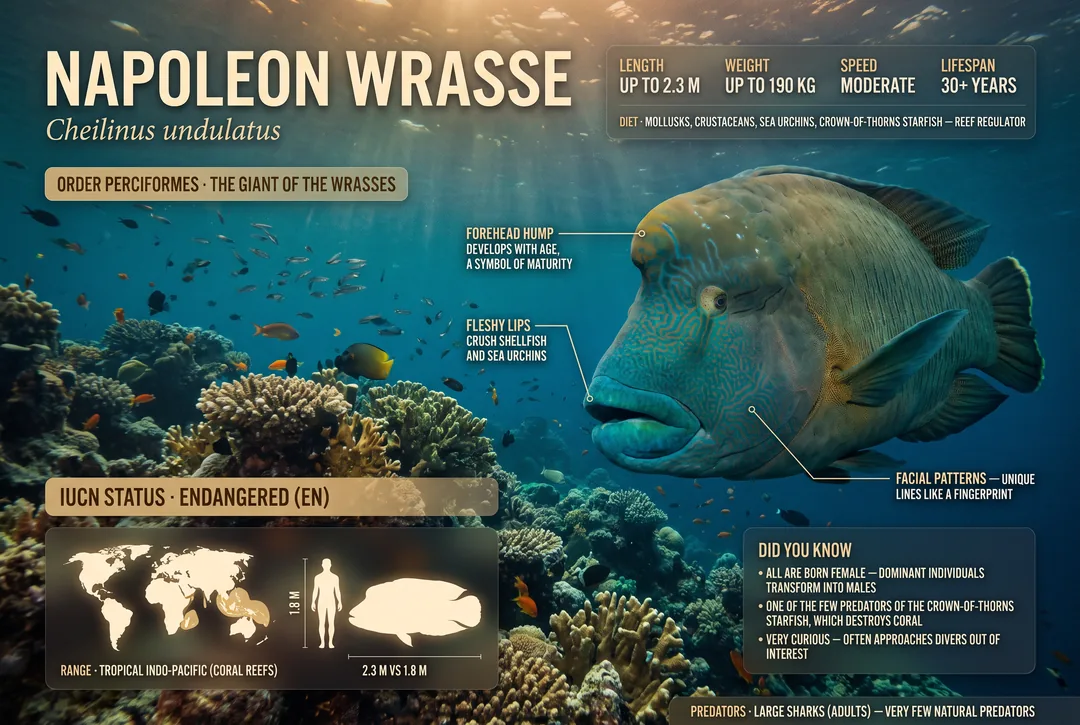
| Size | Up to 2.30 m (average: 0.60-1.50 m) |
| Weight | Up to 190 kg |
| Lifespan | 30+ years (estimates to 50 years for large males) |
| Depth | 1-100 m, most commonly 5-30 m on reef walls and channel passes |
| Diet | Carnivore — mollusks, crustaceans, sea urchins, starfish (including crown-of-thorns), small fish |
| IUCN Status | Endangered (EN) — estimated 50%+ decline in 30 years |
PORTRAIT
Some fish flee the diver. The Napoleon wrasse comes to look at you. It approaches, slows, turns one blue-green eye toward your mask, hovers for a few seconds — then departs with a single sweep of the tail, unhurried, as though it has got what it came for. You do not forget that encounter. The animal carries the curiosity, the deliberateness and the bulk of a creature that knows it is at home.
Cheilinus undulatus is the largest living member of the Labridae — the wrasse family, the second-largest family of marine fish, encompassing more than 600 species. At 2.30 m and 190 kg in the oldest males, it dominates the reef with a presence you spot from a distance: the prominent frontal bump, the thick fleshy lips, the sinuous lines marking the face like deep creases, and that heavy robe of colour — now deep blue-green, now olive — that shifts with mood, age and sex.
The French name refers to the silhouette: that bump on the forehead, seen in profile, recalls Napoleon's bicorne hat. English speakers call it the humphead wrasse, or the Maori wrasse — the facial lines echoing a traditional tattoo. In the Indo-Pacific, fishermen know it from another angle entirely: it is the most expensive fish on the markets of Hong Kong and Canton, and that is what is killing it.
HOW TO RECOGNIZE IT
The Napoleon wrasse cannot be confused with any other fish on the reef — not at this size. An adult male reaches the length of a standing diver. Here are the markers, in the order the eye catches them:
The bump. It appears with maturity and grows throughout life in males. In a large male it forms a prominent, almost vertical forehead, giving the head a characteristic rectangular profile. Females and juveniles lack it or show only a faint swelling.
The lips. Thick, protruding, with an almost soft, fleshy texture — they give the animal a singular expression that often makes divers smile. They serve to crush hard-shelled prey (sea urchins, mollusks, crustaceans) before the pharyngeal teeth finish the job.
The facial lines. Sinuous markings, blue-green to black, run across the cheeks and around the eyes like a network of fine veins. They are unique to each individual and in principle allow photo-identification — a tool still underused for this species.
The colouration. Males display an intense blue-green, sometimes nearly turquoise, that darkens with age. Females and sub-adults are red-brown to olive, more muted. Juveniles are white-greenish with two dark lines running through the eye — at this stage they could almost be mistaken for a different species, were it not for those telltale lips.
For subtitles in English: start the video firstthen click the gearat the top right of the video, select “Subtitles/CC”, then “Auto-translate” and choose “English”.
WAY OF LIFE
The Napoleon wrasse is a solitary, diurnal animal. It spends the day patrolling its domain — a stretch of reef it knows by heart and whose best feeding stations it defends. At night it retreats into a crevice or beneath a coral overhang to sleep, often in the same spot, night after night. This site fidelity is one of the reasons regular divers on a given reef eventually learn to recognise "their" Napoleon.
Feeding. The diet is varied: bivalves, gastropods, crustaceans (crabs, lobsters), sea urchins, and above all species that few other reef predators dare to touch. The Napoleon wrasse is one of the rare consumers of the crown-of-thorns starfish (Acanthaster planci), the coral-devouring sea star whose population explosions devastate reefs. It also eats toxic species — pufferfish, boxfish — with a resistance to toxins that remains poorly understood.
Reproduction and hermaphroditism. Cheilinus undulatus is a protogynous hermaphrodite: all individuals are born female, and some transform into males after sexual maturity, typically between 9 and 15 years of age. The sex change is accompanied by growth of the frontal bump, a shift in colouration toward blue-green, and a surge in size. A dominant male may preside over the spawning aggregation for years. Sexual maturity is late — not before 5-7 years — and fecundity is low for a reef fish: the pelagic eggs are dispersed by the current and larval mortality is high.
Growth. It is slow. A Napoleon wrasse of 60 cm is already 5 to 8 years old. Reaching one metre takes at least 12 to 15. The very large males of 2 m and above are veterans of several decades, and each individual removed from the reef is a gap in the population that takes years to fill — if conditions allow it at all.
WHERE TO SEE IT
The Napoleon wrasse inhabits coral reefs and lagoons across the tropical Indo-Pacific, from the Red Sea to Polynesia. These are the destinations where the chances of an encounter are highest:
Red Sea — Egypt. This is probably the best place in the world to observe the Napoleon wrasse at close range. The waters of Ras Mohammed National Park harbour individuals accustomed to divers for decades — some literally swim out to meet incoming groups. The Brothers Islands (Big Brother, Little Brother) and Daedalus offer sightings along deep walls, often in the company of sharks. The exceptional visibility of the Red Sea (30-40 m) makes every encounter photographically perfect.
Palau — Blue Corner and German Channel. Blue Corner is one of the most celebrated dive sites on the planet, and the Napoleon wrasse is a permanent resident. Divers hooked into the reef with their current hooks regularly watch large males pass within metres, accompanied by grey reef sharks and barracudas. German Channel offers similar encounters in a more sheltered setting.
Sipadan — Borneo. The island of Sipadan (Sabah, Malaysian Borneo) is a marine sanctuary where the Napoleon wrasse is protected and abundant. Dives at Barracuda Point and South Point provide near-systematic sightings of adult males, often alongside the green turtles and barracuda schools that have made the site famous.
Great Barrier Reef — Australia. The outer reef of the Great Barrier, particularly around the Ribbon Reefs and Osprey Reef, is home to resident Napoleon wrasses. The species is strictly protected here, and individuals are often approachable — some dive sites in the northern Barrier have had their resident Napoleon for years.
Maldives. The channels and thilas of the central atolls (South Male, Ari, Vaavu) harbour Napoleon wrasses encountered regularly during drift dives. The individuals are less approachable than in the Red Sea, but sightings remain frequent, often at the turn of a wall or on the flat top of a thila.
Indonesia — Raja Ampat and Komodo. Raja Ampat, with its record-breaking biodiversity, hosts Napoleon wrasses on its fringing reefs and walls. Komodo National Park offers sightings at current-swept sites like Batu Bolong and Crystal Rock, where the fish patrol along the rock faces.
OBSERVATION CALENDAR
| Destination | J | F | M | A | M | J | J | A | S | O | N | D |
|---|---|---|---|---|---|---|---|---|---|---|---|---|
| Red Sea (Ras Mohammed, Brothers) | ||||||||||||
| Palau (Blue Corner) | ||||||||||||
| Sipadan (Borneo) | ||||||||||||
| Great Barrier Reef (Australia) | ||||||||||||
| Maldives | ||||||||||||
| Indonesia (Raja Ampat) | ||||||||||||
| Indonesia (Komodo) |
Click each button to show/hide
CONSERVATION
Cheilinus undulatus has been listed as Endangered (EN) on the IUCN Red List since 2004. Its global population has declined by more than 50% in three decades. The species was placed on Appendix II of CITES in 2004 — the first coral reef fish species to receive this level of protection — meaning that all international trade is subject to export permits.
The primary threat is the live reef fish trade, which supplies luxury restaurants in southern China, Hong Kong and Southeast Asia. A live Napoleon wrasse can sell for more than 200 USD per kilogram in a Canton restaurant. Juveniles are captured using cyanide — poison poured into reef crevices to stun the fish — then held in lagoon cages until they reach market size. The practice destroys coral, kills non-target species and decimates local Napoleon populations.
Other threats include the destruction of reef habitats (coastal development, coral bleaching), gill net fishing, and the biology of the animal itself: late maturity, low fecundity, protogynous hermaphroditism. When the largest males are removed — the most sought-after individuals — the most productive breeders are also removed, and there is no reserve stock of males waiting in the wings. A female must change sex, and the transition takes years. In the meantime, the spawning aggregation turns without a dominant breeder.
The responsible diver never touches a Napoleon wrasse — even when it approaches of its own accord — and never feeds it. Artificial feeding, practised at some sites, creates dependency that alters natural behaviour and exposes the animal to capture.
Organisations to support:
- IUCN Groupers & Wrasses Specialist Group — scientific expertise on global status
- TRAFFIC — monitoring of international wildlife trade
- Coral Triangle Initiative — protection of the Coral Triangle's reefs, the species' stronghold
- PADI AWARE — citizen science programme and sighting reports
3 THINGS YOU PROBABLY DON'T KNOW
1. It is the guardian of the reef — literally. The Napoleon wrasse is one of the very few predators of the crown-of-thorns starfish (Acanthaster planci), the "crown-of-thorns" sea star whose outbreaks destroy entire swathes of coral reef. A single adult Acanthaster can devour 10 square metres of living coral per year. Where Napoleon wrasses disappear, crown-of-thorns populations explode — and the reef dies. The link is not theoretical: it has been documented on the Great Barrier Reef and in several Pacific regions.
2. Every large male is a former female. The protogynous hermaphroditism of the Napoleon wrasse means that every 2 m male you admire on the reef began its life laying eggs. The sex change is irreversible and typically occurs between 9 and 15 years of age. What triggers it is not yet precisely understood — sex ratio of the group, relative size of the individual, social signals. What is certain is that removing the large males does not "promote" a female: the transition takes years, and in the interim the spawning site operates without a dominant breeder.
3. The bump is a mystery. The frontal protuberance that gave the fish its name remains poorly understood. It grows throughout life in males, yet contains neither a sensory organ nor a usable fat reserve — it is dense connective tissue. The dominant hypothesis is that it serves as a sexual signal: an honest indicator of size, age and genetic quality, evaluated by females at spawning time. But no behavioural study has yet formally demonstrated this selection. The Napoleon wrasse keeps its secrets.
PHOTO AND VIDEO TIPS
The Napoleon wrasse is one of the most gratifying underwater subjects: it is large, slow, curious, and it comes to you. The challenge is not in the approach — it is in not missing the moment when it looks at you.
Lens. Wide angle is preferred — 10-17 mm fisheye or 14-24 mm rectilinear in a housing, native field of view on a GoPro. The animal is large enough to fill the frame even at 2-3 metres, but you will often want to include the reef as a backdrop to give context and scale. A macro lens, however, can yield striking results on facial details — the sinuous lines, the eye, the lip texture.
Light. The Napoleon wrasse frequents the 5-30 m range, where ambient light is often sufficient. One or two strobes will bring back the blues and greens of the colouration, which fade quickly with depth. Flash is also useful for close-ups of the face, where the contrast between the dark markings and the lighter skin deserves careful lighting.
Approach. Let it come to you. The Napoleon wrasse is naturally curious and will often approach on its own if the diver remains calm and motionless. Swimming toward it is the surest way to make it flee — or to end up with nothing but a tail shot. If you spot one on a wall, descend slightly below its swimming line and wait for it to pass at your level: eye contact is the key to a good portrait.
The shot to get. The three-quarter portrait, with the Napoleon's eye turned toward the lens, the frontal bump clearly visible and the reef in the background. This is the signature image, the one every diver-photographer seeks. It demands patience, not technique: the animal will eventually turn its head toward you. Wait for that moment, and fire.
Classic mistake. Shooting the Napoleon wrasse from above. Seen from above, it is nothing but a dark, oblong shape — the bump, the lips and the facial markings all vanish. Always position yourself at its level or slightly below.