Horseshoe Crab
Limulus polyphemus
It has survived five mass extinctions. Its blue blood saves millions of human lives every year.
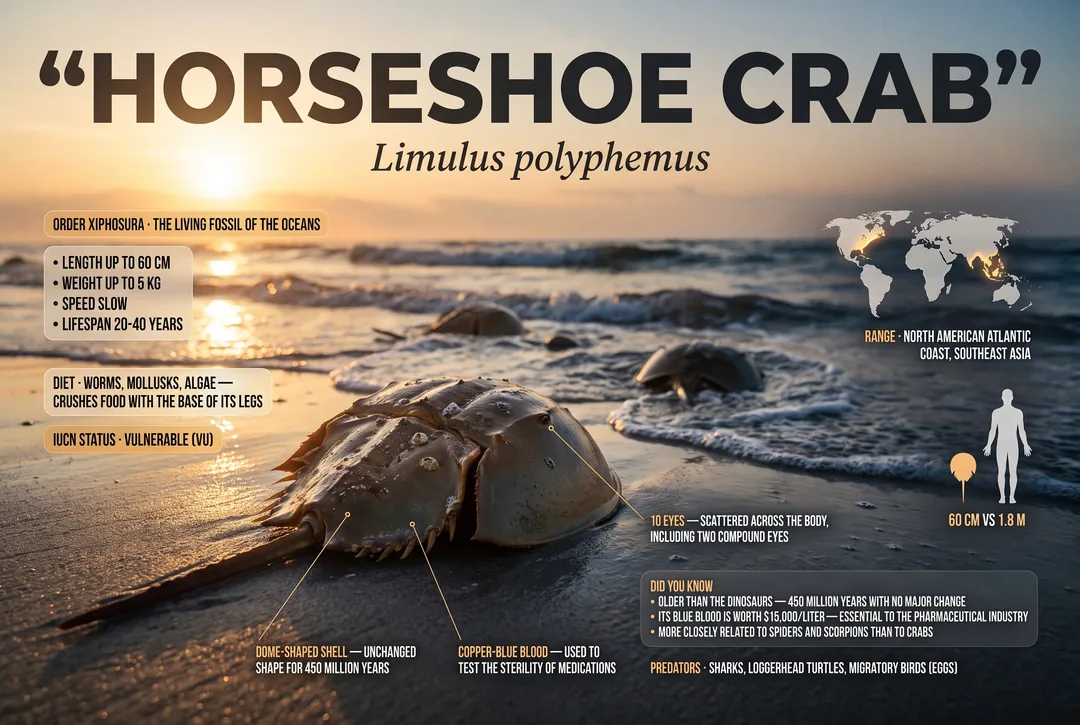
IDENTITY CARD
| Classification | Order Xiphosura, family Limulidae — closer to spiders and scorpions than to crabs |
| Scientific name | Limulus polyphemus (Linnaeus, 1758) |
| Size | Up to 60 cm (carapace), 80 cm including tail; female one-third larger than male |
| Weight | 2-5 kg (adult female) |
| Lifespan | 20-40 years |
| Depth | Intertidal zone to 30 m, occasionally to 200 m |
| Diet | Detritivore and benthic predator — polychaete worms, molluscs, small crustaceans, algae |
| IUCN Status | Vulnerable (VU) |
PORTRAIT
It is neither beautiful nor graceful, yet it commands respect like few living animals. The horseshoe crab is a living fossil in the most literal sense: its body plan has barely changed in 450 million years. It was prowling the seafloor 200 million years before the first dinosaurs appeared, and it outlasted them — along with four other mass extinctions. That flat, armoured silhouette has weathered asteroid strikes, volcanic winters, and the rise and fall of entire phyla without needing to adapt.
Despite its English name, the horseshoe crab is not a crab. It is not even a crustacean. Its anatomy and DNA place it among the chelicerates — the group containing spiders, scorpions, and mites. In terms of kinship, it is closer to the spider in your bathroom than to the crab on your plate. The resemblance to crabs is a coincidence of habit and habitat, not of lineage.
The animal moves slowly across the bottom, ploughing through sediment with its legs to unearth worms and shellfish. Divers encounter it on the sandy and muddy floors of the American Atlantic coast, gliding through the gloom like a relic from the Ordovician. In Asia, three related species — Tachypleus gigas, T. tridentatus, and Carcinoscorpius rotundicauda — haunt the mangroves and estuaries of Southeast Asia and Japan, completing a global distribution that has shrunk but never vanished.
HOW TO RECOGNIZE IT
Unmistakable. Seen from above, the body forms a broad horseshoe-shaped shield — hence the name — extended by a rigid telson (tail spine). The telson is neither a stinger nor a weapon; it is merely a rudder used to right itself when flipped by a wave. Handling the tail does not provoke a sting — the animal is entirely harmless.
The body divides into two articulated sections. The prosoma — the large, smooth, domed front carapace — covers the legs and mouthparts. Behind it, the opisthosoma — the rear section — is bordered by moveable lateral spines.
Turn it over and the architecture becomes alien. Six pairs of jointed legs line the underside, four central pairs tipped with small pincers. Behind the legs, five pairs of book gills are stacked like the pages of a paperback — the same respiratory mechanism as book lungs in terrestrial scorpions, another reminder that this is an arachnid relative, not a crab.
Colour ranges from olive-brown to dark brown, sometimes with a greenish sheen from algal growth. Underwater, the easiest tell is the sediment cloud it trails while moving across a sandy bottom, or the glossy gleam of lamplight catching its carapace at night.
For subtitles in English: start the video firstthen click the gearat the top right of the video, select “Subtitles/CC”, then “Auto-translate” and choose “English”.
WAY OF LIFE
The horseshoe crab spends most of its life on the soft bottoms of the continental shelf, typically between 5 and 30 metres deep. It feeds at night, ploughing through sediment in search of worms, small bivalves, and organic debris. It crushes food using spiny leg bases called gnathobases — it has no jaws.
The most extraordinary spectacle occurs each spring. During May and June, timed to the spring tides of the full and new moon, hundreds of thousands of horseshoe crabs emerge onto the beaches of the North American Atlantic coast. Females dig shallow nests in wet sand and deposit 3,000 to 4,000 greenish eggs per clutch, with males clinging to the females' backs and fertilizing the eggs as they are laid. A single female can produce up to 80,000 eggs per season.
This mass spawning is not just a reproductive event — it is a keystone moment in the Western Hemisphere's ecology. Horseshoe crab eggs are the primary fuel for red knots and other migratory shorebirds that stop on Delaware Bay beaches to refuel during their epic journey from South America to the Arctic. Without those eggs, the birds cannot complete the migration. The fate of a Paleozoic marine invertebrate and an Arctic-nesting shorebird are locked together by a shared beach.
WHERE TO SEE IT
Delaware Bay, USA — the world's largest spawning. Every May and June, during spring tides, hundreds of thousands of horseshoe crabs converge on the beaches of Delaware Bay. Slaughter Beach, Pickering Beach, and Kitts Hummock offer front-row access to one of the most ancient reproductive events still visible on Earth. The spectacle is free, public, and overwhelming.
Florida, USA — Indian River Lagoon and Cape Canaveral. Horseshoe crabs are present year-round on sandy bottoms, with spawning concentrated from March to June. Night dives and snorkel surveys in the lagoon regularly turn up foraging animals. The warm, shallow waters make this one of the most comfortable places to observe them underwater.
Southeast Asia — mangroves and estuaries. Three Asian species — Tachypleus gigas, T. tridentatus, and Carcinoscorpius rotundicauda — inhabit Malaysia, Thailand, Vietnam, the Philippines, and Indonesia. Snorkelling through mangrove channels at low tide occasionally reveals them moving across mudflats, a quiet encounter in a quiet world.
Japan — Kitakyushu. Tachypleus tridentatus is protected here as a natural monument, and the city maintains a Horseshoe Crab Museum. The last Japanese habitats cling to the Seto Inland Sea and northern Kyushu — a population measured in hundreds, watched over with national reverence.
OBSERVATION CALENDAR
| Destination | J | F | M | A | M | J | J | A | S | O | N | D |
|---|---|---|---|---|---|---|---|---|---|---|---|---|
| Delaware Bay (spawning) | ||||||||||||
| Florida (spawning) | ||||||||||||
| Florida (diving) | ||||||||||||
| Southeast Asia | ||||||||||||
| Japan (Kyushu) |
Click each button to show/hide
CONSERVATION
The Atlantic horseshoe crab is classified as Vulnerable (VU) by the IUCN. The Asian species are in worse shape: Tachypleus tridentatus is listed as Endangered (EN), with an 80-90% population decline over thirty years.
Threats are multiple and compounding. On the American coast, overharvest for use as bait in whelk and eel fishing halved the Delaware Bay population between the 1990s and 2000s. The biomedical industry bleeds approximately 500,000 horseshoe crabs annually to extract their blood for the LAL test — a sterility assay used on every vaccine, implant, and injectable device worldwide. Post-bleeding mortality ranges from 10 to 30 percent. Habitat loss from coastal development and the effects of climate change on spawning beach dynamics add further pressure.
In Asia, the picture is grimmer. Horseshoe crabs are consumed as food, and the destruction of mangrove habitat has erased breeding grounds across the region.
There is good news. A synthetic substitute — recombinant Factor C (rFC) — works as well as LAL without requiring animal blood. Approved in Europe since 2020, it could eventually end the annual bleed. Adoption is growing, but slowly — the pharmaceutical industry moves with caution, and regulatory inertia is formidable.
Organisations to support:
- ERDG — Ecological Research & Development Group, dedicated to horseshoe crab conservation
- IUCN Horseshoe Crab Specialist Group — coordinating global research and policy
- The Nature Conservancy — Delaware Bay — protecting critical spawning habitat
3 THINGS YOU PROBABLY DON'T KNOW
1. Its blood is blue — and worth $60,000 per gallon. Horseshoe crab blood contains hemocyanin, a copper-based oxygen carrier that turns blue when oxygenated — unlike our iron-based, red hemoglobin. But the real value lies in the amebocytes: these cells clot instantly in the presence of any bacterial endotoxin, forming a gel barrier around the contaminant. This reaction is the basis of the LAL test, used since the 1970s to verify the sterility of every vaccine, surgical implant, prosthesis, and IV device on the planet. Every injection you have ever received was tested with horseshoe crab blood.
2. It has ten eyes. Two large lateral compound eyes with roughly 1,000 facets each. Two median simple eyes sensitive to ultraviolet light. One endoparietal eye buried under the carapace, regulating the biological clock. And five additional photoreceptors distributed under the tail and across the belly. Neurophysiologist Haldan Keffer Hartline won the 1967 Nobel Prize in Physiology or Medicine for his work on horseshoe crab vision — research that laid the foundations for understanding how human eyes process contrast.
3. NASA drew inspiration from it. The hydrodynamics of the horseshoe crab's carapace — which moves through sand and mud without sinking — inspired NASA probe designs for soft terrain. More profoundly, the principle of lateral inhibition discovered in its vision — each photoreceptor inhibits its neighbours to enhance edge contrast — was directly integrated into the image-processing algorithms used in satellite cameras and medical imaging systems. A 450-million-year-old eye helped sharpen the pictures from space.
PHOTO AND VIDEO TIPS
The horseshoe crab is not spectacular at first glance — but it is fascinating at second. It is slow, cooperative, and entirely unfazed by a photographer's presence, making it one of the most patient subjects on the seafloor.
Lens. A macro or standard lens (60-105 mm) brings out the alien detail of the underside — book gills, gnathobases, the clustered eyes. A wide-angle lens (24-35 mm) works better for atmosphere shots: the animal moving across a sandy plain, trailing its sediment plume, silhouetted against open water.
Lighting. External flash is almost mandatory underwater; horseshoe crabs are typically found on murky, low-visibility bottoms where ambient light is scarce. Position strobes low and slightly behind to avoid harsh reflections off the glossy carapace.
On the beach. During the Delaware Bay spawning in May and June, the most evocative images come from twilight — the last light of evening or the first grey of dawn. Natural light conveys the timelessness of the event better than any flash. Keep the horizon in the frame. Let the scale speak.
Ethics. Do not flip a horseshoe crab to photograph its underside. The telson is fragile, and a flipped animal on wet sand struggles to right itself — each failed attempt costs energy the animal cannot spare during spawning. If you find one already flipped, gently turn it over and move on.
The shot to wait for. A mating pair, photographed from below or head-on — the smaller male clinging to the female's rear carapace with his hook-shaped front legs. The image shows anatomy, behaviour, and scale in a single frame, and carries a weight that no portrait of a solitary animal can match: this scene has played out, uninterrupted, for 450 million years.