Peacock Mantis Shrimp
Odontodactylus scyllarus
The most powerful punch in the animal kingdom, packed into 18 centimetres of rainbow-coloured carapace.
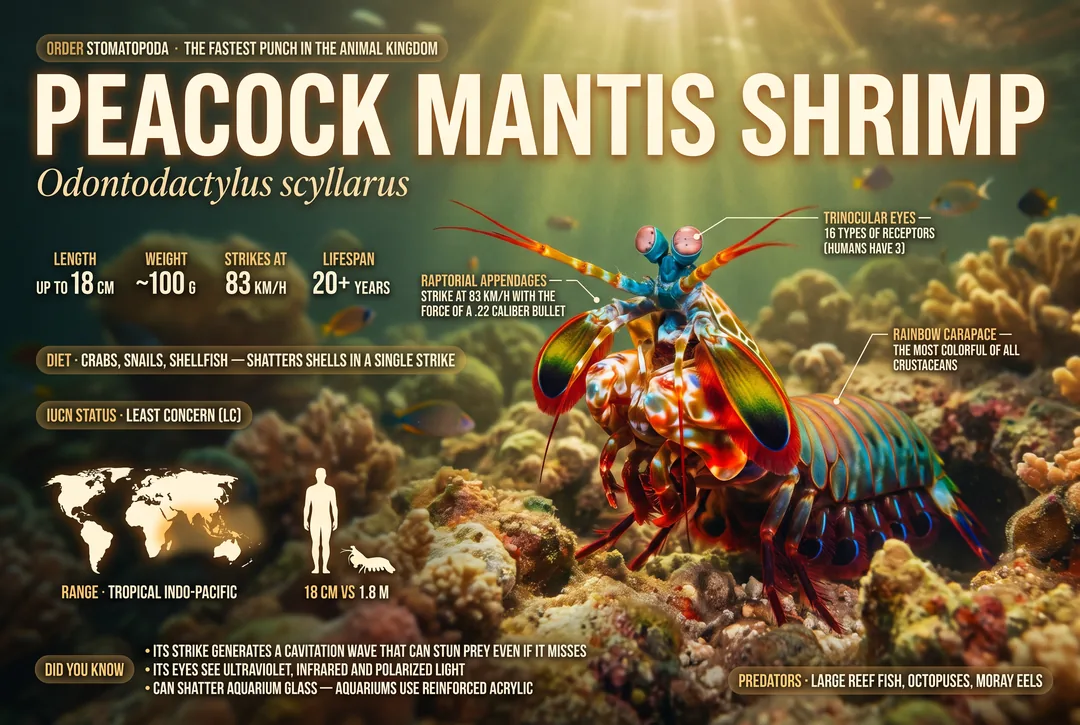
IDENTITY CARD
| Classification | Order Stomatopoda, family Odontodactylidae |
| Scientific name | Odontodactylus scyllarus (Linnaeus, 1758) |
| Size | 3-18 cm (average 8-15 cm) |
| Weight | Up to 200 g |
| Speed | Strike at ~80 km/h — acceleration comparable to a .22 calibre bullet |
| Lifespan | 3-6 years in the wild (up to 20 in captivity) |
| Depth | 3-40 m, mostly 5-25 m on sandy bottoms and coral rubble |
| Diet | Carnivore — gastropods, bivalves, crabs, hermit crabs, small fish |
| IUCN Status | Not Evaluated (NE) |
PORTRAIT
Some underwater creatures reveal that evolution has no sense of moderation. The peacock mantis shrimp is one of them. The size of a pen, painted like a stained-glass window, it possesses the fastest strike in the animal kingdom — and a visual system so advanced it makes the human eye look like a prototype.
Odontodactylus scyllarus is neither a shrimp nor a mantis. It is a stomatopod, a marine crustacean whose lineage diverged from other arthropod groups more than 400 million years ago. The common name "mantis shrimp" comes from its raptorial appendages, folded beneath the thorax like the arms of a praying mantis — but where the mantis catches, the stomatopod strikes. The difference is the difference between a trap and a sledgehammer.
Its livery is among the most spectacular on any reef. An emerald green carapace edged in red. Raptorial clubs flushed orange and crimson. Electric blue antennae. Eyes mounted on independently mobile stalks that shift colour with every angle of the light. In English it is sometimes called the rainbow shrimp — and for once, the nickname is not an exaggeration.
HOW TO RECOGNIZE IT
The body is elongated and dorso-ventrally flattened, armoured in articulated segments. The carapace is bright green with red or orange borders — visible from a distance on sand or rubble.
The most distinctive features are the two raptorial appendages tucked beneath the thorax, each tipped with a club-shaped bulge — the weapon. At rest, they are folded tight against the body; in action, they deploy in under three milliseconds.
The eyes are unmistakable: two spheres mounted on stalks, each rotating independently, divided by a dark median band of specialised photoreceptor rows. No other crustacean — indeed, no other animal — has eyes quite like these.
The telson (tail fan) is thick, ridged, and heavily armoured. It doubles as a shield: the animal backs into its burrow tail-first and uses the telson to block the entrance. The entire colour scheme functions as aposematic warning — a signal to would-be predators that this small crustacean hits far above its weight.
For subtitles in English: start the video firstthen click the gearat the top right of the video, select “Subtitles/CC”, then “Auto-translate” and choose “English”.
WAY OF LIFE
The peacock mantis shrimp is a fierce solitary predator. It excavates and defends a burrow in sand or coral rubble, from which it ambushes passing prey — and into which it retreats at the first sign of serious trouble.
The strike is the defining act. The raptorial club deploys in approximately 3 milliseconds, reaching speeds of 80 km/h. The impact is violent enough to generate cavitation bubbles in the water between club and target. When those bubbles collapse, they produce a secondary shockwave, a flash of light (sonoluminescence), and a momentary temperature spike at the point of implosion. The prey receives two impacts: the physical blow of the club, then the implosion of the cavitation bubble. Measured force: up to 1,500 newtons — extraordinary for an animal that fits in the palm of a hand.
Stomatopods divide into two functional groups: smashers, like O. scyllarus, whose clubs are blunt and deliver crushing blows to crack shells; and spearers, whose appendages are barbed and designed to impale soft-bodied prey. The peacock mantis shrimp is the heavyweight champion of the smashers.
Its visual system is equally extraordinary. Each eye contains 16 types of photoreceptor cells (humans have three). It perceives ultraviolet, visible, and near-infrared light, and — uniquely in the animal kingdom — detects circular polarised light. The eyes process colour information in the retina itself, using a fast pattern-recognition system rather than the brain-heavy processing mammals rely on. Each eye can gauge depth independently, giving the animal trinocular vision — with just two eyes.
Reproduction is monogamous within a breeding season. The female carries the egg mass beneath her thorax, tending it in the burrow until the larvae hatch and disperse into the plankton.
WHERE TO SEE IT
Indonesia — Lembeh Strait, Bali, Komodo. The Coral Triangle is the heartland of the peacock mantis shrimp. Lembeh, the muck-diving capital of the world, offers the most reliable sightings — the animals burrow in the volcanic sand and rubble that carpet the strait. Bali's east coast (Tulamben, Padang Bai) and the rubble slopes of Komodo provide regular encounters as well.
Philippines — Anilao. The "Lembeh of the Philippines." Sandy slopes and coral rubble around Anilao Bay are home to a healthy population. Local dive guides know the resident burrows and can lead you straight to an active animal.
Red Sea — Southern Egypt. The reefs of Marsa Alam and the deep south harbour peacock mantis shrimp on rubble patches between coral heads. Less frequently spotted than in Southeast Asia, but the encounters — often in exceptional visibility — are memorable.
Thailand — Richelieu Rock. This submerged pinnacle in the Andaman Sea, famous for whale sharks, also holds mantis shrimp in the rubble and crevices at its base. An unexpected bonus on a big-animal dive.
Australia — Great Barrier Reef. Sandy channels and rubble zones between bommies on the outer reef support populations of O. scyllarus. Night dives increase the odds, as the animals emerge to hunt after dark.
OBSERVATION CALENDAR
| Destination | J | F | M | A | M | J | J | A | S | O | N | D |
|---|---|---|---|---|---|---|---|---|---|---|---|---|
| Philippines (Anilao) |
Click each button to show/hide
CONSERVATION
The peacock mantis shrimp is not evaluated by the IUCN. As a small, burrowing crustacean with a wide Indo-Pacific range, it has largely escaped the attention of formal conservation assessments. That does not mean it is without threats.
Reef degradation is the primary concern. O. scyllarus depends on the complex mosaic of sand, rubble, and live coral that healthy reefs produce. When reefs are flattened — by bleaching, by dynamite fishing, by coastal development — the rubble habitat that mantis shrimp need for burrowing disappears with them.
The aquarium trade takes a steady toll. The peacock mantis shrimp's vivid colours and extraordinary behaviour make it a prized — if problematic — aquarium specimen. Problematic because the animal can and does shatter aquarium glass. Problematic, too, because it kills tankmates with the efficiency of its strike. Collectors using cyanide or dynamite to stun and extract them cause collateral reef damage far beyond the value of the individual animal.
Overfishing of the invertebrate prey base — gastropods, crabs, bivalves — indirectly reduces mantis shrimp populations by removing food sources.
Organisations to support:
- Coral Triangle Initiative — protecting the epicentre of marine biodiversity
- Reef Check — monitoring reef health worldwide
- Project AWARE — marine conservation and debris clean-ups
- Conservation International — protecting critical marine habitats
3 THINGS YOU PROBABLY DON'T KNOW
1. Its punch produces light. The strike is so fast that it generates cavitation bubbles in the water. When those bubbles collapse, the implosion produces a flash of light — sonoluminescence — and a momentary temperature spike exceeding 4,700 degrees C at the point of collapse. The prey is hit twice: first by the physical club, then by the shockwave of the imploding bubble. Two impacts from a single strike.
2. It sees a world we cannot imagine. Sixteen types of photoreceptor cells (we have three). Sensitivity spanning ultraviolet to near-infrared. The ability to detect circular polarised light — a capability unique among all known animals. Rather than sending raw colour data to the brain for processing, as we do, the mantis shrimp's retina handles pattern recognition locally, enabling near-instantaneous colour discrimination. It is not that it sees "more colours" — it recognises them faster.
3. Its armour inspired military research. The club of the peacock mantis shrimp survives thousands of high-velocity impacts without fracturing, thanks to a structure called the Bouligand structure — layers of chitin fibres arranged in a helicoidal pattern, reinforced with hydroxyapatite. This architecture disperses cracks in spirals rather than letting them propagate in a straight line. Materials scientists have studied and replicated the design for applications in body armour, helmets, and vehicle plating.
PHOTO AND VIDEO TIPS
The peacock mantis shrimp is one of the most sought-after macro subjects in underwater photography — vivid, detailed, behavioural, and challenging to approach.
Lens. Macro is mandatory. A 60 mm works at moderate magnification; a 100 mm or 105 mm is ideal, providing enough working distance to avoid spooking the animal back into its burrow. On a compact system, a wet macro diopter is essential.
Lighting. Twin strobes positioned at 45 degrees, power reduced by one-third from your default. The green carapace reflects aggressively, and overexposure on the back is the most common mistake. Angling the strobes slightly behind the subject reduces specular highlights and brings out the texture of the raptorial clubs and the iridescence of the eyes.
Approach. Slow, flat on the sand, with no sudden movements. The peacock mantis shrimp is territorial but wary — it will retreat into its burrow at the first fast approach and may not re-emerge for several minutes. Patience is the primary skill. Position yourself at burrow level, settle in, and wait. The animal will eventually lean out, scan its surroundings, and present itself.
Focus. Lock on the eyes. Both pedunculate eyes should be sharp, and each should carry a flash catchlight — the dual reflections in those strange, triband spheres are what make a mantis shrimp portrait unforgettable. A narrow aperture (f/16-f/22) helps keep both eyes in the plane of focus despite their independent orientation.
The shot to wait for. The animal fully emerged from its burrow, raptorial clubs slightly open, eyes pointed toward the camera. It happens — but only for photographers who are already in position, already focused, already still.