Blue Starfish
Linckia laevigata
An electric blue jewel resting on the reef — with the power to regrow an entire body from a single severed arm.
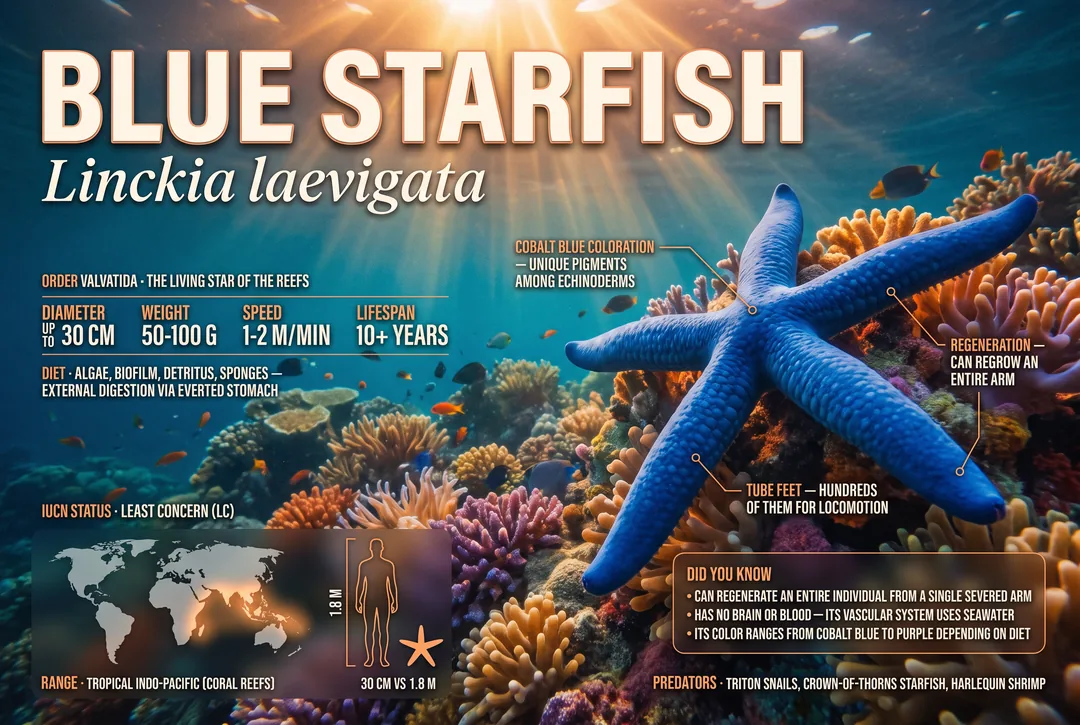
IDENTITY CARD
| Classification | Order Valvatida, family Ophidiasteridae |
| Scientific name | Linckia laevigata (Linnaeus, 1758) |
| Size | Up to 30 cm in diameter (average: 20-25 cm) |
| Number of arms | 5 (rarely 4 or 6) |
| Lifespan | Around 10 years |
| Depth | From the intertidal zone to 60 m, most commonly between 1 and 20 m |
| Diet | Detritivore — algal biofilm, micro-organisms, organic detritus |
| IUCN Status | Not Evaluated (NE) — but subject to massive collection for the souvenir trade |
PORTRAIT
On a Pacific coral reef, you spot it from a distance. The colour is enough: an intense cobalt blue, almost unreal, resting on the substrate like an object left behind by a distracted painter. Linckia laevigata is probably the most photographed starfish in the tropics — and the most instantly recognisable.
Five smooth, cylindrical arms of equal length radiate from a modest central disc. No pincers, no visible spines, no intricate pattern — the surface is uniformly sleek to the touch, covered in granulations so fine they are barely perceptible. The animal's entire identity lies in its colour — a blue unlike anything else on the reef. That blue is not a pigment in the conventional sense. It is produced by a compound called linckiacyanine, unique to the genus Linckia, and modulated by depth, diet and each individual's genetics. Some populations lean towards violet, others towards turquoise; rare specimens appear orange, olive green or even pink. But electric blue remains the rule — and it is what makes Linckia laevigata the star of Indo-Pacific reefs.
For the diver, encountering a blue starfish is one of those moments that feel almost staged — a perfect splash of colour against brown coral or white sand, like a prop placed there for the camera. The animal obliges by staying perfectly still, unperturbed, while you frame your shot.
HOW TO RECOGNIZE IT
The blue starfish is hard to mistake for anything else. Its colour alone distinguishes it from every other species in its habitat. Against a backdrop of brown coral or white sand, it catches the eye from several metres away.
The silhouette is that of a classic five-pointed star, but the arms are longer and more slender than in most common starfish. They are nearly cylindrical in cross-section, tapering slightly at the tips, and their surface is smooth — lacking the spines or prominent tubercles that many other species carry. The central disc is small relative to the total span.
The underside is paler, traversed by ambulacral grooves from which emerge hundreds of tube feet — tiny tubes tipped with a sucker that the animal uses to move and adhere to the substrate. They are clearly visible if you gently turn the animal over (though this is best avoided — see below).
The most common confusion is with Linckia guildingi, a related species found in the Caribbean that can appear blue but tends more towards violet or brown. In the Indo-Pacific, no other species shares this saturated blue.
For subtitles in English: start the video firstthen click the gearat the top right of the video, select “Subtitles/CC”, then “Auto-translate” and choose “English”.
WAY OF LIFE
Linckia laevigata is a slow, discreet and sedentary animal. It spends the day exposed on hard reef surfaces — coral slabs, dead coral blocks, boulders — and moves just a few metres per day in search of food.
Its diet is modest. The blue starfish feeds on the biofilm that coats hard surfaces: a mixture of micro-algae, bacteria and decomposing organic matter. It everts its stomach onto the substrate, digests the biological film in place, then retracts its stomach. This mode of external digestion is common to most starfish, but here it targets only detritus — the animal attacks neither living coral nor shellfish.
The regenerative capacity of Linckia laevigata ranks among the most spectacular phenomena in the animal kingdom. Not only can the starfish regrow a lost arm, but — remarkably — a severed arm can regenerate an entire body, provided it retains a portion of the central disc. Divers regularly observe asymmetrical individuals on the reef: one large arm bearing four tiny developing arms, a form that biologists call the "comet." Complete regeneration takes roughly one year.
Reproduction can be sexual — release of gametes into the water, external fertilisation, planktonic larva — or asexual, through autotomy of an arm that becomes a new individual. This dual strategy partly explains the species' abundance on healthy reefs.
WHERE TO SEE IT
The blue starfish inhabits the entire tropical Indo-Pacific, from the East African coast to the islands of the central Pacific. It is absent from the Atlantic and the Caribbean. Here are the destinations where it is most abundant and easiest to observe while diving.
Indonesia — Raja Ampat and Komodo. The reefs of Raja Ampat harbour some of the highest densities of Linckia laevigata in the world. It appears on virtually every dive, resting on coral flats or shallow reef slopes. At Komodo, sites such as Batu Bolong, Crystal Rock and Manta Alley count dozens per dive, often at shallow depths on hard coral.
Philippines — Visayas. The reefs around Bohol, Cebu, Negros and Siquijor are carpeted with blue starfish. They are especially visible on the shallow drop-offs of Apo Island and Balicasag, and along the seagrass beds of Moalboal. The species is so common that it forms part of the permanent backdrop of Philippine diving.
Maldives. Present on most reefs across the archipelago, particularly abundant on the thilas and outer atoll slopes. Easy to spot during drift dives, perched on coral blocks between 5 and 15 m.
Great Barrier Reef — Australia. The species is common along the entire Great Barrier Reef, from coastal reefs to offshore cays. It is one of the most visible starfish on the reef flats, where it contrasts sharply with brown coral and white sand.
Red Sea — Egypt. Linckia laevigata is present in the Red Sea, though less abundant than in Southeast Asia. It can be found on the fringing reefs of the Egyptian coast and in the southern marine parks, where water clarity makes it especially photogenic.
OBSERVATION CALENDAR
| Destination | J | F | M | A | M | J | J | A | S | O | N | D |
|---|---|---|---|---|---|---|---|---|---|---|---|---|
| Indonesia (Raja Ampat) | ||||||||||||
| Indonesia (Komodo) | ||||||||||||
| Philippines (Visayas) | ||||||||||||
| Maldives | ||||||||||||
| Great Barrier Reef | ||||||||||||
| Red Sea (Egypt) |
Click each button to show/hide
Note: The blue starfish is a sedentary animal, present year-round on the reefs it inhabits. This calendar reflects the best diving conditions at each destination, not the seasonality of the species itself.
CONSERVATION
Linckia laevigata is Not Evaluated (NE) on the IUCN Red List, which means neither that it is doing well nor that it is threatened — simply that a formal assessment has not been conducted. The species is not listed under any international conservation convention.
The most direct and best-documented threat is collection for the souvenir trade. Millions of blue starfish are harvested every year from Southeast Asian reefs, dried and sold to tourists in coastal markets, airport shops and online. Their vivid blue, which partially survives the drying process, makes them one of the most exploited marine invertebrates in the ornamental trade. The species is also collected alive for the marine aquarium market, though it rarely survives in captivity — its biofilm diet is nearly impossible to replicate in a tank.
At the local level, intensive harvesting can visibly reduce populations on heavily visited reefs. Several studies conducted in the Philippines and Indonesia have shown markedly lower densities on reefs near tourist areas compared to protected reefs.
The other threats are those facing all reef inhabitants: coral bleaching, sedimentation, coastal pollution and ocean acidification. The destruction of coral habitat mechanically reduces the surface area available for the biofilm on which the species depends.
The responsible diver does not touch starfish, does not flip them for photographs, and never buys them dried. These are simple actions, but at the scale of millions of divers and tourists, they make a measurable difference.
Organisations to support:
- Reef Check — global coral reef monitoring programme driven by volunteers
- Coral Triangle Initiative — protecting the reefs of the Coral Triangle
- Project AWARE — raising diver awareness for marine environment protection
3 THINGS YOU PROBABLY DON'T KNOW
1. A single arm can give rise to a complete individual. Most starfish can regenerate a lost arm — but Linckia laevigata goes much further. A detached arm, even without a fragment of the central disc, can under certain conditions regenerate the four remaining arms and all internal organs. The intermediate result — a large arm bearing tiny buds — resembles a comet trailing its tail. It is one of the most extreme cases of regeneration in the animal kingdom and has inspired research in regenerative medicine.
2. Its blue exists nowhere else in the marine world. The pigment responsible for its colour, linckiacyanine, is a modified carotenoid unique to the genus Linckia. No other known marine animal produces it. It is not a structural blue (like that of the mandarin fish) nor a common pigment (like melanin) — it is a singular molecule whose biosynthetic pathway remains incompletely understood.
3. It sees without eyes — well, almost. Linckia laevigata has no eyes in the conventional sense, but the tip of each of its five arms bears an ocellus — a cluster of photosensitive cells capable of detecting light and shadow. The starfish forms no image, but it distinguishes day from night, perceives the direction of light, and can orient itself towards shaded areas of the reef. Five rudimentary sensors arranged in a star: an elegant solution for an animal with neither head nor brain.
PHOTO AND VIDEO TIPS
The blue starfish is an almost too-easy photographic subject — and that is precisely the trap. Everyone comes home with the same shot: a blue starfish on brown coral, taken straight down, correctly exposed and thoroughly dull. To do better, think composition.
Lens. Macro or semi-macro ideally — a 60 mm or 100 mm macro on a mirrorless or DSLR, macro mode on a compact or GoPro. A wide-angle lens only does the animal justice if the setting is spectacular. Otherwise, it is macro that reveals the granular surface texture and the intensity of the blue.
Light. Strobes or video lights are all but essential. The blue of Linckia absorbs red wavelengths — without artificial light, the starfish appears dull and dark beyond 5-6 m depth. A burst of strobe makes the colour explode. Two small video lights achieve the same effect continuously.
Composition. Get down to the subject's level — the 90-degree top-down angle is the most commonplace. Lying flat on the sand with the lens at the starfish's height, including the reef in the background, yields a far more dynamic image. Seek contrasts: a blue starfish on white sand, against a red sponge, or beside yellow coral.
Common mistake. Picking up the starfish to move it to a more photogenic spot. It is the most frequent and most harmful error. The stressed animal stiffens, its colours fade, and the handling causes real damage — torn tube feet take weeks to regenerate. The best photograph is always the one of the animal exactly where it chose to be.