Whale Shark
Rhincodon typus
The largest fish on Earth doesn't bite — it filters.
IDENTITY CARD
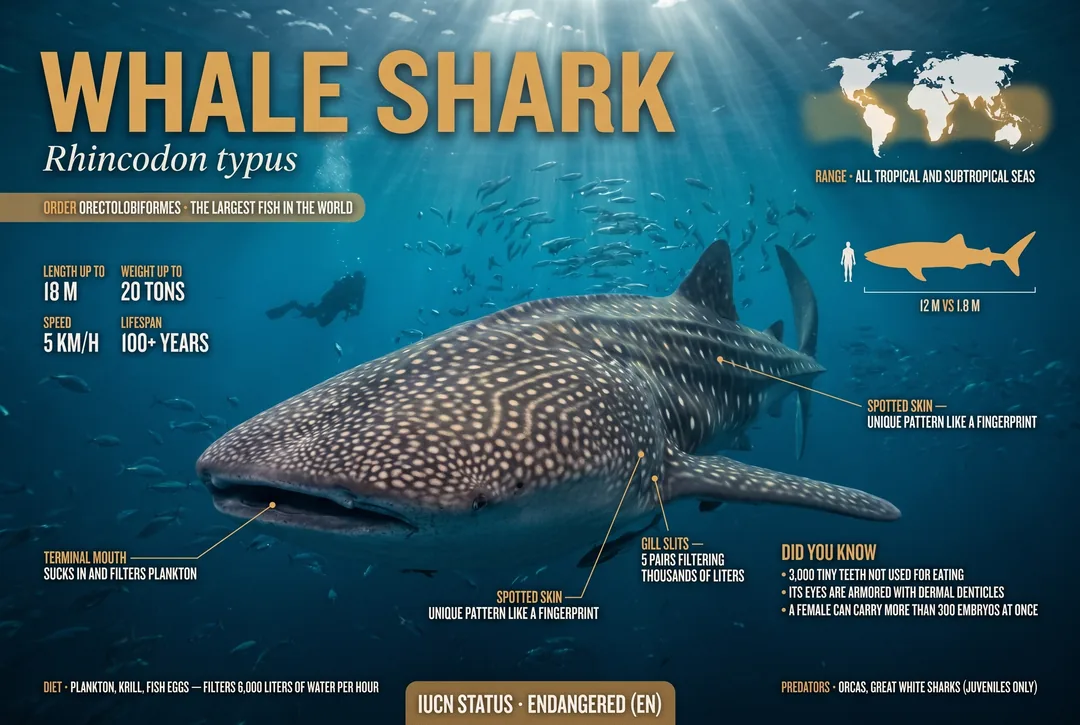
| Classification | Order Orectolobiformes, family Rhincodontidae |
| Scientific name | Rhincodon typus (Smith, 1828) |
| Size | Up to 18 m (typical observed range: 8-12 m) |
| Weight | Up to 20 tonnes |
| Speed | ~5 km/h cruising |
| Lifespan | 100 years and more (estimates up to 130 years) |
| Depth | Surface to 1,900 m, but most commonly observed between 0 and 30 m |
| Diet | Filter feeder — plankton, fish eggs, krill, small pelagic fish |
| IUCN Status | Endangered (EN) — population declined by over 50% in 75 years |
PORTRAIT
Some underwater encounters change a diver forever. The whale shark is one of them. You never quite prepare for it: there it is, emerging from the blue, a tranquil and impossibly vast mass, its mouth agape across a metre and a half of nothing — and you understand in an instant that the largest fish on the planet hunts nothing at all. It inhales.
Rhincodon typus is a filter feeder. It moves slowly, mouth wide open, sifting up to 6,000 litres of water per hour through its gills, retaining only the plankton, fish eggs, and small crustaceans that make up the bulk of its diet. The animal is entirely harmless to humans. Divers who have encountered one before know this; those meeting one for the first time generally need a few seconds to convince themselves.
Its blue-grey skin, stippled with white spots and pale stripes, is one of the most recognisable patterns in the ocean. Across much of the Spanish-speaking world it has earned the nickname pez dama — checkerboard fish. But this pattern is more than decorative: it is unique to each individual, like a fingerprint, and biologists have been using it for years to identify and track populations.
HOW TO RECOGNIZE IT
The whale shark is unmistakable. Its flattened, broad head — almost square when viewed from the front — carries a terminal mouth, a rare trait among sharks, whose mouths are typically positioned on the underside of the head. Three longitudinal ridges run along each flank. The caudal fin is asymmetrical, tall, and crescent-shaped.
Underwater, sheer size strikes first. A 10-metre adult is the length of a city bus. A 4-metre juvenile already exceeds the length of a family car. The belly is white, the flanks checkered with spots. It is the only shark that displays this pattern across both its back and flanks — a visual marker impossible to miss, even in turbid water.
For subtitles in English: start the video firstthen click the gearat the top right of the video, select “Subtitles/CC”, then “Auto-translate” and choose “English”.
WAY OF LIFE
The whale shark is a nomad. It travels thousands of kilometres following plankton blooms and mass fish spawning events, riding warm currents between the tropics. Individuals fitted with satellite tags have crossed the Atlantic and covered over 20,000 km in a single year.
Despite its size, the animal is solitary. The spectacular gatherings observed at certain points around the globe — sometimes hundreds of individuals — are not social events: they are feeding aggregations, forming where food concentrates (upwellings, fish spawning grounds). Each shark comes to eat, not to socialise.
Reproduction remains largely mysterious. Since 1995, thanks to the examination of a female captured off Taiwan, we know the species is ovoviviparous: the eggs hatch inside the mother's uterus, which can carry more than 300 embryos at various stages of development. But no birth has ever been observed in the wild, and the nursery grounds remain unknown — one of the great unsolved mysteries of marine biology.
WHERE TO SEE IT
The whale shark inhabits all warm seas between the tropics. Here are the destinations where chances of an encounter are highest, featuring sites in the DivingDeal catalogue:
Maldives — Ari Atoll and Baa Atoll. South Ari is one of the few places on Earth where resident whale sharks can be found year-round. Sites such as Maamigili, Broken Rock, and Ellaidhoo Hausriff offer regular encounters. At Baa Atoll, Hanifaru Bay hosts spectacular aggregations from June to November, when monsoon currents funnel plankton into this bowl-shaped bay. Snorkelling only at Hanifaru — scuba diving is prohibited to protect the animals.
Red Sea — Egypt. Whale sharks are observed along the southern coast, particularly around Elphinstone, Shaab Sataya (Marsa Alam), and in the waters off Sharm El Sheikh (Ras Nasrani, Shark Observatory). Sightings are seasonal and less predictable than in the Maldives, but the Red Sea's visibility makes every encounter unforgettable.
Mozambique — Tofo. The Inhambane coast is one of the last strongholds of the species in the western Indian Ocean. Sites such as Manta Reef, Galleria, and Praia da Rocha welcome whale sharks from November to March, often alongside manta rays.
Mexico. Two seasons, two coasts. On the Yucatan Peninsula (Isla Holbox, Isla Mujeres), the aggregations from June to September rank among the largest on Earth — hundreds of individuals drawn by tuna spawning events. On the Pacific coast, La Paz (Baja California) offers a season from October to April, peaking from December to February.
Philippines — Oslob and Donsol. Oslob (Cebu) offers near-guaranteed sightings year-round, though the practice of feeding the sharks is controversial. Donsol (Sorsogon), wilder and less developed, offers a snorkelling season from November to June.
Thailand — Koh Tao and the Andaman Sea. Southwest Pinnacle (Koh Tao), Koh Bon, and Richelieu Rock (Similan Islands) are the classic spots. Sightings concentrate from March to June and September to November.
Galapagos — Wolf and Darwin. From June to November, these remote islands attract very large pregnant females — sometimes exceeding 14 metres. Advanced-level diving with strong currents.
OBSERVATION CALENDAR
| Destination | J | F | M | A | M | J | J | A | S | O | N | D |
|---|---|---|---|---|---|---|---|---|---|---|---|---|
| Maldives (Ari Atoll) | ||||||||||||
| Red Sea (Egypt) | ||||||||||||
| Mozambique (Tofo) | ||||||||||||
| Mexico (Yucatan) | ||||||||||||
| Mexico (La Paz) | ||||||||||||
| Philippines (Donsol) | ||||||||||||
| Thailand (Similans) | ||||||||||||
| Galapagos (Wolf/Darwin) | ||||||||||||
| Indonesia (Cenderawasih) | ||||||||||||
| Tanzania (Mafia Island) |
Click each button to show/hide
CONSERVATION
Rhincodon typus is listed as Endangered (EN) on the IUCN Red List. Its global population has declined by more than 50% in 75 years — a figure that climbs to 63% for Indo-Pacific populations. The species has been listed on Appendix II of CITES since 2002, and on the Convention on Migratory Species (CMS).
The threats are multiple: targeted catches for meat and shark fins in parts of Asia, accidental captures (bycatch) in industrial fishing nets, ship strikes, and degradation of coastal habitats. Poorly managed tourism — feeding, harassment, overcrowding of boats — creates growing pressure on aggregation sites.
Responsible divers maintain a distance of 3 metres, never touch the animal, and avoid using flash. These simple rules make the difference between a respectful observation and a disturbance.
Organisations to support:
- Marine Megafauna Foundation — global research and photo-identification programme
- MWSRP — Maldive Whale Shark Research Programme — population monitoring in South Ari
- Save Our Seas Foundation — funding elasmobranch research projects
- PADI AWARE — citizen science programme, sighting reports
3 THINGS YOU PROBABLY DON'T KNOW
1. It has 3,000 teeth — and never uses them. The whale shark's jaw holds roughly 3,000 tiny teeth arranged in 300 rows. They play no role in feeding: the animal filters its food through its gills, not with its teeth. Their function remains debated — perhaps an evolutionary vestige, perhaps a role in courtship behaviour that has never been observed.
2. Its eyes are armoured. Unlike most sharks, the whale shark has no nictitating membrane to protect its eyes. Instead, evolution has given it a unique form of armour: the surface of each eyeball is covered in dermal denticles — the same tooth-like scales that line its skin. It can also retract the eye into its socket when threatened.
3. One litter, 300 pups — and we still don't know where. In 1995, a female captured off Taiwan was carrying 304 embryos at various stages of development. It remains the only direct observation of a whale shark litter ever documented. Thirty years on, we have still not identified the birthing grounds or witnessed a birth at sea. Newborns (40-60 cm) turn up at certain sites, but the nurseries remain undiscovered.
PHOTO AND VIDEO TIPS
The whale shark is arguably the most spectacular and accessible underwater subject. Its slowness and its size make photography technically straightforward — provided you don't let the emotion overwhelm you.
Lens. Wide angle is essential. In a housing: 10-17 mm fisheye or 14 mm rectilinear. With a GoPro or equivalent: the native field of view works perfectly, and stabilised 4K video delivers excellent results.
Light. At the depth where most whale sharks are encountered (0-15 m), natural light is more than sufficient. Flash or video lights are only useful for close-up shots of the skin pattern. For a full-body shot of the entire animal, shooting with the sun behind the photographer (front-lit) produces the clearest images.
Approach. Swim parallel to the animal, slightly below its midline, at 3-4 metres distance. Never approach from above (a predator posture) or position yourself in front of the mouth. The animal cruises at 5 km/h — a sustained kick can keep pace, but you won't catch it if it accelerates.
Classic mistake. Trying to fit everything in one frame. A 10-metre whale shark won't fit in any frame at 2 metres, even with a fisheye. Better to choose: either the portrait (head and first pectoral fin) or the wide shot (pull back to 5-6 m, entire animal with a diver silhouette for scale).