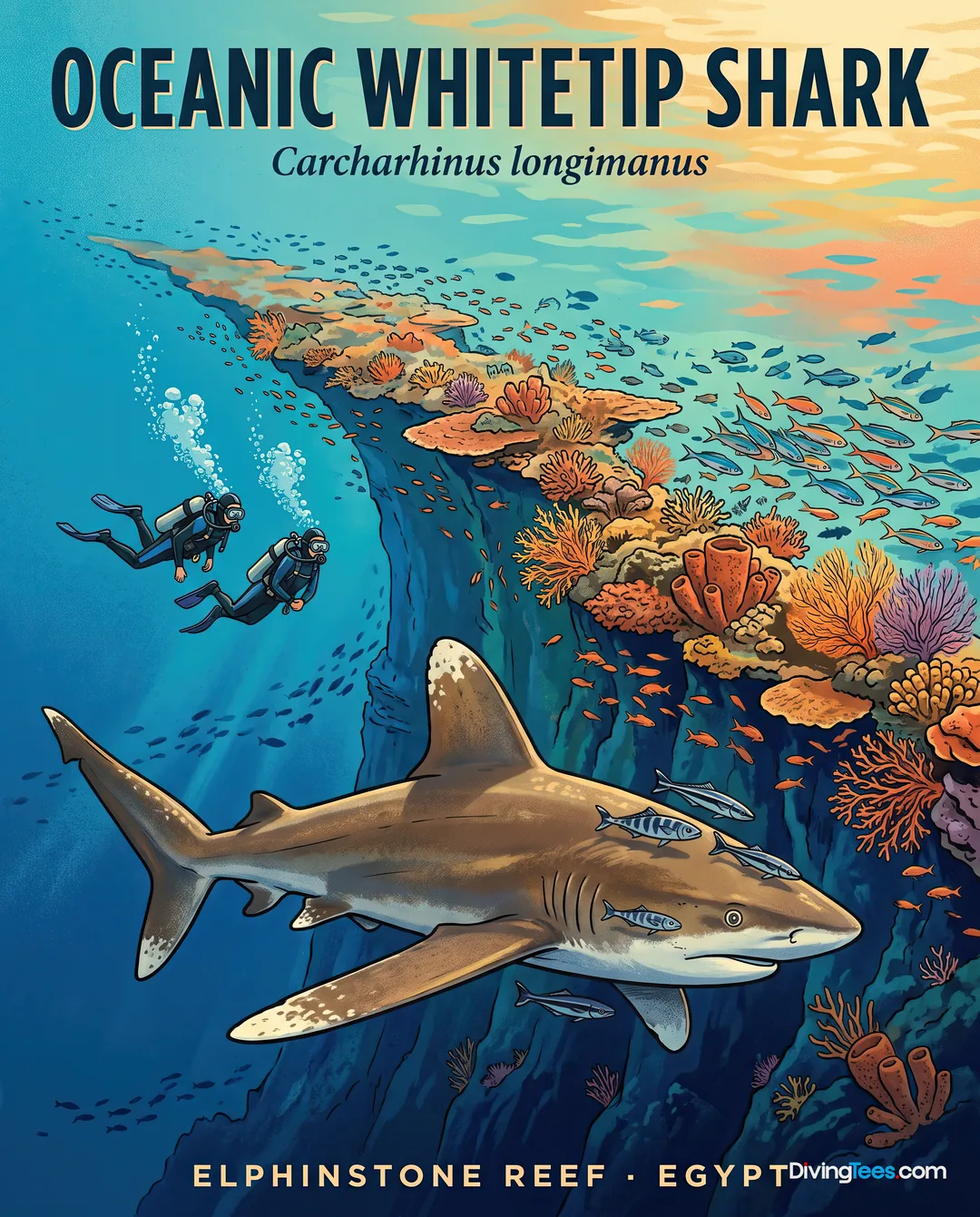
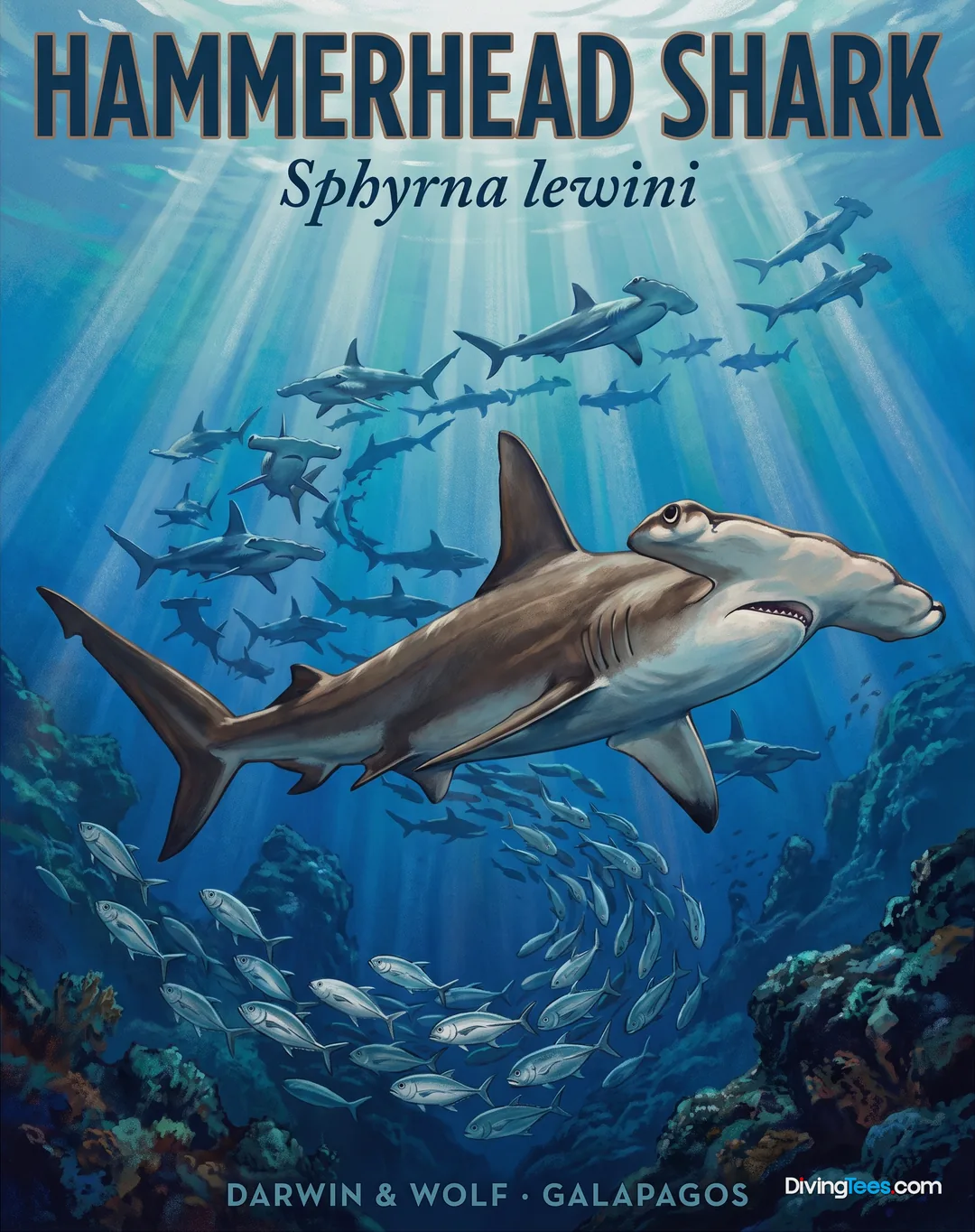
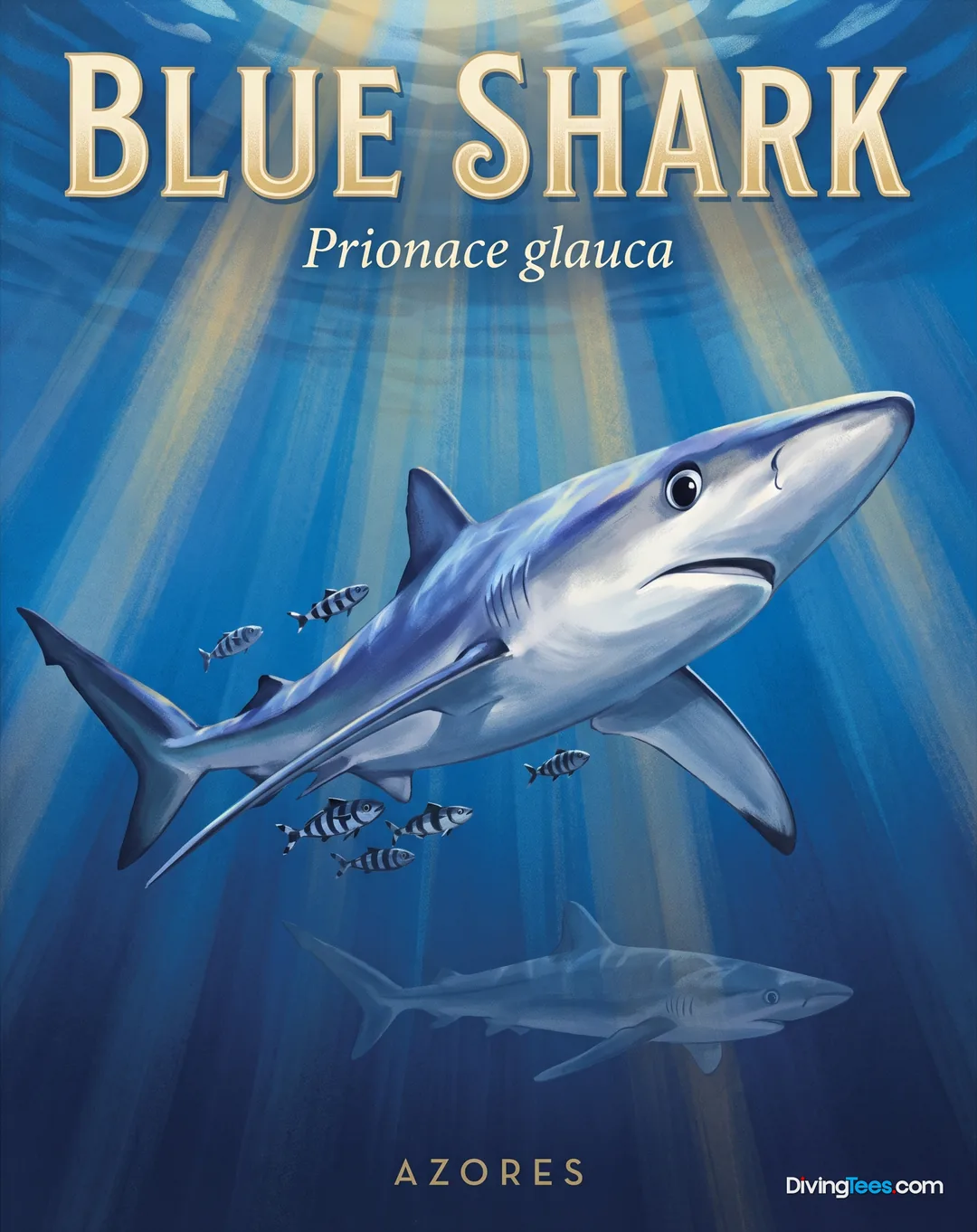
Tiger Shark
Galeocerdo cuvier
The ocean's most versatile jaw refuses nothing.
IDENTITY CARD
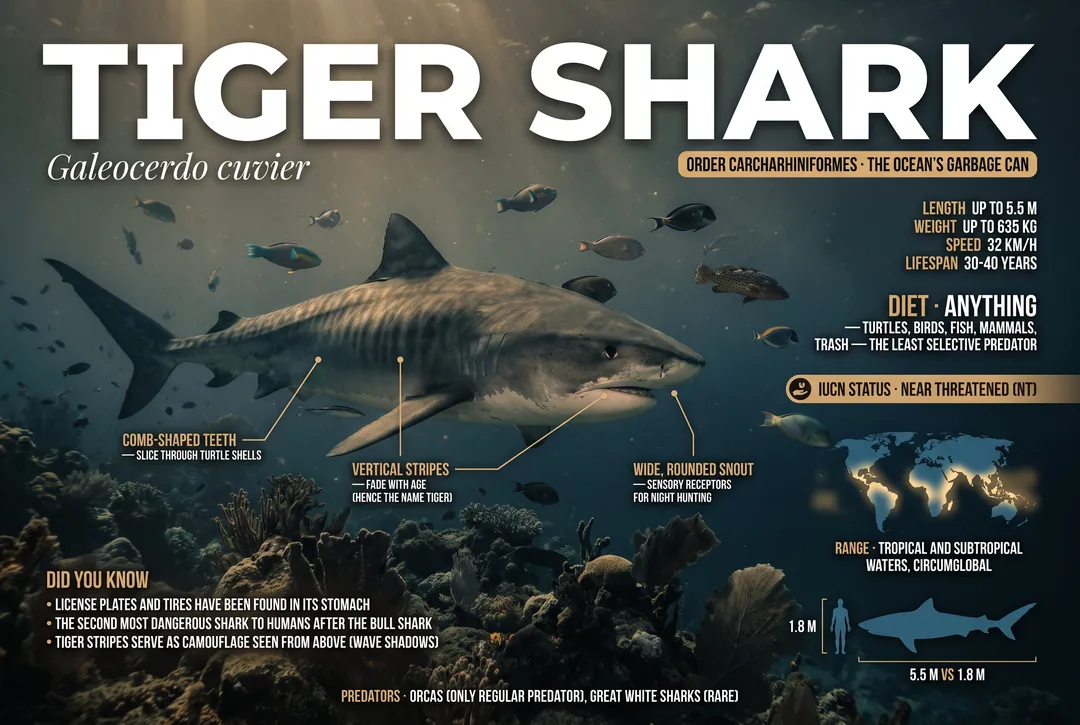
| Classification | Order Carcharhiniformes, family Galeocerdonidae |
| Scientific name | Galeocerdo cuvier (Peron & Lesueur, 1822) |
| Size | Up to 5.5 m (typical observed range: 3-4 m) |
| Weight | Up to 635 kg (records exceeding 800 kg) |
| Speed | ~32 km/h in bursts |
| Lifespan | 30 to 50 years |
| Depth | Surface to 350 m, but most commonly observed between 0 and 140 m |
| Diet | Opportunistic predator — fish, sea turtles, cephalopods, seabirds, rays, other sharks, marine mammals, debris |
| IUCN Status | Near Threatened (NT) — population declining |
PORTRAIT
The tiger shark does not do subtlety. Where other predators specialise, this one chose to eat everything. Fish, turtles, birds, seals, dolphins, jellyfish, other sharks — and when the opportunity arises, licence plates, tyres, chunks of metal. Necropsies of tiger sharks have yielded a catalogue of objects that reads more like an inventory from a junkyard than a biology paper — hence its well-earned nickname, the "garbage can of the sea."
That Rabelaisian appetite rests on a tool of fearsome efficiency: a jaw lined with broad, heavily serrated, slightly curved teeth capable of crushing the shell of an adult hawksbill turtle. Few marine predators can manage that. The tiger shark does it routinely — turtles make up a significant portion of its diet in tropical waters.
Second only to the great white shark in the number of recorded incidents with humans, Galeocerdo cuvier inspires a fear that is not entirely unwarranted. But the statistic deserves context: out of the hundreds of millions of swims, dives, and surf sessions that take place every year in tropical waters, negative interactions number in the dozens. Divers who encounter the tiger shark under controlled conditions — and their ranks are growing — unanimously describe a calm, curious, and majestic animal.
HOW TO RECOGNIZE IT
The tiger shark stands out with a massive, stocky build, a short rounded snout, and above all its dark vertical stripes set against a grey-blue background — the pattern that gave it its name. These bands are strikingly bold on juveniles, sometimes as sharply defined as a big cat's markings. They fade steadily with age: on an adult over four metres, they linger only as faint shadows along the flanks. On the oldest individuals, they may vanish entirely.
The head is broad and flattened, almost square when viewed from above — a distinctive shape that makes identification straightforward even at a distance. The eyes are large and round, equipped with a nictitating membrane. The caudal fin is long, with a greatly elongated and pointed upper lobe that delivers the thrust needed for explosive acceleration.
Underwater, the sheer size commands attention: a four-metre adult stretches longer than a family car. The belly is creamy white, the flanks shifting from grey-blue to olive-brown depending on the light. The pectoral fins are broad and falcate. The overall impression is one of raw power — a far cry from the streamlined elegance of the great white or the restless energy of the bull shark.
For subtitles in English: start the video firstthen click the gearat the top right of the video, select “Subtitles/CC”, then “Auto-translate” and choose “English”.
WAY OF LIFE
The tiger shark is a coastal nomad. It patrols reefs, lagoons, channels, and drop-offs, often at shallow depth, with a preference for turbid water where its approach goes unnoticed. Individuals fitted with satellite tags have covered more than 7,500 km in a single year, navigating between islands and continental coasts as water temperature and prey availability dictate.
Primarily nocturnal, the tiger shark hunts preferentially at dusk and through the night, when its low-light vision gives it an edge over its prey. During the day it often retreats to deeper water or drifts slowly along wall edges — it is during these phases of relative rest that divers most commonly encounter it.
Its diet is the broadest of any shark. Green sea turtles, spiny lobsters, albatrosses, rays, smaller sharks, dugongs — nothing escapes the list. This versatility makes the tiger shark a keystone apex predator in reef ecosystems: its mere presence alters the grazing behaviour of turtles, which in turn protects seagrass beds from overgrazing.
Reproduction is ovoviviparous. Litters range from 10 to 80 pups, sometimes more, after a gestation of roughly 14 to 16 months. Newborns measure 50 to 75 cm and are immediately self-sufficient. Sexual maturity is reached at around 7 to 10 years, which makes the population vulnerable to overfishing — each female produces only a limited number of offspring over the course of her life.
WHERE TO SEE IT
The tiger shark inhabits all tropical and subtropical seas worldwide. Here are the destinations where managed encounters are most reliable:
Bahamas — Tiger Beach. The world's benchmark site. This shallow sandbank (6-12 m), off West End on Grand Bahama, hosts resident females of impressive size, often exceeding four metres. Dives are conducted without a cage, on the bottom, with a strict briefing and experienced crews. Visibility regularly surpasses 20 metres, and the shallow depth provides exceptional light and photography conditions. Peak season runs from October to January, but sightings occur year-round.
South Africa — Aliwal Shoal. This reef off Umkomaas, on the KwaZulu-Natal coast, offers baited dives with tiger sharks from December to May. Individuals regularly reach four metres. Divers also encounter bull sharks, blacktip sharks, and, in season, hammerhead sharks — a concentrated sample of the Indian Ocean's pelagic fauna.
Maldives — Fuvahmulah. This isolated atoll in the southern archipelago has become, in just a few years, one of the world's premier tiger shark sites. Encounters take place on the northern drop-off, in the current, often within the first minutes of a dive. Near-daily sightings from November to April, with individuals exceeding four metres. The site also offers observations of thresher sharks, ocean sunfish, and hammerhead sharks — a combination unique to the Maldives.
Fiji — Beqa Lagoon. The Shark Reef Marine Reserve, off Pacific Harbour on Viti Levu, runs managed feeding dives that attract up to eight species of shark, including the tiger shark. Individuals appear primarily from May to October. The dive takes place at 25-30 m depth, behind a low coral wall, with professional feeders managing the distribution. A conservation model that directly funds reef protection.
Hawaii. The waters off Oahu's North Shore are home to a resident population of tiger sharks. Commercial dive operations out of Haleiwa offer cage and open-water trips, with regular sightings year-round and a peak in autumn when females move closer to shore. Hawaii is also the site of the longest-running tracking study on the species, conducted by the Hawaii Institute of Marine Biology since the 1990s.
OBSERVATION CALENDAR
| Destination | J | F | M | A | M | J | J | A | S | O | N | D |
|---|---|---|---|---|---|---|---|---|---|---|---|---|
| Bahamas (Tiger Beach) | ||||||||||||
| South Africa (Aliwal Shoal) | ||||||||||||
| Maldives (Fuvahmulah) | ||||||||||||
| Fiji (Beqa Lagoon) | ||||||||||||
| Hawaii (Oahu) |
Click each button to show/hide
CONSERVATION
Galeocerdo cuvier is classified Near Threatened (NT) on the IUCN Red List. The species has been listed under Appendix II of the Convention on Migratory Species (CMS) since 2017, and under Appendix II of CITES since 2022.
The primary threats are targeted fishing for fins — tiger shark fins rank among the most prized on the Asian market due to their size — bycatch in longlines and gillnets, and preventive culling programmes carried out in certain regions to protect swimmers. Australia and Hawaii have historically run such programmes, now widely challenged by the scientific community — studies showing they fail to reduce interaction risk while destabilising coastal ecosystems.
The tiger shark plays a documented ecological role: by regulating green sea turtle populations, it prevents the overgrazing of seagrass meadows, which serve as both carbon sinks and nurseries for hundreds of species. Remove the tiger shark from a reef and the seagrass suffers, then the reef itself — a cascade effect demonstrated by the work of Shark Bay Ecosystem Research in Western Australia.
The responsible diver never touches the animal, follows the guide's instructions, and chooses operators that reinvest a portion of their revenue in reef conservation.
Organisations to support:
3 THINGS YOU PROBABLY DON'T KNOW
1. Its teeth are identical on both jaws — and that is exceptional. Most sharks carry different teeth on each jaw: pointed ones below for gripping, triangular ones above for slicing. The tiger shark wears the same type everywhere — broad, heavily serrated, curved, with a characteristic lateral notch. This unique shape works like a universal can opener: it punctures a turtle's shell, shears through a dugong's bone, and carves tuna flesh with equal efficiency. It is this dentition that permits the most eclectic diet of any shark.
2. It controls the health of seagrass meadows — without touching them. In Shark Bay, Western Australia, researchers demonstrated that the mere presence of tiger sharks alters the feeding behaviour of green sea turtles: wary of predation, the turtles avoid the richest seagrass patches and graze in sparser areas where the risk is lower. The result: seagrass in the "dangerous" zones thrives, stores carbon, and functions as a nursery. When tiger sharks desert an area, turtles return to graze unchecked — and the seagrass declines within a few years. Biologists call this indirect effect a "landscape of fear."
3. Its stripes disappear, but nobody is quite sure why. Juveniles sport bold, high-contrast dark bands that act as camouflage in shallow coastal waters — mimicking the play of wave shadows and dappled light on sand. As the animal grows and sheds all natural predators, the bands fade until they nearly vanish on the oldest individuals. The prevailing hypothesis is that camouflage loses its purpose with size: a five-metre shark has no need to hide. But the precise cellular mechanism behind the depigmentation remains poorly understood.
PHOTO AND VIDEO TIPS
The tiger shark is one of the most photogenic subjects in shark diving. Its size, curiosity, and relatively unhurried approach offer generous windows for framing and shooting.
Lens. Wide angle is non-negotiable. In a housing: 10-17 mm fisheye or 14-16 mm rectilinear. On a GoPro: the native field of view works well, and stabilised 4K video delivers the best return on investment for a first trip.
Light. On shallow sites like Tiger Beach (6-12 m), natural light is abundant. Shooting into backlight produces the most readable images. Strobes are useful for close-ups of the head but should never be fired directly into the animal's eyes.
Approach. Stay on the bottom, keep a low profile, stay still. The tiger shark often approaches from below or at eye level — never position yourself above it. The strongest shots come from moments when the animal passes two to three metres from a motionless photographer. Patience outperforms pursuit every time.
Classic mistake. Fixating on the open mouth at the expense of composition. The most powerful images show the whole animal within its environment.