Spinner Dolphin
Stenella longirostris
It spins up to seven times on its own axis in a single leap — and nobody knows exactly why.
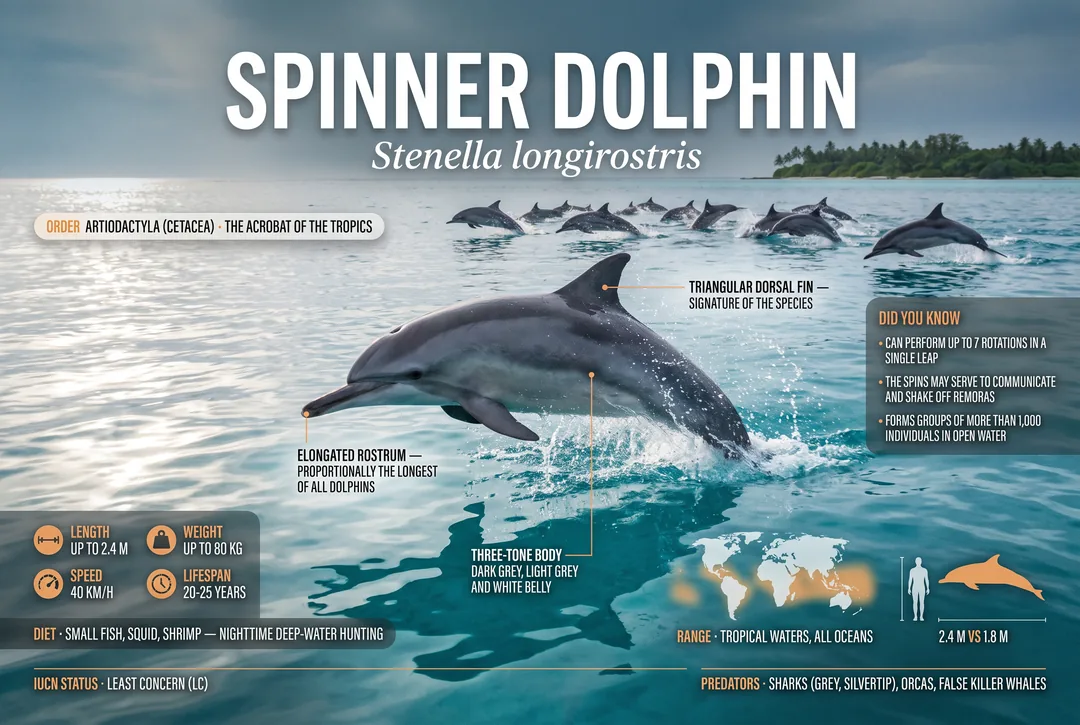
IDENTITY CARD
| Classification | Order Cetacea, family Delphinidae |
| Scientific name | Stenella longirostris (Gray, 1828) |
| Size | 1.3-2.4 m |
| Weight | 23-79 kg |
| Speed | Up to 40 km/h |
| Lifespan | 20-25 years |
| Depth | Surface to 300 m during nocturnal hunting |
| Diet | Carnivore — mesopelagic fish, squid, shrimp |
| IUCN Status | Least Concern (LC) |
PORTRAIT
The spinner dolphin is the ocean's dancer. Its name says everything: Stenella longirostris can launch itself clear of the water and rotate on its longitudinal axis up to seven times in a single leap — a mid-air pirouette of surreal grace. The behaviour is unique among cetaceans, functioning simultaneously as a social signal (announcing the group's awakening and departure for the hunt), a parasite-removal mechanism (dislodging remoras and copepods), and — according to the more cautious researchers — an act of pure play.
This is a modestly sized dolphin, smaller and more slender than the bottlenose dolphin (Tursiops truncatus). Its long, narrow rostrum gives the species its French name ("long bec") and its tricolour body — dark grey on the back, light grey on the flanks, white on the belly — makes identification immediate. Spinners live in groups of 100 to over 1,000 individuals across the tropical and subtropical waters of every ocean.
For divers and snorkellers, the spinner is a magical encounter. Many coastal populations rest in sheltered bays during the day, hovering just a few metres below the surface, and will tolerate a respectful snorkelling approach. Hawaii, Egypt, Polynesia — these are among the most accessible cetacean swim sites on the planet.
HOW TO RECOGNIZE IT
Three traits in combination are diagnostic: an exceptionally long, thin rostrum; a tricolour pattern (dark grey / light grey / white, separated by sharp demarcation lines); and a triangular or slightly falcate dorsal fin whose shape varies by subspecies.
Four subspecies are recognised:
- S. l. longirostris — the grey spinner, the most widespread (tropical Pacific). Triangular dorsal fin, classic tricolour pattern.
- S. l. orientalis — the eastern spinner (eastern tropical Pacific). Adult males sport a strongly forward-canted dorsal fin, sometimes with a pinkish belly.
- S. l. centroamericana — larger-bodied, found along Central America's Pacific coast.
- S. l. roseiventris — the dwarf spinner (Southeast Asia, northern Australia). Smaller, with a rosy belly.
At sea, the spinner is identified by behaviour long before a close look is possible: mid-air spins are diagnostic. No other dolphin rotates on its axis. The leaps are often followed by a loud, flat-sided splash on re-entry, visible and audible hundreds of metres away.
For subtitles in English: start the video firstthen click the gearat the top right of the video, select “Subtitles/CC”, then “Auto-translate” and choose “English”.
WAY OF LIFE
The spinner dolphin lives according to a remarkably predictable daily rhythm. By day, the group rests in shallow, sheltered bays or lagoons — swimming slowly in tight formation, breathing in synchrony. It is an active rest: the brain operates in unihemispheric sleep mode, one hemisphere sleeping while the other stays awake. By night, the group leaves the bay and heads for deep water (200-1,000 m) to hunt the organisms of the deep scattering layer — vast shoals of small mesopelagic fish and squid that rise toward the surface after dark.
Social structure is fluid but dense. Daytime resting groups number from 100 to well over 1,000 individuals, organised into shifting sub-groups of 10 to 30. Male alliances, mother-calf bonds, and constant play interactions weave through the formation.
The spins likely serve multiple functions. The best-documented hypothesis is communicative: the return to the bay after the night's hunt is preceded by an intense bout of aerial acrobatics — the spins may signal to the group that hunting is over and rest has begun. The parasite hypothesis is supported by observations of remoras and copepods being flung free during rotations. The play hypothesis remains unverifiable but entirely plausible.
Reproduction shows no marked breeding season in the tropics. Gestation lasts 10.6 months. A single calf is born and nursed for one to two years. Females reach sexual maturity at 4-7 years, males at 7-10.
WHERE TO SEE IT
Hawaii — Big Island, Oahu, Maui. The bays along Big Island's Kona coast — Kealakekua Bay, Honaunau Bay — are the world's most celebrated spinner dolphin sites. Groups of 50 to 200 dolphins glide in each morning to rest, often at less than 10 metres depth. Snorkelling on the periphery of the group (without entering the resting zone) is the standard approach. Since 2021, NOAA has enforced a 50-yard (46 m) buffer zone to protect the dolphins' daytime sleep.
Egypt — Sataya, Samadai (Red Sea). The Sataya reef and Samadai Bay (Dolphin House, off Marsa Alam) support resident spinner populations that rest in coral lagoons by day. Strict regulations govern snorkelling access: Zone A (resting area, entry prohibited), Zone B (passive observation permitted), Zone C (free swimming). Red Sea liveaboard itineraries routinely include a spinner stop.
French Polynesia — Moorea, Rangiroa. The bays of Moorea (Opunohu, Cook) and the passes of Rangiroa and Fakarava host resident groups. Boat excursions from Moorea deliver near-guaranteed sightings year-round.
Maldives. Spinners are ubiquitous throughout the Maldivian atolls. Sunrise dhoni outings — timed to catch the dolphins returning from the night's hunt, spinning wildly — are a liveaboard classic.
Fernando de Noronha — Brazil. The Dolphin Bay (Baia dos Golfinhos) of this protected archipelago welcomes each morning the largest documented Atlantic concentration of spinners — up to 2,000 individuals. Observation is from a clifftop belvedere only; access to the water inside the bay is prohibited.
OBSERVATION CALENDAR
| Destination | J | F | M | A | M | J | J | A | S | O | N | D |
|---|---|---|---|---|---|---|---|---|---|---|---|---|
| Hawaii (Big Island) | ||||||||||||
| Red Sea (Sataya, Samadai) | ||||||||||||
| French Polynesia (Moorea) | ||||||||||||
| Maldives | ||||||||||||
| Fernando de Noronha |
Click each button to show/hide
Spinners are resident and visible year-round at most tropical sites. Sea conditions and visibility vary with the seasons, but the dolphins themselves are a near-constant presence.
CONSERVATION
Stenella longirostris is classified as Least Concern (LC) by the IUCN, with a global population estimated at several million individuals. The species is not globally threatened, though certain local populations are in decline.
The most devastating historical threat was the eastern tropical Pacific tuna purse-seine fishery. Tuna boats encircled pods of spinner dolphins (and pantropical spotted dolphins) swimming above tuna schools — the dolphins were caught in the nets alongside the tuna. Between 1959 and 1972, this practice killed more than 4 million dolphins — over 300,000 per year at its peak. The resulting public outcry led to the Marine Mammal Protection Act (1972), the Dolphin Safe label on canned tuna (1990), and an international agreement that reduced annual mortality to a few hundred — one of the most dramatic conservation victories in marine history.
The current threat is disturbance in the resting bays. Snorkelling tourism with spinners in Hawaii, Egypt, and Polynesia is growing explosively. Dolphins denied their daytime rest by the constant presence of swimmers accumulate a sleep debt that impairs reproduction, feeding efficiency, and immune function. Buffer zones, access schedules, and boat quotas are effective where enforced — but enforcement remains uneven.
Organisations to support:
- Dolphin Research Center — research and education
- NOAA Marine Mammal Program — cetacean protection in the United States
- Whale and Dolphin Conservation (WDC) — global cetacean conservation
- HEPCA — Red Sea environmental protection
3 THINGS YOU PROBABLY DON'T KNOW
1. Up to seven spins in a single leap — and no one can fully explain why. The documented record is seven complete rotations on the longitudinal axis in one jump — an athletic feat requiring an exit speed above 20 km/h and a gyroscopic mastery of the body that biomechanics researchers still struggle to model. The spin begins underwater with a helical tail movement; the entire body becomes a gyroscope, pectoral fins pressed flat against the flanks to minimise drag. The exact function remains debated: communication, parasite removal, play — or all three at once.
2. Tuna fishing killed 4 million spinner dolphins in 13 years. Between 1959 and 1972, American purse-seine fleets in the eastern Pacific targeted spinner and spotted dolphin pods to capture the yellowfin tuna swimming beneath them. Trapped in the nets, the dolphins drowned by the thousand — over 300,000 per year at the peak. This industrial slaughter triggered one of the largest conservation campaigns in history and gave rise to the Dolphin Safe label found on most canned tuna today.
3. It sleeps with one eye open — literally. Like all cetaceans, the spinner dolphin practises unihemispheric sleep: one brain hemisphere sleeps while the other stays alert to maintain breathing (a conscious act in cetaceans), watch for predators, and navigate. The eye connected to the waking hemisphere stays open. The two sides alternate, and the dolphin accumulates its four to five hours of daily sleep in 10- to 20-minute blocks during the daytime bay rest.
PHOTO AND VIDEO TIPS
The spinner dolphin is photographed almost exclusively from the surface and while snorkelling — not on scuba.
Surface — the spins. Telephoto 70-200 mm or 100-400 mm from the boat. Burst mode at 1/2000 s, continuous autofocus. Spins are brief (one to two seconds airborne) and unpredictable — keep the camera ready, watch where other dolphins are leaping, anticipate the next spin in the same area. The backlit silhouettes of early morning are spectacular.
Snorkelling — beneath the surface. Wide angle or fisheye with dome port. Resting dolphins swim slowly at 3-8 m depth in tight formation. The signature image is the group seen from above in slight low-angle, sun rays filtering through the surface and streaming down across the pod. Never dive toward the dolphins — stay at the surface and let them come to you.
Video. Slow motion (120 or 240 fps) is spectacular for capturing spins. Underwater, a static wide shot — no chasing — with natural sound (clicks, whistles) is more immersive than any edit.
Ethics. Resting dolphins are vulnerable to disturbance. Universal rules: do not swim toward them, do not chase, do not touch, do not block their path. Stay on the periphery of the group. If the dolphins change direction or accelerate, they are being disturbed — back off immediately.