Swimming Pigs of Exuma
Sus scrofa domesticus
They do not dive, they do not hunt: they swim out to your boat to beg for a sandwich.
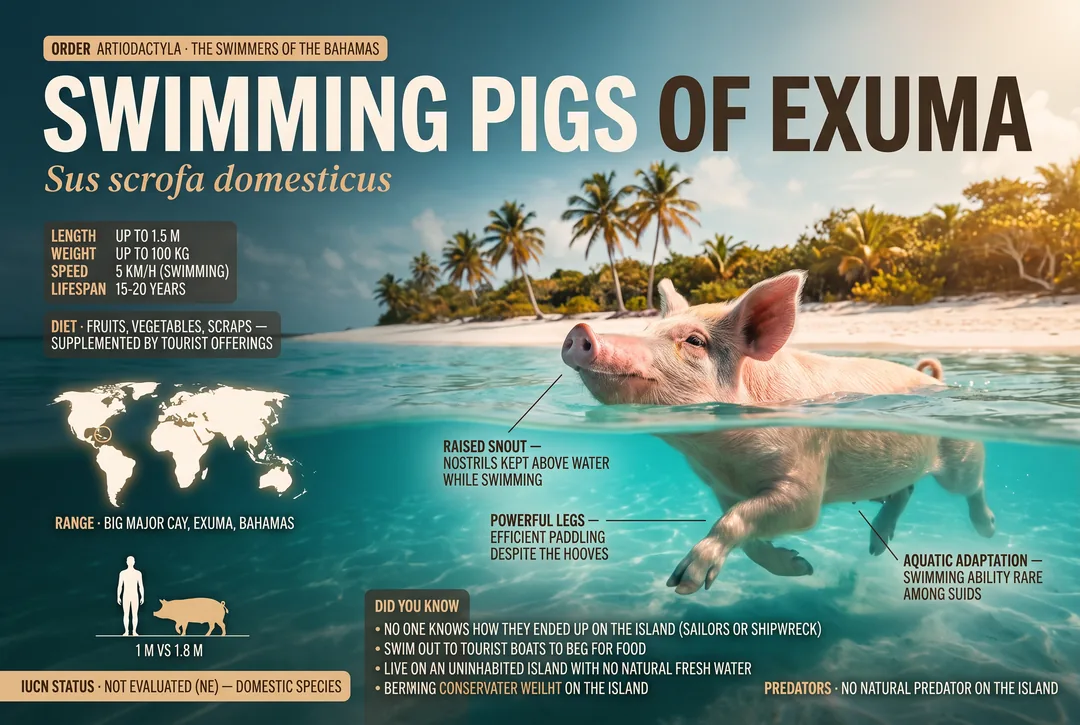
IDENTITY CARD
| Classification | Order Artiodactyla, family Suidae |
| Scientific name | Sus scrofa domesticus (domestic pig returned to a feral state) |
| Size | 90 cm to 1.50 m depending on age |
| Weight | 45 to 110 kg (adults not artificially fed) |
| Swimming speed | ~3 km/h — enough to reach an anchored boat |
| Lifespan | 15 to 20 years (in feral conditions, often less) |
| Habitat | Beach and scrubland of Big Major Cay, Exumas, Bahamas |
| Diet | Opportunistic omnivore — tourist leftovers, fruit, roots, stranded crustaceans |
| IUCN Status | N/A — domestic animal, not evaluated as a wild species |
PORTRAIT
You have to see it to believe it: twenty-odd domestic pigs, legs in the turquoise water of the Bahamas, swimming snout-up toward tourist boats. Big Major Cay, an uninhabited islet in the Exuma chain, has become one of the most photographed backdrops in the Atlantic — and its occupants, the most unlikely Instagram stars of Caribbean wildlife.
The pigs of Big Major Cay are not a wild species. They are domestic pigs (Sus scrofa domesticus) that have returned to a feral state — meaning farm animals whose ancestors were released or abandoned on the island and now live in freedom. Their exact origin is the subject of several competing stories, none of them documented with certainty: sailors may have dropped them off as a living meat reserve and never returned; a livestock ship may have wrecked nearby; farmers from a neighbouring island may have placed them there to keep them away from crops. Whatever the truth, the pigs had already settled by the time the first boaters noticed them in the 1990s — and the explosion came in the mid-2010s, when social media turned a local curiosity into a global phenomenon.
Today, they rank among the most profitable tourist attractions in the Bahamas. The success has been such that other islands in the region — and around the world — have tried to replicate the concept, with mixed results.
HOW TO RECOGNIZE IT
These are not wild boar or peccaries. The pigs of Big Major Cay are ordinary domestic pigs, recognisable by their pink or black-spotted skin, their flat snout, their floppy ears, and their lack of dense fur. Some individuals carry piebald coats (white and brown), others are entirely pink. You can distinguish juveniles — the "piglets" so prized by photographers — and full-grown adults whose build can match that of a medium-sized farm pig.
Underwater — as tourists do join them in snorkelling gear — their silhouette is unmistakable: short legs paddling in the void, round belly, and corkscrew tail. Their stroke is a vigorous dog paddle, snout and eyes held above the waterline. They do not free-dive and never venture into deep water — their range is limited to a few dozen metres around the beach.
For subtitles in English: start the video firstthen click the gearat the top right of the video, select “Subtitles/CC”, then “Auto-translate” and choose “English”.
WAY OF LIFE
The pigs of Big Major Cay live in a semi-feral group on an island roughly 400 metres long with no permanent human inhabitants. Their day revolves around the arrival of excursion boats: as soon as an engine approaches, the boldest ones plunge into the water and swim out to meet visitors. This behaviour, often presented as "natural," is in reality pure operant conditioning — boat equals food.
Outside tourist visits, the pigs root through the island's low vegetation searching for roots, fallen fruit, and small invertebrates. A natural freshwater spring feeds the island, supplemented by water brought over by residents of Staniel Cay, the nearest settlement. The local community considers the pigs a communal asset and ensures their basic nutrition independently of tourist traffic.
The colony generally numbers between 20 and 30 individuals, with regular births. Domestic sow litters average 8 to 12 piglets. In 2017, the sudden death of several pigs — attributed to ingestion of alcohol and unsuitable food given by tourists — prompted a wake-up call about the animals' actual living conditions.
WHERE TO SEE IT
The swimming pigs are inseparable from the Exumas, but a visit combines ideally with the other marine attractions of the region — and that is where the trip gains its full appeal for a diver or snorkeller.
Big Major Cay (Pig Beach) — Exumas, Bahamas. This is the original site, the only authentic one. The island is accessible only by boat, either from Staniel Cay (10 minutes) or as a day trip from Nassau (domestic flight or speedboat, 1.5 to 2 hours). The pigs are present year-round. The most popular excursions depart early in the morning to avoid crowds — in high season, up to 20 boats moor simultaneously in front of the beach.
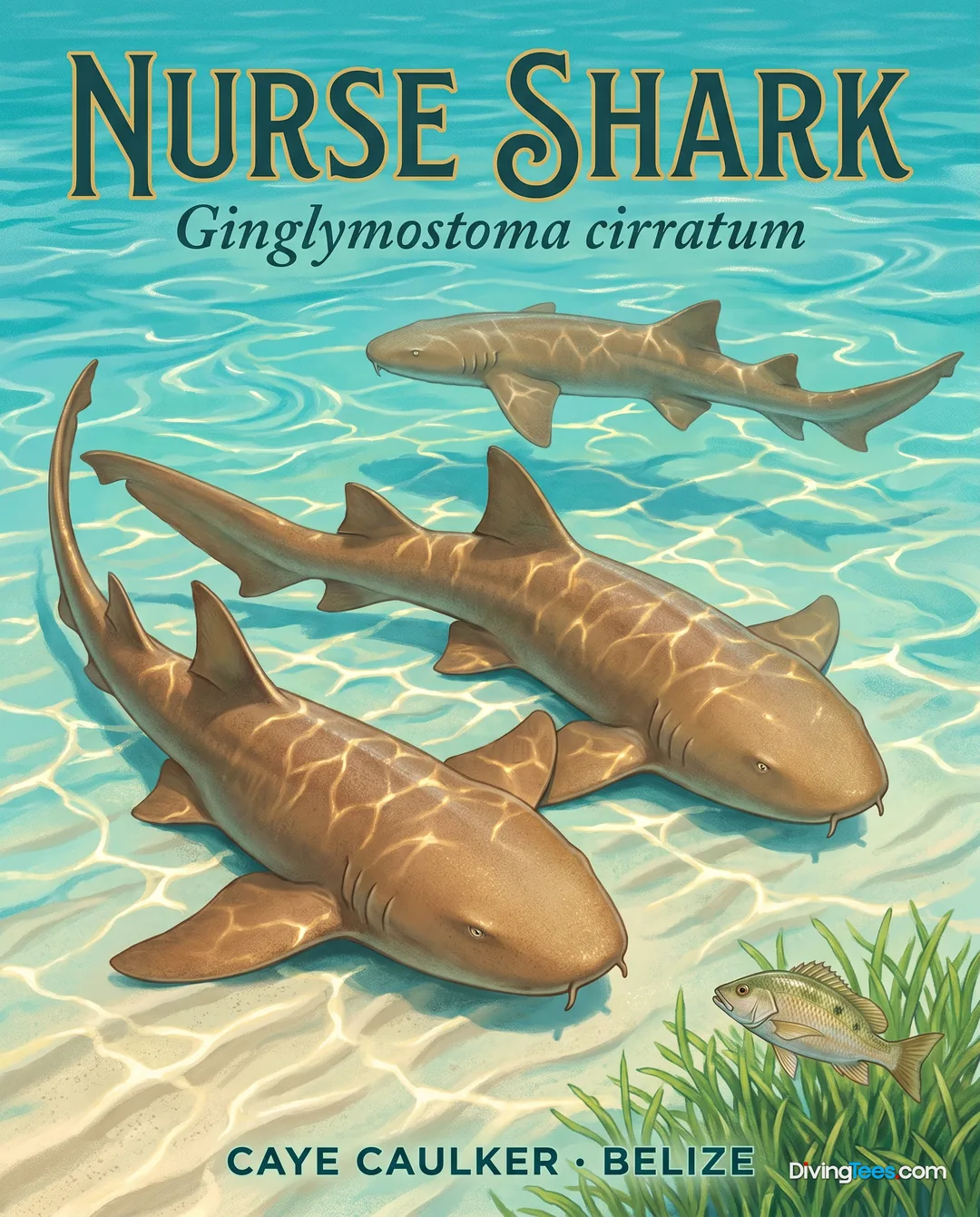
Compass Cay — nurse sharks. A few minutes from Big Major Cay, the Compass Cay marina is home to around ten nurse sharks (Ginglymostoma cirratum) accustomed to humans. You swim with them in a shallow channel. The experience is not technical diving, but it offers close contact with docile sharks and is a natural complement to the pig visit.
Thunderball Grotto. This sea cave, made famous by the James Bond film Thunderball (1965), lies between Staniel Cay and Big Major Cay. You enter by snorkelling at low tide through a narrow opening. The interior, bathed in light filtering through ceiling cracks, harbours dense reef life — angelfish, sergeant majors, lobsters. It is the finest snorkelling spot in the Exuma chain.
Nassau and the Berry Islands. From Nassau, tour operators offer full-day excursions combining Pig Beach, Thunderball Grotto, the iguanas of Allan's Cay, and snorkelling on the reefs of the Tongue of the Ocean, the immense oceanic trench that flanks the Exumas to the west.
Other "swimming pigs" around the world. The success of the Exuma pigs has spawned copies: Koh Samui (Thailand), some Tongan islands, and even waterparks in the United States have introduced pigs on beaches to attract visitors. None of these sites possesses the historical character or the marine ecosystem of the Exumas — they are artificial attractions, not established feral populations.
OBSERVATION CALENDAR
| Destination | J | F | M | A | M | J | J | A | S | O | N | D |
|---|---|---|---|---|---|---|---|---|---|---|---|---|
| Exumas (Pig Beach) | ||||||||||||
| Compass Cay (nurse sharks) | ||||||||||||
| Thunderball Grotto |
Click each button to show/hide
The pigs are present year-round, but the Atlantic hurricane season (June to November, peaking in September) makes navigation unpredictable and excursions less frequent. The best period runs from December to April: calm seas, water temperature between 24 and 27 C, low humidity, and moderate tourist traffic outside Christmas holidays. Spring (March--April) offers the best balance between favourable weather and manageable crowds.
CONSERVATION
The pigs of Big Major Cay are not an endangered species — they are domestic animals returned to a feral state, and their conservation falls under animal welfare rather than population biology.
The main problem is uncontrolled feeding by tourists. The pigs receive daily helpings of unsuitable food: crisps, bread, beer, fast-food leftovers. In 2017, seven pigs were found dead on the beach. An investigation by the Bahamas Humane Society concluded that the probable cause was sand ingestion (the pigs swallow sand with food thrown on the ground) and alcohol. The incident prompted local authorities to establish rules: no alcohol for the animals, feed only fruit and vegetables, do not chase them on the beach.
The ecological impact of the pig colony on the island itself is a less publicised but real concern. The pigs turn over the soil, destroy coastal vegetation, and their waste runs off into the lagoon waters — contributing to the degradation of nearby seagrass beds. No published scientific study quantifies this impact in the Exumas, but the effects of feral pig populations on island ecosystems are well documented elsewhere — notably in Hawaii and the Galapagos, where they rank among the most destructive invasive species.
The responsible visitor feeds only fruit or vegetables, forces no physical contact, stays in the water, and does not chase the pigs on the beach. Piglets, particularly vulnerable, should not be picked up or handled.
Organisations and resources:
- Bahamas Humane Society — animal welfare in the Bahamas, colony monitoring
- Bahamas National Trust — Exuma national park management (Exuma Cays Land and Sea Park)
- BREEF — Bahamas Reef Environment Educational Foundation — marine conservation education in the Bahamas
3 THINGS YOU PROBABLY DON'T KNOW
1. Nobody knows how they got there. Three stories circulate: sailors may have dropped them off as a living meat reserve and never returned; a livestock vessel may have wrecked nearby; farmers from Staniel Cay may have placed them on the island to keep them away from their vegetable gardens. None of these versions is documented. The only certainty is that the pigs were already on the island when the first boaters noticed them in the 1990s — and the explosion happened in the mid-2010s, when social media turned a local curiosity into a global phenomenon.
2. They do not know how to swim from birth. Contrary to popular belief, piglets do not swim instinctively. Like dogs, pigs are anatomically capable of swimming — their subcutaneous fat makes them naturally buoyant — but the behaviour of swimming toward boats is acquired through imitation of adults and reinforced by food rewards. A piglet born on the island learns to swim by following its mother into the water, exactly as it would learn to root in the earth.
3. Big Major Cay almost became a resort. In the 2000s, a developer considered building a hotel complex on the island. The project never materialised — partly due to the lack of sufficient freshwater, partly because the pigs had already become the main attraction and their presence made real estate development awkward. The island remains uninhabited to this day, the pigs are its only permanent residents, and it is precisely this absence of construction that gives the place its charm.
PHOTO AND VIDEO TIPS
The swimming pigs are a photographic subject of disarming ease — they come to you. The challenge is not the approach; it is composition, timing, and crowd management.
Lens. Go wide, without hesitation. In a waterproof housing: 16-35 mm for wide pig-in-turquoise-water shots, 24-70 mm for portraits. With a GoPro: the native field of view is perfect, and semi-submerged split shots (half air, half water) are achievable here without a professional dome port, thanks to the water clarity and shallow depth. A waterproofed smartphone in a waterproof pouch also works — the pigs come within a metre.
Light. Arrive early. Pig Beach faces west: in the morning, the sun lights the scene from the east and the water is at peak turquoise transparency. In the afternoon, backlighting flattens the photos and the water is churned by boat traffic. The ideal window is 8-10 AM, before the big Nassau tours arrive.
Approach. Stay in the water, at pig level. The best photos are taken at the waterline, the photographer half-submerged, the pig swimming toward the lens. Shots from the boat or from the beach looking down are ordinary — everyone has them. The split shot with a piglet swimming, legs visible below the surface and snout above, is the signature image.
Common mistake. Holding out food in one hand and shooting with the other. The pig does not look at the lens; it looks at the food. And an 80 kg pig charging toward a piece of watermelon is not always photogenic — nor risk-free for the camera.