
Crystal Divers Mauritius
Google 4.9/5 (550 reviews)
5.4 km away as the crow flies
Trou aux biches · Mauritius · Indian Ocean
Max. depth · 34 mDescend onto the proud wreck of the Djabeda, an artificial reef teeming with life on a vast sandy expanse off Trou aux Biches.
For subtitles in English: start the video firstthen click the gearat the top right of the video, select “Subtitles/CC”, then “Auto-translate” and choose “English”.
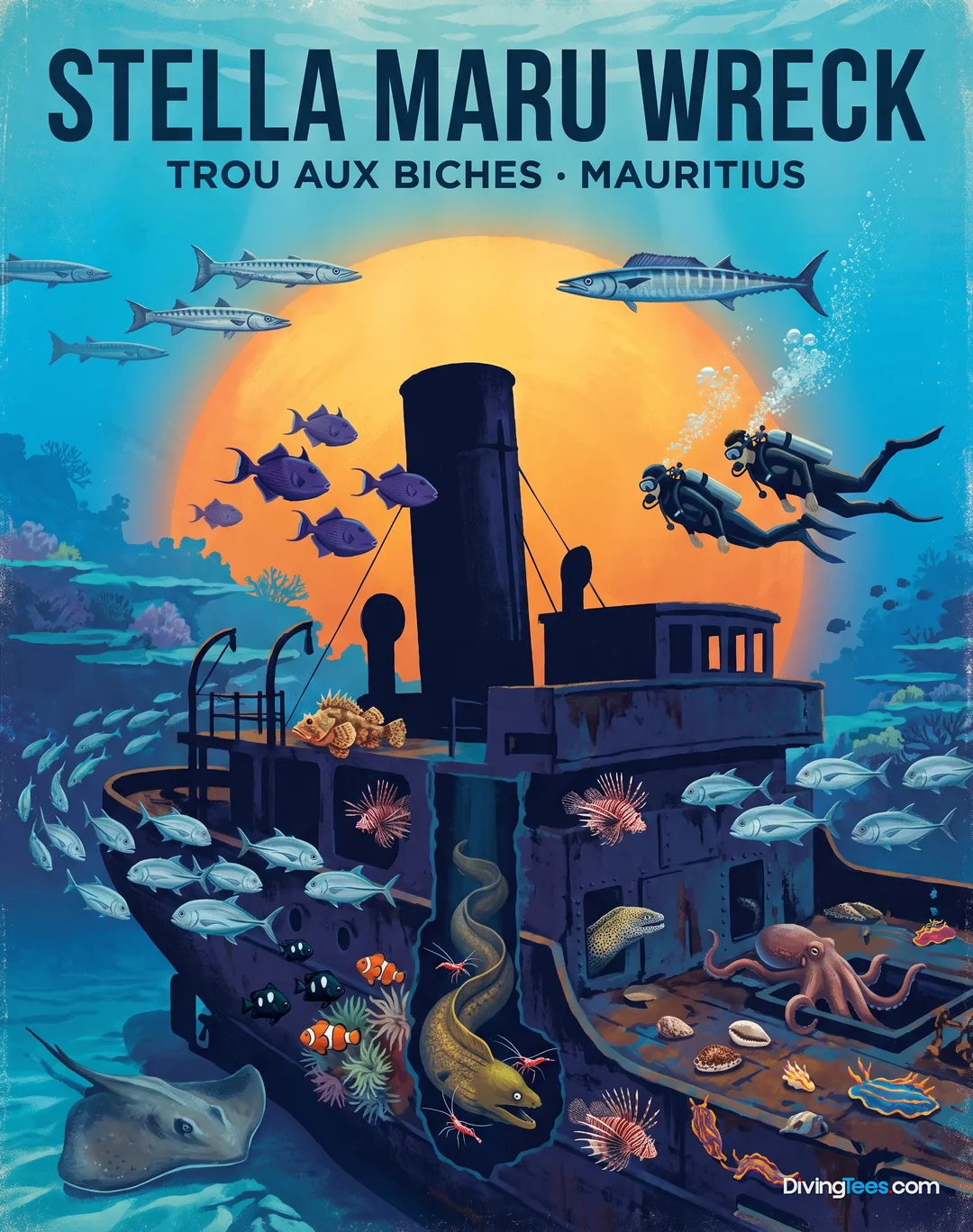
The Djabeda Wreck lies on the southern flank of Coin de Mire Island, within swimming distance of Confetti Bay. This former Japanese fishing trawler was deliberately sunk in 1998, transforming into a vibrant artificial reef that now stands proudly on a wide sandy plain. When conditions are favorable, this unique setting beneath the surface reveals spectacular turquoise hues and offers crystal-clear water, allowing divers to appreciate the complete structure from a distance. The wreck’s isolation on the sand makes it a magnet for marine activity.
As you approach the Djabeda, you'll notice the structure itself is alive, providing shelter and sustenance for a myriad of creatures. Inside the confined spaces of the wreck, a dense school of yellow stripe snappers has established its home, creating a shimmering spectacle as they move in unison. Beyond the immediate shelter of the hull, the entire wreck is encircled by vast shoals of blue fusiliers, their constant motion adding a dynamic layer to the underwater scenery. These resident fish form the foundation of a thriving ecosystem around the artificial reef.
Beyond the smaller reef residents, the Djabeda Wreck acts as a beacon for larger pelagic species drawn to the concentration of prey. It is common to encounter dogtooth tuna, silent hunters that patrol the perimeter, eyeing the abundant fusiliers. Giant trevally also make their presence known, alongside formidable giant red snappers, adding to the list of powerful predators that frequent this site. Observing these larger fish in their natural hunting grounds provides a compelling insight into the food chain of the open ocean.
The sandy bottom surrounding the wreck is not just barren terrain; it hosts its own unique inhabitants. Keep a lookout for stingrays, often resting partially concealed in the sand, their camouflaged forms blending seamlessly with the environment. These bottom dwellers provide a contrast to the schooling fish and pelagic predators, reminding you of the diverse life supported by the wreck's presence. Every corner and contour of the Djabeda offers a potential encounter, from the smallest nudibranch (though not specifically listed for this site, they are common in the region) to the largest transient visitor.
While the Djabeda offers serene beauty, it is located in a region where currents can occasionally be quite strong. These currents, though sometimes challenging, are also part of what makes the site so vibrant, constantly bringing in nutrients and drawing in the larger pelagic life. When the ocean is calm, though, the visibility becomes truly crystalline, allowing light to penetrate deeply and illuminate the wreck in stunning clarity. This interplay of conditions ensures that no two dives on the Djabeda are ever quite the same.
This dive is suitable for all levels of divers, provided there is no strong current during the planned dive. Depths range from 27 meters down to 34 meters. Visibility at the Djabeda Wreck is typically crystalline. While specific weather conditions can influence current strength, the site's clear water remains a consistent feature.
You should plan your dive at the Djabeda Wreck when ocean conditions are calm and there is no strong current. Weather can influence current strength, while calm conditions bring exceptionally clear visibility. In favorable conditions, the turquoise water and isolated wreck on the sandy plain can be appreciated from a distance.
The Djabeda Wreck is suitable for you regardless of your diving level, provided there is no strong current during the planned dive. The site involves exploring a deliberately sunk Japanese fishing trawler and its surrounding sandy bottom. You can encounter marine life inside the wreck, around the vessel, and nearby on the seabed.
The Djabeda Wreck lies between 27 and 34 meters deep. Currents can occasionally become quite strong, with weather influencing their strength, so you should check conditions before diving. When the ocean is calm, the water remains crystalline, allowing you to see the complete wreck structure and surrounding sandy plain clearly.
At the Djabeda Wreck, you can explore a Japanese fishing trawler surrounded by blue fusiliers and find dense schools of yellow stripe snappers inside. Dogtooth tuna, trevally, and giant red snappers patrol the area, while stingrays rest on the sandy bottom. The wreck also shelters a thriving artificial reef community.