
Buceo Estela
Google 5/5 (425 reviews)
Spain · Mediterranean
Rocky pinnacles, Cabo Cope wrecks, moray eels and grouper come together in a quieter corner of Spain’s Mediterranean coast.
For subtitles in English: start the video firstthen click the gearat the top right of the video, select “Subtitles/CC”, then “Auto-translate” and choose “English”.
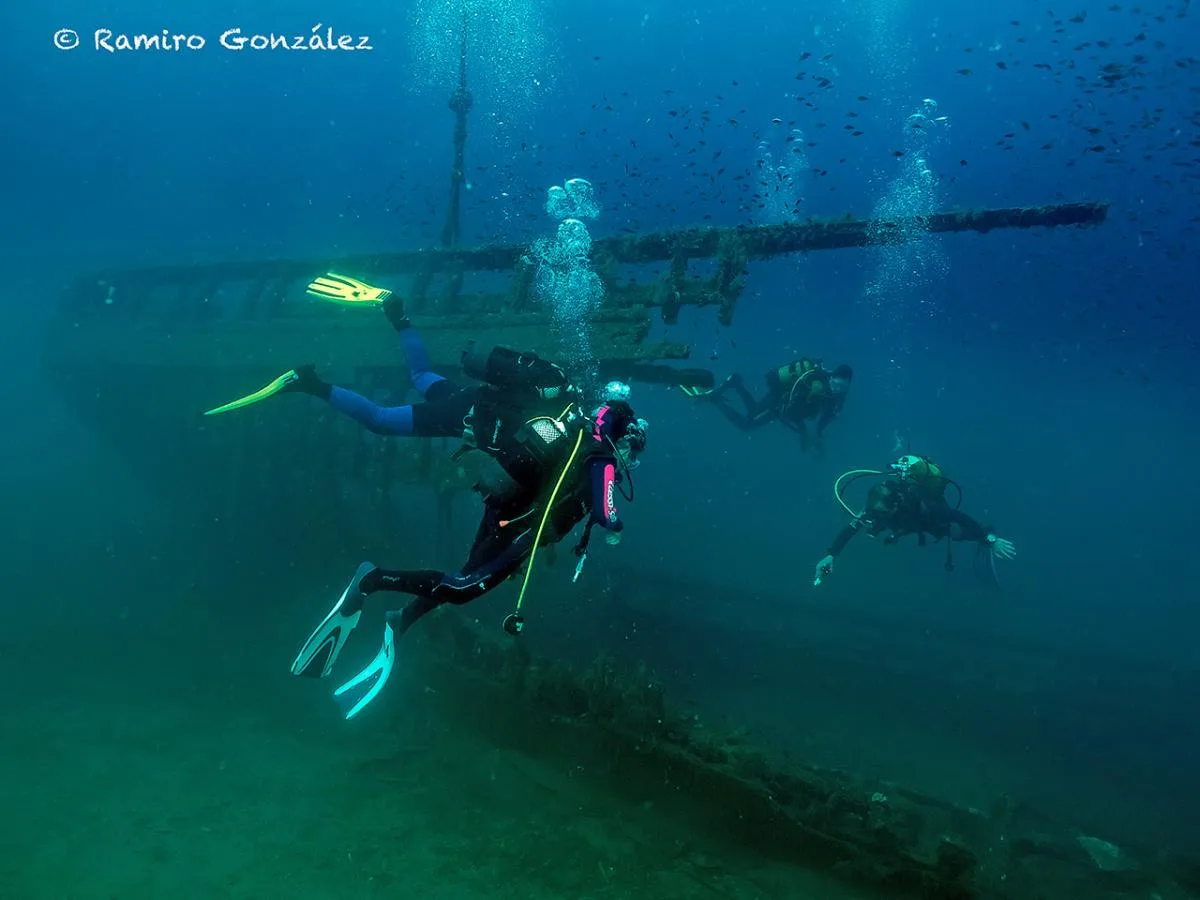
Cabo Cope puts a different face on Águilas: below the boat lie wrecks and structures down to more than 30 metres, while closer in, Isla del Fraile offers rock formations, overhangs and fish-filled shallows. The bay brings gentler profiles, with moray eels, nudibranchs and octopuses tucked among old blocks and harbour remains. This is a practical Spanish coastal base for divers who want proper variety without living aboard, and for non-divers there are beaches, walking trails and the Cabo Cope coastline.
Most dives are short boat trips from Águilas, Calabardina or the nearby harbours. The underwater scenery is Mediterranean rock: walls, boulder fields, overhangs, open caves and the wreck concentration around Cabo Cope. Depths range from roughly 15 metres on easier sites to beyond 30 metres on wrecks and larger drop-offs such as Losa del Cobacho. Currents are generally light, so the dive is usually about working a reef slowly rather than managing a drift dive or downcurrent. Visibility is often strongest in September and October, though wind, southern swell and runoff after rain can cloud the water. Isla del Fraile suits a relaxed morning or late-afternoon outing, while Cabo Cope needs a more deliberate technical plan. Some caves are open and accessible, but they are not an invitation to make untrained penetrations.
The attraction is Mediterranean fish life in and around the rock, rather than tropical coral. Grouper are a regular possibility from May into November, particularly on deeper rock and sites such as El Jardín. Moray eels and conger eels occupy cracks and wreck structures, while nudibranchs, crustaceans and octopuses reward a slow look at the blocks in Águilas Bay. Barracuda and dentex add movement around the larger formations. Ocean sunfish and eagle rays are occasional encounters from May to October, so they are a reason to time a warm-season visit, not a sighting to build the whole trip around. Night dives at Embarcadero del Hornillo or La Pava bring out the cryptic life, especially moray eels, crustaceans and nudibranchs.
April, May, June, September and October offer the most convincing balance of calm water, clear conditions and active marine life. September and October are particularly attractive because the water has retained the summer’s warmth, yet the clearer period before sustained rain has not usually been interrupted by runoff. Summer remains perfectly workable, but surface traffic, baptisms and training groups increase from June into early October, with Easter week another busy spell. Winter and early spring can still produce worthwhile dives, with fewer people aboard, although conditions are less predictable. A full-length 5 to 7 mm wetsuit with hood is the sensible year-round choice, with 5 mm generally adequate in the warmest months.
Beginners and newly qualified divers can use the bay and Isla del Fraile for moderate-depth dives with little current. The wrecks and deeper walls are a different proposition. Advanced Open Water, or equivalent experience, is useful beyond 20 metres and for sites approaching 30 metres, while Nitrox makes sense for repeated wreck days. A Wreck Diver qualification adds structure to Cabo Cope, but the real requirement is comfort with depth, buoyancy and navigation around metal structures. Plan the demanding dives early in the stay rather than after a run of easier immersions.
From London or Manchester, reach Águilas through the main Spanish travel hubs, then continue by road or regional or long-distance train. There is no compulsory ferry crossing and no domestic flight requirement, so the journey’s main variable is the final overland connection. Allow sensible time between arrival and the onward road or rail leg rather than trying to match a tight same-day plan. Águilas station provides a rail option, while the coastal Levant road network gives drivers a straightforward approach from the direction of Murcia or Almería. Once there, the Club Náutico, main harbour and Puerto Juan Montiel are walkable from some accommodation, while Calabardina and outlying hotels call for a car or taxi.
Keep a complete day for Cabo Cope rather than squeezing its wrecks between bay dives. The wreck field reaches around 30 metres, and the structures reward controlled buoyancy, an obvious computer display and enough time to look into the places where moray eels and fish shelter. Put Losa del Cobacho and the deeper wreck work at the start of the stay and the day, then leave the bay and Isla del Fraile for gentler profiles later on. In high season, ask for early departures if you want the more technical sites before boats carrying baptisms and training groups arrive. Isla del Fraile is often more enjoyable early or late, when surface traffic is lighter. For a night dive, Embarcadero del Hornillo and La Pava offer manageable depths and unusually good cryptic-life watching. Treat open caves as overhangs unless properly trained and guided, and do not assume every cavity is suitable for penetration.
Allow five to seven days for a comfortable stay. Use the first part for the bay and Isla del Fraile, when you are settling into local conditions, then reserve a full day for Cabo Cope’s wrecks and deeper walls. Leave room for a night dive and for weather flexibility, since wind or southern swell can change the plan. Between outings, Águilas supplies beaches, a working harbour, coastal walks and town heritage, while Cabo Cope Regional Park provides a worthwhile day above the water.
Hello, I'm Marina, DivingDeal.com's AI assistant. I guide you through destinations, areas and countries.
Thinking about the whole trip and the flights? Talk it over with Edith →
Marina is an AI. Some links are affiliate links: DivingDeal may earn a commission, at no extra cost to you. Bookings are made with the partner.
Visit Aguilas in April, May, June, September or October for a balance of calm water, visibility and active marine life. September and October often bring clear conditions and water retaining summer warmth. Summer remains workable, while winter and early spring offer fewer divers but less predictable conditions. A full wetsuit is sensible year-round.
You can explore Aguilas as a beginner or newly qualified diver by choosing the bay and Isla del Fraile, where profiles are moderate and currents are generally light. Deeper walls and Cabo Cope wrecks require comfort with depth, buoyancy and navigation. Advanced Open Water experience helps beyond twenty metres, while wreck training supports structured exploration.
In Aguilas, expect Mediterranean rock formations, walls, boulder fields, overhangs, open caves and Cabo Cope wrecks rather than tropical coral. Grouper, moray and conger eels, nudibranchs, crustaceans, octopuses, barracuda and dentex may appear. Ocean sunfish and eagle rays are occasional warm-season encounters, while night dives reveal cryptic life around blocks and harbour remains.
Plan five to seven days in Aguilas, beginning with bay and Isla del Fraile dives while you settle in. Reserve a full day for Cabo Cope wrecks and deeper walls, preferably early in the stay, and leave space for a night dive and weather changes. Calabardina and outlying hotels may require a car or taxi.