Blue Shark
Prionace glauca
The most widespread shark on Earth is also the most slaughtered.
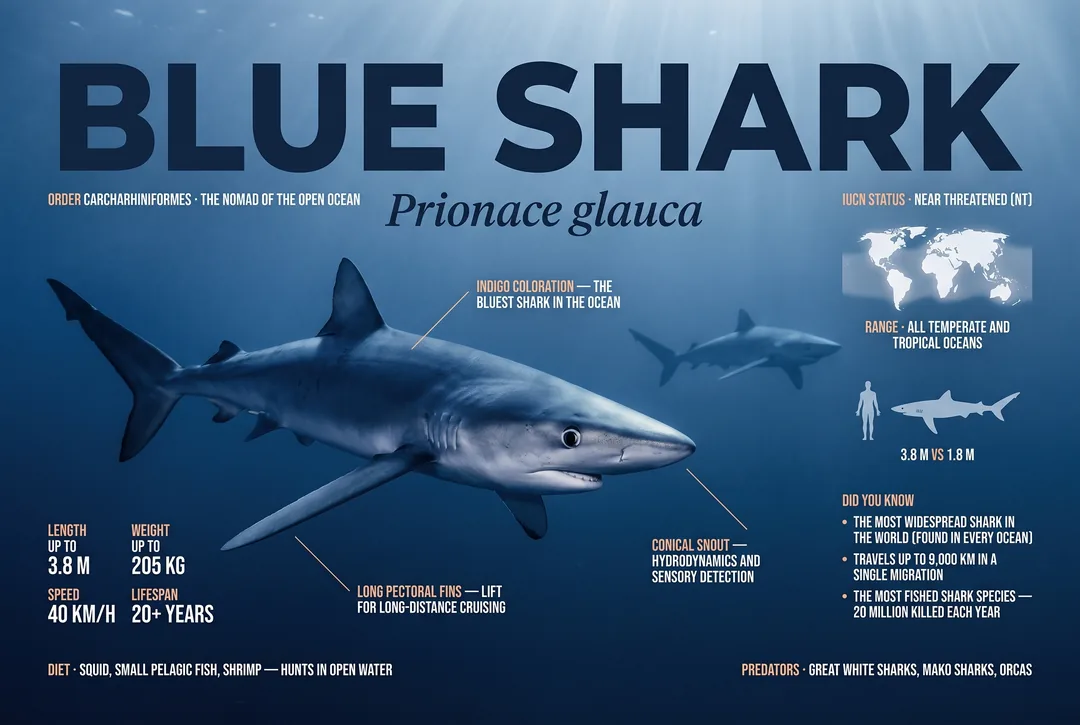
IDENTITY CARD
| Classification | Order Carcharhiniformes, family Carcharhinidae |
| Scientific name | Prionace glauca (Linnaeus, 1758) |
| Size | Up to 3.8 m (typical observed range: 1.8-2.5 m) |
| Weight | Up to 205 kg (average: 30-55 kg) |
| Speed | ~40 km/h burst, ~10 km/h cruising |
| Lifespan | 20-25 years |
| Depth | Surface to 350 m, most commonly observed between 0 and 150 m |
| Diet | Pelagic predator — squid, small pelagic fish (mackerel, herring), cephalopods |
| IUCN Status | Near Threatened (NT) — population declining |
PORTRAIT
It carries the simplest name of any shark, and it is the only one that truly earns it. The blue shark is blue. Not the washed-out grey-blue of most sharks, not the blue-black of a silhouette against the light — electric blue, indigo on the back, cobalt along the flanks, fading to an immaculate white belly. Underwater, when sunlight plays across its skin, the animal seems to glow.
Prionace glauca is the most widespread shark in the world. It inhabits every ocean, from cold temperate waters to the tropics, from the Arctic Circle to the 50th parallel south. It is also the most abundant shark — or, more precisely, the one that used to be. Because the blue shark is likewise the most killed: estimates converge around 20 million individuals taken every year by global fisheries, the vast majority as bycatch on longlines targeting tuna and swordfish.
What strikes you first, once you get past the colour, is the elegance of its build. The blue shark is streamlined, almost delicate. Its pectoral fins are remarkably long — the longest, proportionally, of any shark — and it holds them out like the wings of a glider. This animal does not swim: it soars.
HOW TO RECOGNIZE IT
The blue shark cannot be confused with any other pelagic shark, provided you can see its colours. The intense blue of the dorsal surface and upper flanks contrasts sharply with the pure white belly, with no gradual transition. The caudal fin is long and asymmetric, with a greatly elongated upper lobe.
The body is narrow and hydrodynamic, distinctly slimmer than a mako of comparable size. The snout is conical and pointed, noticeably longer than that of other carcharhinids. The eyes are large, round, and jet black. But the most reliable diagnostic feature is pectoral fin length: they often reach one-fifth of the total body length, giving the animal a wingspan visible from far away.
At depth or in cold water, when light is scarce, the blue shifts to dark grey and identification becomes harder. The instinct then is to look at the ratio between body length and pectoral length — no other open-ocean shark has those proportions.
For subtitles in English: start the video firstthen click the gearat the top right of the video, select “Subtitles/CC”, then “Auto-translate” and choose “English”.
WAY OF LIFE
The blue shark is a long-distance migrant. Individuals tracked by satellite telemetry have revealed straight-line journeys of more than 9,000 km, and some complete full transoceanic circuits. In the North Atlantic, the population follows a circular pattern: individuals move up along the European coast in spring, cross to North America in summer, drop south through the Caribbean and the Azores in autumn, then loop back along West Africa. It is one of the longest known migrations among sharks.
The animal is gregarious, at least in phases. Observers regularly report schools segregated by sex and size — females on one side, males on the other, juveniles apart. This segregation is not trivial: it shapes the species' geographic distribution. Divers who encounter blue sharks in the Azores see almost exclusively young females; those off Cornwall are more likely to meet adult males.
Reproduction is viviparous with a placental connection. Gestation lasts 9 to 12 months, and a female gives birth to 25 to 50 pups per litter, sometimes more — up to 135 have been documented. The female's skin is two to three times thicker than the male's, a direct adaptation to the violence of mating: the male bites the female to maintain his grip, and the scars are so deep that sexually mature females can be identified by the naked eye.
WHERE TO SEE IT
The blue shark inhabits every ocean, but in-water encounters are rare: the animal lives in the open sea, far from coastlines and far from reefs. You have to go looking for it. A handful of destinations have specialised in guided open-water sessions, almost always in snorkelling or drift diving from a boat offshore.
Azores (Portugal). The archipelago is now the world's top destination for blue shark diving. Trips depart from Ponta Delgada or Faial between June and October. Operators use scent bait to draw the animals toward the boat, then divers enter the water at the surface. Atlantic visibility — often 25 to 40 metres in summer — and the density of the species in Azorean waters make encounters near-certain in high season. Visitors almost exclusively see young females between 1.5 and 2.5 metres, curious and unafraid.
Cape Point (South Africa). Off the tip of the Cape, where the Atlantic meets the Indian Ocean, cold nutrient-rich waters attract blue sharks year-round, with a peak from March to September. Trips depart from Simon's Town. Water is colder than the Azores (14-18 C) and visibility more variable, but the animals are often larger — adults of 2.5 to 3 metres. Mako sharks share the same waters, and both species sometimes show up on the same day.
Cornwall (United Kingdom). Southwest England is a lesser-known but serious spot. From July to October, blue sharks follow mackerel schools into the temperate waters of the western English Channel. Trips depart from Penzance or Falmouth. The water is cold (14-17 C) and visibility modest (5-15 metres), but proximity to mainland Europe and the quality of the operators make it an accessible destination.
New England (United States — Rhode Island). Off Montauk and Rhode Island, the Gulf Stream pushes blue sharks close to shore from July to October. Offshore trips of 30 to 60 miles depart from Point Judith and Narragansett. The waters along the Gulf Stream's edge offer 10 to 30 metres of visibility and tolerable temperatures (18-24 C), with good-sized animals.
Baja California (Mexico). Off Cabo San Lucas and La Paz, blue sharks are present from November to April in the eastern Pacific. The season coincides with the cold waters of the California Current, and divers regularly encounter makos and hammerhead sharks on the same trips.
OBSERVATION CALENDAR
| Destination | J | F | M | A | M | J | J | A | S | O | N | D |
|---|---|---|---|---|---|---|---|---|---|---|---|---|
| Azores (Portugal) | ||||||||||||
| Cape Point (South Africa) | ||||||||||||
| Cornwall (United Kingdom) | ||||||||||||
| New England (Rhode Island) | ||||||||||||
| Baja California (Mexico) |
Click each button to show/hide
CONSERVATION
Prionace glauca is listed as Near Threatened (NT) on the IUCN Red List. That status sounds almost reassuring given the reality: the blue shark is, in absolute numbers, the most captured shark in the world. Around 20 million individuals perish every year in the nets and longlines of industrial fishing — roughly 55,000 per day.
Most of this mortality is accidental. Longlines targeting tuna and swordfish drift for tens of kilometres, and blue sharks hook onto them in massive numbers — the species is the leading elasmobranch by bycatch volume in the Atlantic and Pacific. But a growing share is deliberate: blue shark fins supply the Asian shark fin soup market, and its meat is consumed in Europe, particularly in Spain, Portugal, and Italy, where it is sold under the names marrajo or smeriglio.
The species is listed in Appendix II of the Convention on Migratory Species (CMS). Its high fertility — litters of 25 to 50 pups — explains why the population has withstood this pressure better than other species, but the signals of decline are there. North Atlantic populations have dropped by a third in thirty years; Pacific populations are following the same trajectory.
A diver who encounters a blue shark is looking at an animal that statistically has very little chance of reaching adulthood. Supporting research on fishing gear selectivity and campaigns to ban shark finning is the most meaningful gesture.
Organisations to support:
- Shark Trust — UK-based shark conservation NGO, very active on blue shark issues in the North Atlantic
- Blue Shark Snorkel — research and photo-identification in Cornwall
- Pelagios Kakunja — research on pelagic sharks of the eastern Pacific
- PADI AWARE — citizen science programme, sighting reports
3 THINGS YOU PROBABLY DON'T KNOW
1. Its skin pioneered modern hydrodynamics. The blue shark's skin is covered in dermal denticles arranged in longitudinal ridges that channel water flow and reduce drag. This micro-structure inspired high-performance swimsuits and aeronautical coatings. Airbus tested an adhesive film modelled on shark skin on A350 aircraft: the fuel savings are measurable — on the order of 1 to 2%.
2. It circles the Atlantic in a year. Satellite tagging data show that some blue sharks complete a full transoceanic circuit in the North Atlantic. They leave the European coast, cross to North America following the Gulf Stream, travel south along the American coast to the Caribbean, then return toward Africa and the Azores following the trade winds. A journey of more than 15,000 km, completed once or twice a year.
3. Females wear armour. The skin of the female blue shark is two to three times thicker than the male's — a unique adaptation to the brutality of mating. The male grips by biting deeply into the female's back and flanks, leaving distinctive parallel scars that last for months. Biologists use these marks to identify females that have recently reproduced.
PHOTO AND VIDEO TIPS
The blue shark is almost always photographed at or near the surface, from in the water, without scuba. The challenge is not depth — it is colour.
Lens. Wide angle is essential, but not necessarily a fisheye: a rectilinear 16-24 mm (full-frame equivalent) renders the body proportions more faithfully. The blue shark is slimmer than a whale shark or a great white, and a fisheye exaggerates the head at the expense of the overall silhouette.
Light. The animal's blue is its greatest asset — and it only shows when natural light is generous. Dive during the middle hours of the day, when sunlight penetrates the water vertically. Flash crushes the metallic reflections of the skin and flattens the colour. For video, disable automatic white balance and set it manually to preserve the cool blues.
Approach. The blue shark is curious. Sometimes too curious: it approaches the photographer, circles, comes back. Do not retreat (that signals prey), do not touch. Let it orbit and fire when the animal presents its flank, at 2-3 metres. The best shots are those where light strikes the back at 45 degrees, revealing the gradient from electric blue to white belly.
Common mistake. Forgetting the background. The blue shark lives in open water: behind it, there is nothing but blue. Without a visual reference — a diver, the surface, the boat's silhouette — the image lacks scale and depth. Placing a dive buddy in the frame, even out of focus in the background, transforms the photograph.