Oceanic Whitetip Shark
Carcharhinus longimanus
Once the most abundant shark on the planet, it has lost 98% of its numbers in half a century — and remains one of the most beautiful animals you can encounter in open water.
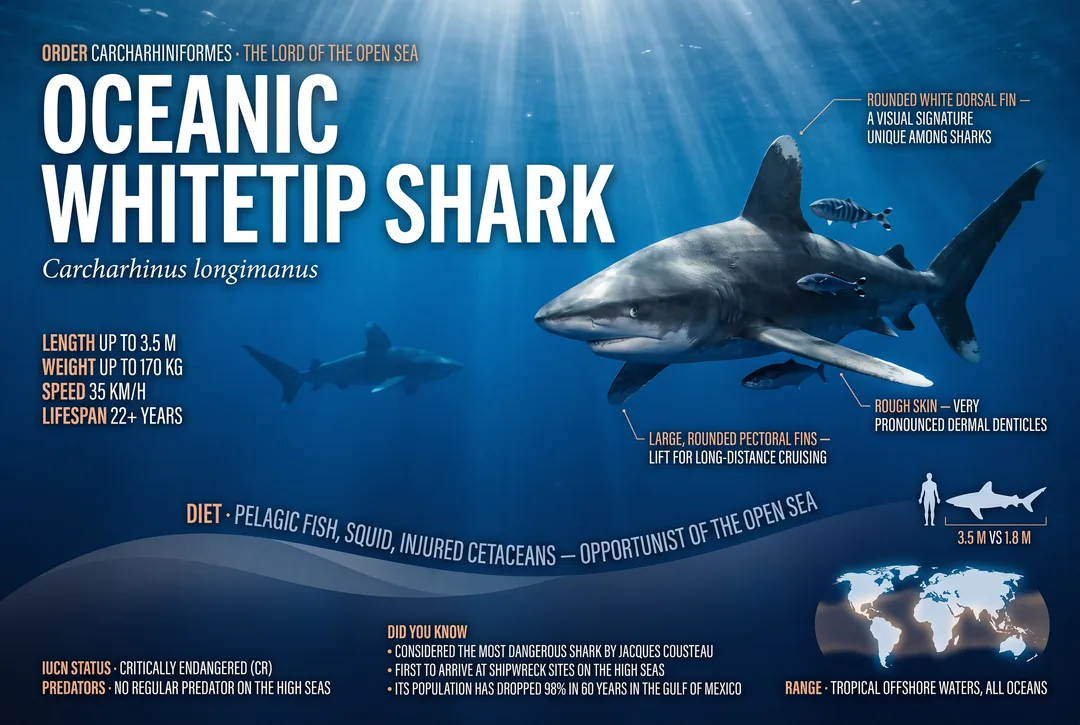
IDENTITY CARD
| Classification | Order Carcharhiniformes, family Carcharhinidae |
| Scientific name | Carcharhinus longimanus (Poey, 1861) |
| Size | 2-3 m, up to 4 m (females larger than males) |
| Weight | 60-170 kg |
| Speed | ~30 km/h cruising |
| Lifespan | 15-25 years |
| Depth | Surface to 230 m, usually 0-150 m |
| Diet | Opportunistic carnivore — tuna, squid, pelagic fish, seabirds, sea turtles, carrion |
| IUCN Status | Critically Endangered (CR) — population declining |
PORTRAIT
The oceanic whitetip — Carcharhinus longimanus, literally "long hands" — is the fallen lord of the open ocean. Until the 1970s, it was the most abundant large shark on Earth, patrolling every warm ocean in uncountable numbers. Jacques Cousteau called it "the most dangerous of all sharks" — not because it was inherently aggressive, but because it was everywhere, profoundly curious, persistent, and utterly fearless in the presence of humans.
Its beauty hits you before anything else. The body is massive yet elegant, built for effortless cruising across thousands of kilometres of open blue. But the signature is in the fins: extraordinarily long, broad pectoral fins — rounded at the tips and marked with white as if painted with chalk. The high, rounded first dorsal carries the same white badge. No other shark has this silhouette. At fifty metres in clear water, before you can see a single detail, you know exactly what is coming toward you.
Today, the oceanic whitetip has lost more than 98% of its population in the Atlantic and Pacific. Industrial longline fishing — where the species is taken as massive bycatch — has dismantled one of the ocean's great populations in barely two generations. The few remaining reliable encounter sites — the Egyptian Red Sea, the Bahamas — have become involuntary sanctuaries, places where divers now travel from across the world for the privilege of meeting an animal that once met everyone.
HOW TO RECOGNIZE IT
The oceanic whitetip cannot be mistaken for any other shark, provided you see it clearly. The combination of features is unique among pelagic sharks: very long, broad pectoral fins with rounded, white-tipped ends — never pointed, never angular. The first dorsal fin is high, distinctly rounded, and also tipped with white. The snout is short and blunt. The body is stocky, broader than a blue shark of comparable length, with a bronze to grey-brown back, lighter flanks, and a white belly. The white markings are often splashed with irregular dark mottling — a pattern as individual as a fingerprint.
But the ultimate identifier is behaviour, not anatomy. The oceanic whitetip approaches directly, slowly, with a deliberate lateral sway — pectoral fins deployed like the wings of a glider, mouth slightly open, eyes fixed. It circles, returns, insists, tests. This is not aggression. It is investigation — patient, methodical, and completely unintimidated. No other open-ocean shark behaves this way.
One critical distinction: do not confuse this animal with the whitetip reef shark (Triaenodon obesus), a much smaller species (typically 1.5 m) that lives on the reef bottom and is harmless. The two share nothing but a common name.
For subtitles in English: start the video firstthen click the gearat the top right of the video, select “Subtitles/CC”, then “Auto-translate” and choose “English”.
WAY OF LIFE
The oceanic whitetip is a permanent pelagic predator — an open-ocean nomad that may cover hundreds of kilometres in a week, following warm water masses and the concentrations of prey they carry. It rarely approaches coastlines or reefs except where deep water meets a wall, as at the offshore reefs of the Red Sea.
Its diet is opportunistic in the truest sense. Tuna, dolphinfish, squid, pelagic fish of every size — but also seabirds taken from the surface, sea turtles, and carrion. It is almost always accompanied by a retinue of pilotfish and remoras, which cluster around it like attendants. Its hunting strategy is patience itself: the shark cruises slowly, pectoral fins spread wide for hydrodynamic lift, and inspects every anomaly in its environment with the same calm, methodical attention.
Reproduction is viviparous with a placental connection. Gestation lasts approximately twelve months, and litters are small — one to fifteen pups, with an average of six. Females reach sexual maturity at seven to nine years, males at six to seven. This slow reproductive cycle is the species' fundamental vulnerability: even if all fishing stopped tomorrow, recovery would take decades.
WHERE TO SEE IT
The oceanic whitetip once inhabited every tropical and warm-temperate ocean. Today, reliable encounters are limited to a handful of sites where resident or semi-resident populations persist — and even there, sightings are never guaranteed.
Red Sea — Elphinstone, Daedalus, Brothers (Egypt). This is the best place in the world to encounter an oceanic whitetip. A resident population frequents the offshore reefs south of Marsa Alam, particularly Elphinstone Reef, the Brothers Islands, and Daedalus Reef. Access is by liveaboard departing from Marsa Alam or Port Ghalib. The peak season runs from September to November, though encounters are possible year-round. The typical meeting unfolds like a scene from a film: one or two whitetips materialise from the deep blue during a safety stop, circling the reef edge with their unmistakable slow, wing-spread approach.
Bahamas — Cat Island, Eleuthera. One of the last significant populations in the western Atlantic. Operators run pelagic snorkelling drifts over thousand-metre drop-offs, where the sharks cruise the upper water column. The season peaks from March to May. The encounters are raw and open-water — no reef, no bottom, just blue and the shark.
Hawaii. Occasional encounters off the Kona coast of the Big Island, usually during deep-water dives or open-ocean snorkelling. Not a primary destination for the species, but sightings occur.
OBSERVATION CALENDAR
Click each button to show/hide
CONSERVATION
Carcharhinus longimanus has been listed as Critically Endangered (CR) on the IUCN Red List since 2018. The numbers are staggering: a decline of more than 98% in the Atlantic, and 80-95% across the Pacific and Indian Oceans, all within the span of roughly fifty years.
The primary cause is industrial longline fishing. The oceanic whitetip's habit of cruising near the surface makes it exceptionally vulnerable to longlines set for tuna and swordfish — it is taken as bycatch in enormous numbers. Compounding this, its long pectoral fins are among the most prized in the shark fin trade, fetching up to $100 per kilogram. Shark finning is now banned in most major fisheries, but bycatch mortality continues largely unchecked.
The species is listed in Appendix II of CITES since 2013 and Appendix I of the Convention on Migratory Species (CMS). Egypt banned all shark fishing in its waters in 2005 — one reason the Red Sea population has held. But for an animal with small litters, late maturity, and a generation time measured in decades, even perfect protection would require generations to reverse the collapse.
Organisations to support:
- Shark Trust — UK-based NGO fighting for shark conservation across European and international waters
- HEPCA — Hurghada Environmental Protection and Conservation Association, active in Red Sea marine protection
- Sharks4Kids — education-focused shark conservation
- Pelagios Kakunja — research on pelagic sharks and rays
3 THINGS YOU PROBABLY DON'T KNOW
1. Cousteau called it "the most dangerous of all sharks." In The Silent World (1956), Cousteau singled out the oceanic whitetip above all other species. The danger was not ferocity but behaviour: in the open ocean, where there is nothing else to investigate, it approaches everything — patiently, repeatedly, testing with its mouth. In shipwreck situations, this exploratory behaviour becomes lethal. The sinking of the USS Indianapolis in 1945 — 879 sailors dead, many attributed to shark attacks — is the most cited example, and the oceanic whitetip is widely believed to have been the primary species involved.
2. Its fins inspired its Latin name — and caused its downfall. Longimanus means "long hands." The oceanic whitetip has the proportionally largest pectoral fins of any carcharhinid — broad, paddle-shaped, unmistakable. Those same fins are among the most valued on the shark fin market, where a set can fetch over $100 per kilogram. The very feature that makes the animal extraordinary is the one that made it a target.
3. It nearly vanished — and almost nobody noticed. A 98% population decline over fifty years, happening entirely in the open ocean, far from coastlines, far from observers. No media champions. No dedicated monitoring programme. The oceanic whitetip is a textbook case of shifting baseline syndrome: each generation of fishers and sailors considered "normal" whatever they observed, never knowing what had come before. By the time the collapse was measured, it was nearly complete.
PHOTO AND VIDEO TIPS
The oceanic whitetip is one of the most photogenic sharks in the ocean — large, slow-moving, cooperative, and strikingly beautiful. The combination of its chalk-white fin tips, bronze skin, and deep blue background produces images that need almost no post-processing.
Lens. Wide angle is essential. A fisheye in the 10-17 mm range (full-frame equivalent) captures the full wingspan of those extraordinary pectoral fins and the infinite blue behind them. Rectilinear wide angles work too, but the fisheye's curvature complements the shark's rounded fin shapes.
Light. Full-power strobes. The encounters happen in the upper water column — usually during safety stops or blue-water drifts — where ambient light is generous. Strobes restore the warm bronze of the skin and make the white fin tips pop against the blue. Without flash, everything shifts to monochrome blue-grey.
Composition. The signature shot is a front or slight three-quarter angle with the pectorals fully deployed, pilotfish in attendance, and nothing behind the shark but deep blue. The animal's approach behaviour works in your favour: it comes to you, slowly, repeatedly. Let it set the range. The best images are taken at two to three metres — close enough for detail, far enough for scale.
Behaviour. Never swim away from an oceanic whitetip. Retreating triggers pursuit instinct — the shark reads fleeing as prey behaviour. Face the animal, maintain eye contact, and hold your position. The shark will circle, inspect, and eventually move on. This is also, not incidentally, exactly what produces the best photographs.