
Roatan Divers
Google 5/5 (408 reviews)
3.1 km away as the crow flies
Roatan · Honduras · Americas
Max. depth · 33 mExplore the dramatic El Aguila Wreck, a 60-meter cargo ship intentionally sunk and then reshaped by a hurricane, now teeming with massive groupers and vibrant marine life.
For subtitles in English: start the video firstthen click the gearat the top right of the video, select “Subtitles/CC”, then “Auto-translate” and choose “English”.
The El Aguila Wreck dive begins with a descent along a mooring line directly to the stern of a 60-meter German-built cargo vessel. This ship was intentionally sunk in 1997 to create an artificial reef, but its structure was significantly altered a year later by Hurricane Mitch in 1998, breaking it into three distinct sections. This natural event created a more varied dive profile, offering multiple entry and exit points for exploration of its internal compartments.
Upon reaching the sandy bottom at 30 to 33 meters, the true scale of the El Aguila becomes apparent. You can navigate around all three sections of the wreck, observing how marine life has embraced the exposed metal and internal spaces. For those with appropriate training and experience, various points offer the chance to penetrate its interior, revealing different perspectives of its structure and the creatures that now inhabit it, including a long corridor in the fragmented mid-section, making it an accessible first wreck dive.
A defining feature of the El Aguila is the constant presence of enormous groupers (Epinephelinae), including black groupers (Mycteroperca bonaci), tiger groupers, and Nassau groupers (Epinephelus striatus), which are often encountered in numbers around all parts of the cargo ship. Inside the wreck and around its broken sections, green moray eels (Gymnothorax funebris) are a common sight, alongside schools of blue parrotfish (Scarus coeruleus).
Further along, the bow section presents additional exploration opportunities with portholes and a mast that rises to 15 meters. This mast is particularly rich in growth, sheltering arrow crabs and frogfish among vibrant coral formations. The structure's age means that elephant ear sponges and soft corals now fully cover many surfaces, transforming the metal into a living reef structure.
Beyond the wreck itself, a nearby vibrant reef wall provides a natural extension to the dive, allowing you to combine wreck exploration with a dynamic reef dive. The journey from the artificial structure to the natural reef provides a change in topography and marine life, with the coral coverage becoming increasingly magnificent as you ascend slightly towards the wall. The shallowness invites more light, illuminating the intricate details of the reef system and offering hiding spots for various smaller reef inhabitants.
The sandy areas surrounding the wreck, particularly at 33.5 meters, host a garden of garden eels (Heteroconger longissimus or Heterocongrinae), their heads swaying in the currents. These often-shy creatures provide a delicate contrast to the imposing presence of the wreck and the large groupers. Caribbean whip-tail stingrays (Himantura schmardae) can also be found gliding over the sand.
This site is best accessed by advanced divers with at least an Advanced Open Water certification, reaching a minimum depth of 30 meters and a maximum of 33 meters. Visibility is consistently very good, generally ranging from 12 to 30 meters, often exceeding 20 meters. While strong currents are not typically reported and the region generally experiences minimal currents, conditions on the north coast can vary; always check with your dive operator on the day. The best period for diving the El Aguila is from March to November, with the dry season from February to September typically providing the best visibility and calmer waters.
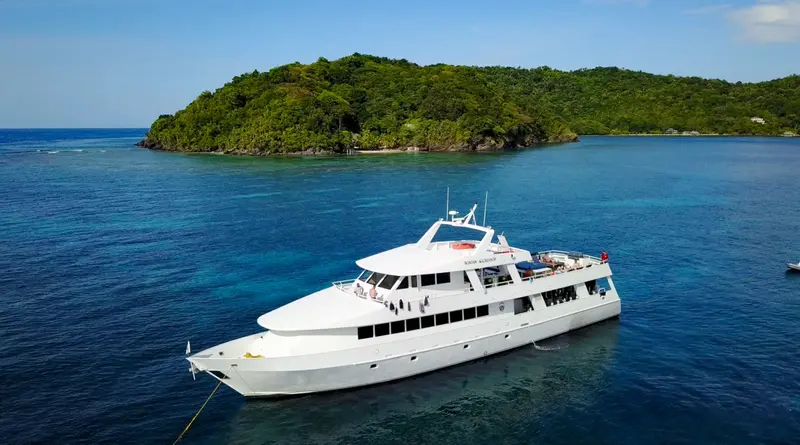
1 liveaboard departs from Roatan another way to explore the region, over several days at sea.
Plan your El Aguila Wreck dive between March and November. The dry season, from February through September, typically brings the clearest visibility and calmer water. Visibility generally ranges from 12 to 30 meters and often exceeds 20 meters, giving you useful conditions for exploring the wreck and nearby reef wall.
El Aguila Wreck is suited to advanced divers with at least Advanced Open Water certification. You will reach the sandy bottom at 30 to 33 meters, with the wreck’s maximum depth at 33 meters. Wreck penetration into the mid-section and internal compartments is available only with appropriate training and experience.
Strong currents are not typically reported at El Aguila Wreck, and Roatan’s region generally has minimal currents. However, conditions along the north coast can vary. Check with your dive operator on the day before entering the water, particularly if you plan to explore the wreck’s sections or nearby reef wall.
You can explore a 60-meter German-built cargo ship divided into three sections, with internal compartments, portholes, and a bow mast rising to 15 meters. Large black, tiger, and Nassau groupers, green moray eels, blue parrotfish, arrow crabs, frogfish, soft corals, elephant ear sponges, garden eels, and Caribbean whip-tail stingrays inhabit the wreck and surrounding areas.